Scrooge 3.0
A 3-D motion-capture version of A Christmas Carol.
After you've seen A Christmas Carol, listen to our Spoiler Special discussion on Zemeckis' take on this holiday classic:
You can also click here to download the MP3 file, or you'll find this and dozens of other Spoiler Specials in our iTunes podcast feed here.
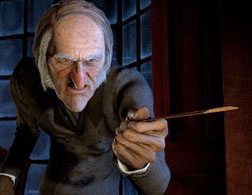
Robert Zemeckis may have found the way to spend his late career: making 3-D motion-capture versions of literary classics that, while they threaten to vulgarize their sources, wind up remaining curiously true to them in spirit. His adaptation of Beowulf wasn't perfect, but it barreled along with admirable energy, fueled by Zemeckis' notion that the oldest poem in the English language was a predecessor of the superhero comic. With A Christmas Carol (Disney), though, Zemeckis (who also wrote the screenplay) treads on more perilous ground. Rollicking though it is, Beowulf is known to most of us as a high-fiber offering in high school or early college English classes. Dickens'A Christmas Carol is one of the most-read and best-loved short stories in the English language, adapted for the screen some 20 times (depending on whether you're counting Ghosts of Girlfriends Past), and its iconic phrases—"I wear the chain I forged in life." "Bah, humbug!" "God bless us, every one!"—are as familiar to speakers of English as the 23rd Psalm.

The ominous words "Jim Carrey as Scrooge" cause a chill more glacial than a London Christmas Eve to run up a Dickens fan's spine. But wonder of wonders, Carrey isn't asked to mug, pander, or prance. He plays the heartless miser straight, the already angular planes of his face digitally lengthened into sharp points. Nearly every line of dialogue in this adaptation of A Christmas Carol comes directly from the story. What interpolations there are have to do with juicing up the transitions between scenes with unnecessary, but not obnoxiously intrusive, action. When the Ghost of Christmas Past (played, like all three ghosts, by Jim Carrey, and rendered as a kind of glowing humanoid candle) takes Scrooge to visit his childhood boarding school, the matter-of-fact magic of the story: "They passed through the wall, and stood upon an open country road"—turns into a high-speed flight over the rooftops of London, with 3-D snowflakes falling in several planes of depth. All this looks very cool and will no doubt keep a few fidgety kids in their seats, though parents might think twice about taking non-Goth children to this gloomy Victorian meditation on loneliness, poverty, and death.
In between these high-tech hurtlings, Zemeckis slows the hectic pace to watch as Scrooge stands by, invisible and powerless, witnessing scenes from his life unfold. The struggles of Scrooge's underpaid clerk Bob Cratchit (Gary Oldman, who looks inexplicably adorable rendered in motion-capture) and his penniless but happy family alternate with the old man's memories of his onetime fiance Belle (Robin Wright Penn, who's becoming Zemeckis' mo-cap muse; she also played the female lead in Beowulf). Scrooge's only surviving relative, his nephew Fred (Colin Firth), convinces his fellow revelers to drink a toast to the old man who's never once said yes to a holiday dinner invitation. As a willing sucker for Dickens' exquisitely calibrated sentimentality, I waited in vain for these scenes to strike a false note, but the tears welled up just in the spots they always do. Zemeckis may not be the most sophisticated filmmaker ever to take on this story, but he has sense enough to stay out of Dickens' way.
The single best filmed version of A Christmas Carol, the 1951 Scrooge starring Alastair Sim (if you've ever watched TV at 2 a.m. on Christmas Eve, you know the one I mean), is more leisurely and melancholic than this punchy 88-minute retelling. * But in some respects, they're surprisingly similar. Both treat the tale more as a ghost story than a holiday frolic—and don't skimp on the spooky bits. And both retain Dickens' concern with social injustice, preserving the scene in which the Ghost of Christmas Present reveals the allegorical figures of Ignorance and Want crouched beneath his robe.

Most incongruously for a Disney holiday release that's timed to sweep family crowds into the theater, this Christmas Carol remembers that its much-recycled source material is less a children's story than a fairytale for the middle-aged. The series of affects Scrooge goes through in the course of that Christmas Eve—the sharp pain of nostalgia, the regret for irreversible mistakes, the sudden realization that life is shorter than one thought—these are not the emotions of the young. How they made it into this Disney adaptation unprettified is a Christmas miracle in itself.
Slate V: The critics on Disney's A Christmas Carol and other new releases
Correction, Nov. 6, 2009: This review originally misspelled the name of the actor Alastair Sim. (Return to the corrected sentence.)