Mad Men, Season 3
Season 3 Preview: In Praise of the Gluttonous, Lecherous, Over-Entitled Roger Sterling
Mr. Swansburg, Ms. Turner,
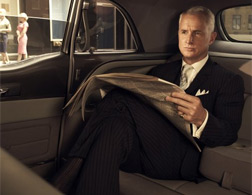
What dreadful things does it say about me that my favorite character in Mad Men is Roger Sterling, the gluttonous, lecherous, over-entitled, walking-heart-attack philosopher-hedonist whose name, as he is wont to observe, is "on the building"? In a show packed with ids in skinny ties, Roger manages both to take the antics up a notch (I'm looking at you, Cartwright double-sided aluminum twins) and to rhapsodize about those antics—and articulate his angst—more poetically than any other character.
I mean: "One minute you're drinking at a bar and they come and tell you your kid's been born. Next thing you know, they're headed off to college."
To say nothing of: "He's young, handsome, a Navy hero. Honestly, it shouldn't be too difficult to convince America that Dick Nixon is a winner."
And while Roger may be an old line WASP, my wife insists that John Slattery, the guy who plays him, looks kind of uncannily like my father and uncle—long nose, small eyes, complexion like a tall glass of milk. So, you know, between the freckles and the boozing and the coronaries, it's just another Thanksgiving at the Keefes'.
On the relative merits of the seasons, I see your point, Julia, but I'm squarely with John.
"I didn't know there was going to be a second season," Weiner tells Vanity Fair of writing the show's first season, "I used everything." And at times, I think it shows. I actually kind of liked the temptation-by-the-stables routine, if only because it gave Betty something to do (and because her jodhpured suitor was played by that bloodless gopher from the Bourne movies, the excellent Gabriel Mann).
But I didn't like Don's California interlude. I understand why writers are partial to these fish-out-of-water scenarios, and at their best (Tony Soprano on Meadow's college tour), they can open up the universe, making you feel as though you're watching real people in the real world, not just some contrivance on the same soundstage week after week. But the culture clashing in Mad Men is best when it's a little more subtle than the swinging father-daughter jet-setters Don encounters in Palm Springs.
I'm totally with you on Peggy, Julia. One great thing about Season 2 was the degree to which she emerged as Don's opposite, and in some ways more interesting, cipher, and you have to wonder how long it'll be before her name is right up there on the building next to Roger's. (And how precisely Roger will kill himself when it is.)
But my big hope is that this season delves a little more deeply into race. The show is so effective in exploring the fault lines between genders, social classes, even generations (think of Roger's frequent disquisitions on the difference between his war—World War II, and Don's—Korea). And there have been telling sideways glances at the African-Americans who run the elevators and serve the drinks. There's the opening scene of the pilot, when Don interrogates a black waiter about his preference for Old Golds over Luckies, and that powder room attendant in another episode, who murmurs, "If these purses get any smaller, we're gonna starve."
I was so excited in Season 2 when Paul Kinsey took up with Sheila White, an African-American, and the two set off for Mississippi to register black voters. As a nascent plotline it promised to place the show more solidly in the early 1960s. After all, the civil rights movement was happening all around Sterling Cooper. It would be madness not to explore the ways it did and did not affect the men and women who worked there. And who it impacted. Of course it was the aptly named Kinsey, who, incidentally, John, is my choice for your Mad Men avatar; I think it's the pipe that does it.
But somehow Sheila fell by the wayside. Is racism too discomfiting (and enduring) a social ill for the show to explore without sacrificing some of its gauzy, almost intoxicating, nostalgia? Mad Men is never less than sympathetic to its minor black characters, but there's an arms-length quality to its treatment of what was a fundamental tension permeating American society (and the American workplace in particular) during this period. Why not delve into that further? Is Mad Men, in the end, a show not about the changing social mores in America around 1960—but a show more narrowly about gender relations? Is sexual politics simply safer territory, because in getting from "there" to "here," as Julia so eloquently puts it, we might have come a lot further with gender than with race?
Happy watching, and I look forward to picking this up next week.
Patrick