"Now I Have a Machine Gun. Ho Ho Ho."
Slate's guide to overlooked Christmas movies.
This holiday season, some of you—no matter what anyone says—are still going to snuggle up on your couch with a mug of hot chocolate and watch It's a Wonderful Life. That's fine; there are worse Christmas movies out there. But for those of you who like to spike your cocoa, Slatehas compiled a list of alternative Christmas classics. These movies fall into two categories: Christmas movies that never quite made it into the canon, and films that aren't Christmas movies per se, but are set during the holiday and evoke it every bit as well as the old standbys. Why settle for Jimmy Stewart when you can have Bruce Willis?
*******

Die Hard The Nakatomi Corporation may have the finest fern lobby that money can buy, but it throws a terrible Christmas party. It's held on Christmas Eve ... in the office. The employees, surrounded by strange stairways leading nowhere, snort cocaine and chase each other into bathrooms. Cut to John McClane, an NYPD cop so humble that he refuses to ride in the back seat of a limousine from the airport. Walking into this desperate holiday revel, Bruce Willis dons the smirk that he'll wear for the rest of the movie. Through his eyes, the office Christmas party is revealed for what it really is: the fake fun of capitalism, the dying gasp of another pointless year.
Hans Gruber, played by the pre-Snape Alan Rickman, understands this too. He shows up at the Nakatomi building as a kind of anti-Santa Claus, with a band of long-haired blond German elves. Gruber, with his nihilistic, European-educated mind, knows that Christmas is a time when international corporations with $640 million in their safe show their soft underbelly. They are understaffed and vulnerable to a well-organized team of crooks in knit shirts. The only requirement for this advantage is scorn for Christmas.
Throughout the ensuing cat-and-mouse chase, carols are used as ironic counterpoint to the fights and explosions. But Die Hard's most elegant Christmas sneer occurs early in the movie, when McClane sends a dead German down the elevator, strapped to a chair, wearing a Santa hat, with the following written on his gray sweatshirt: "NOW I HAVE A MACHINE GUN. HO HO HO." Rickman's line reading is exquisite. With three punctuated Hos, he deftly inverts the joy of those words, expressing all the contempt that the manufactured cheer of Christmas can inspire.— Michael Agger

Yogi's First Christmas
A surprisingly touching ode to ursine innocence, Yogi's First Christmas never even got a shot at the big screen. When it debuted in 1980, it did so on syndicated TV, stuck between reruns of Emergency! and local newscasts. It seldom aired after that, consigned to Hanna-Barbera's vast vault of cartoon esoterica.
Yet Yogi's First Christmas doesn't deserve the obscure fate of Hong Kong Phooey. Directed by animation veteran Ray Patterson, who drew for classics like Fantasia, the movie is far smarter than the standard kiddie dreck. The story, for starters, depends on the viewer possessing at least a passing knowledge of zoology: Yogi Bear and his sidekick Boo-Boo are accidentally aroused from hibernation, allowing them to enjoy their first Yuletide celebration.
When not learning to ski or fending off the lusty Cindy Bear, Yogi stays busy foiling the Grinch-like plans of a spoiled brat named Snively and his trollish associate, Herman the Hermit. When the nasty duo's resistance to holiday cheer inevitably melts, Yogi deserves all the credit—his message of unconditional love is one that does Christmas' holy namesake proud.
Yogi's First Christmas is by no means perfect, and there are headscratching moments of terrible pacing and belief-defying idiocy—how, for example, did Herman learn to fly a helicopter? But for viewers willing to look past the film's minor flaws, a retro treat awaits—see for yourself.— Brendan I. Koerner
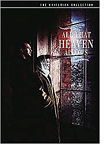
All That Heaven Allows
Douglas Sirk's romantic melodrama All That Heaven Allows (1954) contains what may be the saddest Christmas scene in cinema history—sad not only because it ironically sets a character's miserable experience against a jolly holiday backdrop (lots of movies have done that, from Citizen Kane to this season's The Savages), but because it constitutes a withering critique of the holiday itself. A wealthy widow (Jane Wyman), having fallen passionately in love with her much-younger hunk of a landscape gardener (Rock Hudson), is guilt-tripped into giving him up by her grown children. These two are appalling—a pair of smugly conventional brats who are scandalized by the notion of their middle-aged mother experiencing pleasure and freedom. When they come to visit her at Christmas, completely oblivious to her stark despair, they present her with the latest in high-tech entertainment—a television set in front of which to while away her declining years, alone. In a justly famous shot, Sirk shows Wyman's expressionless face reflected in the blank TV screen, surmounted by a huge bow. In addition to being beautiful enough to print on wrapping paper, it's an image that speaks volumes about the rise of consumerism, the prison of gender roles, and the bottomless loneliness of post-WWII America.— Dana Stevens
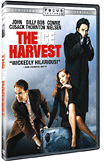
The Ice Harvest
John Cusack honed his luckless-schmuck-in-winter chops in movies like Better Off Dead and The Sure Thing. All grown up, he plods sullenly through The Ice Harvest as Charlie, a shyster attorney who conspires to relieve a local mob boss of a couple million dollars and flee iced-over Wichita, Kan. But the ill-fated heist isn't nearly as engaging as the dysfunctional lives of Charlie and his misfit friends as they unfold on the eve of Charlie's escape. It also happens to be the eve of Jesus' birthday, but Christmas is just a well-deployed prop, used to illustrate Charlie's misery. He's berated by his young son over cranberry sauce and stuffing at Christmas dinner, and he finds his buddy's wife idling near a Christmas tree, only to discover a bullet hole in her head. The holiday is becoming a nightmare for Charlie, and the darkly funny patter between him and his best friend Pete (Oliver Platt) is a fitting antidote to the usual holiday season sap (think Serendipity). When Charlie places gifts hastily purchased for his kids from a gas station under the cheerless tree in his ex-wife's house, his desire to escape the pain and disappointment he's created is etched across his face. With all that purloined cash, he's determined to give himself a gift, too—a new life.— Melonyce McAfee
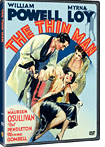
The Thin Man
I'm hard-pressed to name my favorite Christmas movie, but my favorite Christmas-movie tableau appears in The Thin Man (1934).
We begin with a close-up of a Christmas tree festooned with balloons. We hear a quiet bang! and one of the balloons pops. Reverse shot to Nick Charles (William Powell), lying on a couch wearing white pajamas, a dressing gown, and a pair of slippers. He holds a small pellet rifle. He fires again but the rifle is empty. Hmm, he mutters thoughtfully and reloads. In the frame's left corner, Nick's wife Nora (Myrna Loy), dressed in a mink coat, slumps back sleepily in an armchair.
Nick fires again. Another balloon pops. Ah, Nick says, contentedly. He reloads the gun, while Nora sends him a mock long-suffering glance. Nick raises his slippered feet to cradle the rifle's barrel. He shoots and scores a third time. Nick raises his feet again, this time placing the barrel underneath, and shoots out another balloon.
Now Nick is really showing off. He rolls onto his stomach, holds up a silver ashtray as a mirror, and shoots backward. This time, the pellet bypasses the tree and cracks the picture window behind it. Nora rolls her eyes, and Nick assumes the fetal position.
"Well," Nora says, the dialog at last resuming. "I hope you're satisfied."
In symbolic terms—don't tell the Hays Office!—it's perfectly obvious that Nick and Nora are enjoying a lazy Christmas-morning screw. (This scene takes place in a hotel room.) But the implied carnality does nothing to mar the overall tone of innocent (if mischievous) play. It is Christmas morning, and Nick is behaving exactly like a happy child who has identified his favorite new toy while an indulgent woman looks on. We therefore have, in one brief sequence, an affirmation of just about every category of family pleasure. Real Christmas mornings are seldom this perfect, but that's why we have the movies.— Timothy Noah
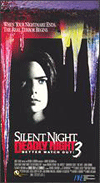
Silent Night, Deadly Night 3: Better Watch Out! Morbidly obese, red-faced like an angry drunk, bellowing monosyllabic gibberish out of his sweaty, haggard beard—let's face it, Santa Claus is a frightening bastard. Although Hollywood tends to perpetrate the myth of a jolly St. Nick, some mavericks have had the courage to show the fat man's uglier side. Films like To All a Good Night (1980), Christmas Evil (1980), and Santa Claws (1996) make Billy Bob Thornton's Bad Santa look like the Good King Wenceslas.
The best entry in the Really Bad Santa genre, however, is the Silent Night, Deadly Night series, which did for Claus what Child's Play did for dolls, and what It did for clowns. That is to say, it turned Santa into a homicidal maniac. In the first film, a man dressed in a Santa outfit shoots a young boy's father in front of him, then rapes his mother and slits her throat. The boy, Billy Chapman, grows up to be a serial killer who murders anyone he deems to be naughty. This mostly means teenagers who have sex.
My personal favorite of the series is Silent Night, Deadly Night 3: Better Watch Out! (1989), directed, sadly, by Monte Hellman (Two-Lane Blacktop) and starring future Twin Peaks cast members Richard Beymer and Eric Da Re. The movie opens with a woman being chased through a maze of hallways by a gore-spattered, knife-wielding zombie whose brain is visible through a transparent dome. When the woman skids around a corner, however, she encounters a calming sight: Santa Claus. As a warped, Casio version of "We Wish You a Merry Christmas" plays in the background, she sits on Santa's lap and tells him what she wants for Christmas. "Ho, ho, ho," says Santa. And then he raises a bloody knife … — Nathaniel Rich

How the Grinch Stole Christmas (1966) When I was little, I used to turn off the animated How the Grinch Stole Christmas before the redemptive last five minutes. Without the ending, the movie is the ultimate fantasy for a Jewish kid with a case of Santa/tree/carols envy—Christmas, canceled.
Now that I'm grown up, I dutifully watch the movie all the way through and use the end to instruct my children about the holiday's true spirit. The Whos of Whoville hold hands and sing in their empty village square even as their gifts and trimmings teeter on the mountaintop to which the Grinch and his long-suffering dog have repaired. See? Christmas isn't about getting. But somehow, my sons still root for the Grinch to heave the toys into the abyss—it's a let-down for them when he rushes back to return the loot and carve the Whos' roast beast. Maybe this is an intergenerational pathology. Or maybe it's just the anticipation of an enormous, irresistible splat.— Emily Bazelon
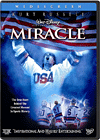
Miracle
As miracles go, the virgin birth has never really done it for me. (I've long suspected Mary was just a fast girl with a knack for spin.) But the Miracle on Ice—the U.S. hockey team's 1980 defeat of the seemingly unstoppable Soviets at the Olympics in Lake Placid, N.Y.—is one I still marvel at. The story seems made for Hollywood: Tough coach whips ragtag band of amateurs into shape; team, after questioning itself briefly, pulls off stunning upset. But the game itself is more riveting than cinema, the score ricocheting back and forth until the U.S. team, up 4-3, holds the aggressive Russians scoreless for 10 long minutes to hang on to the victory. The purest way to appreciate this terrestrial wonder is to watch clips of the original. But if you want to savor the back story, I recommend Miracle, the 2004 film that starred Kurt Russell as coach Herb Brooks. The movie has the rare virtue of being a top-caliber Hollywood sports flick—player rivalries swiftly sketched; training montages inspiringly scored; coach's speeches truly moving—that spends enough time on the sport. The hockey here is so fleet and swift and true that when, at the climax, you hear the old tape of Al Michaels screaming, "Do you believe in miracles?" you can only think, "Yes!"— Julia Turner
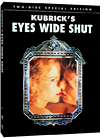
Eyes Wide Shut
Released over the summer of 1999, Stanley Kubrick's anguished journey through fin-de-millénaire Manhattan wasn't presented as a holiday movie. This tale of jealousy and narcissism may not overflow with holiday spirit, but you'll be hard-pressed to find a work of art that's so thoroughly and gorgeously imbued with Christmas.
The cinematography alone composes a brilliant essay on the yuletide aesthetic: The movie is draped from front to back with curtains of tinsel and shimmering lights, and some form of baubled Christmas tree lends a creepy opalescence to almost every scene. Kubrick's doll's-house reconstruction of New York City, built from the ground up on a London soundstage, perfectly captures the discordant emptiness of Midtown on Christmas Eve.
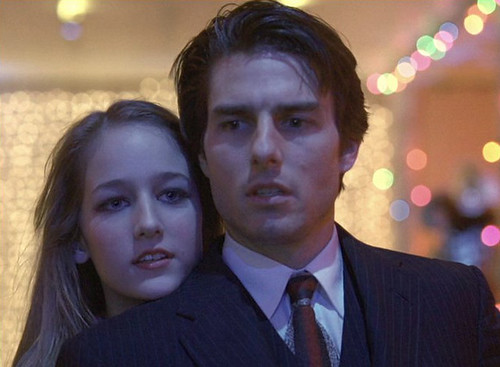
The film just as deftly articulates the nauseous materialism and alienation of the holiday season. Navigating among decadent champagne parties and Masonic orgies, child prostitutes and drugged-out sex slaves, it returns again and again to a central theme: Christmas is a time for buying, and everything—and everyone—is for sale. Kubrick puts an exclamation point on this bleak sentiment in the final scene, when the miserable couple Bill and Alice take their daughter on a holiday shopping spree. "There is something very important that we need to do as soon as possible," intones Alice, as their odyssey of cruel infidelities finally draws to a close.
"What's that?" asks Bill.
"F---."
Merry Christmas.— Daniel Engber
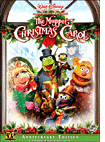
The Muppet Christmas Carol
Most remakes of the Charles Dickens classic (and there have been dozens) are stiff and dour outings that try too hard to re-create the 19th century. The Muppet version, while admirably faithful to the original, doesn't have this problem. Indeed, Muppets are the perfect medium for the Christmas Carol. Instead of costumed actors, we get a whimsical Ghost of Christmas Past Muppet, a jolly giant Ghost of Christmas Present Muppet, and a terrifying Ghost of Christmas Yet To Come Muppet. Kermit, meanwhile, makes for a perfectly pathetic Bob Cratchit, Scrooge's much put-upon employee and the father of the sickly Tiny Tim. (Who can stand seeing the lovable frog abused by that miser?) And the songs are damn catchy. I love "When Love Is Gone," the sweet number Scrooge's one-time love, Belle, sings to him as she breaks his heart. That song is reprised at the end of the movie, when Scrooge has transformed, as "When Love Is Found." Dickens might be horrified by the idea of Miss Piggy and gang infiltrating his tale. But given the choice, I bet he'd prefer the Muppet version to the other adaptation for the under-12 crowd: The Jetson Christmas Carol.— Torie Bosch

Trading Places
The 1980s witnessed the emergence of a peculiar subgenre in Hollywood: the comedy in which down-and-out black guy + ostentatious wealth = guaranteed hilarity. But what The Toy, Brewster's Millions, and the Beverly Hills Cop franchise lacked was a Christmas setting. Trading Places unfolds during the week between Christmas and New Year's in Philadelphia, drawing out the standard Christmas movie preoccupation with haves and have-nots, and turning on a nature-versus-nurture wager between two commodities traders, the Duke brothers. Can Eddie Murphy's Billy Ray Valentine, who starts out begging in the guise of a blind, legless veteran, be coached to become a townhouse-residing tycoon? And will Dan Aykroyd's Louis Winthorpe III turn to begging if he's cast out of that same townhouse and into the street? Murphy gets some great lines ("Didn't I tell you that the phone in my limousine is busted, and I can't get in contact with my bitches?") and Aykroyd becomes a drunk, suicidal, gun-toting Santa. Their eventual revenge on the Dukes hinges on whether a cold winter will affect the price of oranges, but the movie's real pleasures lie in the tense banter between rich and poor. "Five dollars," the elderly bartender at the Duke's club murmurs, when presented with his Christmas bonus. "Maybe I'll go to the movies … by myself." — Patrick Keefe
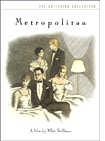
Metropolitan
Whit Stillman's Metropolitan (1990) isn't a Christmas movie; it belongs, fittingly, to a more exclusive club: the Christmas break movie. On winter vacation from Princeton, Tom Townsend (Edward Clement), a West Sider of limited resources, falls in with a group of well-to-do East Siders in the thick of New York City's deb season. It seems there's a severe shortage of escorts, and Tom, against his better judgment (he's a Fourierist, after all), is conscripted into accompanying young Audrey Rouget (Carolyn Farina) to a fortnight of dances and after-parties. Along the way, Audrey convinces Tom to read Jane Austen, question his faith in Fourier, forget an old flame from his Pomfret days, and fall in love with her—all before New Year's. * Metropolitan's affectionate satire of preppies—I'm sorry, of the urban haute bourgeoisie —is unrivaled, but its pleasures are also nostalgic, and not just for viewers inclined to nod along when Nick Smith (Chris Eigeman) rues the decline of the detachable collar. The luxury Metropolitan really makes you yearn for is school vacation: two weeks of staying out till dawn, sleeping till dusk, and generally being beholden to no one.— John Swansburg
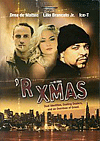
'R Xmas
Those who associate the holiday season with captivity and extortion will relate to Abel Ferrara's mordant slice-of-life'R Xmas. Here, the usual stress and aggravation of the Christmas rush is compounded when the male half of a husband-and-wife team of heroin suppliers (Lillo Brancato Jr. and Drea de Matteo) is abducted for ransom by a ring of crooked cops just before Noel. (The scenario is based on an actual early-'90s NYPD corruption scandal.) The kidnappers' timing couldn't be worse for the couple, since most of their staff has hightailed it to the Caribbean for some winter R&R. Ferrara, director of the sleaze operas King of New York and Bad Lieutenant, specializes in exploring the grimy, treacherous New York underworld, but here he moves with uncharacteristic tenderness and—true to the memory-dredging effects of the Christmas season—even a bemused sense of loss: Released eight years after its December 1993 setting,'R Xmas is very much a period piece, transpiring just before Manhattan became a Middle American retail destination and ceased being, well, an Abel Ferrara movie. The cops (led by Ice-T) are menacing, but nothing in the film terrifies quite so much as a New York City toy store just before yuletide. When Brancato looks on as upper-crust moms deploy their manicures in a scrap over merchandise, his nonplussed expression sums up the existential condition of the last-minute Christmas shopper.— Jessica Winter
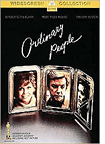
Ordinary People
What better way to celebrate the birth of Christ than with tears, attempted suicide, and a proclamation of atheism? Much of Robert Redford's 1980 directorial debut, Ordinary People, takes place around Christmas, though the holiday is barely recognizable through the film's thick haze of tragedy and family dysfunction. Conrad Jarrett, a clinically depressed teenager, has just returned home from a psychiatric ward after slitting his wrists. His beloved brother has recently died in a boating accident, for which Conrad is partly to blame. His parents, sheepish Calvin (Donald Sutherland) and controlling, image-obsessed Beth (Mary Tyler Moore), are hiding a crumbling relationship behind a facade of normality—but the house looks lovely with all the lights! Instead of inspiring a unifying spirit of goodness, everything holiday-related ends up signifying the disintegration of family. The Christmas tree is a sad, skeletal thing, and the only time the family gathers 'round it is to verbally abuse one another. One of the film's most revealing scenes takes place in a Christmas-decorated McDonald's, where Conrad tells his girlfriend he doesn't believe in God and that life, for him, is like falling into a hole. Makes your family's squabbling over the holiday ham feel positively festive, doesn't it? — Andy Bouvé

2046
Hong Kong director Wong Kar-wai makes lush, fetishistic films about the melancholy of loneliness, and 2046 is his bittersweet ode to the loneliest time of year. The movie swirls back and forth, between Hong Kong and Singapore in the 1960s, and into the hallucinatory future of the title year, as imagined by Tony Leung's writer hero. But Christmas exerts a strange gravitational pull. Title cards pop up periodically, situating the action on Dec. 24 of a given year. 'Tis the season for nagging regrets and misbegotten hook-ups. Surrounded by sad strands of tinsel and the silken tones of Nat "King" Cole's "The Christmas Song," characters muse out loud about how awful it would be to spend a night like this alone. The holiday blues even infect Leung's whimsical science fiction—the coldest sections of his story's time-traversing bullet train are known as 1224 and 1225 (i.e., Christmas Eve and Christmas Day) and come with a warning that "passengers are advised to hug each other to keep warm." (Leung's character and alter-ego, traveling alone, must make do with an android cabin attendant.) Wong's great subject is time—its pitiless passage, the way it distorts memory, our helpless desire to regain or halt it—and in 2046, Christmas is the cruelest anniversary of all.— Dennis Lim
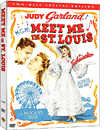
Meet Me in St. Louis
Meet Me in St. Louis, which spans a year in the life of the Smith family, is not a traditional Christmas movie. But the climactic Christmas scene so aptly captures the yuletide spirit, the film belongs in your Netflix queue alongside It's a Wonderful Life.
Despite his family's fervent protests, Mr. Smith is moving his family from St. Louis to New York just after Christmas so he can take a new job. But Christmas Eve brings unexpected events. Esther's (Judy Garland) beau proposes. She wants desperately to say "yes" unequivocally but she can't bear to stay behind when her family moves. She heads home, head heavy, to find her baby sister, Tootie (Margaret O'Brien), waiting up for Santa. Tootie, too, is distraught about what the move will bring. Esther soothes her sister and quietly begins singing "Have Yourself a Merry Little Christmas," the bittersweet classic that was composed for the movie.
The carol perfectly captures the moment: The Smiths, on the eve of life-changing events, want to enjoy their last sweet moments at home, together, and to believe that next year life will present fewer obstacles. Mr. Smith is touched by his daughters' sadness, and, as he walks through his dismantled house—pictures removed from walls, the grandfather clock wrapped up—he suddenly realizes he can't move his family away. He wakes everyone up to share the news, and they're buoyant. This movie is about what it means to be home—being with family you love, comforting them. And it's about the joy that comes from bringing others happiness—the ultimate Christmas gift.—Jill Hunter Pellettieri

Beautiful Girls
Beautiful Girls may not be a traditional holiday movie—it takes place post-Christmas; there is nary a wreath to be found—but it hits the same nerves rubbed raw by a seasonal visit home. Willie C. (Timothy Hutton) returns to his hometown ostensibly to attend his high-school reunion, but really to mull a crossroads in his life. Is it possible to go back to where you came from without thinking about where you're going? Beautiful Girls captures the peculiar melancholy of a pilgrimage home in the dead of winter: the lure of the pretty but desolate snow-covered town you grew up in, the strangeness of staying in your childhood room, the awkwardness of seeing family members you may no longer have much to say to, the pull of hanging out with the buddies you used to know so well. And, last but not least, the appeal of the girl next door, a "beautiful girl"-to-be (a teenage Natalie Portman). Beautiful Girls is about when to give up your highest hopes and settle for a real life. Is it possible to become an adult but still stay cool forever?— Ellen Tarlin
Correction, Dec. 17, 2007: Fourier's name was originally misspelled as Faurier. (Return to the corrected sentence.)