An Ounce of Prevention ...
It’s harder for poor countries to respond to natural disasters. We should help them be better prepared before hurricanes and earthquakes strike.
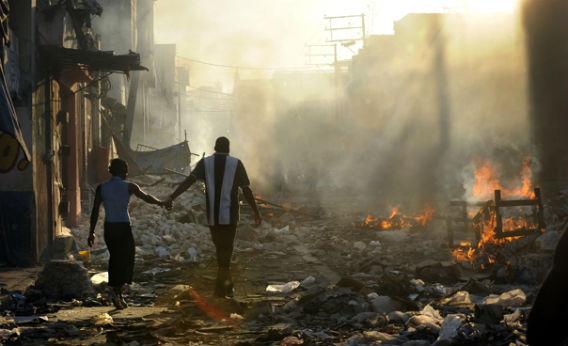
Photograph by the Washington Post.
In this series, Bjorn Lomborg explores the smartest investments to respond to global challenges—and readers get to have their say. See the earlier articles here. And read Bjorn’s responses to readers and find out which investments are currently at the top of the Slate readers’ priority list here. Be sure to vote in the poll at the bottom of each article.
Hurricane Katrina, Australian floods, Japan’s 2011 earthquake and tsunami: Even the wealthiest, best-prepared countries can experience large-scale damage and destruction when natural disasters strike.
But the situation is much worse in poor countries without the resources to protect their population or economy against catastrophes. Building codes are lacking or poorly enforced, and infrastructure is insufficient to send out information before a disaster, or assist victims promptly after it hits. The 2010 earthquake in Haiti starkly illustrated what happens when natural disasters strike an unprepared and poor country.
Oftenpoor countries only make the pages of our newspapers when disasterstrikes. Tragic images prompt us to give generously to assist those who have been hurt or made homeless. But what if we adopted an “ambulance at the top of the cliff” approach and tried to increase the resiliency of developing countries to natural disaster?
Hurricanes, earthquakes, and floods impose an economic toll that can disrupt and undermine a fragile country for a long time. This cost is growing. According to the reinsurer Munich Re, direct economic losses from natural catastrophes amounted to $1.6 trillion from 2001 to 2011. Small island economies like St. Lucia and Samoa have suffered high losses to productivity because of disasters. Nature can impose a roadblock to the growth that lifts people out of poverty.
Costs from natural disasters are increasing largely because more people choose to live in harm’s way. This trend, combined with the expectation of some events becoming more extreme because of changes in climate patterns, challenges the human capacity to adapt. In an innovative paper for Copenhagen Consensus 2012 released today, Professors Howard Kunreuther and Erwann Michel-Kerjan from the Wharton School at the University of Pennsylvania propose a series of concrete actions that would reduce the vulnerability of poor nations to such large-scale catastrophes.
They propose investments in four risk-reduction measures. The first three proposals are designed to better protect against damage and loss of life from earthquakes, floods, and hurricanes, and the final one is intended to more generally increase the resilience of communities.
First, the authors propose designing schools that can withstand earthquakes to reduce damage and also the number of fatalities to children, teachers and other staff. Retrofitting the schools in all 35 most-exposed countries around the world would save the lives of 250,000 individuals over the next 50 years. Costs vary dramatically from country to country: In the Solomon Islands it would cost just $36 million to retrofit schools with cumulative total benefits worth $187 million, but for all other countries the benefits are dramatically lower, meaning that any program of global reach would probably pay back less than the initial investment.
Kunreuther and Michel-Kerjan’s second proposal is to invest in community flood walls and elevated homes to protect areas subject to floods. It would cost $5.2 trillion to elevate by one meter all houses subject to flooding in the 34 countries most susceptible to this hazard and another $940 billion to build walls around the relevant communities in all 34 countries. The most cost-effective approach would be to invest $75 billion into building flood walls around some of these communities. Kunreuther and Michel-Kerjan calculate the benefits over the next 50 years as $4.5 trillion, making the benefits a remarkable 60 times higher than the costs. Those benefits would mostly come from reduction in damages, though the walls would also save 20,000 lives.
Thirdly, they propose strengthening the roofs of houses in countries with high exposure to hurricanes and cyclones to reduce losses from wind damage. This would cost $951 billion in the 34 countries most prone to high wind events, with benefits ranging between two and three times this amount. This measure would save 65,700 lives over the next 50 years.
Finally, Kunreuther and Michel-Kerjan explore setting up early disaster warning systems. Based on existing studies and research from Stephane Hallegatte, they find that early warning systems in developing countries would require less than $1 billion a year and would have direct benefits (reductions in the losses from disasters) of between $1 billion and $5.5 billion per year. There are additional benefits, such as the reduction in evacuation costs, the reduced costs to the health care system, improved continuity of education (from preserving schools), reduced social stress, and avoided business interruption, which is worth at least another $3 billion and possibly $30 billion. In total, the benefits could range from four to 35 times their cost.
But who should pay for disaster protection measures? As Kunreuther and Michel-Kerjan point out, there is a need to persuade international donors to start investing more systematically in disaster risk reduction before a disaster strikes, rather than focusing almost exclusively on post-disaster assistance, as they do today. Similarly, NGOs must put their time and energy into promoting measures that reduce future losses and fatalities rather than focusing on emergency relief. And more governments in developed countries and multinational corporations need to provide funding and technical expertise to assist low-income countries in undertaking these measures.
Kunreuther and Michel-Kerjan point out that the way that we often approach decisions, with short-term costs in mind rather than long-term benefits, can get in the way of policy-makers making the change in approach that they need to. To address these issues, they propose new programs such as multi-year insurance coupled and disaster-risk reduction loan programs, as well as alternative risk transfer instruments for covering catastrophic losses.
A disaster in one part of the world can have ripple effects on many other countries, so it should be in everybody’s interest to try to increase resiliency. If a few key decision makers, organizations and countries take the initiative this may lead others to follow suit, tipping the world in the right direction. But the clock is ticking: Another large-scale disaster can happen tomorrow. What’s your view? Is this an area that you think that policymakers and philanthropists should prioritize? Or, do you think that these measures should be lower-priority than the others that you’ve read about so far? Have your say in the poll:
Remember: You can still go back and vote in all of the various polls (they are in each of the stories you can see here); we’ll be finalizing the Slate readers’ list at the end of the series. And, each day, I respond to your comments and update you on how readers are prioritizing pieces so far. See which of the solutions we’ve presented so far are Slate readers’ favorites.
On Monday, we will look at an issue that has really emerged as a focal point for the developing world in the past few years: biodiversity. How big is the problem of disappearing species, and what exactly can we do about it?
In this series, Bjorn Lomborg explores the smartest investments to respond to global challenges—and readers get to have their say. See the earlier articles here. And read Bjorn’s responses to readers and find out which investments are currently at the top of the Slate readers’ priority list here.