War Is a Long, Messy Hell
And it’s more important than ever that we try to prevent it in the first place.
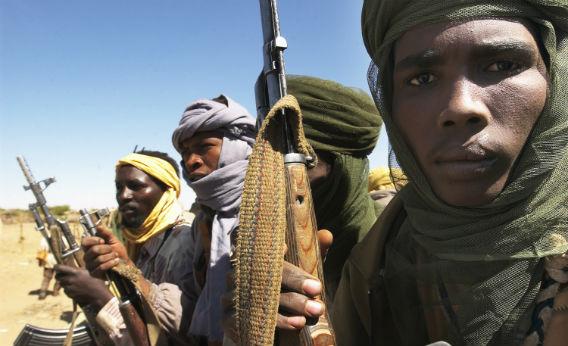
Photograph by Jacob Silberberg/Getty Images.
In this series, Bjorn Lomborg explores the smartest investments to respond to global challenges—and readers get to have their say. See the earlier articles here. And read Bjorn’s responses to readers and find out which investments are currently at the top of Slate readers’ priority list. Be sure to vote in the poll at the bottom of each article.
Without peace and stability, there are impediments to solving every other challenge that we have looked at in the Copenhagen Consensus 2012 series. Armed conflict is a major global problem that disproportionately affects the world’s poorest. Not a single low-income country afflicted by violence has achieved even one of the eight Millennium Development goals.
In each year of the 1980s and 1990s there were between 30 and 40 major armed conflicts in progress, though over the past decade, major armed conflicts have declined. In 2007, there were 14 major armed conflicts in 13 locations around the world, nearly all of which were civil wars. There was a wide variation in the intensity of these conflicts, from "low intensity" battles between guerrillas and governments, to conflicts between relatively large and well-equipped armies.
There are now more states than ever and also more disputes, but still relatively few of these lead to war. Though there are now fewer fights, they last longer than they once did. The types of conflicts range from the ideological struggles that we see in Mozambique, Eritrea, or Nicaragua, to the more fragmented decentralized conflicts such as those of Somalia and Rwanda. Many are a mixture of both.
The nature of war has changed with a decreasing role for formal armies, lack of battlefield engagement, and increased involvement of civilians as victims.
The costs from conflicts can be immense and devastating—yet they are almost always understated because we ignore the legacies that violence leaves behind. The immediately apparent, direct costs are obviously loss of life and injury on the battlefield. But in many countries, conflict leads to far greater casualties because of economic collapse so that fewer can afford health care, proper food, and education. Because of the long lag in economic recovery after a conflict, people will die for years after a conflict ends. In addition to the direct and legacy costs, there are spinoff costs such as the expense of looking after refugees displaced by one country’s internal strife.
In a research paper released today for Copenhagen Consensus 2012, Paul Dunne attempts to tally all of these costs and work out the benefits of using more and new funds to respond to armed conflicts in different ways.
Clearly, the complex nature of conflict makes finding solutions immensely challenging. To be able to approach the problem more easily, Dunne focused on the three obvious points at which we can try to reduce the devastating impact of conflict: preventing it in the first place, intervening to end it when it occurs, and helping to reconstruct a nation after it has ended.
According to Dunne’s analysis, conflict prevention is the most cost-effective solution. The causes of conflict are hugely varied and the roots of war are multifaceted, with important historical contexts. There are a number of factors that can be identified including colonial legacy, military governments and militaristic cultures, ethnicity and religion, unequal development, inequality and poverty, bad leadership, polity frailties and inadequacies, external influences, greed, and natural resources.
So how can we stop conflicts before they occur? Dunne pinpoints early warning mechanisms, peacekeeping operations, economic sanctions, and aid as the tools that have proved effective.
Dunne calculates that spending about 56 billion over four years on a combination of these measures would lead to benefits on the magnitude of at least $606 billion. Among these benefits, the avoided deaths, injuries, and other conflict-related violence are perhaps the most compelling arguments for the use of available funds for prevention.
Given the high possible benefits of avoided carnage and relatively low costs, conflict prevention has a benefit-cost ratio of at least 11. This means that, when we frame it in economic terms so that it can be compared to other interventions, each dollar spent achieves benefits worth at least $11.
If conflicts do break out, the next stage is intervention. At this stage it will be impossible to avoid a significant part of the cost of conflict, and the intervention itself will also be more costly. The projected $100 billion cost of intervention includes better intelligence, economic sanctions, and aid, as well as most likely military intervention. This is nearly double the cost of preventing a conflict in the first place. Yet, with benefits of at least $606 billion, there are still large pay-offs. For each dollar spent, we can avoid conflict damage worth about $5, making intervention a cost-effective use of resources.
When conflicts end, what is needed for reconstruction is contingent on the nature of the conflict and the way that it ended. Most of the costs of conflict have already been incurred, but experience shows it is possible to speed recovery and reduce the risk of relapse into further violence. Particularly important are the legacy costs of the conflict, such as more general violence within the society. Post-conflict policies can be costly but are also cost-effective in preventing suffering and building up economies that provide new markets and raw materials. According to research by former Copenhagen Consensus expert panel member and researcher Paul Collier, economic reconstruction reduces the risk of a renewed outbreak of conflict by 42 percent in 10 years.
The cost of post-conflict policies is higher than intervention at around $140 billion, and the benefits are also smaller at $404 billion. In total, it is estimated that each dollar will avoid at least $3 of conflict damage. While post-conflict policies may not have the highest benefit-cost ratio, Dunne argues that they are crucial in ensuring successful development can occur. For that reason, these policies are already attracting considerable resources from the international donor community.
Dunne emphasizes that although he has examined many of the different ways that conflicts impose a cost on society, the true cost is still likely to be hugely underestimated. There are immeasurable quantities and legacy costs that are difficult to identify. The existence of drugs, criminal gangs, and violence in South American countries such as Colombia in the present day, for example, can be traced back to the ending of an armed conflict without true peace being achieved.
Too often, developed and stable nations have turned a blind eye to conflicts, done too little, too late. This analysis shows that, at the very least, from an economics perspective, there are sound reasons to change that approach. What’s your view? Are these investments that you think that policy-makers and philanthropists should prioritize? Have your say in the poll:
Remember: In each of the stories published to date, there’s a poll, and you can still go back and vote in all of the polls today. Each day, as well as publishing a new topic of research, I respond to your comments and update you on how readers are prioritizing pieces so far. See where readers’ priorities stand right now.
Tomorrow, we will wrap up our look at the Copenhagen Consensus 2012 research papers by examining education. Can we improve the quality of education that kids receive, or is quantity what matters?
In this series, Bjorn Lomborg explores the smartest investments to respond to global challenges—and readers get to have their say. See the earlier articles here. And read Bjorn’s responses to readers and find out which investments are currently at the top of Slate readers’ priority list. Be sure to vote in the poll at the bottom of each article.