It's a Small World After All
-
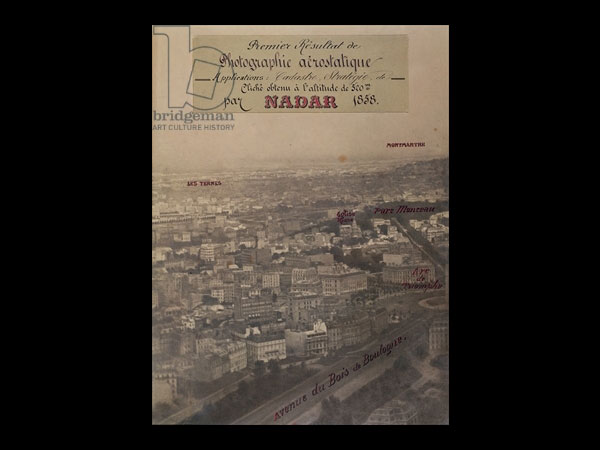 CREDIT: Photograph courtesy Archives Charmet.
Paris, France, photographed by Gaspard Felix "Nadar" Tournachon from a tethered hot air balloon (1858).
Tournachon, a writer, caricaturist, and photographer who went by "Nadar," snapped the very first aerial shot from 262 feet above the Bievre Valley on the outskirts of Paris. It has since been lost. But 10 years later, he hovered with his balloon Le Geant (The Giant) over Paris and captured this famous view of the city at about 1,700 feet.
Le Geant was no ordinary hot air balloon. The photo-processing method at the time—the collodion or "wet plate" technique—required immediate development because the glass negative plates dried out quickly. In order to preserve his shots, Nadar built a portable darkroom in the balloon's basket.
-
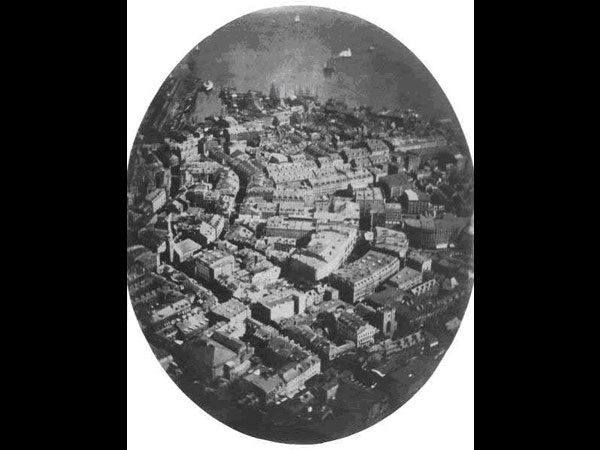 Photograph courtesy Wikimedia Commons.
Boston, photographed by James Wallace Black from a tethered hot air balloon (1860).
Black tagged along with balloonist Samuel A. King to snap the first aerial image of an American city. He called it Boston as the Eagle and the Wild Goose See It. His picture is the oldest aerial photograph to have survived.
-
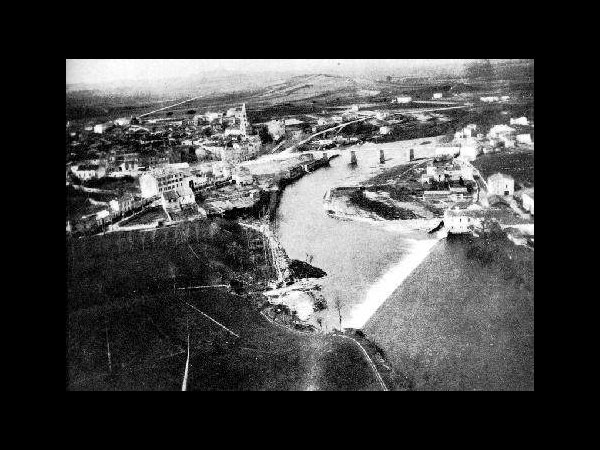 Photograph courtesy Wikimedia Commons.
Labruguiere, France, photographed by Arthur Batut using a kite (1889).
When the Eastman Kodak company invented roll film in the late 1880s, the camera became so lightweight that it could be attached to a kite. Some early experimenters controlled their cameras from a trigger on the ground while others used a timer. Batut is widely credited as being the first successful kite photographer, but that title actually belongs to British meteorologist E.D. Archibald. He fastened a camera to a kite in 1887.
-
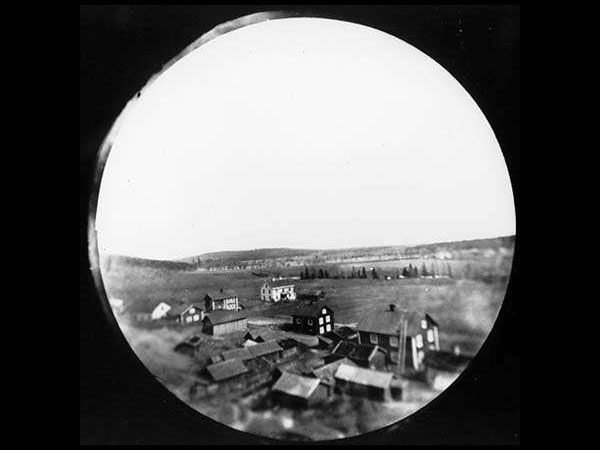 Photograph courtesy Wikimedia Commons.
Village in Sweden, photographed by Alfred Nobel using a photo rocket (1897).
Experts dispute two aspects of this photo: one, that it was taken with a rocket, and two, that it was the first of its kind. Frenchman Amedee Denisse designed what historians believe is the first photo rocket in 1888, but no one knows whether he ever built it. Nobel (yes, that Nobel) designed a similar model in 1897. Some say he used it to take this picture of the Swedish countryside. Others think he used a balloon, noting that the day's slow film speed would not have produced such a clear picture given a rocket's high velocity. Generally, when photographers wanted to take pictures using a rocket, they would place the camera in the rocket's nose, which was also enclosed in some kind of capsule or return vessel. At a certain altitude, the nose cap came off, the camera snapped pictures, and the other parts of the rocket dropped away. Parachutes were also commonly attached to the return capsules.
-
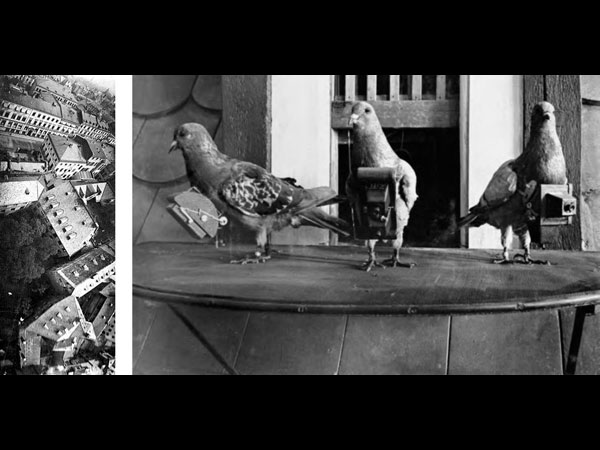 Photographs courtesy Wikimedia Commons.
Kronberg, Germany, photographed by Julius Neubronner using pigeons (1908).
Apothecary Julius Neubronner frequently used pigeons to carry important medication to his customers. After one of those pigeons got lost in the fog and arrived at his destination four weeks late, Neubronner got curious about where his pigeons were going. In 1903, he patented a timed pigeon camera to trace the path of his birds. He affixed it to a flock of pioneering pigeons a few years later to take photos of a castle in Kronberg.
-
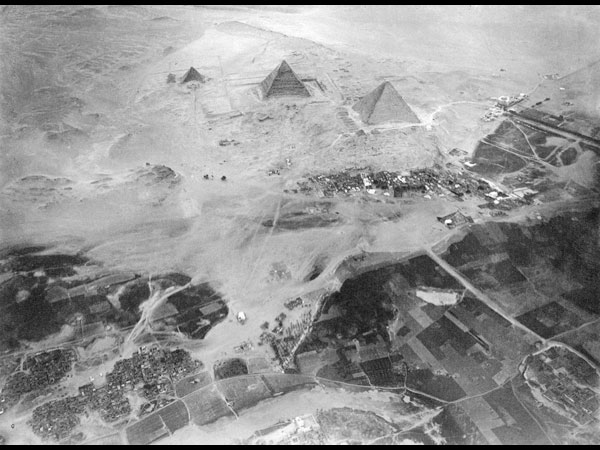 Photograph courtesy Wikimedia Commons.
Pyramids of Giza, Egypt, photographed by Edward Spelterini from a free-flying hot air balloon (1904).
Spelterini, a balloon pilot famous for his photos of the Swiss Alps, snapped this image about 600 meters above ground. Several of Spelterini's earlier photos appeared in the August 1899 issue of Strand magazine.
-
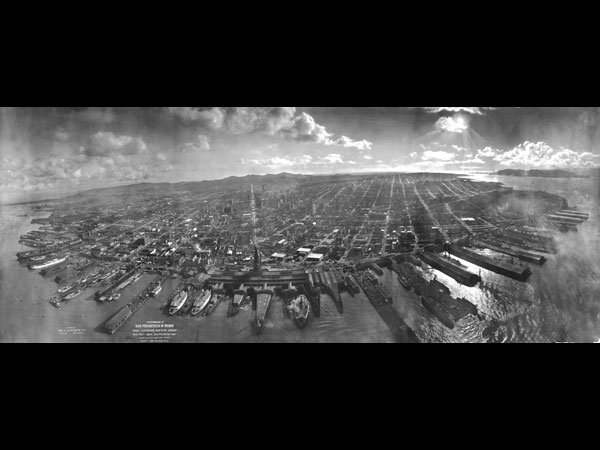 Photograph courtesy Wikimedia Commons.
San Francisco, photographed by George R. Lawrence using a kite (1906).
About six weeks after an earthquake and fire devastated the city, Lawrence took this 130-degree panoramic photo from between 600 and 2,000 feet over San Francisco Bay. Lawrence's camera was 49 pounds, so to support it he attached it to roughly 16 linked kites. He activated the shutter with an electric current delivered along a line from the ground to the camera. This photo, taken on May 28, and several others Lawrence took ran in various parts of the San Francisco Examiner through August of that year.
-
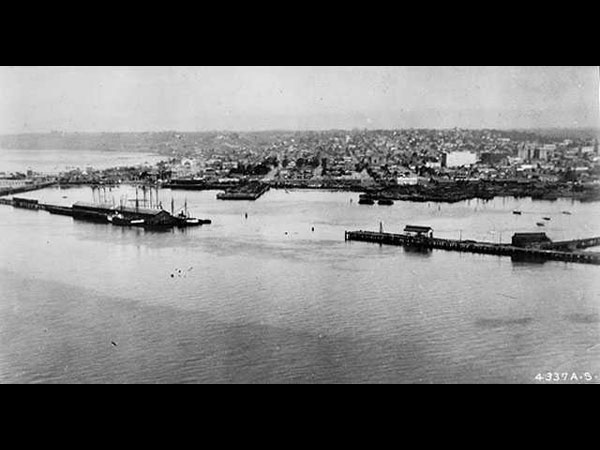 Photograph courtesy the Smithsonian Institution and the Defense Visual Information Center.
San Diego, photographed by Harry A. "Jimmy" Erickson using a Curtiss Hydroplane (1911).
Famous for his aerial imagery, Erickson was also known as "The Flying Photographer." Some experts think this was the first photograph taken from an airplane in the United States.
-
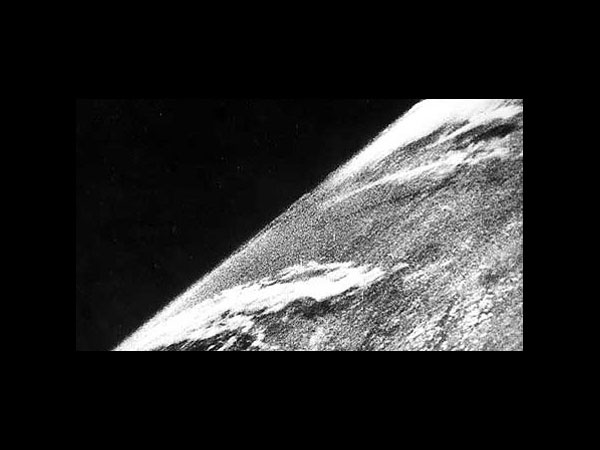 Photograph courtesy CREDIT: Air and Space magazine.
Earth, photographed by soldiers and scientists at the White Sands Missile Range with a V-2 missile (1946).
The same rocket that Germany developed to rain explosives on London in World War II also gave photographers the technology to capture the planet from space. The V-2 rose 65 miles and came crashing to the Earth at 500 feet per second. The steep fall obliterated the camera, but the film, encased in steel, remained intact. When the scientists found the preserved film, "They were ecstatic, they were jumping up and down like kids," Fred Rulli, a member of the team that recovered the original shots, told Air and Space magazine in 2006. For the first time, the photos showed "how our Earth would look to visitors from another planet coming in on a space ship," wrote Clyde Holliday, the engineer who created the V-2's camera, in a 1950 National Geographic.
-
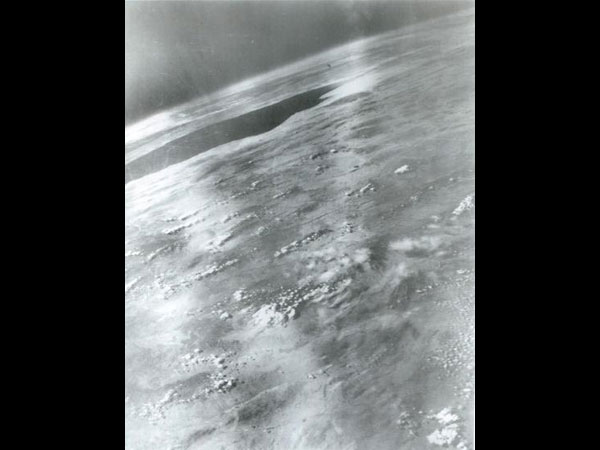 Photograph courtesy CREDIT: Air and Space magazine.
Earth, photographed by soldiers and scientists at the White Sands Missile Range with a V-2 missile (1947).
Another V-2 photography mission snapped this photo from 101 miles in the air. The darker area to the left is the Gulf of California.
-
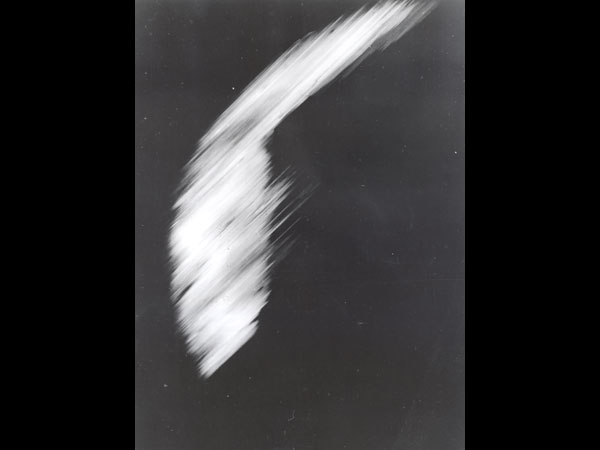 Photograph courtesy NASA.
Earth, photographed by NASA with the Explorer VI Satellite (1959).
The very first satellite photo of the planet more closely resembles a blurry golf club than the stunningly vivid images astronauts would snap a decade later. This photo depicts the Central Pacific Ocean, and was captured while the satellite crossed over Mexico.
-
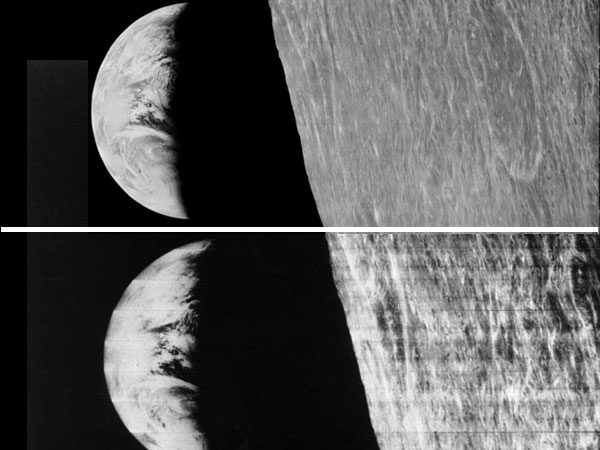 Photograph courtesy NASA.
Earth, photographed by NASA with the Lunar Orbiter I (1966).
The unmanned precursor to the Apollo program snapped the first "Earthrise" photo, sparking the imaginations of a generation of astronomers and would-be astronauts. To contemporary space enthusiasts, it was striking because of its place in history, not its photographic quality. But in 2008, NASA restored the 1966 image (the original is pictured on the lower right) and created a high-resolution duplicate. NASA launched five Lunar Orbiter missions between 1966 and 1967 to map the surface of the moon before sending humans.
-
 Photograph courtesy Wikimedia Commons.
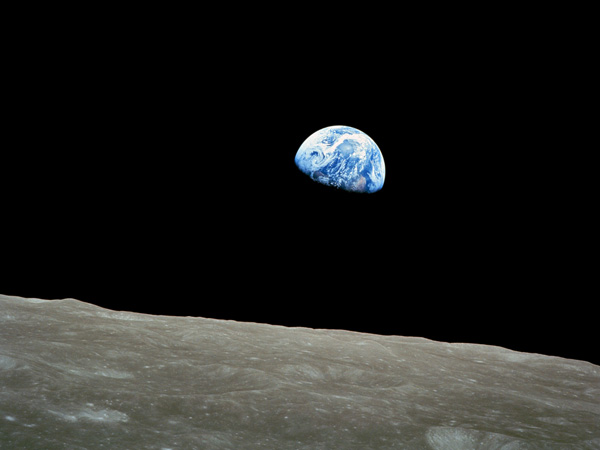
Earth, photographed by astronaut Bill Anders on the Apollo 8 mission (1968).
"We came all this way to explore the Moon, and the most important thing is that we discovered the Earth," remarked astronaut Bill Anders, reflecting on the photographs of the mission. Anders, James Lovell, and Frank Borman were the first humans to leave the Earth's orbit, and the first to watch the Earth rise up from behind the moon. Some say this photo's staggering beauty sparked the environmental movement; the first Earth Day was celebrated 15 months later. "I suspect that the greatest lasting benefit of the Apollo missions may be, if my hunch is correct, this sudden rush of inspiration to try to save this fragile environment—the whole one—if we still can," wrote a correspondent in Science magazine 1970.
-
 Photograph courtesy Wikimedia Commons.
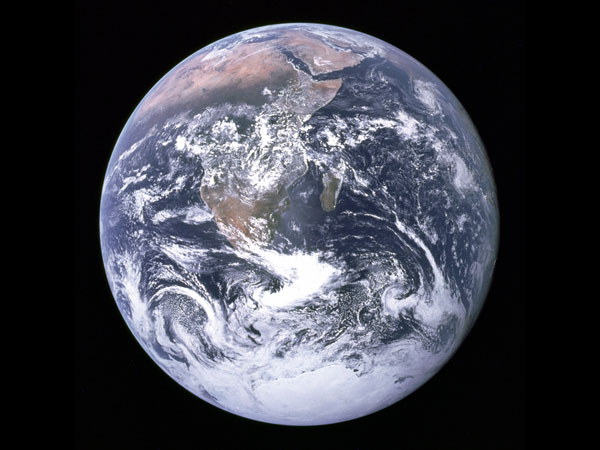
Earth, photographed by Eugene Cernan, Ronald Evans, and Harrison Schmitt aboard the Apollo 17 spacecraft (1972).
The face that launched a thousand coffee mugs, T-shirts, and inflatable globe balls, the "Blue Marble" image is one of the most widely disseminated pictures in the world. It was the first time astronauts captured the entire surface of the Earth, and the last time man walked on the moon. It's also considered the most true-color photo of the Earth ever taken.
-
 Photographs courtesy NASA.
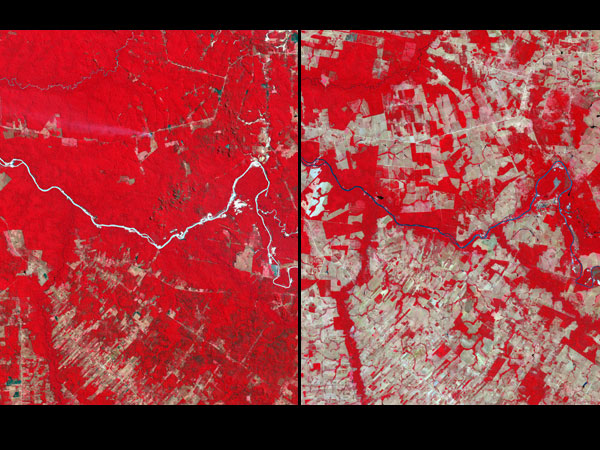
Deforestation in Mato Grosso, Brazil, photographed by the Thematic Mapper on NASA's Landsat 5 satellite, and NASA's Terra satellite.
Over the past couple of decades, NASA's MODIS sensor technology has dramatically enhanced our ability to track the effects of human activity on the environment. In these photos, taken from the Terra satellite, vegetation is pictured in red. The beige chunks mark areas of deforestation. The first photo was taken in 1992, the second in 2006. The region of Mato Grosso, deep in the Amazon.
