On the Offensive
After Brüno, Hollywood depictions of gays may never be the same. That's a good thing.
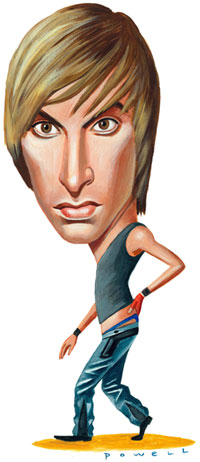
Love it or hate it, Brüno confirms Sacha Baron Cohen's gift for sniffing out cultural landmines—and his corresponding willingness to walk right over them. The British comic anarchist's latest piece of daredevil performance art is another Tocquevillian trip through the American psyche, this time in the company of a flaming Austrian fashionpolizei and fame whore. Just as the Anti-Defamation League expressed concern over the anti-anti-Semitic humor of Borat, gay rights groups like the Gay and Lesbian Alliance Against Defamation and the Human Rights Campaign have questioned the wisdom and taste of Brüno's full-frontal assault on homophobia: Does the movie send up stereotypes or perpetuate them? Who's the joke on? Who's the joke meant for? What if they don't get it?
Lost amid the dutiful hand-wringing about the movie's capacity to offend is the rather remarkable fact that it takes on, with unprecedented purpose and directness, some of the most vexing and enduring bugbears surrounding on-screen homosexuality. Herewith, a few old themes and taboos that Brüno has its way with and that, if we're lucky, will never be the same again.
1. The gay joke
In 1973, the Gay Activists Alliance, fed up with insensitive screen portrayals of gays and lesbians, called for a meeting with Hollywood producers and drew up a set of guidelines to improve the "treatment of homosexuality" in film and television. The first item on the list: "Homosexuality isn't funny. Sometimes anything can be a source of humor, but the lives of twenty million Americans are not a joke."
In keeping with this dictate, most post-Stonewall mainstream films about homosexuality are notably unfunny, as if determined to disprove those clichés about gay wit and droll dandies. As gay liberation took root, gay movies went through a gradual coming out as well, and the early ones clearly bore an educational onus. The most visible gay-themed films of the early '80s were earnest romantic dramas like Making Love and Personal Best, which sought to validate same-sex relationships by presenting them in polite, nonthreatening terms. While the advent of AIDS activism and queer theory spurred independent directors like Todd Haynes and Tom Kalin to make formally and politically radical work, mainstream gay films took a detour into illness-weepie territory with Longtime Companion and Philadelphia. There is a far greater variety of styles and agendas in the mix when you consider indie and foreign queer cinema, but Hollywood, to an overwhelming degree, has played it safe and somber. The long-standing complaint that gay characters routinely meet unhappy ends still applies, to judge by the most prestigious gay films of recent years, Brokeback Mountain (a tragedy of the closet) and Milk (a biopic of a slain activist).
Which isn't to say that gay jokes are a rarity on-screen. Quite the opposite: There is a long, mostly ugly history of gay or crypto-gay characters serving as comic villains and buffoons, from the nervous Nellies of the Production Code era to Bond baddies to the punching bags of countless high-school movies. Gay humor is a staple of contemporary straight-guy comedies (Judd Apatow buddy movies, in particular), though they're often self-aware enough to cover themselves with the meta-bigotry defense. (The gay jokes double as jokes about gay jokes.)
The closest Hollywood has come to a progressive gay-themed comedy is I Now Pronounce You Chuck and Larry, in which two straight firefighters fake a domestic partnership for the benefits. An update of a 1969 trifle called The Gay Deceivers (in which two straight guys feign homosexuality to dodge the draft), it directly, if broadly, tackles prejudice and preconceptions, assigning Adam Sandler a climactic courtroom speech disavowing the use of the slur faggot. But even this good-natured, GLAAD-endorsed pro-tolerance fable looks for laughs in familiar places—for instance, milking the old "don't drop the soap" gag while acknowledging its absurdity.
It is into this odd, patchy landscape of humorless gay films and suspect gay humor that Baron Cohen's big gay joke of a movie arrives. The worries over Brüno among gay-culture gatekeepers spring from two longstanding assumptions: 1) Mainstream gay movies are basically didactic and as such should advance positive images of homosexuality. 2) Gay humor in the mainstream, often perpetrated by straights, is basically malicious.
But Brüno is, in more than one sense, beyond gay. Is any viewer really going to think that this hyperbolically crass and ridiculous narcissist—who wears mesh tops and eye-searing lederhosen, refers to his adopted African baby as a "dick magnet," and drops faux-Teutonic vulgarities about his waxed arschenhaller—represents "the mainstream of the gay community," as one troubled Hollywood "gay insider" put it? And are the gays who anxiously anticipate the mocking, hostile reactions of the unenlightened really that blind to Brüno's obvious counteroffensive strategy, which is to make that mocking, hostile idiocy the subject of his film? The beauty—and perhaps even the moral logic—of Baron Cohen's method is that those who're not in on his joke are invariably the butts of the joke.
2. The sissy
There's no getting around it. Brüno is—to cherry-pick from the glossary that opens Parker Tyler's 1972 book Screening the Sexes, a superbly entertaining critical survey of homosexuality in the movies—a daisy, a fairy, a nonce, a pansy, a swish. And to put it mildly, this makes most people, gay and straight alike, uncomfortable.
Film historians like Tyler and the more strident Vito Russo, author of The Celluloid Closet, have explored the pre-liberation phenomenon of the "professional sissy" (to use Tyler's phrase), best exemplified by campy character actors like Edward Everett Horton and Franklin Pangborn. In a more repressed time, sissified men and butch women on-screen served as gaydar activators, barely coded signals that created an unspoken community among closeted filmmakers, performers, and viewers. But the move toward acceptance and assimilation brought with it a reassertion of traditional gender roles. When gay male heroes finally materialized, they were expected to be masculine. Sissies became ever easier to disparage, not least for gays who saw them as Stepin Fetchit-like relics of a less progressive age.
Baron Cohen, who is straight, has been accused of indulging in gay minstrelsy. It's true that he does not "play gay" in the respectably stoic, square-jawed manner of Tom Hanks and Heath Ledger. But Brüno is less a character than a button-pushing social experiment in locating the tipping point of tolerance: How much can he get away with? What does it take to unleash the inner bigot? For his merciless ambushes to work, Brüno needs to be this flamboyant—and this moronic. (Baron Cohen's interview subjects typically reward his deeply stupid questions with even stupider answers.)
The most discomfiting—and incongruous—aspect of Brüno's pinkface masquerade is the character's over-the-top sexual voracity. An early outré-sex montage that features a dildo rigged to an exercise bike establishes that we're not in Kansas anymore. Brüno is a far cry from the prim and prissy old-school sissies, who were all innuendo and no libido. We have long been conditioned to regard effeminacy as a neutered, negative stereotype, but there are moments when Baron Cohen's extravagant prancing—playing out amid what Brüno's trailer calls "real people, real situations"—seems not grotesque but defiant, forcing his foils (redneck hunters, straight suburban swingers) to recognize the screaming presence of Otherness.
In that sense, Brüno could be considered an homage to the proto-gay-lib classic The Naked Civil Servant, a 1975 film based on the memoirs of Quentin Crisp, the author and actor who called himself the "stately homo of England." An exhibitionist flamer in oppressive early 20th-century Britain, Crisp (played by John Hurt) is a magnet for persecution, but he holds his hennaed head up high. "The world is full of Aborigines who don't even realize that homosexuality exists," he declares. "I shall go about the routine of daily living making this particular fact abundantly clear."
3.Homosexual panic
Gay humor thrives on ticklish suggestions of homosexual panic, the straight fear of being hit on (or possibly even converted) by gays. There's also a far nastier side to the concept, given the emergence of the "gay-panic defense" as a controversial legal strategy in cases of gay-bashing. Brüno attacks this idea by subjecting it to ridicule: In an effort to go straight, our mincing hero solicits pointers from a martial-arts instructor in beating up gays.
In the most notorious of all gay-panic movies, William Friedkin's Cruising (1980), Al Pacino plays a cop on the trail of a serial killer in the hard-core leather scene of the West Village. Going undercover, the Pacino character succumbs to the sexy-scary Dionysian ambience (or is it the amyl nitrate fumes?). Villified for linking homosexual and homicidal urges, Cruising has since undergone a minor rehabilitation, with defenders, like critic Robin Wood, who applaud its fluid conception of sexuality.
While Cruising is an ambiguous wallow in the psychology of gay panic, twisting impulses of disgust and curiosity into what Wood calls a "knot of contradictions," Baron Cohen, in his interactions with unsuspecting, camera-hungry dupes, simply induces that panic before our eyes. Brüno is more uneven than Borat and relies more on scripted filler, but one area in which it has an edge is the frisson of risk. On the loose in an Orthodox neighborhood in Israel or in small-town red-state America, Brüno is, in more than one sense, cruising for a bruising. Baron Cohen has acknowledged that the prevalence of homophobia makes it more dangerous to do Brüno than Borat. That constant threat of physical violence—evident even in the segments on TV's Da Ali G Show (like the one below, in which Brüno visits the "gayest part of America: Alabama!")—is central to the experience of watching the film and to its larger political point.
Borat and Brüno are comedies of difference, documentaries of bigotry, and they more or less require the viewer to pick a side. Baron Cohen doesn't play nice, but there's real value to the aggression of his literally confrontational method. How many political entertainments can match the satisfaction of watching Borat trash an antique store full of Confederate kitsch or Brüno compliment an ex-gay preacher/deprogrammer's "amazing blow-job lips"? For the climax of Brüno, which echoes the rodeo scene in Borat, Baron Cohen, disguised as a tough-guy wrestler, starts making out with another man mid-cage match, sending the drunken mob into a horrified frenzy. Leave it to a movie with a talking penis to come up with a brilliant tactic against homophobia: the gay-panic offense.