Twin Peaks Revisited
The second season is not what it seems.
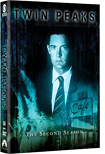
David Lynch's Twin Peaks was one of those improbable, instant phenomena that almost give you nostalgia for the days when network television had an iron grip on American culture. Centered on the murder of a homecoming queen with dark secrets, the 1990-91 mystery drama landed Lynch on the cover of Time and made a backwards-speaking midget and a schoolmarm seer known as the Log Lady into the subjects of heated water-cooler debate. To its commercial detriment, though, the show that asked, "Who killed Laura Palmer?" … just kept on asking. In fact, Twin Peaks dithered and lingered over nearly everything—all it did in a hurry was get cancelled. After waiting patiently for answers through the show's eight-episode opening run, viewers fled in droves. ABC banished the second season to the ratings Siberia of Saturday nights at 10, and "Peaks mania" was officially over by the time America finally discovered the culprit in episode 14. Lynch and company managed to deliver another 15 episodes, but few of those who realized the show was still on the air thought to complain when it was killed, scarcely a year after its huge debut.

Today, the lame-duck second season is remembered fondly by only the most die-hard of Peaks fans. But time has been kind to Lynch's TV turn. Free from the inescapable hype that once surrounded the series, the unlamented later episodes contain a lot to admire and enjoy. And now both cultists and the merely curious can watch the second act, finally available on DVD as a six-disc set from CBS.
The very peculiarities of Lynchian temperament that made Twin Peaks stand out—its waterworks emotions, inch-by-inch pacing, and surfeit of red herrings and general abnormality—became liabilities as the series went on. But much of what played poorly then holds up well for an audience lacking the itch to know whodunit. It's certainly easier to forgive co-creators Lynch and Mark Frost for dragging their heels when one watches the singular working methods of FBI Special Agent Dale Cooper—an adherent of Zen practice and dream logic—proceed over the course of a few evenings, rather than a year. And the earlier episodes in the set maintain the sensational first season's balance of levity, sudsy intrigue, and undercurrents of terror—the last personified in the bogeyman Bob, whose demonic rictus was a special effect unto itself.
A bizarro blend of police procedural and soap opera, Twin Peaks also remained a strongly character-driven drama throughout. The series is justly credited as the template for both the paranormally inflected serial (The X-Files, Lost) and the cockeyed ensemble melodrama (Desperate Housewives, Six Feet Under), but its most important legacy may be that it got deeper under the skin of its characters than ever before on the small screen. The show brimmed with searching, leisurely conversation; at times it was as content as a French art film simply to observe people as they talk, listen, and think.
Consider these set pieces: Paragon of stoic decency Ed Hurley delivers a touching monologue on how he and his soul mate ended up married to different people. Goody-two-shoes Donna Hayward inherits Laura's sunglasses and promptly rebrands herself as a femme fatale—a hilarious case study of adolescent self-dramatization, realized to flinty perfection by 20-year-old Lara Flynn Boyle. Acerbic forensics specialist Albert Rosenfield, whose character functioned as in-house critic of both the homespun quirk and supernatural gobbledygook native to the series, comes out of the closet as an unrepentant pacifist.
Crucially, the second season also intensified the queasy pathos of Laura's father, Leland, that lover of show tunes, so quick to tears but quicker to break into unscheduled song and dance. Especially in the set's four Lynch-directed episodes, music is a shape-shifting character unto itself, whether in Angelo Badalamenti's ominous synthesizer instrumentals or in the retro-minimalist ballad that sultry biker-boy James plucks out in the Palmers' parlor. This was a show that would just sit back and watch a young girl, dressed as a fairy princess, performing Mendelssohn on the family upright, with only Lynch's floating, almost imperceptibly trembling camera to destabilize the anodyne domestic tableau.
Twin Peaks' rapt, patient gaze was extraordinary then and unthinkable now; what was palatable as a one-off proved too much to ask of a mass audience week after week. Those who gave up too soon, however, missed out on That Episode—"Lonely Souls," where all is made clear, the series' pinnacle and one of Lynch's finest hours. A mood of chaotic foreboding is established early as Cooper and his team coordinate an ad-hoc police lineup for a mentally imbalanced witness, known as the One-Armed Man, in the lobby of the Great Northern Hotel, much to the displeasure of slimy proprietor Ben Horne.
Off-kilter out of the gate, the episode builds to a stunning pair of scenes: Leland Palmer, in the grip of demon Bob, beats Laura's look-alike cousin Maddy to death in what a typical newspaper recap called "one of the most gruesome displays of violence ever to hit a prime-time series." (The episode's revelation that the clownish sad-sack Leland raped and murdered his own daughter seems at once unthinkable and, in retrospect, a truth hidden in plain sight all along.) At the same time, at the local tavern, a pale chanteuse sings the lover's requiem "The World Spins" as a communal sadness descends over the place like a specter. This is Lynch at the top of his powers: his brutal efficiency as a horror director—one whose scary monsters of choice are the mangled psyches of our families and neighbors—matched with his troubling gift for illuminating voluptuous beauty in abject pain and sorrow. It's still hard to believe that something like this was on American broadcast TV, sharing a network with America's Funniest Home Videos.
It took Cooper two more episodes to solve Laura's murder. He spent much of the rest of the season trying to outmaneuver his deranged ex-partner, who tracks him down to Twin Peaks and appears to have a nasty fate in store for one of the town's many teenage beauties. This new villain couldn't compare to the greasy malevolence of Bob, though, and it's easy to understand why many have written off these later, meandering episodes—though they did generate their fair share of curiosities. Future X-Files fans got their first glimpse of David Duchovny, who starred in three episodes as a transvestite FBI agent, and Cooper found a love interest in the form of Heather Graham, whose doll-like blankness works to haunting effect in the series finale. Lynch returned to direct the creepy send-off episode, wherein Cooper reunites with the aforementioned midget and the vengeful ghost of Laura Palmer for what might be described as an encounter-group session of the damned.
Twin Peaks could have ended with Maddy's murder, and maybe it should have. After that, the show lost much of its narrative energy, if not its taste for the avant-garde. Bob became a kind of freelance fiend, but he worked far better as a metaphor for the evil and depravity lurking next door or, perhaps, at your own kitchen table—a theme that Lynch mined in his feature films Eraserhead (1977) and Blue Velvet (1986). And Lynch was unhappy that intense pressure from ABC and antsy viewers had cracked the show's big secret open far sooner than planned—if he'd had his way, the Palmer investigation might have spun out indefinitely. Yet the director has done some of his best work within unwelcome constraints: The extreme financial limitations he faced during the five-year production of Eraserhead, for example, or the practical problem of turning the open-ended TV pilot Mulholland Drive (2001) into a self-enclosed feature film.
The same was true with Twin Peaks. Forced to stop teasing his viewers and deliver a payoff, Lynch administered it like a flawlessly calibrated punishment, proving that he could be a master of plot and pacing. His genius is to pull up the living-room carpet and show us all the muck and pestilence underneath, and in Twin Peaks, the sexual pathology and homicidal tendencies familiar from his films were all the more disturbing for being veiled and muted to meet network standards. Some of Twin Peaks is brilliant; some of it is virtually unwatchable. But at its best, this strange, aborted experiment showed that having to think inside the box didn't pen in Lynch's vision, but only concentrated it.