Pardon the Interjection
The Internet and the rise of awwa, meh, feh, and heh.
One night last week, I explained to a youthful hotel desk clerk that my family and I were interested in playing cards up in our room, then asked her if the hotel had a deck. She made this sound:. Then she said no.
The sound she made was familiar to me. It is a fairly recent variation on the venerable American interjection aw, which achieved prominence in the expression "aw, shucks" and is defined by the Oxford English Dictionary as "an exclamation usually expressing mild remonstrance, entreaty, commiseration, disgust, or disapproval." I should say a variation on a variation. For quite a while, aw, or more precisely awww—with a more drawn-out pronunciation and usually a descending pitch—has been a common way that studio audiences and regular people react to something touching or sad. About two years ago, I started noticing female students of mine using the new, ascending-pitch, abbreviated version—in linguists' tonetic stress mark notation, it would be rendered as aww/uh— as an acknowledgment of a specific subset of touchingness, viz, cuteness. This quality is perceived in an impressive variety and number of situations. On a recent episode of The O.C., one character introduced Summer to a couple of young blondes and told them she was about to be married. Their response: "Aww/uh!"
This is a different morpheme from aw, but you won't find it listed in the OED or in any other dictionary on your library's shelves. That's not surprising. Interjections are probably the most expressive part of speech. They are definitely the most disregarded and always have been. When the Greek grammarian Thrax came up with the idea of dividing language into parts of speech in about 100 B.C., he didn't include interjections, and his English-language heirs have tended to do so grudgingly. In the 18th century, John Horne Tooke decried "the brutish, inarticulate Interjection, which has nothing to do with speech, and is only the miserable refuge of the speechless. … The neighing of a horse, the lowing of a cow, the barking of a dog, the purring of a cat, sneezing, coughing, groaning, shrieking, and every other involuntary convulsion with oral sound, have almost as good a title to be called Parts of Speech, as Interjections have."
The enmity persists. The authors of the authoritative, 1,842-page Cambridge Grammar of the English Language, published in 2002, dispense with interjections in five sentences. The Merriam-Webster dictionary has been choosing the top 10 words of the year since 2003 (the just-announced 2006 winner is truthiness), and no interjection has ever made the list. The American Dialect Society has picked a single Word of the Year since 1990 (this year's puzzling choice is pluto, a verb meaning "to demote or devalue something," as happened to Pluto when it was delisted as a planet), and just once has an interjection gotten the nod: not! in 1992.
The main reason for the grammarians' neglect is that interjections operate outside of grammar—they are words that unilaterally express a sentence (or more) worth of meaning. Not!:"My previous statement is inoperative." Duh:"You've stated something rather obvious." Psst: "Come closer, without calling attention to yourself. I want to tell you something in confidence." Ka-ching: "That's a good idea. You might even make some money off of it." Lexicographers, meanwhile, have given this category short shrift because dictionaries have always emphasized the written word, while the home turf of interjections—pace Tooke—is speech.
The Internet, where writing and talking sometimes seem to merge, is changing all of this. Thus awwa and awwe—which seem to be the preferred spellings for the cute-expressing awww—are all over the Web, as in this blog entry by a teenager: "[a boy is] so cute and i love hugging him and awwa how cute is this.. the otherday he kissed me on the head.... lol wow I'm such a girl."
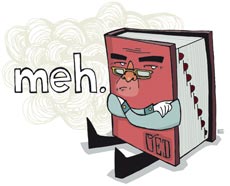
It's not that e-mail, blogs, IM-ing, message boards, and texting have spawned a litter of brand-new interjections. (I don't count emoticons because you can't utter them, and I don't count acronyms like LOL and CU because they represent phrases with grammatical standing.) Rather, they have given lots of marginal ones, like awwa, a spelled-out form and thus a major shot in the arm. A personal favorite is meh, which (of course) has no definition in the OED but 173 * separate ones on urbandictionary.com, including: "A random word when people either don't know what to say, don't care, can't answer a question or are too drunk to form a coherent english phrase."Meh— which can also be used as an adjective, e.g., "I felt kind of meh about the whole thing"—had the ultimate honor of being featured in a Simpsons exchange:
Homer:(after watching Blockoland commercial) All right, kids ... who wants to go ... to ... Blockoland?
Bart and Lisa: Meh.
Homer: But the commercial gave me the impression that ...
Bart: We said meh.
Lisa: M-E-H. Meh.
Feh, a venerable Yiddish term indicating disgust or dismissal, has ridden to popularity on meh's coattails. "Flameviper," an urbandictionary.com contributor, explains some of feh's fine points: "When it is the answer to a question, it usually means 'no.' It is also used to calmly dismiss insults without resorting to a direct comeback (which could lead to a confrontation). Also used to dismiss orders. Sometimes (rarely) used in frustration."
When it comes to interjections associated with humor or jokes, online writing contains multitudes. There are subtle distinctions among ha, haha, heh, and he-he, mainly having to do with whether the joke teller or the recipient has the floor, and how much irony or sarcasm is being applied. On the other hand, I cherish getting a Hah! reply from an e-mail buddy of mine—it means I've really gotten off a good one.
Interjections are suitable for online writing, as I say, because of the way online writing mimics speech. But newspaper and magazine writers who spell out interjections and other vocalisms run the risk of coming off as cute—as in yucky ew rather than adorable awwa. Most egregiously abused are what linguists call "discourse markers"—short sounds (it seems a stretch to call them "words") that speakers use to register hesitation, agreement, encouragement, ambivalence, and other responses. Uh, er, and um, in particular, have been flagrantly overused by feature writers and columnists to signal an impending attempt at irony or humor; the maneuver is now well beyond cliché, somewhere in the neighborhood of desperation. A LexisNexis search of major English-language newspapers for um yields 132 hits in just the last week, including a striking number in various newspapers' coverage of the Grammy Awards:
The Toronto Sun's preview: "Watch for Justin Timberlake pairing up with someone in a duet (which often can be quite, um, revealing)."
The Chicago Sun-Times, looking back on a winner of yore: "the Starland Vocal Band, who gave us the, um, unforgettable single, 'Afternoon Delight.' "
The Oregonian, referring to Christina Aguilera: "the girl who was once known as much for her, um, dirrtyness showed she cleans up real nice, too."
St. Petersburg Times: "Shakira, Wyclef, and, um, Shakira's abs teamed up for the dance smash Hips Don't Lie."
My reaction to all that?
Feh.
Interjection stylings by Maria Yagoda. Thanks to Mark Liberman for counsel on tonetic stress mark notation.
Correction, Feb. 21: This piece originally asserted that urbandictionary.com includes 737 definitions of meh. It has 173 definitions of the word. (Return to the corrected sentence.)