Upstairs, Downstairs
-
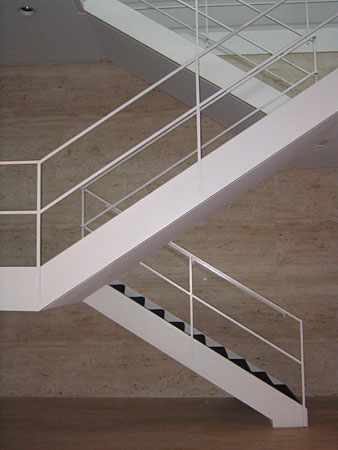 Image courtesy Arts Club of Chicago.
"God is in the details," Mies van der Rohe is supposed to have said. He did not simply mean that building details are important; he meant that they are the very soul of architecture. An easy way to appreciate this is to look at how different architects handle a very simple detail, such as a door handle, a baseboard—or a stair balustrade. The function of a balustrade is straightforward: It is both a guardrail and a climbing support. Yet the variety of designs that can perform these functions is vast. Mies' balustrade at the Arts Club of Chicago (1948-51, relocated 1997), for example, is a perfect expression of his reductive minimalism: The identical square steel bars serve as handrails, stanchions, and safety rails. The result is less about functionalism (the handrail is a bit too small to be really comfortable) than about the strict minimalism that characterizes all his work. Less is more.
-
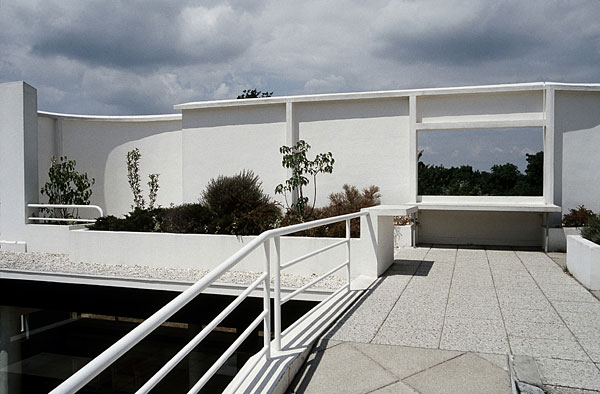 Photography by Jeffrey Howe.
Mies' stair at the Arts Club is his own particular version of that old modernist chestnut: the pipe railing. In the 1920s, architects such as Le Corbusier commonly used balustrades made of steel pipes, partly because they admired steamships and factories, and partly to épater les bourgeois. Undecorated, functionalistic, and vaguely industrial, pipe railings—like glass blocks, flat roofs, and white-painted exteriors—became a hallmark of the International Style. At right is a classic: the railing of the rooftop ramp of the famous Villa Savoye (1928-31).
-
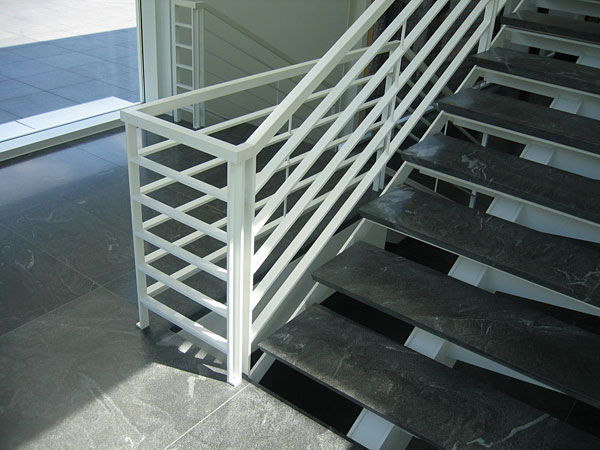 Image courtesy the author.
Modern steel balustrades, like this example designed by Richard Meier in 1996 for a house in Dallas, have long since shed their industrial roots. Like the Miesian example, this one is an aesthetic exercise, though less minimalist, with a slightly thicker handrail and narrow vertical reinforcements. Notice how the horizontal safety rails change angles, always a challenging element, but handled particularly elegantly here. The railing incorporates Meier's interest in geometry, his purism, and his subtle mannerism—there are no less than five rails. These multiple rails, which recall sheet-music staves, have been much imitated.
-
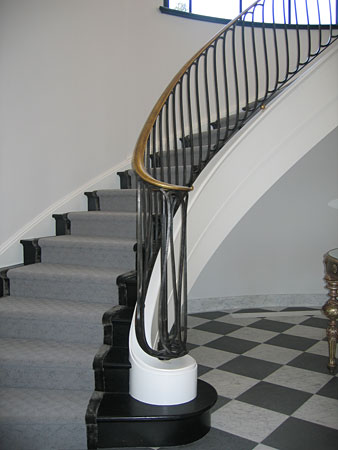 Image courtesy the author.
The materials of this monochrome balustrade in a California house, designed in 1999-2003 by Robert A.M. Stern, are similar to those of the Meier house. The design is, in some ways, simpler, but the effect is quite different. This stair appears more glamorous, the balustrade softened by its sinuous supports, which are abstracted, slightly Art Deco versions of 18th-century balusters. Nothing factorylike about this opulent design.
-
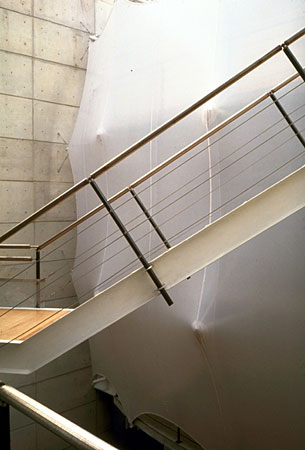 Image courtesy of TEN Arquitectos.
Many modernist architects are interested in lightness, and one way to lighten a steel balustrade is to substitute stretched wires for solid rails. There are many examples; this early one is a stair in the Alianza Francesa in Mexico City, designed by Enrique Norten of TEN Arquitectos in 1990-92. Unlike Meier and Stern, Norten dramatizes the way the balustrade is constructed, accentuating the hardware and connections. The turnbuckles needed to keep the wires taut are part of the techno-deco scheme. The stanchions, at right angles to the slope of the stair stringer, are an affectation popular in the '90s.
-
 Ezra StollerCREDIT: © Esto.
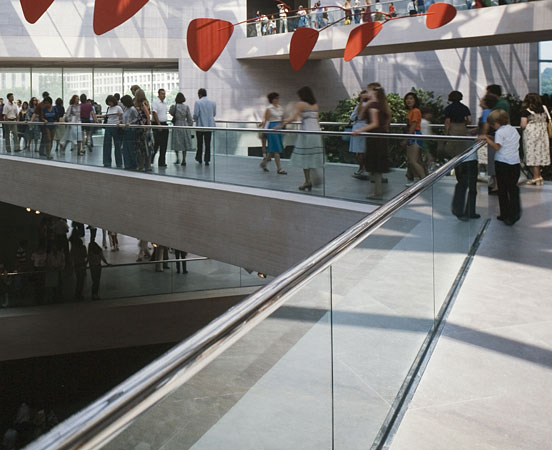
The most dramatic way to lighten a balustrade is to make it disappear altogether. That is what I.M. Pei did at the East Wing of the National Gallery of Art in Washington, D.C., (1978), in what must be one of the most imitated balustrades of recent times. Sheets of thick, tempered glass, recessed into the floor, replace the stanchions and rails. A cap of round, stainless-steel tubing forms the handrail. As throughout Pei's buildings, construction is concealed rather than revealed, hardware is minimized, simple elegance is stressed, and the whole thing also happens to function well—as long as someone regularly cleans children's fingerprints off the glass.
-
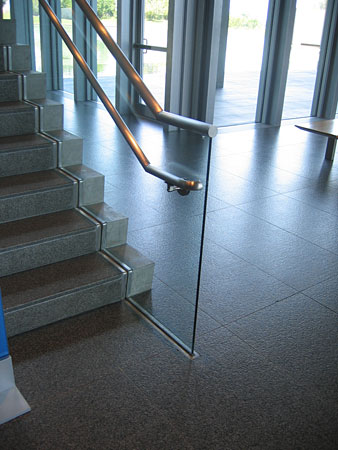 Image courtesy the author.
Glass balustrades are as ubiquitous today as pipe railings were in the '20s. This one, in the New Modern Art Museum of Fort Worth, was designed by Tadao Ando in 2003. The basic technology is the same as Pei's. But in this design, theatricality plays an important role, a dramatic moment in Ando's otherwise spare aesthetic. The handrail floats, while the sheet of glass appears to have been pushed into the stair and the granite floor, like a knife into butter. Ando, known for his use of polished concrete, actually manages to make this glass balustrade look massive.
-
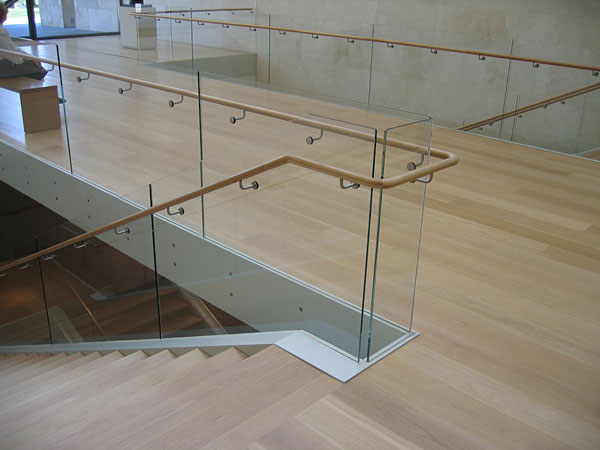 Image courtesy the author.
The Renzo Piano Building Workshop designed this glass balustrade, in the Nasher Sculpture Garden in Dallas, a year after the Ando example. It's light as a feather. Piano dispenses with the top rail altogether and slightly separates the glass sheets, which have beveled edges and rounded corners. The handrail floats, but instead of stainless steel, it's wood. The overall effect is to emphasize the different parts—glass sheets, metal brackets, wood rail—and the manner of their assembly. Although the entire balustrade is elegant, the effect is not minimalist or purist; each part is allowed to do its own job. The wood rail also feels good to the touch.
-
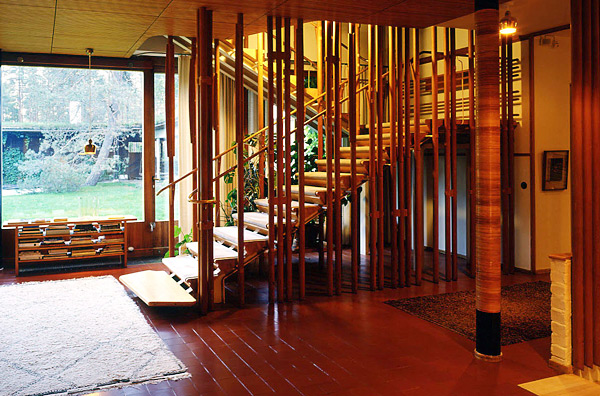 Photograph by Maija Holma. Image courtesy Alvar Aalto Museum.
The main staircase of the Villa Mairea in Noormarkku, Finland, designed by Alvar Aalto in the late 1930s, remains as fresh as ever. Although the wooden treads are supported by a steel beam, the balustrade is wood. Glass and steel emphasize precision; wood has a softer, natural appearance, which is accentuated here. Instead of using stanchions and rails, Aalto has made a full-height screen of unevenly spaced varnished wood uprights, to which he attaches the bent-wood handrail, whose sharply turned ends are brass. Very different from a pipe rail. Although this house is considered a model of the International Style, the balustrade shows Aalto's ambivalence toward industrialization, and his willingness to introduce quirky design and hand-crafted workmanship into a "machine for living."
-
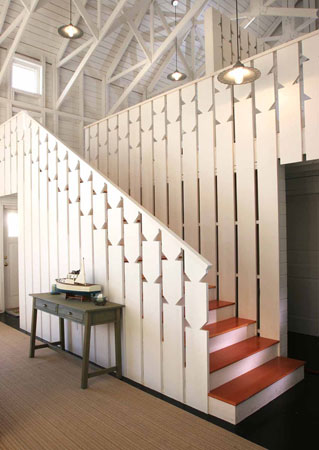 Photography by Brian Vanden Brink. Image courtesy Eck MacNeely Architects Inc.
This wood balustrade was designed in 2005 by Jeremiah Eck Architects for a new cottage in Maine. In the postmodern fashion popularized by Robert Venturi, the supports are flattened, cartoonish versions of traditional turned wooden balusters. The decorative, repetitive pattern has some of Aalto's folkish charm as well as Meier's abstract, white simplicity. This dichotomy reveals a lot about Eck's pragmatic approach to design: modern and yet not modern. Mies' aphorism is incomplete: It is not only God who is in the details, but also the Architect.