WASHINGTON, D.C.--The guy skitters through the crowd and grabs an empty beer bottle from an overturned trash can. He hunches over to hide himself. His face is masked by a black bandanna. He sneaks behind a knot of protesters, crouches down, and hurls the bottle at the line of cops 30 yards away. It explodes harmlessly against a cop's armored shin. Black Bandanna high-fives another masked man, then races away.
A moment later, the crowd erupts with shouts of "gas!" A cloud of white smoke billows from a canister in the middle of 14th Street. The 300-odd anarchist protesters retreat south from the police line, thrusting their vinegar-soaked bandannas over their faces. A few don gas masks. I duck my head under my shirt. Someone grabs a smoking canister and chucks it back toward the cops--a fruitless gesture because they're wearing gas masks. A few people, mostly cameramen, run away clutching their faces. "Medics" wearing red cross patches race over to pour water in their eyes. Like most people, I catch a only few whiffs, enough to set my eyes watering and scrape my airways.
(Embarrassing next-day confession of error: After reading Monday's news reports, your riot-inexperienced reporter realizes that what I thought was tear gas was actually pepper spray and smoke bombs. The smoking canisters were smoke bombs, and the substance that irritated everyone's eyes was pepper spray.)
This confrontation between cops and World Bank/IMF protesters had begun building about 15 minutes earlier--around 9:45 a.m.--at the intersection of New York Avenue and 14th Street. A16 demonstrators had pulled down the fence around a construction site. They started borrowing construction material to erect a barricade. They piled up metal reinforcing rods, two-by-fours, wire fencing, and newspaper boxes across New York Avenue. A contingent of a dozen cops, batons at the ready, moved out from behind their barricade to try to secure the construction site. The protesters had surged around them, shouting "Nonviolence!" and "It's our street!" The cops soon withdrew behind their metal barrier, but a crowd began marching north on 14th Street.
The crowd's aim wasn't clear--they were moving away from the cordoned-off center of the protests. They seemed to be following a contingent of cops ahead of them. The crowd seemed guided by the "black-bloc" anarchists. These are the radicals who reject the nonviolent principles of the A16 organizers. They were gunning for a confrontation.
When the crowd reached McPherson Square a block north, the 20-odd cops advanced toward the protesters. A few bandanna-wearing men hurled fruit at the cops, then chunks of plastic. The cops charged, pushing protesters with their batons. (They did not swing their batons.) The anarchists dispersed at the charge. Some of them pulled out vinegar bottles and began soaking their bandannas. The crowd reassembled on 14th Street. Someone grabbed a trash can and heaved it copward. Bottles started to fly at the cops. The officers donned their gasmasks. They fired a smoke bomb. More bottles. They fired more smoke bombs and sprayed pepper.
By the time the smoke clears, two dozen reinforcements have arrived and the police have marshaled a line across 14th Street. The officers stand three-deep, all in gas masks and heavy armor. Bottles continue to crash near them, but they don't flinch. Peaceful protesters--the majority of the crowd--try to stop the bottlethrowers by yelling "Nonviolence." The throwers shout back, "Fuck the police! Fuck the police!" The gasmasked cops and the anarchists stare each other down. Everyone waits for more bottles or more smoke. It doesn't come.
A demonstrator lays down a stars-and-stripes cloth at the cops' feet and garlands it with flower petals. The black-bloc folks yell more curses at the cops, trying to incite them. The cops ignore the taunts. The black bloc melts away. (They seem to be racing around the demonstration, stirring up trouble where they can find it and generally irking the vast majority of protesters who are nonviolent.)
By 10:15, there are more cops than demonstrators on 14th Street, and more journalists than cops. The cops remove their gas masks: Their faces are sweaty and relieved.
The standoff marks the darkest moment of a morning of civil disobedience that is gleeful, passionate, spectacular, and largely ineffective. Several thousand direct-action protesters descend on downtown Washington at 6 a.m. with the goal of stopping the World Bank/IMF meetings scheduled for today and tomorrow. Just as many D.C. police, Secret Service, and Park Service officers are there to stop them. The city has cordoned off almost a square mile in the heart of downtown, blocking all access to the bank with metal barricades and formidable numbers of cops.
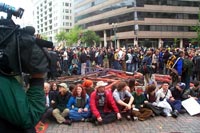
"Affinity groups"--small, independent activist groups--fan out, encircling the cordoned area. They are assigned to particular intersections but are free to disrupt however they choose (as long as they are nonviolent). Most are trying to block cars or buses carrying bank delegates from reaching the meetings. (A legal demonstration began at 11 a.m. at the Ellipse.)
Even at 6:30 a.m., and even in a drizzle, the demonstration soon takes on the spirit of a festival. A human chain blocks every street, alley, and sidewalk with access to the bank. Demonstrators block transit by stringing twine from traffic signal to traffic signal, weaving a spider web across most intersections. Each block feels like its own street theater. By Lafayette Park, a "Caterpillar"--10 people wrapped in green plastic bags and attached by duct tape--blocks H Street. Behind them, the five members of the "Monkey Cluster" are lying on their backs, locked together, their arms encased in PVC pipe. Cops can only move them by sawing through their "lockboxes." "Vegan First," the Monkey Cluster's spokesman, tells me, "We are attacking the root cause of all problems in this world: capitalism." Then he asks me to pull his bandanna down so people can't see his face.
A posse of Brown students--most of them Young Communists or Women for Peace, according to their "media coordinator"--forms an amoeba, their pile of bodies blanketing the intersection of 18th and I Streets. A 30-person lockbox circle holds 21st and Pennsylvania. Rev. Bob, a self-described "fake preacher," entertains them with anti-IMF stand-up comedy. An anarchist soccer game breaks out at 17th and E. Appropriately, there are no teams and no goals, only random kicking. A dozen protesters costumed as trees rove the barricades, a mobile forest. A half-dozen topless women, their nipples covered by anti-World Bank stickers, race from street to street. One woman's chest is painted with the slogan: "The IMF wants the shirt off your back."
A pair of "guerrilla gardeners" scratch away at a scrubby patch of dirt next to the George Washington University student center. One of them, "Be" from Athens, Ohio, is planting pumpkin seeds. A man costumed as a horned "IMF Capitalist Fiend" sneaks up behind Be and shouts: "Don't plant trees, plant concrete!" Be jumps up, startled. Then he laughs and chats cheerfully with the fiend.
A block away, the frat boys of GWU's Delta Tau Delta hang a banner out their window: "American Capitalist and DAMN Proud of It." A woman walking by--a "social welfare fish" chasing an IMF "loan shark"--sees the sign and yells: "American Communist, and DAMN Proud of It!"
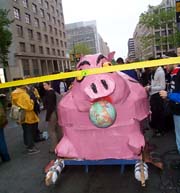
Puppets weave their way from intersection to intersection: A 20-foot three-headed cobra--each head representing a sinister international institution--dances near the White House. One group chains itself to an enormous World Bank pig with a globe stuck in its mouth. A Trojan Horse wheels around on a shopping cart. Hidden in its belly is consumer detritus: Hi-C bottles and fast-food wrappers. Everyone wears a slogan: "Rage Against Sweatshops"; "Viva la Revolucion"; "Fuck the IMF"--or carries a banner. My favorites are: "Globalize This"--illustrated by an extended middle finger--and "IMF and World Bank: Loan in Hell."
A thumping soundtrack of drums and chants (and police helicopters) accompanies the protest. "Ain't no power like the power of the people 'cause the power of the people don't stop!" is a favorite cry. When a street gets quiet, someone invariably starts, "More world, less bank."
The cops observe this revelry from behind the barricades, stone-faced. They are outfitted for violence. All of them wear riot gear. Some are full-on Robocops: They resemble giant arthropods, with every body part covered in segmented plastic armor. Occasionally a team of motorcycles buzzes out from behind a barricade. A police SUV rushes up the street, then squeals to a stop before the crowd, prompting a hail of protester hissing.
But despite the blockades, the chanting, the paramilitary policing, something is missing from A16: the World Bank and IMF delegates. Human chains bar a handful delegates from entering. Throughout the morning, rumors fly that "the delegates are loading into vans, so get ready." But they're nowhere to be seen. At around 8:30, it becomes clear why. News reports begin filtering down to the anarchists. The meetings have started. Almost all the delegates are already inside: They arrived by bus and van at 5 a.m., a full hour before the A16 protesters massed.
There is an important lesson here: In a contest between bankers and anarchists over who can get up earlier, never bet on the anarchists.
A16 organizers try to spin their failure to stop the meetings. "Normally, these guys arrive at the bank in chauffeured limousines," says Patrick Reinsborough of Rainforest Action Network. "But this morning, we made it so they had to be taken in by bus, at four in the morning, like a bunch of unruly schoolchildren."
"It's not a big deal that the meetings have started," echoes Matthew Smucker, another organizer. "Last week no one knew what the World Bank is. Today, everyone does."
At 8:45 a bus tries to break the anarchist lines at 18th and E Streets. Dozens of people throw themselves on the ground in front of the bus. A score of riot cops escorting the bus drag bodies out of the bus's path, yanking anarchists away by their belts and underwear. (Anarchists wear boxers, not briefs, apparently.) The bus, nudging forward to the entrance, misses outstretched legs by inches.
Its path finally seems clear when one last guy flops down and simply will not be dragged out of the way. He seems superglued to the pavement. After 10 seconds, an eternity, Superglue Man is hauled aside, but his persistence has given other demonstrators time to block the passage. The bus driver gives up, reversing away as the demonstrators cheer and hug each other.
A young man next to me observes what no one else seemed to: The bus was empty. One of the day's slogans is: "No one in, no one out, that's what this line is all about!" When the meeting breaks late this afternoon, the anarchists will try to keep the world bankers imprisoned downtown. They couldn't stop the delegates from reaching their meeting, so now they are trying to stop them from leaving it. First they didn't want the meetings to start: Now they don't want the meetings to end.
Come to think of it, this latest tactic may be a sound one: If the World Bank and IMF are like every other bureaucracy--and all evidence suggests they are, only more so--the more they meet, the less they'll do. The protesters should keep them bottled up at their meetings for weeks: By the time the meetings end, the World Bank and IMF will have formed so many new subcommittees and commissioned so many pointless studies that the organizations will have castrated themselves.