Will Robots Steal Your Job?
Software could kill lawyers. Why that's good for everyone else.
Imagine you've been served with a legal complaint. Your startup company makes a very popular widget, and your chief rival, MicroWidget International, is suing for patent infringement. If MicroWidget prevails, you could be out tens of millions of dollars.
You go to your in-house lawyer, who recommends that your company hire a patent expert at Moneybags & Moneybags, LLP. The next day, a brigade of Moneybags lawyers marches into your firm and outlines your options. Defending the MicroWidget case will be costly—in addition to the thousands of billable hours for the attorneys assigned to your case, you'll have to hire expert witnesses and jury-selection specialists, and pay for travel and court filing fees. The total legal bill will be about $5 million, give or take. But Mr. Moneybags, Esq., the firm's ancient senior partner, assures you it will be money well spent—he's worked on many of these cases, he says with a wink, and he's got a gut feeling you'll win this one.

Your other option is to settle with MicroWidget. You could pay a licensing fee of $10 million, which would be painful, but not fatal, to your firm—and it would allow you to go on with your business.
What do you do?
There's no easy answer. The legal industry is one of the few remaining outposts of the corporate world whose operations are dictated mainly by human experience. Basic questions that anyone would want to know before committing to a million-dollar case—How likely is it that I'll win? How good are my lawyers? Should I settle?—can't be answered with certainty. "There's a culture in the law around expertise," says Daniel Katz, an assistant professor at the Michigan State University College of Law who is among the vanguard of legal researchers working to bring empiricism and artificial intelligence into law. "There's a lot of human intuition, and people tend to think that whatever legal knowledge they have is uniquely human, and not subjectable to data and computers and automation."
Katz is working on something he calls "quantitative legal prediction." Thousands of patent cases are filed every year in the United States. There's a good chance, then, that MicroWidget's case against you shares some similarities with a bunch of those other cases. What if you could analyze the key features of MicroWidget's claim, and then see how thousands of comparable cases fared? "Lawyers will be able to say to their clients, 'Here's what we think your chances are—and based on 10,000 cases that are just like yours, here's what the computer thinks your chances are,' " Katz explains.
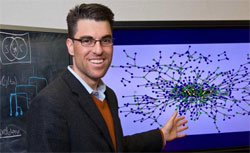
There is no machine that does this today, but it's coming. In the last piece, I examined the technology that's encroaching on journalism—computers are getting so skillful with language that they can now write stories all by themselves. But journalists are small fry; if you want to go after a profession that relies heavily on language, the deep-pocketed legal world is a fatter target.
In the last few years, the law has seen a rush of technological innovation, all stemming from computers' increasing capacity to decipher and understand written documents. Many law firms now use "e-discovery" tools that can scan large caches of evidence in search of interesting facts and figures. Firms also have software to draft legal documents in a fraction of the time a human would take. And a few services on the horizon might do even more—negotiate the terms of a contract, for instance, or determine whether or not you should sue.
Automation will bring legal services to the masses. Many people who ought to hire an attorney to handle business or personal disputes can't afford to do so. Software could potentially step in when you want to fight your mortgage lender, draw up contracts to start a small business, or sue for child-support payments.
While legal automation will be a boon for those who can't afford representation, it's bad news for lawyers. The industry is already in a slump, and law school is no longer seen as a sure path to riches. Because software will allow fewer lawyers to do a lot more work, it's sure to drive down both price and demand.
"In Illinois, where I live, you see vast stretches of unoccupied land—because you no longer need people to farm the corn and soybeans that we grow around here," says Larry Ribstein, a professor at the University of Illinois College of Law who has written several papers on the information technology revolution in law. "When I look at soybean fields now, I think of lawyers."
***
In my article on robots and medicine, I argued that primary-care physicians might survive the robot invasion because their jobs depend on irreplaceably human skills, like the ability to steer a face-to-face conversation. At first glance, the law seems similar: Laws are designed by human politicians and they're enforced by human authorities. When disputes arise, they're settled by human judges and juries. And just about every aspect of the legal world—from the specialized language involved in contracts and complaints to the complex analytical reasoning and reliance on precedent mastered by clerks and judges—springs from the frontal lobes of those strange creatures we call lawyers.
Yet if you look at the tasks most lawyers perform each day, you find many that machines can handle. Language processing, grappling with complex logic, making predictions about situations involving several variables—computers are getting better at all of this stuff.
Consider that most pedestrian of legal tasks: writing up a business contract. In her career, an attorney might design thousands of contracts, many of which contain numbingly similar bits of language. Now, several legal tech companies have created programs that build these documents automatically. These pieces of software work a bit like TurboTax, asking a series of questions and using branching logic to delve deeper into specific areas. Matt Kesner, the chief information officer of the pioneering Silicon Valley law firm Fenwick & West, told me that document-creation programs save its clients time and money. Last year, Fenwick developed a system that automatically creates the documents that startups need when incorporating. "It reduced the average time we were spending from about 20 to 40 hours of billable time down to a handful of hours," Kesner says. "In cases with even extensive documents, we can cut the time of document creation from days and weeks to hours."
E-discovery software has been similarly revolutionary. These systems can mine huge volumes of material (like all the email correspondence in a civil suit) for damning evidence. The simplest software looks for specific keywords, but more sophisticated systems can detect patterns of behavior that might interest lawyers. This was the sort of work that once consumed the lives of first-year associates; now computers do it faster, at lower cost, and with about as much success as humans.
At the moment, human lawyers have one thing on their side: The legal world is generally suspicious of automation, and in some respects downright inhospitable to it. To build his legal-prediction system, Daniel Katz needs a large cache of case documents. But such databases aren't readily available. Courts publish written decisions, but other data—like case filings and motions—are locked in databases like the federal courts' PACER system, which charges a fee for access. Until that information is easier to extract, human lawyers will have an edge.
But just as the rules and regulations protecting human pharmacists won't be around forever, lawyers shouldn't take comfort in today's imperfect databases and software. Katz and other researchers are working on ways to extract and interpret historical data—one project, called RECAP, aims to build a free mirror of PACER. And in some specialized areas of the law, data analysis is already widespread. In 2008, a group of attorneys and technologists at Stanford created the Intellectual Property Litigation Clearinghouse, a project that tracks more than 100,000 patent and trademark lawsuits. The database—which Stanford spun off last year into a start-up called Lex Machina—is the most comprehensive collection of patent suits ever assembled, and it has already helped overturn some bedrock beliefs in patent law. For years, patent attorneys believed that courts in the Northern District of California tended to be friendly to defendants, while courts in the Eastern District of Texas favored plaintiffs—a line of thinking that routinely prompted lawyers to go venue shopping. "But when we checked in the Northern District of California, plaintiffs were winning more on trial—the opposite of conventional wisdom," says Joshua Walker, Lex Machina's CEO.
Stories like these—instances of data analysis revealing errors in human perception—suggest the power of computerized analysis. Lex Machina is still a young project, and at the moment nobody is using the database to make predictions about the outcomes of specific patent cases. Still, you can see how such a system would come in handy in your suit with MicroWidget. At the very least, you could use it to pick your lawyers and to decide whether or not to settle.
Walker argues that something like Lex Machina is designed to supplement human intelligence rather than replace it. By augmenting humans, he says, the database is making lawyers better at what they do. That may be true. But it's also true that systems that help clients decide, systematically, whether or not to sue—and which legal representation to hire, and where to file the case—will reduce the utility of lawyers. None of the legal researchers I spoke to disputed this, but some argued that, in the long run, automation would make being a lawyer more fun. Much of the work that computers are taking on is the stuff that lawyers hate to do. As Daniel Katz sees it, attorneys will be able to outsource the worst of the jobs to machines, while they'll increasingly focus on managing client relationships and ensuring the computers are doing their jobs.
"You'd keep the virtual assembly line moving along—you'd be the maestro moving the stick, in charge of the whole process," Katz says. Not only will automation allow lawyers to escape drudgery, but it will also let them serve more clients. What's more, instead of serving just a handful of high-paying clients, this maestro might be able to use machines to help serve thousands of clients over the Web, providing legal help to those who can't access it today.
If automation brings more people legal services, at lower prices, while also pruning the ranks of human lawyers, I suspect most readers will consider that a win, win, win. And in the long run, this could well be. The trouble is that the path from here to there will be rocky—many firms will be shuttered, an ever-larger number of newly minted young attorneys will fail to find work, and a huge industry's economic prospects will fade.
Still, of all the professions I've covered so far, the prospects for the legal industry seem the least awful. Sure, lawyers will suffer, but the rest of us will benefit. "The law doesn't exist to provide jobs for lawyers," Katz says. "That's not its function in society. It's there to help people solve problems—and if we could serve more people with fewer lawyers, I don't think that's an unreasonable path to take."
As I'll explain next, I uncovered a similar trend in science. Computers may soon decipher some of the fundamental mysteries of nature. Should we care that they might displace humans in the process?