Will Robots Steal Your Job?
You're highly educated. You make a lot of money. You should still be afraid.
Join Farhad Manjoo in Washington, D.C., on Thursday, Sept. 29, for a Future Tense event on robots and the workforce. Manjoo will be joined by Tyler Cowen, author of The Great Stagnation and blogger at Marginal Revolution; Robbie Allen, whose company StatSheet could put sportswriters on unemployment lines; and others. To RSVP for a free ticket, click here.
If you're taking a break from work to read this article, I've got one question for you: Are you crazy? I know you think no one will notice, and I know that everyone else does it. Perhaps your boss even approves of your Web surfing; maybe she's one of those new-age managers who believes the studies showing that short breaks improve workers' focus. But those studies shouldn't make you feel good about yourself. The fact that you need regular breaks only highlights how flawed you are as a worker. I don't mean to offend. It's just that I've seen your competition. Let me tell you: You are in peril.
At this moment, there's someone training for your job. He may not be as smart as you are—in fact, he could be quite stupid—but what he lacks in intelligence he makes up for in drive, reliability, consistency, and price. He's willing to work for longer hours, and he's capable of doing better work, at a much lower wage. He doesn't ask for health or retirement benefits, he doesn't take sick days, and he doesn't goof off when he's on the clock.
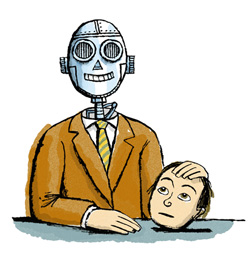
What's more, he keeps getting better at his job. Right now, he might only do a fraction of what you can, but he's an indefatigable learner—next year he'll acquire a few more skills, and the year after that he'll pick up even more. Before you know it, he'll be just as good a worker as you are. And soon after that, he'll surpass you.
By now it should be clear that I'm not talking about any ordinary worker. I'm referring to a nonhuman employee—a robot, or some kind of faceless software running on a server. I've spent the last few months investigating the ways in which automation and artificial intelligence are infiltrating a range of high-skilled professions. What I found was unsettling. They might not know it yet, but some of the most educated workers in the nation are engaged in a fierce battle with machines. As computers get better at processing and understanding language and at approximating human problem-solving skills, they're putting a number of professions in peril. Those at risk include doctors, lawyers, pharmacists, scientists, and creative professionals—even writers like myself.
This is not a new story. People have been fretting about the rise of the machines since Ned Ludd took a hammer to his knitting frames, and probably before. In general, these fears have been unfounded. Yes, better technology sometimes replaces workers in the short run, but over the long march of history, technological improvements have been a key to economic growth, and economic growth improves prospects for workers across a range of industries. Indeed, economists have a name for the popular but misguided notion that technology will displace human workers: They call it the Luddite fallacy, after old Ned himself. To many in the academy, it's an iron-clad law of how economies work.
But this time could be different. Artificial intelligence machines are getting so good, so quickly, that they're poised to replace humans across a wide range of industries. In the next decade, we'll see machines barge into areas of the economy that we'd never suspected possible—they'll be diagnosing your diseases, dispensing your medicine, handling your lawsuits, making fundamental scientific discoveries, and even writing stories just like this one. Economic theory holds that as these industries are revolutionized by technology, prices for their services will decline, and society as a whole will benefit. As I conducted my research, I found this argument convincing—robotic lawyers, for instance, will bring cheap legal services to the masses who can't afford lawyers today. But there's a dark side, too: Imagine you've spent three years in law school, two more years clerking, and the last decade trying to make partner—and now here comes a machine that can do much of your $400-per-hour job faster, and for a fraction of the cost. What do you do now?
There is already some evidence that information technology has done permanent damage to workers in a large sector of the economy. This specifically applies to workers who are considered "middle skilled," meaning that they need some training, but not much, to do their jobs.
Middle-skilled jobs include many that are generally recognized to be antiquated—secretaries, administrative workers, repairmen, and manufacturing workers, among others. Since the 1980s, across several industrialized nations (including the United States), the number of workers in these job categories has been rapidly declining (the pace of the decline increased greatly during the last recession). Instead, most job growth has been at the poles, in professions that require very high skills and earn high wages, and in the service sector, where most jobs require few skills and pay tiny wages.
David Autor, an economist at MIT who is the leading scholar of this phenomenon, calls it "job polarization." Autor identifies a number of causes for the decline of middle-skilled work, including the decreasing power of unions and the declining federal minimum wage. He puts one factor above the rest, however: The rise of information technology.
Video: How real-life robots differ from bots in TV and movies.
Autor argues that middle-skilled jobs tend to have two factors in common—they are composed of lots of tasks that are both routine and geographically portable. What does a secretary do all day? He files, sorts, organizes, watches for calendar conflicts, and in other ways manipulates information. What does a tax preparer do? He asks you a series of questions, and performs some calculations based on your answers. These are all tasks that can be written in software—and, once there, they can be done faster, and more cheaply, by machines. And even when a computer can't completely replace these middle-skilled jobs, it can make them easier to transfer to lower-wage humans—you still need a human being to answer tech support questions, but now you can hire someone in Andra Pradesh rather than Alabama. This decimation of middle-skilled work explains another unsettling trend in American business. New companies today are starting up with far fewer workers than in the past, and they're staying smaller as they grow.
Low- and high-skilled jobs have so far been less vulnerable to automation. The low-skilled jobs categories that are considered to have the best prospects over the next decade—including food service, janitorial work, gardening, home health, childcare, and security—are generally physical jobs, and require face-to-face interaction. At some point robots will be able to fulfill these roles, but there's little incentive to roboticize these tasks at the moment, as there's a large supply of humans who are willing to do them for low wages.
So if computers have already come for middle-skilled workers, and if low-skilled workers aren't an attractive enough target, who's left? That's right: Professionals—people whose jobs required years of schooling, and who, consequently, make a lot of money doing them. As someone who is fascinated with technology, the stuff I found in my investigation of robots and the workforce tickled me. I got to see a room-size pill-dispensing robot, machines that can find cervical cancer on pap-smear slides, and even servers than can write news stories. As someone who likes his job (and his paycheck), what I saw terrified me.

Most economists aren't taking these worries very seriously. The idea that computers might significantly disrupt human labor markets—and, thus, further weaken the global economy—so far remains on the fringes. The only deep treatment of this story that I've seen has come from a software developer named Martin Ford. In 2009, Ford self-published a small book called The Lights in the Tunnel: Automation, Accelerating Technology and the Economy of the Future. In his book, Ford argues persuasively that computers will redefine the very idea of "work" in the modern age.
When I spoke to him recently, I asked Ford about economists' standard rebuttal to fears of automation—the story of the decline of agricultural jobs in the United States. In 1900, 41 percent of the American workforce was employed in agriculture. Over the next 100 years, the technological revolution in farming dramatically increased productivity, enabling fewer and fewer people to produce more and more food. By 2000, just 2 percent of the workforce was employed in agriculture. Yet this shift, which required millions of people to move off farms and acquire new skills, didn't ruin the economy. Instead, by reducing food prices and freeing up people to do more profitable things with their time, it contributed to massive growth. Why won't that happen again with information technology—why won't we all just learn new skills and find other jobs?
"There's no question that there will be new things in the future," Ford says. "But the assumption that economists are making is that those industries are going to be labor-intensive, that there are going to be lots of jobs there. But the fact is we don't see that anymore. Think of all the high-profile companies we've seen over the past 10 years—Google, Facebook, Netflix, Twitter. None of them have very many employees, because technology is ubiquitous—it gets applied everywhere, to new jobs and old jobs. Whatever appears in the future, whatever pops up, we can be certain that IT will get applied right away, and all but the most non-routine-type jobs won't be there anymore."*
Over the next few days, I'll be examining how Ford's predictions are playing out in a number of professions. I'll start by looking at how the people in my own life are being replaced by machines. First, I'll look at my dad's career, pharmacy. Then, I'll examine my wife's line of work, medicine. In my third piece, I'll turn my investigation inward—how will robots replace writers like myself and Web curators like Jason Kottke? I'll end the series with a pair of stories on how machines will change the lives of lawyers and scientists. I hope you read every part—if you're going to outsmart the robots, you'll need all the help you can get.
Correction, Sept. 26, 2011: Due to a transcription error, this article originally misquoted software developer Martin Ford. Ford said that in the future, "all but the most non-routine-type jobs" will cease to exist, not "all but the most routine-type jobs." (Return to the corrected sentence.)