Mark of Distinction
What the Democratic field can learn from Mark Warner.

Friday, Oct. 13, 2006
Family Ties: Any parent can understand why Mark Warner didn't want to leave home before his three daughters. Building a nationwide campaign that takes you to every county in Iowa: $100 million. Never missing your daughters' soccer games: priceless.
Running for president is a wrenching family decision for any politician, but especially for a governor. Senators, by definition, have already chosen to live part of their lives on the road. Some move their families to Washington and spend more weekends than they'd like politicking back in their home state. Some take an apartment in Washington and commute home to see their families from Friday to Monday (when they're not politicking). Only a lucky few, like Tom Carper of Delaware, live close enough to see their children every morning and every night.
Unlike the commuter's life of senators and congressmen, a governor's home life is remarkably normal. Governors work just as hard and campaign just as much, but they live above the store. In most states, the job comes with a mansion—so governors' kids not only still get to see their mom or dad every night, but the state gives them a bigger room and backyard in the bargain. With state helicopters at their disposal, no late votes, and state troopers chauffeuring them at 90 miles per hour, governors can almost always make it home for dinner.
That's one reason most governors wouldn't trade their current jobs for anything, and those who give them up because of term limits or to run for the Senate often wish they could have their old jobs back. When he announced his presidential campaign 15 years ago, Bill Clinton wasn't kidding when he said he was giving up "a life and a job I love." George W. Bush said the same in 2000. In a country suspicious of political ambition, both Clinton and Bush benefited as candidates from the sense that they'd almost rather be governor than be president.
So, John Dickerson is right: Anyone who has spent time around Warner can see why he would rather wave off a presidential bid than say goodbye too soon to his family.
In the first major spin scrum of the 2008 cycle, Warner's decision prompted a mad scramble to declare which other unannounced candidates gained the most from a race without him. Like most preseason handicapping, that's a silly question with no known answer.
The truth is that in the main, every potential candidate stands to lose from Warner's exit. A presidential race is not a cakewalk, where each departure automatically boosts the chances of all the remaining contestants. Nor is it a dinner party with assigned seating, liberals at one table and moderates at another, where one candidate can watch another leave and think, "More wine for me!"
No, the nominating contest is more like a friendly argument—a group effort to answer the same two extraordinarily hard questions: how to get elected president, and what to do for the country. Just as any group discussion suffers from the loss of a voice of reason, the whole Democratic field will miss the smart, sensible voice of Mark Warner.
The most successful presidential candidates, in fact, are those who learn the most from their rivals. In 1992, Bill Clinton gained a great deal from running against smart, sensible primary foes like Paul Tsongas and Bob Kerrey. In the general election, he even benefited from Ross Perot, a nut whose ideas made sense nonetheless.
George W. Bush won the Republican nomination in 2000 by pretending to be a reformer like John McCain and would have been a stronger candidate if he'd actually learned enough to mean it. After the 2004 primaries, John Kerry should have taken Will Saletan's advice to steal John Edwards' message.
At the end of his ill-fated 1988 primary campaign, Al Gore used his concession speech to thank each of his rivals, one by one, for the particular lessons they'd taught him. It was a classy move, only slightly marred by the fact that the field was so large, he forgot to mention one candidate's name and had to learn one last, painful lesson.
As a fiscally responsible governor who understood the importance of questioning orthodoxy, of going after every voter, and of the need to persuade both parties to do what he wanted, Warner had many strengths that would have made the whole Democratic field stronger. In the long run, the candidate who benefits the most from Mark Warner's departure from the race will be the one who best remembers what he would have brought to it. ... 1:02 P.M. (link)

Wednesday, Oct. 11, 2006
Can't Lose:Ask paranoid Democrats their innermost fears going into the midterm elections, and you'll hear two answers. First, that the Foley scandal will force another October surprise to come out of the Republicans' closet: Osama Bin Laden. Second, that on Election Night, Diebold electronic voting machines nationwide are secretly programmed to stop counting Democratic votes as soon as Democrats pull within one seat of taking back the House or the Senate.
Attention, conspiracy theorists: The biggest conspiracy to steal votes already happened. It's called redistricting, and it offers Republicans' only real hope of holding onto the House this fall.
Democrats have never quite recovered from the anguish of watching Al Gore win the popular vote in 2000, only to lose the presidency in the Electoral College. Since 2004, many Democrats have become convinced that rigged voting machines in Ohio cheated John Kerry out of his chance to lose the popular vote and still win the Electoral College.
But you don't need a tinfoil hat to see how much redistricting could cheat an unsuspecting electorate this fall. In every national poll, Democrats now lead the congressional vote by a ridiculously large margin: Newsweek has it at +12 points (51-39), Washington Post/ABC at +13 (54-41), the New York Times at +14 (49-35), CNN at +21 (58-37), and USA Today/Gallup at an unimaginable +23 (59-36)—twice the lead Republicans had before the 1994 sweep.
The election is still four weeks off, and these generic ballot questions are of little value in actual races. Three weeks ago, the same USA Today/Gallup poll had Democrats and Republicans in a dead heat, at 48-48. Mark Foley and Bob Woodward didn't cost Republicans 23 points in one month; more likely, Gallup just happened to interrupt the dinners of a different mix of people.
Even so, the Election Scorecard average of those five polls, all conducted at the end of last week, gives Democrats a whopping 17-point advantage. In a presidential election, a 17-point win would produce a 500+ electoral vote landslide. In 1994, Republicans took back the House by winning the popular vote by seven points—51.5 percent to 44.7 percent—and picked up 54 seats.
Yet even after poring over this week's bleak poll numbers, Karl Rove isn't completely crazy to imagine his party holding onto the House in November. Democrats aren't likely to win the popular vote by seven points, let alone 17. But what's really keeping Rove's dark hopes alive is the Safehouse that Jack and Tom Built—the firewall of safe districts that could enable the Republican party to survive what would otherwise be a China-syndrome political meltdown.
If congressional districts were truly representative, a party that won a seven-point victory in the popular vote would walk away with a 7 percent edge in the 435-member House of Representatives, or roughly a 30-seat majority. For Democrats, that would represent a pickup of around 45 seats.
In a Category 5 political tsunami, anything is possible. But a cold-eyed look at the districts in play shows the tough slog Democrats have, even in a banner year, just to get to a simple House majority.
The RealClearPolitics rankings of the Top 40 House races show how steep the terrain has become. By RCP's count, in order to pick up 10 seats, Democrats will have to carry five districts that Bush won by 14 points or more in 2004, including three that Bush carried by more than 20 points. For a 30-seat gain, Democrats will have to carry 12 districts that Bush won by 10 points or more. Only one of those 30 districts gave a 10-point margin to John Kerry.
That's no reason to discount Democrats' chances of taking back the House in November. In each of the top 30-40 races, it's quite possible to see how the Democrat can win. But Democrats need to remember about the House what we learned the hard way about the Electoral College—even with a popular majority, we still have to run the table.
Tom DeLay traded his career for a mug shot in order to build the Republican majority's most formidable levee, the gerrymander of Texas's 32-seat delegation. In 2005, two big states—California (with 53 seats, more than the 20 smallest states put together) and Ohio (with 18, a number remarkably close to the incumbent Republican governor's approval rating)—trounced fair-redistricting initiatives that would have put more House seats in play.
California Democrats opposed redistricting in order to punish Schwarzenegger. As a result, House Republicans could well survive the worst political year in a generation without losing a single seat in the largest state (and one of the bluest). And because he got pounded at the polls, Schwarzenegger turned himself back into a centrist who's now riding the wave instead of drowning in the tsunami.
Rigged districts defeat the very reason we have a House of Representatives in the first place. The founders wanted one chamber that would be held accountable to the popular will every two years. When the Electoral College is wrong, at least it's a wrong the framers intended.
Thanks to DeLay, conservatives who now want their party to surrender Congress in November may find that they can't lose for trying. The irony is profoundly tragic: A Republican Congress that owed its existence to the term-limits movement went on to build the most absurd system of incumbent protection since the Great Wall of China.
If the GOP somehow holds on next month, voters will have every right to suspect the election was stolen. But it won't do any good to blame machines, when a conspiracy of incumbents did all the stealing. ... 1:54 P.M. (link)
Thursday, Oct. 5, 2006
Surely, You Joust: Already, our polarized country has descended into a Kausfiles-like debate over how House Republicans will pretend to solve the Foley problem. On Monday, I suggested that they build a fence around congressional pages. On Wednesday, Harold Meyerson proposed building the fence around Republican members of Congress. My way's cheaper, but Republicans may prefer Harold's based on its greater potential for government contracts.
Hastert's fellow Illinois Republican, Rep. Ray LaHood, chimed in with another suggestion—abolishing the page program altogether. Nevada Rep. Jon Porter wants to do that, too. John Tierney liked the idea so much, he wrote his whole column in the New York Times about it. (TimesSelect subscription required.)
Meyerson and others have been quick to point out the hypocrisy in the age-old strategy of blaming the victim. But there's a bigger problem with the page ban. While Tierney mocks congressional pages as an aristocratic relic in an age of modern electronic communications, he overlooks the great irony of his own suggestion. If Congress no longer had pages to carry messages, the only way for members to send messages would be to spend more time IMing.
On Mark Foley's very first day in Congress—in January 1995, at the opening session of the Republican Congress swept into office in the 1994 election—the House of Representatives adopted a new rule: "Neither shall any person be allowed to ... use any personal, electronic office equipment (including cellular phones and computers) upon the floor of the House at any time." According to a 1997 House report, the rule was a bipartisan crackdown on the constant "chirping" of pagers and cellphones and other electronic "disruptions and distractions."
That report quoted the first floor speech to air on C-SPAN, in which Rep. Al Gore predicted in 1979 that television would change the House, "but the good will far outweigh the bad." The report then asked "whether the good outweighs the bad in terms of electronic devices on the floor for Member use." One warning stands out as particularly prescient:
"If electronic devices were allowed on the floor it is possible that some Members would be focused on the electronic world. … The chamber should remain the place where lawmakers joust intellectually and politically, free from the presence of electronic 'intruders.' "
Heeding that report, the House didn't amend its rules to permit "unobtrusive handheld electronic devices" in the chamber until January 2003. That appears to be the very same year Mark Foley began living dangerously.
The use of cell phones and laptops is still prohibited on the House floor, along with hats and smoking. House members can vote electronically, but have to meet their other electronic needs elsewhere.
If Congress sent all the congressional pages home, the cell phone and laptop bans would be sure to follow. Both chambers might become a buzzing, chirping jungle. The same institution that once listened in awe to Daniel Webster would sound like Amtrak's Acela train when there are no seats left in the quiet car.
As America is exposed to each sick new IM revelation, the term "PDA" takes on new ironic meaning. Considering how much damage Mark Foley did with an unobtrusive handheld, imagine what he might have done with a laptop. ... 7:28 A.M. (link)
Wednesday, Oct. 4, 2006
I Sink, Therefore IM: Politics is a cruel business. Dennis Hastert has spent seven years just two heartbeats away from the presidency, as the longest-serving Republican Speaker in history—and America has never even heard of him. Almost overnight, Mark Foley has become a household name as the biggest creep in IM history—and Hastert is the one Republicans are taking off their Buddy List.
The last four days should remind conservatives why they wanted to lose Congress in the first place. Even in the best of times, "control of Congress" is an optical illusion. In a political crisis, it vanishes altogether. As Hastert knows all too well, when the shooting starts, you'd rather not be in a foxhole with 230 members in full-scale political panic.
So far, the congressional leadership's effort to put the scandal behind them looks more like a slapstick routine to keep the audience's attention. One after another, congressional leaders have gone out of their way to protect their individual interests by blaming Hastert, while the speaker stubbornly ignores their collective interest by waiting for the writing on the wall to get bigger.
If scandals are a test of political reflexes, the agony of Dennis Hastert shows why Congress's reflexes are so slow and errant. As the center of the political universe, White Houses are far more prone than Congress to be hit by scandals. But as an institution, the White House is also far more likely to survive them.
A White House has three inherent advantages in scandal management. First, it gets plenty of practice. No team makes it to the White House without being tested repeatedly on the campaign trail. In office, the political equivalent of tropical storm warnings are issued every day, and Category 3 political hurricanes or worse happen a few times a year.
Members of Congress and their staffs may be better pols, but rarely get the same chance to stay in training. Most senior members and their staffs haven't seen a competitive race in years. Most congressional crises come in varying degrees of the same category—member gone bad—and lend themselves to the same treatment: Throw out the bad apple.
Second, the White House wakes up every morning knowing a pack of wolves is at the door. Instead of hating its press corps, every White House should be grateful: The pack means you're far less likely to go for a walk in the dark woods, and you're not caught off guard when grandma is eaten. Members of Congress have the opposite problem: They spend their lives competing to get press attention. The average member wants to start fires, not stop them. When 535 Little Red Riding Hoods compete for the same wolf, everybody wants to be the one with the plunging neckline.
Third, and most important, the White House is built to respond to crises, while Congress is built to trip over them. The White House team reports to one chief of staff, and serves one elected leader. While fierce administration infighting may line Bob Woodward's pockets, an administration has the enormous advantage of having its arguments around the same table. Whatever its differences, a White House has to decide on a strategy and hold people to it.
That's why any White House worth its salt rarely loses a congressional showdown. The president not only has the Bully Pulpit, the veto pen, and the nation's captive attention. He also has the ability to chart his own course, and the equally vital ability (too little appreciated by the current president) to turn the ship around when it's headed for the rocks.
With so many interests and so many tables, Congress can't really decide on a coherent strategy, let alone change or enforce it. In times of political crisis, congressional leaders are weakest when they need to be strongest, because they owe their power to the members no longer standing behind them. That's the painful lesson Dennis Hastert is learning this week: The head you roll may be your own. ... 12:17 P.M. (link)
Monday, Oct. 2, 2006
All in the Family: For all its talk of a united base, the Republican Party is an awkward marriage of convenience between two competing camps—economic conservatives and social-issue ones. George Bush promises the moon to both sides, but while business conservatives always get their tax cuts, social conservatives rarely see their wish list (an end to abortion and same-sex marriage) come true.
So, in the battle of conservative degenerates, it's only fair that a social-issue hypocrite like Rep. Mark Foley—rather than a business hypocrite like Jack Abramoff, or a values-for-hire crossbreed like Ralph Reed—would be the one to bring down the Republican House. Voters may have a hard time deciding which is most damning about this scandal—the crime, the cover-up, or the creepiness. But the Foley case proves what social conservatives have been telling economic conservatives all along: There are other sins than greed.
By the time middle America hears the sick-sick-sick details, the Foley scandal promises to be a body blow to Congress' already battered reputation. Only 25 percent approved of the job Congress was doing before the story broke. A do-nothing Congress will seem like the good old days once voters hear that "get a ruler and measure it for me" was Foley's idea of oversight.
The Cunningham, Ney, and Abramoff scandals faded because most voters think everybody in Washington takes bribes and sells votes; a Republican Congress just does it better. Most Americans are not yet to the point that they think everybody in higher office sends sexually explicit IMs to underage male teenagers they met on the public payroll.
What can the Republican leadership do to stop the bleeding? Their opening bid—asking the Justice Department for an FBI investigation—won't do much. The press has already agreed to handle the investigation for them.
To keep this scandal from sweeping them out of office, Republican leaders will have to respond in sweeping fashion. Here's a list of suggestions to help get them started:
1. Convince Dennis Hastert to step down as speaker. His office already had to backpedal from saying he had "no knowledge of" the emails to saying that, if he did, he forgot all about them. Even if that's the truth, it's not much of an excuse, and not one his colleagues or the press will likely let him get away with. His caucus probably would have elected a new speaker earlier this year if Hastert hadn't pledged to retire after the next term. Now, it's a race to see who makes him walk the plank first—his colleagues or the voters. By stepping aside, Hastert could exit the way DeLay did—sacrificing himself to try to save his caucus.
2. Build a fence around the congressional pages. Hey, it worked with immigration!
3. Call members back for a special session of self-flagellation and atonement. The House underreacted to the Abramoff scandals: Congress wouldn't have the lowest approval ratings in decades if they'd passed sweeping reforms to stop lobbying abuses and budget earmarks, instead of fake ones. This might be a good time for Republicans to try overreacting. Pass the political reform measures. Put a long-term freeze on congressional pay. Raise the minimum wage, and make sure congressional pages are covered. Special bonus: The less time members spend back home campaigning, the less they have to answer voters' questions about their friend Mark Foley.
4. Tell FBI agents that they can use the same interrogation techniques allowed under the new detainee bill to uncover the full truth in the Foley investigation. That's a twofer: Voters will either be reassured that the bill must not gut the Geneva Conventions—or be persuaded that Congress must mean business in cleaning up the scandal.
5. Ban instant messaging with minors. Perhaps the creepiest moment in the Foley IMs is when the teenage boy he's harassing has to say "brb" so he can go talk to his mother, then signs off because he has to do his homework. That exchange is every parent's worst nightmare of what goes on in their children's secret online world. Most parents consider IM as the world's biggest waste of time and a high-speed road to ruin. If parents could have their way, Congress would pass a constitutional amendment to ban IMing altogether. But we'd settle for one that just makes it a crime for any grown-up to IM our children.
6. Fire Rumsfeld. Republicans have spent months trying to keep Iraq off the front pages. They finally got their wish. Now the GOP has a month to figure out how to get congressional pages off the front pages. ... 3:01 P.M. (link)
Friday, Sept. 29, 2006
What It Takes: With five weeks left, Democrats and Republicans head toward a coin-flip midterm election with widely different expectations. Democrats could make big, important gains in the House, Senate, and governorships, and still feel shortchanged if neither house turns from red to blue. By contrast, Republicans are so T.O.'d that win or lose, we won't know whether the verdict on conservatism should be attempted suicide or accidental overdose.
Whatever happens on election day, Democrats can take heart that after running lousy campaigns in 2000, 2002, and 2004, Democratic candidates and campaign committees have run a strong one this time. Win or lose, Republicans can take heart that they won't be running in the sixth year of the second-most unpopular Republican administration in history again anytime soon.
What neither side is likely to learn from this election is what it takes to win the next one. For Democrats, 2006 has been the George Bush show, in a way that 2008 will not. For Republicans, 2006 has been the George Allen show—one long experiment to see just how much bad news voters can swallow.
Anyone who wants to find out how to win the next campaign should read Tony Blair's farewell address to the Labour Conference earlier this week in Manchester. Although largely overlooked here in the American press, Blair's swan song is the best political speech of 2006—and the best political memo for 2008.
The British press hailed Blair's performance as "a masterclass in the art of political speaking." It was even harder to top as political theater. For weeks, Labour had been battered by all-out civil war between supporters of Blair and his likely successor, Gordon Brown, who lives over the shop at 10 Downing Street and has waited a decade to take over the family business. On Tuesday, Brown's party conference speech was drowned out by unconfirmed reports that Blair's wife Cherie had walked out in the middle and called the man a liar. When Blair took the podium the next day, he not only gave Brown a ringing endorsement, but delivered one of the great stand-by-your-spouse lines of all time: "At least I don't have to worry about her running off with the bloke next door."
Blair devoted part of his speech to how much New Labour has transformed Britain's economy and politics over the past decade. "The core vote of this Party today is not the heartlands, the inner city, not any sectional interest or lobby," he said. "Our core vote is the country." But Blair expressed more interest in New Labour's future. Far from offering the stale incumbent mantra of "stay the course," his plea was just the opposite—to apply the same tough-minded rigor of reform and change to today's challenges that enabled New Labour to take office in the first place.
In 1997, Blair explained, Britain's problems were primarily British; today, they're primarily global—economic competitiveness, energy, the environment, and terrorism. Blair promised to spend his last year reviewing every policy to see whether it had kept pace: "The danger is failing to understand that New Labour in 2007 won't be New Labour in 1997."
But the real value of Blair's speech is his candid advice on how to win, how to lead, how to think, and how to earn the right to govern. Blair made plain that he was delivering a political memo. "It's up to you," he told his party. "You take my advice. You don't take it. Your choice."
It's a first-rate memo and shows why, for all his recent woes, Tony Blair produced the longest-serving, most successful Labour government in history. The memo makes four main points that any party forgets at its peril.
First, winning is better than losing, so long as it's winning with a purpose. Blair says New Labour got back in the game the moment "we abandoned the ridiculous, self-imposed dilemma between principle and power." These days, some Democrats spend half their time equating winning with unprincipled expediency, and the other half whining about losing. Thanks to Karl Rove, Republicans know how to say or do anything to win, and find themselves wondering whatever happened to their party's principles. It's time to remember that Henry Clay was wrong—the whole point is figuring out how to be right and be president.
Second, make change a tradition. By their very nature, political parties are creatures of nostalgia and habit. But Blair points out that a party cannot stay true to its oldest principles if it is afraid to modernize its policies: "Values unrelated to modern reality are not just electorally hopeless, the values themselves become devalued. They have no purchase on the real world." Blair says he has always loved the Labour Party, but adds: "There's only one tradition I hated: losing."
Third, don't forget to think and believe at the same time. Blair reminds us that the true measure of political courage is not what a party can promise, but what it can deliver:
"The true believer believes in social justice, in solidarity, in help for those not able to help themselves. … But they also know that these values, gentle and compassionate as they are, have to be applied in a harsh, uncompromising world and what makes the difference is not belief alone, but the raw courage to make it happen."
Finally, and perhaps most important, relish the hard choices that come with responsibility, not run from them. Under Bush, Republicans have become far too comfortable in ignoring the country's problems, and Democrats sometimes too comfortable in opposition. As Blair says,
"The danger for us today is not reversion to the politics of the 1980s. It is retreat to the sidelines. To the comfort zone. It is unconsciously to lose the psychology of a governing Party. As I said in 1994, courage is our friend. Caution, our enemy. A governing Party has confidence, self-belief. It sees the tough decision and thinks it should be taking it. Reaches for responsibility first. Serves by leading."
As new threats to our national and economic security emerged over the past six years, we could have used a governing Party here in America. Will we reach for responsibility in 2008? It depends on whether the next president gets the memo. ... 2:49 P.M. (link)
Tuesday, Sept. 26, 2006
Fail-Safe:As Jacob Weisberg explained last week, a growing chorus of conservative pundits has decided Republicans would be better off losing the midterm elections. This widespread conservative death wish casts new light on the Bush record. All these years, we've assumed Bush was running the country into the ground as a matter of principle. But perhaps his administration's penchant for failure is just another way of pandering to the defeatist conservative base.
Conservatives say they want to lose, but can they pull it off? Republicans may have the desire, but can they overcome Democratic strategists' experience and expertise?
To be sure, Republicans have worked hard to lay the groundwork for a big defeat. But national elections are rarely lost solely on the merits. A losing campaign needs a losing game plan.
In that regard, Republicans already seem to have stolen a page from the 2000 to 2004 Democratic playbook. In today's world, it's too risky to rely on a single bad strategy to lose an election. Campaign strategists need a fail-safe backup plan in case something goes wrong and the original losing strategy has to be abandoned.
Republicans know how to devise a losing strategy. Just ask Donald Rumsfeld. But when it comes to elections, they've had trouble switching losing horses in midstream. Sure, the Republican political strategy over the past six years has been deeply flawed—writing off the independent vote, making a mess of America's economic and national security. But instead of panicking down the stretch and improvising a whole new failed strategy, Republicans stubbornly ride it out. Even a bad campaign strategy can look good when everyone sticks to it.
This year, the GOP seems determined not to make that mistake again. Thanks to Tom DeLay's resignation and President Bush's unpopularity, party discipline will no longer hold Republicans back. Bush's low numbers free other party strategists to move out from under the shadow of Karl Rove. Although Rove is fully capable of leading his party to defeat—he nearly blew the 2000 election in the closing weeks, and deserved to lose in 2004—he's not the kind of sure loser who can botch entire elections all by himself.
Free to think for themselves at last, Republicans have already come up with at least three distinct and contradictory losing strategies for 2006. The contradictions alone suggest that together, Republicans can do worse.
The first Republican strategy, coming from the White House, has been to raise the president's profile down the stretch so that the election is all about Bush. Even with the slight uptick in some recent polls, Bush's unpopularity is conservatives' best hope for big midterm losses.
The second GOP strategy, coming from the Senate, has been to remind voters that any Republican voices of reason will be detained and forced to undergo intense negotiations—and that the president himself retains ultimate authority to make sure that moderation is allowed only on a case-by-case basis.
Yet both of these strategies can only carry the GOP so far. Bush's name is not actually on the ballot in November, and some voters may be confused about how to vote against him. Others may see John McCain and John Warner on the news and somehow conclude that what Ron Brownstein of the Los Angeles Times calls "the prudence party" has gained the upper hand in Republican circles.
To be on the safe side, Republicans have come up with a third strategy to lose the midterms: let Congress be Congress. The press loves to focus on Bush's approval ratings, which hover in the high 30s and low 40s. But according to the most recent New York Times poll, Congress's approval rating is just 25%—the lowest since the 1994 election.
Conservatives, rejoice! America hates the current Congress—and unlike Bush, every Republican House member is actually on the ballot.
In recent weeks, growing tensions between the House and Senate have helped remind voters how little Congress has accomplished. With his eye on the Republican nomination, Senate Majority Leader Bill Frist has a particular incentive to give conservatives the midterm spanking they're demanding. With only a week to go before adjournment, he seems poised to deliver a do-nothing Congress well worth losing.
Republicans will need all these strategies, and a national tide, to make their base happy losers in November. If they didn't want Congress, Republicans shouldn't have fought for partisan redistricting that saddled them with so many safe seats.
Of course, if their party fails to lose this fall, conservatives will be quick to blame Democrats. But by fighting back, running hard, and offering an alternative, Democrats are trying to help Republicans take a beating in November. Conservatives are right to put their foot down: If Republicans can't lose this year, they ought to find a new profession. ... 1:17 P.M. (link)
Friday, Sept. 22, 2006
Doppelgänger Schadenfreude: Last we'd heard of my evil twin Ralph Reed, he had just lost the Georgia primary for lieutenant governor. In an ironic twist worthy of O. Henry, Ralph was undone by the immorality of the very Congress and administration he had built a moral majority to elect. Leading up to the primary, Ralph Reed seemed poised to move two heartbeats away from the presidency. The day after, he looked like just another has-been.
Yet this week, as suddenly as he disappeared, Ralph is back. On Monday, he started going soul to soul with Rev. Jim Wallis, shepherd of the religious center-left, in a week-long diablogue on Beliefnet. On Wednesday, Secret Service logs revealed that Ralph and fellow Abramoff profiteer Grover Norquist have been to more than 100 meetings in the Bush White House, including some with the president himself.
Naturally, my initial reaction to Ralph's reemergence was sheer panic. I've known all along that Ralph would rise again, but when that hand suddenly reaches up from the grave, it's hard not to scream even if you see it coming.
In the Beliefnet photo, Ralph is smiling as if those stunning setbacks never happened. If a crushing defeat and national scandal don't break his stride, what kind of life form might we be dealing with?

Once the shock faded, however, I realized that this was no comeback. The White House logs can only mean that Ralph's defense team will pocket more of his ill-begotten gains. Blogging about "what values voters should value most" is another painful reminder of how Ralph lost his primary. The Christian Coalition, once his stock in trade, ran away when they saw the rest of his portfolio.
So Ralph is back, but on the road to perdition, not redemption. The right won't forgive him. The center and left never liked him. His electoral future is grim enough that for the next decade, at least, I can stop worrying that I'm about to be a dead ringer for a bad president.
Now that my look-alike is no longer a threat to ruin my life, I've decided to turn the other cheek. Instead of praying he won't succeed, I have devised the perfect plan for Ralph Reed's resurrection.
Why save a man whose face has haunted me for more than a decade? Because that's the kind of thing evil twins do for each other.
The plan is so devious and cunning, I'm surprised Ralph hasn't figured it out already. It's devilishly simple: suffer like a sinner, apologize like a pope, and sing like a jailbird.
First, the suffering. Ralph has always campaigned on Church Lady sanctimony, while behind closed doors, his e-mails spewed cynical, cold-hearted strategery. Let's face it: America loves sinners, not paper saints. Instead of smiling like an idiot, Ralph should put on a hairshirt and show us how much it pains him to have been the Right Hand of God who grabbed that dirty money.
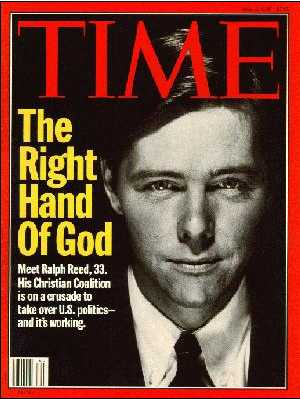
Second, the apology. Lawyers always want their clients to say they did nothing wrong, but voters—especially values voters—want contrition, not legalism. We know Ralph must be sorry—he gave up mighty dreams for filthy lucre. He should say so. Instead of the hollow regrets that doomed his campaign ("Nevertheless, had I known then what I know now, I would not have undertaken that work"), he should bare his soul and say the devil made him do it. Ralph ought to confess to avarice, condemn Washington as a den of iniquity, come clean about his lifelong lust for power, then thank the people of Georgia for voting against him so he can mend his ways before the Day of Reckoning, the only election day that matters.
Third, and most deviously, the stool pigeon. Guilty or not, Ralph should cop a plea and bring the whole administration and Congress down with him. Sure, it sounds crazy and counterintuitive to rat out every Republican from President Bush to Grover Norquist. But Ralph has nothing to lose, and someone has to throw the moneychangers from the temple. For the left, he can aspire to be the next John Dean, an overnight sensation with an overnight salvation. For the right, he can be the next Charles Colson, ministering to the wayward and preaching the virtue of forgiveness.
Ralph may well be innocent of any wrongdoing, apart from hypocrisy and greed. But considering how badly the primary went, why take chances with another jury? In return for immunity from prosecution, tell the story of the whole sordid enterprise. Better yet, pick a televangelist and spill the beans on the 700 Club or in the Crystal Cathedral.
Of course, it may be a long, hard road from the confession booth to higher office. But I can bring myself to forgive and forget—and if takes Ralph Reed decades to clear our last name, I, for one, am willing to wait. ... 11:55 A.M. (link)
Friday, Sept. 15, 2006
The Aspens Are Turning: In today's column in the Wall Street Journal's OpinionJournal.com, Reagan-Bush speechwriter Peggy Noonan writes that autumn is the time to turn over a new leaf: "My resolution is to try in a renewed way, each day, and within my abilities, to be fair."
In that spirit, Noonan acknowledges that most Americans have stopped listening to George Bush, that he might well be "a catastrophe," and that it's exhausting to watch "this historical drama queen." She even adds, albeit not very convincingly, "I like Democrats."
Then, Noonan promptly predicts that Democrats will lose the election because it's all about Bush. "Familiarity doesn't only breed contempt, it can breed content," she writes even-handedly.
Her article is titled, "To Beat a Man, You Need a Plan." Apparently, the same strategy is needed to beat a drama queen. Noonan concludes, "If you're going to turn away from him, you'd better be turning toward a plan, and the Democrats don't appear to have one."
But, wait—Democrats do have a plan. We even call it The Plan. I guess in that same spirit of friendship, Noonan will have to turn over a new leaf and predict a sweeping Democratic victory. We haven't been friends for long, but it's only fair. ... 1:36 P.M. (link)
Thursday, Sept. 14, 2006
Not a Wimp, But a Seeker: President Bush will be thrilled to learn he's not the only one who sees America in the midst of a spiritual awakening. So does Newsweek. This week's issue even agrees with Bush that the '60s made it happen. The only difference is that while Bush says the '60s sparked a conservative Christian backlash, Newsweek says George Harrison, Sun Myung Moon, and easy access to drugs launched Boomers on a lifelong spiritual journey.
The magazine suggests that when it comes to finding their way through the wilderness, Moses, Jesus, and Mohammed had nothing on Boomers:
Americans who came of age in the 1960s were the first generation born in the shadow of the atom bomb; just awakening each morning was something to be thankful for. But they were also the first generation born into mass affluence, for whom material sustenance and comfort were a given, a situation that breeds spiritual hunger. So in addition to everything else the baby boomers were known for—political activism, sexual freedom, Yuppie careerism and a taste for expensive imported cheese—they have also distinguished themselves as what the sociologist Wade Clark Roof calls, in the title of his 1993 book, "A Generation of Seekers." To be sure, followers of the maharishi, or the Rev. Sun Myung Moon, or Hare Krishnas, Scientologists or the people who called themselves Jesus Freaks were a minority among the boomers. "But they were the trendsetters," says Dean Hoge, a sociologist at Catholic University of America. "They were the cultural innovators."
Mamas, don't let your babies grow up to be sociologists. The article goes on to explain how the largest generation in American history came to believe that prayer and faith were old-fashioned compared to "chanting and peyote." Inspired by Transcendental Meditation, Boomers then "wrought another, subtler shift on American religion, turning it from a preoccupation with salvation in the next life to fulfillment in this one."
"What fueled this restless impulse for self-transformation?" Newsweek asks. Its answer – drugs, of course: "Drugs opened users' minds to the subjective nature of reality and the shortcomings of reason as the only path to truth."
But even a boomer-based newsmagazine can't embrace drugs as the only answer – Tom Cruise and other Scientologists might be watching! So Newsweek reminds us, "Drugs alone are a spiritual dead end." Side effects may vary, so be sure to consult your pastor.
The magazine even credits Boomers' willingness to question authority with cleaning up the Catholic Church: "Would the sexual abuse of children by priests have come to light if the 1960s had never happened?" By Newsweek's count, the '60s are pretty much a wash, launching one sexual revolution but ending another.
Newsmagazines love writing about the Baby Boom, and religious covers also are big newsstand sellers. So it shouldn't surprise us that sooner or later, a newsmagazine would get peanut butter in its chocolate.
But it's hard to look at religious belief in America today, and give celebrities and Boomer icons the credit. Christianity's current lead over Scientology is about 224 million to 77,000, which means that despite TomKat's efforts to catch up, the children of the children of the '60s are still mostly heading off to Sunday school.
For the most part, the Baby Boom is following the same faiths as our parents – if anything, in greater numbers. Which makes it all the more curious that Newsweek would end its story with this parting thought about Boomers:
Their journey has been an eventful one, and in the coming years they will, in increasing numbers, be preparing for the event that used to be called meeting one's maker. They must be curious to know which one it will be.
"Used to be called"? "Which one"? Relax, aging flower children. Your doctor can probably prescribe something. ... 4:17 P.M. (link)
Wednesday, Sept. 13, 2006
Wake-Up Call: As if stagnant incomes and a sputtering foreign policy weren't giving Republicans enough troubles this fall, President Bush revealed yesterday that under his watch, one of America's great awakenings has gone missing. First, the Bush White House lost track of Osama Bin Laden. Now, they've lost count of America's religious revivals.
In an Oval Office conversation with conservative journalists, Bush suggested that despite its current tribulations, the right will triumph in The End. According to National Review editor Rich Lowry, Bush told his fellow travelers:
"Cultures do change. … Ideological struggles are won, but it takes time. It just takes time. You look back at the '50s, I don't know how evident it was that—I guess there was—when you think about it, there was a pretty stark change in the culture of the '50s and the '60s. I mean, boom. But I think something is happening here."
Stephen Stills, call your agent! But as it turns out, Bush was just quoting the '60s, not predicting their return. The president was making a broader point, although what it is ain't exactly clear:
"I'm not giving you a definitive statement—it seems like to me there's a Third Awakening with a cultural change. And it would be interesting to get your observations if that is accurate or not accurate. It feels like it. I'm just giving you a reference point, if this is something you're interested in looking at. It feels like it to me. I don't have people coming in the rope line saying, 'I'd like a new bridge, or how about some more highway money.' They're coming to say, 'I'm coming to tell you, Mr. President, I'm praying for you.' It's pretty remarkable."
Of course, if Americans are looking for more than just a new bridge or some highway money, perhaps they should pray for a new Congress.
But Bush's quest for meaning is understandable. When times are tough, people count their blessings. When presidencies are tough, presidents count their awakenings.
Who's Counting: Unfortunately, while Bush's faith is admirable, his arithmetic—as usual—is not. Most historians and religious scholars agree that America has already been through at least Three Great Awakenings, or revivals of religious piety. Some scholars insist that we've had Four:
The First Great Awakening took place in the mid-1700s, during the heyday of Jonathan Edwards, of fire-and-brimstone (not Two Americas) fame.
The Second Great Awakening, led by New Englanders like Harriet Beecher Stowe's father Lyman Beecher, helped fuel the abolition movement. Bush alluded to that awakening yesterday, suggesting that his base was a lot like Lincoln's—Abraham, not Chafee. Just as many of Lincoln's strongest supporters were deeply religious people "who saw life in terms of good and evil" and slavery as evil, Bush said his strongest supporters feel the same way toward terrorism. The Mormon Church also emerged during this period but went on to become part of Bush's base, not Lincoln's.
The Third Great Awakening, in the late 19th century, helped fuel the social reforms of the Progressive Era and emboldened reformers of all stripes, such as William Jennings Bryan, Carrie Nation, and Mary Baker Eddy. Bush did not claim any of them as his base.
But many historians, scholars, and people of faith aren't willing to stop at three. In 2000, Nobel Prize-winning economist Robert Fogel wrote a book called The Fourth Great Awakening, which described the rise of evangelical Christianity since the 1960s and the emergence of the Christian right, and suggested that it might lead to an egalitarian backlash. For those keeping score at home, here's Fogel's clip-and-save chart of Great Awakenings.
That same year, longtime Slate favorite Hanna Rosin made a persuasive case that as Great Awakenings go, today's religious ferment doesn't hold a candle to "the one in which nineteenth-century New England teemed with religious prophets and the quest for the supernatural in everyday life lasted a generation."
"I Mean, Boom": If the 1960s kicked off our Fourth Great Awakening, why is Bush so tentative in hinting to the press corps that maybe, just maybe, we might be starting our Third?
Bush is like an evangelical Dr. Evil, the villain in the Austin Powers movies who was cryogenically frozen in the 1960s, thaws out three decades later, and tries to shock the world by demanding "one million dollars!"
Which Great Awakening is the president rubbing out? Does he discount the First, which helped put "endowed by their Creator" in our Declaration of Independence and "In God We Trust" on our coins? Does he refuse to recognize the Third, which led to Prohibition as well as William Jennings's Bryan's last stand for creationism?
Does he share the Rosin view that Pat Robertson and Jerry Falwell are no Nathaniel Taylor? Or the Plotz view that there are just too many Numbers? Or is Bush simply speaking in some secret exurban code, trying to trump the longstanding appeal of Bill Clinton's Third Way with his own Third Awakening?
You're in our prayers, Mr. President. But next time we see you in the rope line, we'll demand a recount. ... 5:42 P.M. (link)
**Big Sleep Update: Learned reader and coin aficionado Jose points out that "In God We Trust" was added to U.S. coins during the Civil War as a result of the Second Great Awakening, not the First. Shortly after an impassioned plea from a Pennsylvania minister, Lincoln's Treasury Secretary Salmon Chase ordered the director of the mint to express America's trust in God in the "fewest and tersest words possible."
Francis Scott Key had conveyed the same notion years earlier in the last verse of "The Star-Spangled Banner": "And this be our motto: In God is our trust." Key wrote that anthem in 1814, between the First and Second Great Awakenings. Whatever we want to call such periods in the national REM cycle when the country wasn't awakening—Great Asleepenings?—Key had an excuse: He'd been up all night. ... 10:29 P.M.
Tuesday, Sept. 12, 2006
Base Knock: For the past year, disgruntled conservatives have given a host of reasons why President Bush is having trouble motivating his base. They complain that he spends like a drunken sailor. He never met a war he could win. He's an incompetent panderer, and if he really cared about the base, he'd be a competent one.
But the most overlooked reason for Bush's lackluster Republican support was on full display in his Oval Office address last night: He has become boring.
Except in moments of crisis, most Americans would offer the same basic advice to their presidents about prime time: If you can't say something new, don't say anything at all. To the country's increasing chagrin, the Bush White House has a different philosophy—that voters are no match for the numbing repetition and discipline of the Bully Pulpit.
That's why the president spent 17 minutes on Monday night giving more or less the same speech he has given on many prime-time occasions before. With Michael Gerson's departure to become a syndicated columnist, the quality of Bush's imagery has slipped. Last night, he looked forward to the day "when the people of the Middle East leave the desert of despotism for the fertile gardens of liberty"—which sounded more like ad copy for a Dubai desalination plant.
Stone Soup: But in every other respect, the speech tilled the same familiar ground. Bush referred to resolve four times. He promised to find Bin Laden and bring him to justice—one day after the Washington Post reported that our search party "has not received a credible lead in more than two years" and the trail of the greatest manhunt in American history has gone "stone cold." Most Americans have heard that speech so many times, they wouldn't be surprised if it bored Bin Laden.
Even the conservative echo chamber is tired of its own echo. As John Dickerson points out, most Republican candidates—worried about being banished to the political wilderness—don't have the patience to hum along when Bush promises to rain democracy on the Middle East.
The White House has run up against the same problem that plagues horror-film sequels. If the whole point is to scare people, that gets harder to do when they think you're just boring.
Back in the day, the Bush team understood the element of surprise. Before the president's Oval Office address in May 2002 endorsing the creation of the Department of Homeland Security, only a handful of his own aides knew what was coming. It turned out to be by far the dumbest idea Bush ever stole, but at least it was a new one.
The headline of today's Post analysis declares, "President Tries to Win Over a War-Weary Nation." If that's the strategy, it's bad enough that Bush spent the one day of the year when he didn't have to talk about his troubles in Iraq doing exactly that.
But the White House needs to recognize that above all, the country and the conservative base are Bush-weary. Unless the president is going to advance the ball, even Republicans would just as soon he didn't interrupt the football game. ... 2:08 P.M. (link)
Monday, Sept. 11, 2006
The Mother of Invention: For all the partisan suspicions about tonight's prime-time presidential address, the timing couldn't be more perfect. On ABC, the speech will run smack in the middle of the Bush episode of the network's crockumentary, "The Path to 9/11." That means that for the first time in history, an Oval Office address will be preceded by repeated viewer warnings that it has been "fictionalized" for "dramatic and narrative purposes."
All these years, we may have been judging the administration by the wrong standard. For a democracy, the Bush White House makes a lot of stuff up – but they prefer to think of themselves more as a docudrama.
In a brief talk at the World Trade Center last night, the president sounded the themes he no doubt will return to tonight. He spoke of approaching 9/11 "with a heavy heart." He called it a day of remembrance, healing, and renewed resolve: "It just reminded me that there's still an enemy out there that would like to inflict the same kind of damage again."
Remembrance, healing, and resolve are welcome virtues, and this anniversary should be a day of somber reflection. But if, at this late date, the president wanted to become an agent of healing rather than division, he would use tonight as an opportunity to give a different speech.
Unresolved: For five years, George Bush has delivered the same, numbing message: "all resolve, all the time." The White House long ago chose to stress character over results. The president and his advisers believe that the more they tout their resolve, the fewer problems they actually have to resolve.
If Bush had his way, he would change the back of the one-dollar bill to drop "Novus Ordo Seclorum" – the Latin inspiration for his father's "New World Order" – and replace it with his own national security motto, "Wibli Vibrant Non Cadunt": "Weebles Wobble, But They Don't Fall Down."
White House councilor Dan Bartlett explains in today's Washington Post that "there is an inherent contradiction" between Bush's two messages – that Americans should return to their daily lives and leave it to the president to watch their back in the war on terror. Bartlett unwittingly puts his finger on the fundamental flaw in the administration's approach. By making the post-9/11 era a test of his character rather than ours, Bush is betting on the wrong horse. His message is never, "Ask what you can do for your country," but rather, "Ask me what I can do for you." Inevitably, the answer turns out to be a disappointment.
Tonight, Bush ought to move beyond resolve, reflection, and remembrance, and ask the country for something more. Last week – and in most of the 250 weeks before that – Bush gave partisan speech after partisan speech about 9/11. If he wants to prove that this prime-time address is any different, he should find a way – any way – to ask us to make more of our daily lives, not just return to them.
Challenges, Not Promises: America would be far better off today if the president had used the aftermath of 9/11 to seek patriotic rather than partisan advantage. The irony is that Bush would be immeasurably better off as well.
It's probably too late for him, because he doesn't realize that it's not about him. But it isn't too late for us. And as one of the most unpopular presidents in history, Bush has precious little left to lose. For example, if tonight he issued a rousing challenge for Americans to cut gasoline use in half – and actually offered the policies that would enable them to do so – it's even possible a few voters might give him another look.
We now know Bush is a voracious reader who plows through three Shakespeares in a single summer. This evening, if the president followed our suggestion to ask all young people between the ages of 18 and 25 to perform three months of universal civilian service, Rahm Emanuel and I would be glad to send him a free copy of our book, The Plan.
But more likely, Bush will leave it to his successor to summon America to an historic and higher calling. Someday America will have a real 9/11 president. For now, we'll have to settle for the fictional version. ... 1:47 P.M. (link)
Friday, Sept. 8, 2006
Surprise Party: George Bush may have caught some in his own party off guard with Wednesday's September surprise challenging Congress to pass legislation to help him put the 9/11 masterminds on trial. Some Republicans are still using the GOP's 2004 talking points, when Bush ran ads insisting that only wimps think terrorism is a law enforcement matter. Others—like Sens. John Warner, John McCain, and Lindsey Graham—have been busy drafting an alternative because they think the administration's approach won't stand up in court.
Most congressional Republicans have a more fundamental objection to the president's challenge: The last thing they want to do is stick around here debating constitutional niceties when they need to wrap up this session of Congress and rush home to save their seats. Republicans already knew the Bush administration was running a secret prison: For embattled incumbents, the Republican Congress has become one.
But Republican members who don't want to spend the last "working" month of the 109th Congress actually working can relax: The Bush White House probably doesn't want them to get a bill done, either. According to the Rove playbook, this legislation will do more to motivate the conservative base if Republicans can blame Democrats for obstructing it.
As Ron Brownstein suggests in the Los Angeles Times, the White House may want to reprise its 2002 September surprise, when Republicans refused to reach agreement over an obscure civil service provision of the Democrats' homeland security bill so they could run attack ads claiming Democratic incumbents were against homeland security.
Mustn't Pass: In years past—especially election years—September and the first part of October have been the congressional equivalent of finals week: a brief flurry of frenzied activity after an otherwise wasted year. This trend intensified in the last few years of the 1990s, when the Republican Congress grew so tired of losing policy debates to Bill Clinton that it refused to take up anything all year except the must-pass annual appropriations bills required to avoid another government shutdown.
Ironically, this strategy put Republicans in the weakest possible bargaining position, trying to enact their conservative wish list just weeks before members had to face an electorate that wanted Congress to do just the opposite. After caving to Clinton's demands right before the 1998 midterms, Republicans figured out a way in 2000 to avoid the voters altogether, by putting off the must-pass bills until a brief lame-duck session after the election. Conservatives weren't kidding about government efficiency: Why spend a whole year on a do-nothing agenda when you can finish it in one day?
Even with one of their own in the White House, the Republican Congress seems determined to seek still greater efficiencies. Republican leaders spent August holding field hearings designed to prevent an agreement on immigration. They're advertising their own internal differences on domestic surveillance, perhaps to lay the groundwork for gridlock on that front. They'll probably postpone any tough must-pass appropriations until after the election—when a lame-duck session may have more lame ducks than usual.
Bush's Wednesday gambit was the latest adlib in this year's improvisational conservative comedy, "Whose Fault Is It, Anyway?" For the last several months, most Republican incumbents in tough races have worked diligently to distance themselves from the Bush White House. From Bush's troubles abroad to his agenda at home, the Republican message to voters is, "Don't blame me—I just work here."
Understandably, the White House has a different approach. Never mind that Republicans in Congress are the biggest obstacles to Bush's agenda on immigration and military tribunals. This White House wants voters to believe that if illegal immigration has ballooned on its watch, and Republicans can't pass a bill to address the problem, it must be Democrats' fault.
Madmen Theories: Ironically, the president might do his party's incumbents more good by accusing Republicans of obstructing his agenda. That would free the Republican leadership to carry out the Mickey Kaus ploy on immigration—by scaring voters into thinking that a Democratic Congress might pass the Bush plan.
If Republican incumbents can't persuade Bush to attack them, they could turn to their own mad scientist, Dick Morris—an old master at pitting one branch of government against another. In his column in The Hill on Wednesday, Morris gave his fair and balanced view of the 109th in action:
"This has been, truly, the do-nothing Congress of all time!"
Morris offers an excellent critique of this Congress's many failures—whiffing on ethics reform, setting records for earmarks, raising student loan rates—but focuses principally on its refusal to enact the Bush agenda of immigration and Social Security reform. As it happens, those are precisely the two issues that endangered Republican incumbents most want to convince voters they opposed.
At last, we can imagine a simple 30-second message for Republican incumbents to put in their October ad buys:
"My Democratic opponent claims she'll block the Bush agenda, but talk is cheap. If you want to make sure nothing gets done in Washington, you need a congressman with the experience to make nothing happen. Unlike my opponent, I don't have my own agenda, and I'm not afraid to drag my feet on the president's or anyone else's. Vote for me, and I won't just promise to do nothing all the time – I'll give you the do-nothing Congress of all time." ... 12:08 A.M. (link)
Friday, Sept. 1, 2006
There's No "We" in Team: If George Bush has his way, the Republican message for the fall elections will be the banner headline from this morning's Washington Times: "We Have Resolve." Republicans who are actually on the ballot this fall have a different message: "What do you mean 'we,' kemosabe?"
Frightened of Bush's unpopularity, Republican congressional leaders have spent the past year attempting to localize the midterm elections. With more than two-thirds of Americans convinced the country is going in the wrong direction, GOP incumbents are desperate for an alibi: Members say they were so busy bringing home the bacon, they were nowhere near the scene of the crime.
Until recently, Bush played along with that strategy, ducking into states and districts to raise campaign money but otherwise keeping his head low. This week, however, the White House shifted gears. Bush is giving a series of thinly veiled campaign speeches designed to nationalize the election around the administration's favorite theme—that if Democrats were in charge of the war on terror, we'd all be speaking French.
Muscular co-author Rahm Emanuel smartly parried Bush's thrust yesterday by calling for a no-confidence vote on Defense Secretary Donald Rumsfeld, the runaway winner in any secret ballot on "who lost Iraq?" Instead of just putting Democrats on the spot, the White House campaign forces Republican incumbents to make a fundamental strategic decision about whether all politics is local—or global.
Run Away!: Judging from the early returns, the smart Republicans aren't taking the White House's bait. John McCain, who said long ago he has "no confidence" in Rumsfeld, used a campaign appearance for Ohio Sen. Mike DeWine to criticize the administration's handling of Iraq. As John Dickerson reports, Rudy Giuliani—who is courting the conservative base—went out of his way to warn against waving the partisan shirt in wartime.
One of the most embattled Republicans in the country, Arnold Schwarzenegger, is running so far away from Bush that he spent the week letting Democrats give California its own foreign policy by enacting a landmark plan to cut the state's carbon dioxide emissions.
White House strategists no doubt believe their gambit will work this time because it worked before, in both 2002 and 2004. As a certain wildly overhyped book points out:
Rove invented a perpetual-motion machine: Republicans fail on national security, which invites Democratic criticism, which lets Republicans attack Democrats for lack of resolve, which buys Republicans more time to fail on national security.
Off the record, White House aides might also argue that they have no other choice—in most polls, national security is just about the only issue where Democrats don't have a substantial lead.
It's the Perfect Way to Hide: But the real reason for the White House strategy may be more basic: An all-politics-is-local campaign would leave the president with nothing to do. Bush rightly considers himself one of the best campaigners on the Republican side and doesn't want to spend his last campaign as little more than fundraiser-in-chief.
As a result, the president is like King Arthur's trusted servant Patsy in Spamalot. While Republican incumbents everywhere try to sing, "I'm all alone," Bush keeps interrupting to say, "Oh, no, you're not … I'm here, you twat!"
Individual Republicans in tough swing districts will still try to run local races and pretend they've never met either Jack Abramoff or the president. But the new White House strategy virtually guarantees that voters will see the midterms as a national election. These days, nothing could do more to test Republicans' resolve than hearing Bush say, you're either with us or against us. ... 12:33 P.M. (link)
Wednesday, Aug. 30, 2006
Tale of the Tape: Forget the Census Bureau's report on income and poverty and the College Board's report on declining SAT scores. The only one number from today's papers that George Bush cares about is in the Style section: Just weeks after the aging president's annual physical revealed that his weight, body mass index, and body fat all ballooned last year, Karl Rove is running around boasting that a liquid diet has helped him lose 22 pounds.
In the Bush White House, lying about leaking was no big deal. But one-upping this president's waistline? That's the kind of offense that could get even Rove fired.
He'll be lucky to last till suppertime. An ABC News headline after the president's physical asked, "How Much Is Too Much: Is the President Too Chunky?" and included Bush in a photo essay on "Famous 'Overweight' Men." The Washington Post headline on Rove's diet declared, "'Leaner and Meaner' Rove Has Less Weight to Throw Around."
The president wants to run a tight ship. But any empire builder like Bush must be familiar with Julius Caesar's famous words:
Let me have men about me that are fat;
Sleek-headed men and such as sleep o' nights:
Yond Cassius has a lean and hungry look;
He thinks too much: such men are dangerous.
Over the years, presidential candidates have surrounded themselves with political consultants of Caesar's description – Roger Ailes, Dick Morris, Bob Shrum—although lucrative commissions may have shaped those men more than Caesar's warning. But even in America's thinner days a century ago, the very first political consultant—Rove's lifelong hero, Mark Hanna—was widely mocked for his girth. While the phrase didn't appear until two decades after his death, Hanna may well have been the original "fat cat."
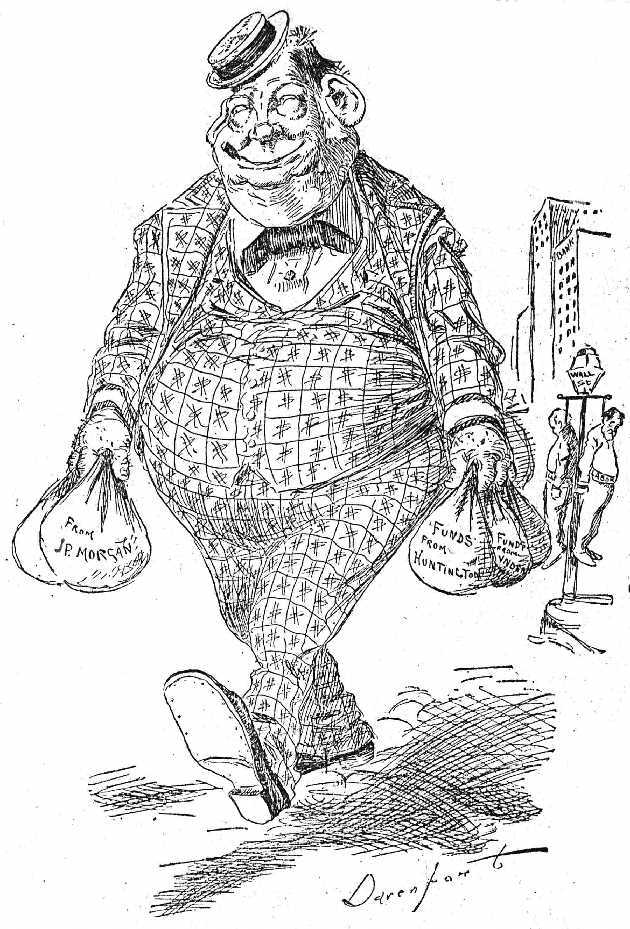
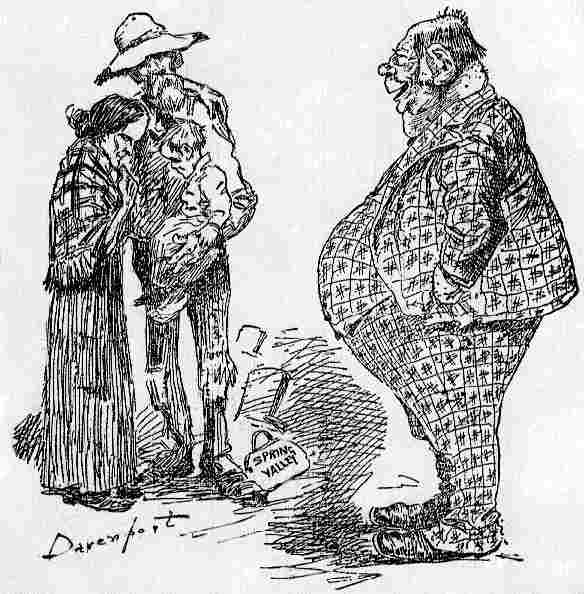
"I Shamelessly Promoted The Planand Lost 80 Pounds": Characteristically, Rove appears to have concealed key details, such as body fat, BMI, and how much he weighed before he started losing. Rove's diet claims are a bit like Bush's claims on the budget deficit: it's easy to declare victory when you get to make up your own base line. As Rahm Emanuel and I write in our new book, The Plan, "No one should take seriously a political platform that promises more and expects less, any more than a diet book that says eating more and exercising less is the way to lose weight."
But apart from the sheer cheek of Rove's weight loss, what must concern Bush most is the way he lost it: a liquid diet. Bush gave those up years ago—and you don't have to be Gail Sheehy to assume that bad experiences with drinking spurred the president to become a fitness nut in the first place. (Rove doesn't help by attributing his success to "clean living.") More to the point, Bush must sneer at liquid protein shakes—rather than exercise – as the wimp's road to weight loss.
The Architect: If Rove is Bush's guru, Rove's guru is Dr. Arthur Frank, medical director of the obesity management program at George Washington University and a widely quoted expert on weight loss. Wait till conservatives find this out: Karl Rove's diet doctor seems to support a Twinkie tax.
In a 1999 piece called "Time for a Twinkie Tax?", U.S. News reported that Dr. Frank was "joining the call for the Pillsbury Doughboy's head." "We are losing the battle," Frank said. "It may be time for a last resort." Last year, in a Washington Post online discussion, Frank appeared to agree with a questioner's suggestion about advertising restrictions and Twinkie taxes. "We have to change the world of sloth and superabundance," he said.
Frank is also treasurer of the American Obesity Association, which holds a number of policy positions that won't endear Rove to Bush. The group wants a congressional investigation into whether the No Child Left Behind Act increases childhood obesity, supports making federal projects submit "Human Physical Impact Statements" similar to Environmental Impact Statements, and worries that American culture is making immigrants fat.
Rove's only hope: tell Bush that in 2002, the association helped convince the IRS to allow tax breaks for obesity treatment. So in the long run, the Twinkie tax is actually revenue neutral.
Keep Your Mouth Shut: Of course, if Dr. Frank had his way, Rove would never have blabbed about his weight loss to begin with. As Frank told the Post's "Lean Plate Club" just last month, many patients make the mistake of advertising their success because "they think it will help to keep them on the straight and narrow," then can't handle the pressure once everyone around them starts judging their every bite. "It's better not to get other people involved unless they have to know," he says—proving that Rove's diet doctor might have done an even better job as Rove's lawyer.
Frank and his colleagues direct successful patients to what sounds like another conservative nightmare, the National Weight Control Registry. Indeed, Rush Limbaugh may already be on the airwaves with the warning, "If food is outlawed, only outlaws will have food."
But so far, the National Weight Control Registry only wants to know your weight if you've lost more than 30 pounds and kept it off at least a year. They're not interested in Karl Rove; they have their eye on Arkansas Gov. Mike Huckabee.
The registry uses its members to conduct studies on what separates dieters who put weight back on from the one in 20 who succeed in keeping it off. Last year, Oprah magazine reported on the registry's "potentially groundbreaking study" into how dieters think. The study found that success depended on which quadrant of the dieter's brain was dominant.
Rove is often called "Bush's brain," but which quadrant? Judging from the study's description, he's clearly not the upper right ("strongly visual and easily bored, attracted to new ideas, fun, and risk taking") or lower right ("emotional, spiritual, and focused on people and human connection"). He would seem to be closest to the upper left ("analytical, mathematical, logical problem solvers" who are "drawn to statistics and the workings of machinery").
Scales of Justice: The study suggests that the quadrant successful dieters need is the lower left: "Punctual and neat, they always have a plan, timetable, and calendar with appointments penciled in." That's bad news for Rove. The only way he dodged indictment was by claiming to forget which reporters he talked to when. If he keeps the weight off, we'll know he hid his lower left quadrant from the special prosecutor to save his own skin.
But just in case Rove was telling the truth, the Oprah article spells out how absent-minded dieters can train themselves to become lower-left-brained, through a three-week regime to "bolster your inner bookkeeper."
Step One: "Begin with organization. Alphabetize your CDs, then, a few days later, your spices. A few days after that, rearrange your closet, then your tax papers." Step Two: "Keep a time log of your daily activities." No wonder the Fitzgerald report sold so well—it doubles as a diet.
But poor Karl Rove may never get that far. The president may want to help his old friend stay slim by giving him a little extra work on Step One: clean out your desk and organize your walking papers. ... 3:31 P.M. (link)