The Supreme Court Shortlist
The views of the likely candidates.
Justice Sandra Day O'Connor announced Friday that she is stepping down from the Supreme Court. In anticipation of resignations—Chief Justice William Rehnquist's had been thought most likely—the Bush administration has floated several names for possible nominees. What views have the president's shortlisters expressed, on and off the bench? In order of our best guess as to the likelihood that they'll be chosen, here's a guide to the prospective nominees' records.
Michael J. Luttig
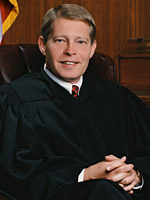
Age: 51 Graduated from: University of Virginia School of Law. He clerked for: then Judge Antonin Scalia, Chief Justice Warren Burger. He used to be: White House assistant counsel for Ronald Reagan and in the Justice Department during the administration of George H.W. Bush. He's now: a judge on the U.S. Court of Appeals for the 4th Circuit (appointed 1991).
His confirmation battle: Luttig is often cast as a mini-Scalia. The characterization fits him well. In his judicial opinions, he sometimes rejects the statesman model in favor of cutting sarcasm and has shown a tendency to adhere to his own restrained method of judging even on the rare occasions when it leads him to unpopular or anti-conservative positions. Fairly or not, Luttig watchers invariably speculate as to whether a personal tragedy in his past—the murder of his father in a carjacking in 1994—has influenced his approach to criminal law.
Civil Rights and Liberties
Voted unsuccessfully for the full 4th Circuit to rehear the case of Yaser Esam Hamdi, an American citizen captured in Afghanistan and held as an enemy combatant in the United States. The panel opinion (written by J. Harvie Wilkinson III) denied Hamdi's claims by deferring to the power of the president, while at the same time preserving a limited role for judicial review. Luttig charged Wilkinson both with going too far and not far enough. In Luttig's view, his approach to the case failed to acknowledge that Hamdi was denied "meaningful judicial review" and failed to defend the full authority of the president. (Hamdi v. Rumsfeld, 2003)
Writing for the 4th Circuit as a whole, struck down certain aspects of the Violence Against Women Act, a far-reaching statute that allowed victims of gender-motivated violence to bring claims in federal court. Luttig argued that Congress could not authorize suits for damages against states through its power to regulate interstate commerce. The Supreme Court later endorsed Luttig's basic conclusions by a 5-4 vote. (Brzonkala v. Virginia Polytechnic Institute and State University, 1999)
Separation of Church and State
Voted unsuccessfully (along with Wilkinson) to reconsider a case in which a three-judge panel found that a superintendent at the Virginia Military Institute who required cadets to say a prayer before eating supper in the mess hall possibly violated the First Amendment principle of separation of church and state. (Mellen v. Bunting, 2003)
Environmental Protection and Property Rights
Dissented from an opinion (by Wilkinson) upholding various Fish and Wildlife Service regulations promulgated under the Endangered Species Act. In Luttig's view, the regulations overstepped the federal government's role because they reached only a small number of wolves with no discernable connection to any economic activity. Luttig took issue with Wilkinson for calling the pro-states'-rights decisions of the Rehnquist Court' "judicial activism." (Gibbs v. Babbitt, 2000)
Criminal Law
Failed to convince the 4th Circuit to rehear a decision that granted immunity to police officers who handcuffed a man to a metal pole in a shopping-center parking lot in the middle of the night. Luttig said the officers' actions were plainly unconstitutional. (Robles v. Prince George's County, 2002)
Abortion
Voted to deny rehearing in a case about South Carolina's decision to offer "choose life" license plates. Luttig's vote helped to uphold a ruling that the license-plate program violated the First Amendment because it did not offer pro-choice advocates a similar opportunity to make license plates that asserted their views. (Planned Parenthood of S.C. Inc. v. Rose, 2004)
Stayed a district court's judgment invalidating Virginia's ban of so-called partial-birth abortion on the theory that the law was constitutional. The Supreme Court later disagreed by a vote of 5-4. (Richmond Medical Center for Women v. Gilmore, 2000)
John Roberts
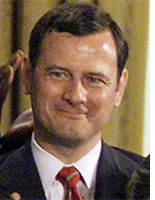
Age: 50 Graduated from: Harvard Law School. He clerked for: Judge Henry Friendly, Chief Justice William Rehnquist. He used to be: associate counsel to the president for Ronald Reagan, deputy solicitor general for George H.W. Bush, partner at Hogan & Hartson. He's now: a judge on the U.S. Court of Appeals for the D.C. Circuit (appointed 2003).
His confirmation battle: Roberts has been floated as a nominee who could win widespread support in the Senate. Not so likely. He hasn't been on the bench long enough for his judicial opinions to provide much ammunition for liberal opposition groups. But his record as a lawyer for the Reagan and first Bush administrations and in private practice is down-the-line conservative on key contested fronts, including abortion, separation of church and state, and environmental protection.
Civil Rights and Liberties
For a unanimous panel, denied the weak civil rights claims of a 12-year-old girl who was arrested and handcuffed in a Washington, D.C., Metro station for eating a French fry. Roberts noted that "no one is very happy about the events that led to this litigation" and that the Metro authority had changed the policy that led to her arrest. (Hedgepeth v. Washington Metropolitan Area Transit Authority, 2004).
In private practice, wrote a friend-of-the-court brief arguing that Congress had failed to justify a Department of Transportation affirmative action program. (Adarand Constructors, Inc. v. Mineta, 2001).
For Reagan, opposed a congressional effort—in the wake of the 1980 Supreme Court decision Mobile v. Bolden—to make it easier for minorities to successfully argue that their votes had been diluted under the Voting Rights Act.
Separation of Church and State
For Bush I, co-authored a friend-of-the-court brief arguing that public high-school graduation programs could include religious ceremonies. The Supreme Court disagreed by a vote of 5-4. (Lee v. Weisman, 1992)
Environmental Protection and Property Rights
Voted for rehearing in a case about whether a developer had to take down a fence so that the arroyo toad could move freely through its habitat. Roberts argued that the panel was wrong to rule against the developer because the regulations on behalf of the toad, promulgated under the Endangered Species Act, overstepped the federal government's power to regulate interstate commerce. At the end of his opinion, Roberts suggested that rehearing would allow the court to "consider alternative grounds" for protecting the toad that are "more consistent with Supreme Court precedent." (Rancho Viejo v. Nortion, 2003)
For Bush I, argued that environmental groups concerned about mining on public lands had not proved enough about the impact of the government's actions to give them standing to sue. The Supreme Court adopted this argument. (Lujan v. National Wildlife Federation, 1990)
Criminal Law
Joined a unanimous opinion ruling that a police officer who searched the trunk of a car without saying that he was looking for evidence of a crime (the standard for constitutionality) still conducted the search legally, because there was a reasonable basis to think contraband was in the trunk, regardless of whether the officer was thinking in those terms. (U.S. v. Brown, 2004)
Habeas Corpus
Joined a unanimous opinion denying the claim of a prisoner who argued that by tightening parole rules in the middle of his sentence, the government subjected him to an unconstitutional after-the-fact punishment. The panel reversed its decision after a Supreme Court ruling directly contradicted it. (Fletcher v. District of Columbia, 2004)
Abortion
For Bush I, successfully helped argue that doctors and clinics receiving federal funds may not talk to patients about abortion. (Rust v. Sullivan, 1991)
Judicial Philosophy
Concurring in a decision allowing President Bush to halt suits by Americans against Iraq as the country rebuilds, Roberts called for deference to the executive and for a literal reading of the relevant statute. (Acree v. Republic of Iraq, 2004)
In an article written as a law student, argued that the phrase "just compensation" in the Fifth Amendment, which limits the government in the taking of private property, should be "informed by changing norms of justice." This sounds like a nod to liberal constitutional theory, but Roberts' alternative interpretation was more protective of property interests than Supreme Court law at the time.
Emilio Garza
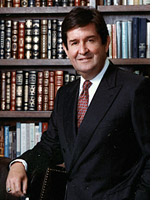
Age: 58 Graduated from: University of Texas School of Law. He used to be: a Marine captain, a Texas trial judge, a U.S. District Court judge in the Western District of Texas. He's now: a judge on the U.S. Court of Appeals for the 5th Circuit (appointed 1991).
His confirmation battle: Garza would be the first Hispanic Supreme Court justice since Benjamin Nathan Cardozo in the 1930s, making him harder for liberal groups to oppose. His lengthy record on the bench is conservative. One exception: Garza has expressed some concern about the Texas death penalty, which in recent years has come under repeated scrutiny by the Supreme Court. Still, he usually affirms lower-court decisions approving executions.
Civil Rights and Liberties
Agreed with a decision by the 5th Circuit as a whole to reverse a ruling in favor of the father of a 14-year-old girl who sued a Texas school district on a civil rights violation after his daughter was kept after school by her teacher and then raped in an empty classroom. The court found that schools do not have a constitutional duty to protect students, who, unlike prisoners and mental patients, return home each day. (Doe v. Hillsboro Independent School District, 1997)
Dissented from an earlier decision finding that a 15-year-old girl whose teacher had sex with her had a winning civil rights claim, on the theory that schoolchildren have a liberty interest in their bodily integrity. Garza's dissent argued that the school district was not liable because the state did not authorize the teacher's behavior. He joined in another dissent noting that the girl "was of sufficient age to bear children" and arguing that it was not clearly established that she was "sufficiently immature" to warrant a finding that she'd been sexually abused by the sex with her teacher. (Doe v. Taylor Independent School District, 1994)
Over a dissent, wrote for the 5th Circuit as a whole in rejecting the civil rights claims of a mother who was arrested and handcuffed for not wearing a seatbelt, not fastening her children's seatbelts, driving without a license, and not providing proof of insurance. The opinion found that the police had probable cause to arrest the mother and did not conduct the arrest in an extraordinary manner. (Atwater v. City of Lago Vista, 2000)
Environmental Protection and Property Rights
Over a dissent, wrote for the 5th Circuit as a whole in rejecting a suit by environmental groups challenging a U.S. Forest Service policy of clear-cutting in the Texas forests. Held that, because the groups were challenging the forest service's general practices, the court could not grant them relief. (Sierra Club v. Peterson, 2000)
Habeas Corpus
Dissented from a decision to overturn the conviction of a death-row inmate against whom there was no physical evidence and whose lawyer failed to interview the single eyewitness to the crime. In Garza's view, his court could not hear the defendant's claim that his lawyer was ineffective because he had not raised it directly enough in his federal habeas petition. (Soffar v. Dretke, 2004)
Agreed to deny relief to a death-row inmate whose lawyer put on no evidence about his clean criminal and psychiatric record. In a concurrence, Garza expressed concern that the jury instructions given in the case might have been unconstitutional because they did not ask whether there were mitigating circumstances that might lead the jury to impose a sentence less than death. Also expressed skepticism about the validity of psychiatric predictions about the future dangerousness of a defendant. (Flores v. Johnson, 2000)
Abortion
Agreed to strike down Louisiana's abortion law as unconstitutional because it criminalized abortions except to save the life of the mother, or in cases or rape or incest. In a concurrence, Garza noted his disagreement with the relevant Supreme Court precedent, saying, "the Constitution says absolutely nothing about abortion" and "I would allow the people of the State of Louisiana to decide this issue for themselves." (Sojourner v. Edwards, 1992)
Agreed to strike down Louisiana's statute allowing teens seeking abortions to go to court rather than notifying their parents, on the grounds that the exceptions made to parental notification were too narrow. In a concurrence, reiterated his stance that the Supreme Court's opinions granting a right to abortion are "inimical to the Constitution." (Causeway Medical Suite v. Ieyoub, 1997)
For a unanimous panel, held that Congress' power to regulate interstate commerce gave it the authority to pass a law limiting the access of protesters to the entrance of abortion clinics. (U.S. v. Bird, 2005)
Judicial Philosophy
In Causeway Medical Suite v. Ieyoub, expressed dismay that the Supreme Court's broad readings of the word "liberty" in the Constitution "have slowly eroded the scope of public debate." Garza argued that if the court had stayed out of several arenas—for example, marriage, child rearing, school curricula, abortion—state laws might have changed "as public attitudes changed." Instead, "the people's Constitution—at least as to unenumerated constitutional rights—has become the Court's Constitution."
Michael McConnell
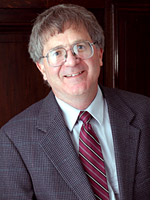
Age: 50 Graduated from: University of Chicago Law School. He clerked for: Judge Skelly Wright, Justice William Brennan. He used to be: a law professor at the University of Chicago and the University of Utah, an appellate attorney for Mayer Brown. He's now: a judge on the U.S. Court of Appeals for the 10th Circuit (appointed 2002).
His confirmation battle: When McConnell was nominated to the 10th Circuit three years ago, he had the support of liberal law professors who called him Bush's "most distinguished" nominee and signed a letter of support for him. Other liberal groups, on the other hand, fought hard against his confirmation, highlighting his support for expanding the role of religion in the public sphere. How to account for the split? As a respected and well-liked law professor, McConnell was well-placed to win support in the academy, and one of the arguments made on his behalf was that, as an advocate of judicial restraint, he'd be sure to follow the Supreme Court's directives. McConnell wouldn't be similarly bound by precedent, however, if he joined the high court himself. Instead, the combination of his hard-line conservative views and his sunny disposition could make him extremely effective at bringing about change.
Civil Rights and Liberties
In a law review article, argued that the support for school desegregation in Brown v. Board of Education is consistent with the intentions of the framers of the 14th Amendment to guarantee equal protection under the law. McConnell's remains the minority view.
In a Slate dialogue, opposed a constitutional right to assisted suicide.
Before the Supreme Court, represented the Boy Scouts in their successful suit to keep out gay scoutmasters. (Boys Scouts of America v. Dale, 2000)
On the bench, dissented from a ruling in favor of Jessica Gonzales, who sued the city of Castle Rock, Colo., when her three children were killed by her ex-husband after the police failed to enforce a restraining order against him, despite her repeated calls. McConnell said that the majority's ruling would "expand greatly the liability of state and local governments." A Supreme Court ruling is pending in this case. (Gonzales v. City of Castle Rock, 2004)
Separation of Church and State
In a law review article, argued that the framers intended to provide for broader protections for religiously motivated conduct than modern jurisprudence allows for.
In a law review article, questioned the outcome of Bob Jones University v. United States, the 1983 Supreme Court decision that revoked the school's tax-exempt status because it forbade interracial dating. McConnell argued that even if Bob Jones' policy is "morally repugnant to most of us" the rule affected "only those who choose to become part of the religious community defined by Bob Jones" and so should come under the constitution's protections of freedom of speech and freedom of religion.
In a Slate dialogue, backed government-funded school vouchers that can be used at parochial schools. Argued that religious activity in a public setting or paid for by public funds is OK, as long as the government remains neutral rather than supporting a particular faith.
Agreed to grant a preliminary injunction to a New Mexico sect to stop the government from prosecuting its members for using a hallucinogenic tea during worship. In a concurrence, McConnell argued that the sect's interest in religious observance trumped the health risk to the sect's members and the interests of the federal government in enforcing its drug laws. (O Centro Espirita Beneficiente Uniao do Vegetal v. Ashcroft, 2003)
Environmental Protection and Property Rights
For a unanimous panel, upheld a law that Congress passed specifically to permit logging in the Black Hills National Forest in South Dakota. The law upended a court settlement designed to prevent the logging from going forward. (Biodiversity Associates v. Cables, 2004)
Criminal Law
For a unanimous panel, held that the federal prosecution of a child pornographer—who paid a boy to photograph him and transported him across states lines—was consistent with Congress' power to regulate interstate commerce. (U.S. v. Riccardi, 2005)
Abortion
In 1996, signed a statement supporting a constitutional amendment to ban abortion. "We believe that the abortion license is a critical factor in America's virtue-deficit," the statement reads.
Before Congress, testified in opposition to a bill designed to limit the access of protesters to abortion clinics.
Judicial Philosophy
Supports the originalist approach to constitutional analysis, which urges judges to interpret the Constitution in accordance with the understandings of its framers.
Alberto Gonzales
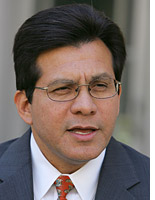
Age: 49 Graduated from: Harvard Law School. He used to be: general counsel to George W. Bush when he was governor of Texas, a lawyer at Vinson & Elkins, a justice of the Supreme Court of Texas, White House counsel to Bush. He's now: attorney general of the United States.
His confirmation battle: Gonzales faced concerted opposition when he was nominated to be attorney general, mostly because of the role he played as White House counsel in easing the way toward coercive interrogation of the Guantanamo Bay detainees. But he was confirmed with 60 votes, which puts him over the filibuster threshold. If Gonzales were nominated for the Supreme Court, liberals might look past his torture tarnish and figure he's the best Supreme Court material they're likely to get from the Bush administration. Gonzales' bigger problem may be the religious right: When the administration floated his name as a serious candidate last week, conservative groups yelped because he's viewed as moderate on abortion and affirmative action. The quip by Republican Hill staffers reported by the National Review two years ago: "Gonzales is Spanish for Souter."
Civil Rights and Liberties
As White House Counsel, Gonzales reportedly weakened the administration's opposition to the affirmative action policies of the University of Michigan that came before the Supreme Court in 2003, arguing for challenging the way in which Michigan used race-based preferences rather than all forms of preference. "I know that I've been helped because of my ethnicity," Gonzales told the Los Angeles Times in 2001. "Personally, I'm not offended that race is a factor. But it should never be the overriding factor or the most important factor."
As White House counsel, Gonzales wrote a memo arguing that the president had the authority to decide not to grant foreign detainees the protections of the Geneva Conventions and was the recipient of a memo that defined torture far more narrowly than international or constitutional law.
On the Supreme Court of Texas, agreed that Texas agencies had to abide by a state law passed to protect employees who file worker compensation claims from being fired. The decision broke with previous rulings of the court on the question of whether the state had waived its immunity from suit. (Kerrville State Hospital v. Fernandez, 2000)
Abortion
Over a dissent, agreed that a 17-year-old girl could have an abortion without getting her parents' consent. The court was applying a Texas statute allowing an abortion without parental consent if the teenager asking for it "demonstrates that she is mature and sufficiently well informed." In a concurrence, Gonzales argued that the dissent's position—that exceptions to the rule of parental notification should be rare and require a high standard of proof—were policy decisions for the legislature, not the court. To construe the statute more narrowly than the text amounted to "an unconscionable act of judicial activism." (In re Jane Doe, 2000)
In another parental-notification case, the Supreme Court of Texas held that the teenager seeking an abortion had not established that she was sufficiently mature and well informed to do so without telling her parents. Because the girl's hearing took place a few days after the court issued its decision In re Jane Doe, Gonzales wanted to send the case back to the trial court, where the girl would have another chance. He explained that the evidence presented thus far did not prove that she had "thoughtfully considered her alternatives, including adoption and keeping the child" or that telling her parents about the abortion could subject her to emotional abuse. (In re Jane Doe 3, 2000)
Judicial Philosophy
In the abortion cases, argued for a restrained role for judges. "While the ramifications of such an [abortion] law and the results of the Court's decision here may be personally troubling to me as a parent, it is my obligation as a judge to impartially apply the laws of this state without imposing my moral view on the decisions of the Legislature."
In a case about whether a Texas law exempted insurers from paying attorney fees in breach-of-contract actions, strongly supported the principle of stare decisis, which directs a court generally to stand by its previous decisions. Respect for precedent promotes "efficiency, fairness, and legitimacy." (Grapevine Excavation, Inc. v. Maryland Lloyds, 2000)
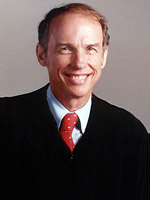
Age: 60 Graduated from: University of Virginia School of Law. He clerked for: Justice Lewis F. Powell. He used to be: a law professor at the University of Virginia. He was also at the Justice Department during the Reagan administration and served as the editorial-page editor of the Virginian-Pilot. He's now: a judge on the U.S. Court of Appeals for the 4th Circuit (appointed 1984).
His confirmation battle: Wilkinson is reported to be an affable, middle-of-the-road southerner like Lewis Powell, the Supreme Court justice for whom he clerked. But his record as a forward-looking defender of core conservative values is more akin to William Rehnquist's. Like Rehnquist, Wilkinson has a long affiliation with the Republican Party (he ran unsuccessfully for a House seat in Virginia in 1970). His confirmation battle would probably highlight his willingness to defer to the president in the case of Yaser Esam Hamdi. Wilkinson's approach to the case was overturned by the Supreme Court and pilloried, in a separate opinion, by Scalia. Another factor to consider is Wilkinson's age—at 60, he is the oldest of the shortlisters by a significant margin.
Civil Rights and Liberties
For the 4th Circuit as a whole, upheld the military's "don't ask, don't tell" policy. Wilkinson's opinion rejected the claims of a gay-rights group that the policy violated the equal-protection clause of the Constitution by discriminating against homosexuals. (Thomasson v. Perry, 1996)
In the 1985 book One Nation Indivisible: How Ethnic Separatism Threatens America, sharply criticized affirmative action for causing racial division.
Over a dissent, struck down an affirmative action program in Richmond, Va., which guaranteed that at least 30 percent of municipal contracts would go to minority-owned businesses. Wilkinson's approach was adopted by the Supreme Court. (J.A. Croson Co. v. City of Richmond,1987)
For a unanimous panel, rejected the claims of Yaser Esam Hamdi. Wilkinson argued that the president's war powers allowed him to hold Hamdi without trial as an enemy combatant captured abroad and that he was not entitled to the protections of the Geneva Conventions. The Supreme Court rejected this approach. (Hamdi v. Rumsfeld, 2003)
Separation of Church and State
For a unanimous panel, found that a "non-sectarian invocation" recited at the start of meetings of a county board of supervisors in Virginia does not violate the Constitution's prohibition against government-endorsed religion. (Simpson v. Chesterfield County Bd. of Supervisors, 2005)
For a unanimous panel, reversed a district-court ruling to find that the Religious Land Use and Institutionalized Persons Act, a federal law that requires prisons to accommodate the religious observance of prisoners, is constitutional. The Supreme Court unanimously reached the same conclusion. (Madison v. Riter, 2003)
Voted unsuccessfully (along with Luttig) to reconsider a case in which a three-judge panel found that a superintendent at the Virginia Military Institute who required cadets to say a prayer before eating supper in the mess hall possibly violated the First Amendment principle of separation of church and state. (Mellen v. Bunting, 2003)
Environmental Protection and Property Rights
Over Luttig's dissent, upheld various regulations issued by the Fish and Wildlife Service promulgated under the Endangered Species Act in the face of a challenge that they exceeded Congress' authority under the Commerce Clause. (Gibbs v. Babbitt, 2000)
Abortion
Voted to deny rehearing (along with Luttig) in a case about South Carolina's decision to offer "choose life" license plates. Wilkinson's vote helped to uphold a ruling that the license-plate program violated the First Amendment because it did not offer pro-choice advocates a similar opportunity to make license plates that asserted their views. (Planned Parenthood of S.C. Inc. v. Rose, 2004)
For a unanimous panel, found that an anti-loitering statute was invalid as applied to a group of protesters staging a pro-life rally because the statute did not give them proper notice that the core political speech and expressive activity in which they were engaged was prohibited by law. However, the panel refused to find the city of Norfolk, Va., liable. (Lytle v. Doyle, 2003)
Judicial Philosophy
In a law review article, responded to the charge that the conservative "preoccupation with the abstract, the collective, and the impersonal has locked actual human beings out." Wilkinson argues that conservative jurisprudence is compassionate, but that it is also committed to crafting "narrow rulings" that show "deference to democratic solutions."
In a law review article, defended the record of the Rehnquist Court. Wilkinson contends that the "modest" interventions of the Rehnquist Court are about preserving a space for state laws and do "not pose any threat to such basic premises of constitutional law" as the "binding effect of the Bill of Rights upon the states, or to the constitutional underpinnings of our most basic national civil rights statutes."
Edith Brown Clement
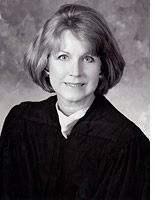
Age: 57 Graduated from: Tulane Law School. She clerked for: Judge Herbert W. Christenberry. She used to be: a judge on the U.S. District Court, Eastern District of Louisiana. She's now: a judge on the U.S. Court of Appeals for the 5th Circuit (appointed 2001).
Her confirmation battle: Clement doesn't provide much ammunition for opposition groups, but perhaps not much for conservatives to get excited about either. She hasn't written anything notable off the bench (or at least nothing that's come to light yet), and most of her judicial decisions have been in relatively routine and uncontroversial cases.
Civil Rights and Liberties
For a unanimous panel, allowed a plaintiff who sued the police for violating his right to due process to proceed with his claim that the officers who arrested him used excessive force when they allegedly injured him by slamming the door of their car against his head. Reversed the district court's finding that the plaintiff could also sue for unlawful arrest and excessive force involving the use of handcuffs. (Tarver v. City of Edna, 2005)
Environmental Protection and Property Rights
Voted for the 5th Circuit to rehear a decision blocking developers from building on a site where six endangered bug species lived in a cluster of limestone caves. Clement joined a dissent that argued that the decision's rationale for protecting the bugs—to preserve the interdependent web of species—bore no relationship to Congress' power to regulate interstate commerce. (GDF Realty Investments v. Norton, 2004)
Criminal Law
For a unanimous panel, rejected the claim of a man flying to Nigeria that his luggage was unlawfully searched at the border. Clement ruled broadly that customs inspectors need not have probable cause to search the bags of people who are leaving the country. (U.S. v. Odutayo, 2005)
Agreed with a unanimous panel that an asylum applicant who was 20 minutes late to a hearing because he'd taken the wrong highway exit should not have been ordered deported in absentia and was entitled to a new hearing. (Alarcon-Chavez v. Gonzales, 2005)
Habeas Corpus
Over a dissent, ruled that a death-row inmate who claimed to be mentally retarded was entitled to a lawyer to develop that claim in a habeas petition. Clement's ruling followed the Supreme Court's 2002 decision barring the execution of the mentally retarded. She followed up with a second opinion that limited the significance of her ruling by stating "this is a fact-bound case." (Hearn v. Dretke, 2004)
For a unanimous panel, reversed a decision of the district court finding that a police officer convicted of civil rights violation, for hitting a drunk suspect in the head with his baton, was entitled to a new trial because his lawyer was ineffective. The officer argued that his lawyer erred by failing to call character witnesses to rebut testimony that he'd complained about the need to control Mexicans in the United States. Clement said the rebuttal evidence would have been irrelevant because the officer was not charged with a hate crime. (U.S. v. Harris, 2005)
Damage Awards
Over a partial dissent, in reviewing a jury verdict in favor of a man whose wife and 3-year-old daughter were killed in a car crash, affirmed damage awards of $1.9 million for the man's loss of his wife and $1.5 million for the loss of his daughter. Reduced from $200,000 to $30,000 an award to the wife's estate for her pain and mental anguish before her death and eliminated a $200,000 award to the daughter's estate for her pain and mental anguish. (Vogler v. Blackmore, 2003)
Samuel Alito
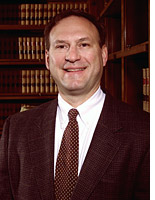
Age: 55 Graduated from: Yale Law School. He clerked for: Judge Leonard Garth. He used to be: deputy assistant attorney general under Reagan, U.S. Attorney for the District of New Jersey. He's now: a judge on the U.S. Court of Appeals for the 3rd Circuit (appointed 1990).
His confirmation battle: Alito has the Scalia-esque nickname "Little Nino" and the Italian background to match it. As the author of a widely noted dissent urging his court to uphold restrictions on abortion that the Supreme Court then struck down, in a decision that reaffirmed Roe v. Wade,Alito could be especially filibuster-prone. Like Scalia, he frequently makes his mark in dissent.
Separation of Church and State
For a unanimous panel, upheld a lower-court order requiring a school district to allow a Bible-study group to set up an information table at an elementary-school back-to-school night. Reasoned that by preventing the group from displaying its literature, the district was discriminating on the basis of viewpoint. (Child Evangelism Fellowship of N.J., Inc. v. Stafford Township School District, 2004)
For a unanimous panel, denied standing to a group seeking to take down a municipal holiday display that included a menorah and a crèche. Alito said that the group couldn't challenge the display as taxpayers because the items were donated rather than bought by the town. (ACLU-NJ v. Township of Wall, 2001)
Dissented from a ruling by the 3rd Circuit as a whole that an elementary school did not violate the First Amendment rights of a kindergartener by taking down (and then putting back up) a Thanksgiving poster he'd made that said the thing he was most thankful for was Jesus. The majority decided to throw out the case on a technicality; Alito protested that the child's claim should go forward. (C.H. v. Oliva, 2000)
Criminal Law
Allowed a federal probation office in Delaware to condition the release of a man who had pleaded guilty to receiving child pornography on his willingness to submit to random polygraph tests about whether he'd had impermissible contact with children. (United States v. Warren, 2003)
Dissented from a refusal to grant police officers immunity from a civil suit brought by a mother and her 10-year-old daughter who'd each been strip-searched because they lived in the home of a suspected drug dealer. Alito felt the police had behaved reasonably because the warrant led them to conclude that there was probable cause to search everyone in the house for drugs. (Doe v. Groody, 2004)
Habeas Corpus
Granted the habeas claim of an African-American defendant who sought to introduce evidence that a juror made a racist remark after the jury reached its verdict. (Williams v. Price, 2003)
Abortion
Dissented from a decision holding that Pennsylvania could not require women to inform their husbands before getting abortions. Alito argued that because the law only required the husbands to have notice and did not give them a veto over their wives' decisions, it did not pose an "undue burden" for women. This approach was rejected by the Supreme Court. (PlannedParenthood v. Casey, 1991)
Agreed that an immigration judge was within his discretion to find not credible an application for asylum based on China's forced-abortion policy. (Xue-Jie Chen v. Ashcroft, 2004)
Editors' Note, July 1, 2005: When this piece originally appeared in Slate on June 24, 2005, the lead paragraph focused on the likely resignation of Chief Justice William Rehnquist. We have now changed three sentences of the opening paragraph.