Joe Eszterhas
How did a B-movie screenwriter become an A-list celebrity?
No profession embraces the brash and talentless more warmly than the movie industry, and no one is better evidence of this than Joe Eszterhas. Eszterhas is America's most famous--or rather, notorious--screenwriter. His career is dedicated to the principle that the 14-year-old boy has something to say. Eszterhas is the Shakespeare of the Jerry Springer crowd, the eminence greasy of Hollywood.
Most film types get the chance to create only one disastrous flop in a lifetime. After last week, Eszterhas has two to his credit. Eszterhas, you may remember, is the genius behind Showgirls. The 1995 lap-dancing epic is arguably the worst movie of the decade and inarguably the worst-written movie of the decade. Eszterhas' dialogue, delivered by bimbos painted and injected to a fare-thee-well, is an (unintentionally) hilarious parody of porn.
Eszterhas' latest movie, a much-anticipated, much-hyped Hollywood satire called An Alan Smithee Film: Burn Hollywood Burn, opened--and closed--last week. The film's conceit (always a good word to use around Eszterhas) is that a director steals his own terrible movie to prevent its release. If only the same fate had befallen Burn Hollywood Burn. Critics have called it "bilious," "ham-handed," "a hapless display ... of groundless vanity," a "wretched fiasco." Even Eric Idle, the movie's star, dismissed the film as "not funny." Burn Hollywood Burn cost $10 million and grossed approximately ... nothing.
Apart from his two megafailures, Eszterhas has devoted his career to the artful composition of smut and violence. Since the mid-1980s, Eszterhas has been churning out more or less identical genre pictures: Jagged Edge (1985), Betrayed (1988), Basic Instinct (1992), Sliver (1993), Jade (1995). Basic plot: Hero/heroine falls for weirdo. Many sweaty breasts and bloody corpses later, the weirdo turns out to be--surprise!--a raving, homicidal nut job. Eszterhas not only recycles plot, he recycles dialogue. He even recycles his sex obsessions: Sliver and Basic Instinct both devote inordinate amounts of attention to the fact that Sharon Stone is not wearing any underwear. (Eszterhas' sex fixation is legendary and comical: His original draft of One Night Stand [1997] opened with a 65-page description of a marathon sex session.)

Eszterhas is not a hit-maker, at least not anymore. Several of his '80s movies, including Flashdance (1983) and Jagged Edge, were moneymakers. But his last real success was Basic Instinct back in 1992. Since then he's written six flops in a row. Hollywood isn't deterred: He's now being paid $4.5 million to script a movie about Russian mobsters.
This raises a question: Why? Eszterhas is probably not the worst screenwriter in Hollywood--Jagged Edge and Basic Instinct are quite fun. But Eszterhas is an object lesson in the perils of the Brand Name Economy. By tradition, Hollywood screenwriters are anonymous. They're supposed to be heard but not seen. Actors and directors are stars; writers--like composers, cinematographers, editors--settle for a credit line and a chubby paycheck. There have been only a handful of famous screenwriters, all of them authors of magnificent movies. Eszterhas essentially invented the celebrity screenwriter. "He's a run of the mill screenwriter who created a myth that he was an idiosyncratic rebel," says Entertainment Weekly critic Owen Gleiberman.
Eszterhas has always been a masterful self-promoter. The child of Hungarian World War II refugees, he started his career as a reporter for the Cleveland Plain Dealer. He won fame by obtaining photographs of the My Lai massacre, then caught the eye of Rolling Stone with his bold crime stories. The magazine was in its days of high gonzo, but even by that standard, Eszterhas stood out. At editorial meetings he would brandish a knife.
Hollywood beckoned in the late '70s. Eszterhas' first movie was F.I.S.T. (1978), a labor drama starring Sylvester Stallone. When Stallone took credit for the script, Eszterhas challenged him to a fistfight. It was a sign of things to come. Ever since, he has used belligerence, bravado, and a gift for charming the media to make himself a star. When Flashdance's director suggested rewriting the lead character, Eszterhas bullied him out of the idea. He did the same thing when the studio tried to change the ending of Jagged Edge. Both incidents burnished his image. In 1989, Eszterhas made headlines by challenging superagent Michael Ovitz, then Hollywood's most powerful man. Ovitz had threatened to destroy Eszterhas' career if he switched to another agency; Eszterhas leaked this to the press, humiliating Ovitz. He twice brought attention to himself by storming off the set of Basic Instinct. Burn Hollywood Burn had its press-getting Eszterhas stunt, too. He dumped his director and edited the film himself.
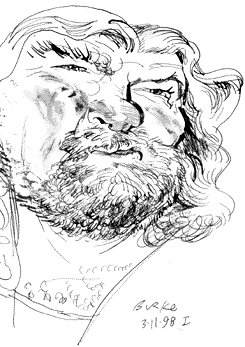
Eszterhas still presents himself as a radical tough. He has long hair and a motorcycle-gang beard--the sort of hair that looks bad enough at age 33 and positively absurd at 53. He has been known to bring a wooden stick into meetings, then smash it on the table when he's angry. He has turned his private life into fodder for his myth. In 1994, when Sharon Stone took up with a producer named Bill McDonald, McDonald's wife Naomi Baka took refuge with Eszterhas and his wife of 24 years. Eszterhas promptly left his wife and their two kids for Baka. Then, according to press reports, he signed a contract with Vanity Fair to tell all about the sordid affair. No piece ever ran.
E szterhas' posturing worked: He became the celebrity he'd always hoped to be--brash, appealing, larger than life. Moviegoers knew his name and his legendary audacity. Producers fell hard for the schtick, making him the most expensive writer in Hollywood. He got $3 million for Basic Instinct, then $2.5 million for a four-page outline (!) of Jade, then $4 million for One Night Stand. And thanks to his bullheadedness, he exerts more control over production than almost any other screenwriter. Directors alter his scripts at their peril.
There is a mysterious disconnect between Eszterhas' self-image and his work. Eszterhas is a self-promoter but not a cynic. He honestly believes himself Hollywood's bravest outsider, and he has written passionately about the need for screenwriters to stand up for artistic integrity. He also honestly believes in his scripts. One of the most endearing qualities of B-movie makers such as Roger Corman is their self-consciousness, their recognition that they're making crass, but fun, junk. That's absent in Eszterhas: He's an Ed Wood for the '90s. Eszterhas is "delusional in the sense that he believes that everything he touches is serious," says film critic and historian David Thomson. In the publicity leading up to the release of Showgirls, Eszterhas gave interview after interview about the importance of the movie, of its deep moral message, its serious purpose. He even called it--this T & A sleazefest about a Vegas stripper--"a deeply religious experience."
Eszterhas is reminiscent of Playboy's Hugh Hefner: They share the same exaggerated sense of importance, the same pontificating humorlessness about their ridiculous jobs. Hefner published pictures of naked women and believed himself a radical. Eszterhas writes movies about naked women and believes himself an artist. (No surprise that Playboy's April issue publishes a long interview with Eszterhas.)
Eszterhas' career did not have to be this way. He's capable of much more than he usually gives. In 1990, he wrote TheMusic Box, a movie about an American lawyer who defends her Hungarian immigrant father when he is accused of Nazi war crimes. It is a beautiful, sad little movie about betrayal. It was glowingly reviewed. But the actors and the movie drew most of the publicity. Eszterhas didn't.
This is Eszterhas' tragedy and the dark side of his celebrity. When he writes sensationalist schlock, he gets the attention he craves. When he writes moving, interesting drama, he doesn't. So schlock it will be.