The Simple, Humble, Surprisingly Sexy Button
A visual history.

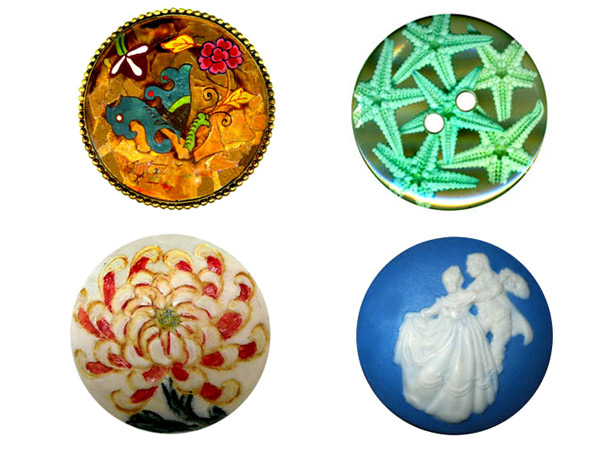
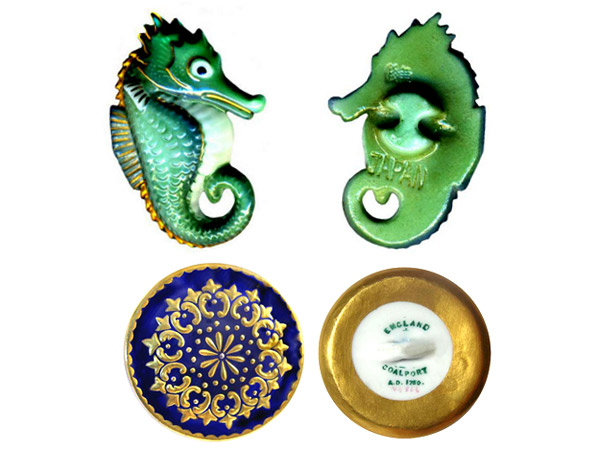
Courtesy Button Country.
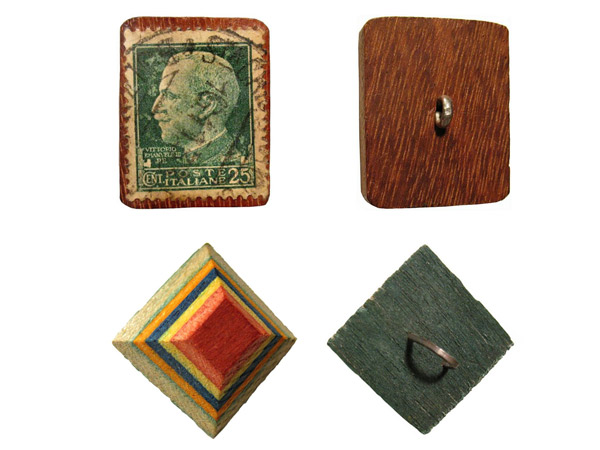
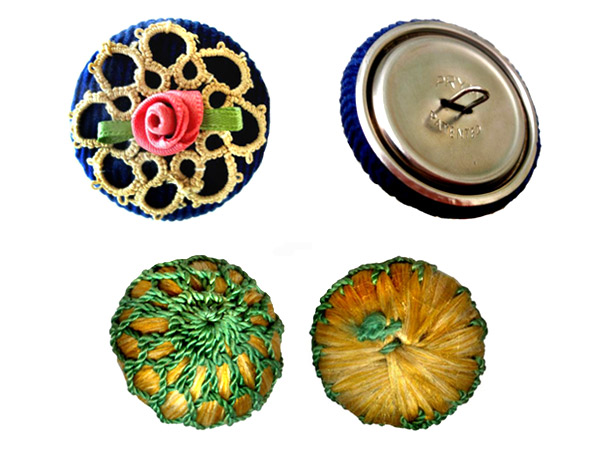
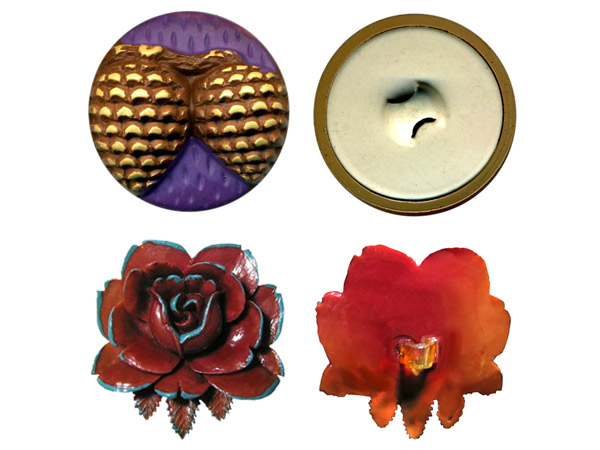
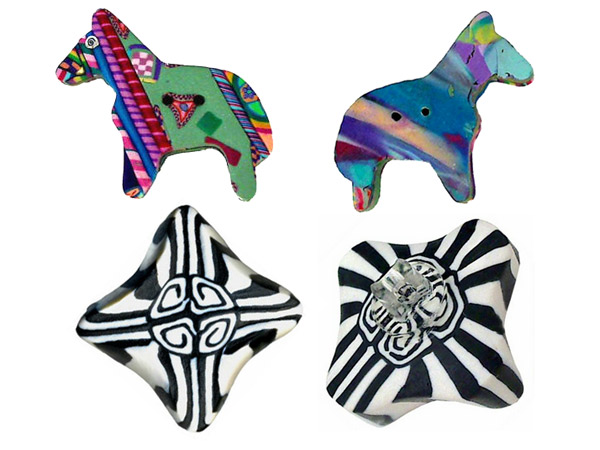
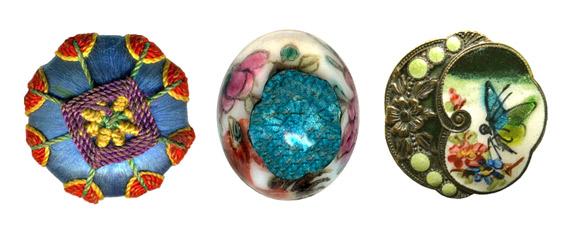
The button—with its self-contained roundness and infinite variability—has a quiet perfection to it. Running a cascade of buttons through your fingers feels satisfyingly heavy, like coins or candy; their clicking whoosh and blur of colors lull you. A button packs an extraordinary amount of information about a given time and place—its provenance—onto a crowded little canvas. Children learn to button and unbutton early in life, and they keep doing it until they’re dead.
6. 99% Invisible, “The Sound of the Artificial World” (2011)
Some 99% Invisible episodes make me crave a visual supplement. (What did the lost walled city of Kowloon look like?) But in this episode, Roman Mars’ beloved short-form design podcast asks how sound designers make “organic sounds for inorganic things.” The clicks, sproings, and clatters that sound engineer Jim McKee demonstrates for Mars are the background noise of everyday life for people who use digital devices. The episode singles these sounds out for analysis and deconstructs their origin, a classic 99% approach that works beautifully. You may find yourself looking toward your phone several times during the episode’s five-minute run, thinking you’ve received a text—a weird overlap of podcast and life that makes the episode’s point perfectly.
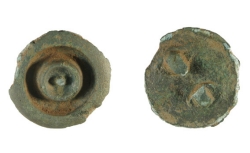
Courtesy Portable Antiquities Scheme.
The earliest known button, writes Ian McNeil in An Encyclopedia of the History of Technology, "was originally used more as an ornament than as a fastening, the earliest known being found at Mohenjo-daro in the Indus Valley [now Pakistan]. It is made of a curved shell and about 5000 years old." Early buttons like these usually consisted of a decorative flat face that fit into a loop. (Reinforced buttonholes weren’t invented until the mid-13th century). Percent% Buttons in this period almost never appeared in straight rows, but were used singly as sartorial flourishes.
Along with brooches, buckles, and straight pins, buttons were used in ancient Rome as decorative closures for flowing garments. However, none of these options worked perfectly. Pins poked unsightly holes into precious fabrics. Supporting yards of cloth at a single point required buttons of architectural heft, made of bone, horn, bronze or wood. Some designs took the functional pressure off buttons by knotting the fabric securely into position, then topping off the look with a purely ornamental button.
(Incidentally, as a button alternative, Mycenaeans of the Roman era invented the fibula, a surprisingly modern forerunner to our safety pin. This design was lost with them until it re-emerged in mid-19th century America.)
The button became more prominent among the wealthy in the Middle Ages. “About the middle of the eleventh century,” writes Carl Köhler in A History of Costume, “clothes began to be made so close-fitting that they followed the lines of the body from shoulders to hips like a glove.” Buttons helped that snug fit along. This didn’t mean clothes were cut more sparingly; wealthy people still liked the costly display of excess fabric. But, on both men’s clothes and women’s, buttons helped accentuate lovely lines, of the arm, say, or the bosom.
The first button-makers guild formed in France in 1250. Still regarded as less-than-functional jewelry, buttons were so prized that sumptuary laws restricted their use. Books, Banks, Buttons and Other Inventions from the Middle Ages by Chiara Frugoni relates how, in a period tale, a magistrate quizzed a woman overly bedecked in buttons.
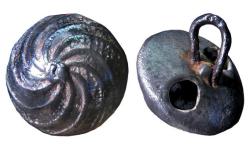
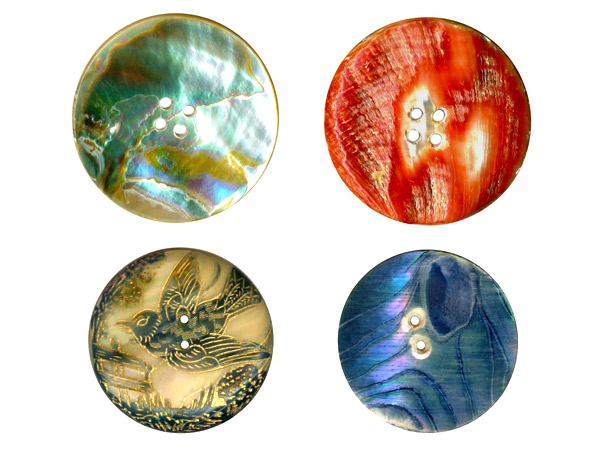
Courtesy Button Country.
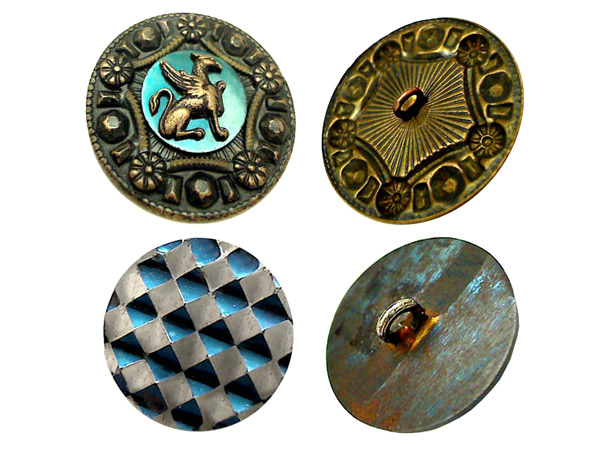
Buttons came in all shapes and sizes, but most often they were mounted on a shank; you ran thread through the shank’s hole to attach the button to fabric. Unlike modern buttons with their iconic four-square holes, the shank style left the button’s face totally free: a tiny blank canvas one could cover, carve, polish, or paint with luxurious abandon.
The medieval period was the era when wearing lots of buttons meant big money. Franco Jacassi, reputedly the world’s biggest button-collector, describes this as a time when you could pay off a debt by plucking a precious button from your suit. Italians still describe the rooms where powerful leaders meet as stanze dei bottoni, “rooms of the buttons.”
On women’s clothes particularly, buttons traced the body’s lines in suggestive ways, making clothes tight in all the right places or offering up intriguing points of entry. Along with ribbons, laces or bows, buttons were often used on detachable sleeves, a fad that ran from the 13th to 15th centuries. These sleeves could be easily swapped between outfits and laundered whenever they got dirty. Courtiers might accept an unbuttoned sleeve from a lady as a love token, or wave sleeves in jubilation at a jousting tourney.
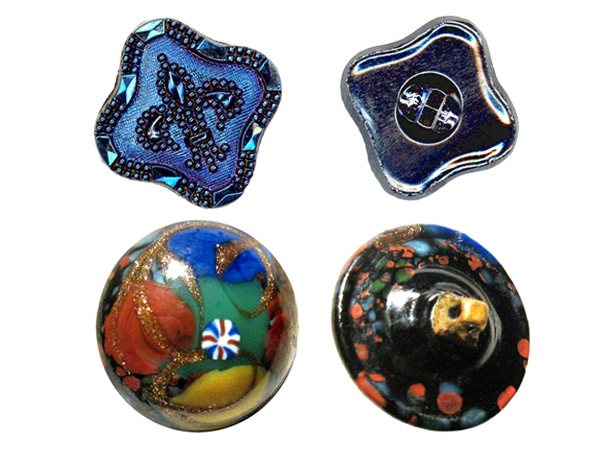
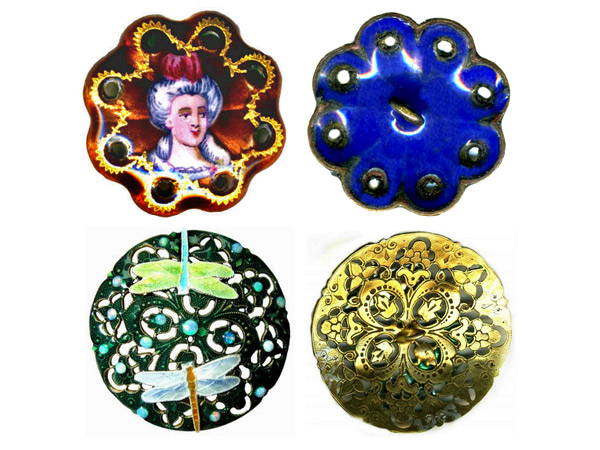
After the Renaissance in Europe, buttons—along with many other things—became increasingly baroque, then rococo. Among the more extreme examples were “habitat” buttons, built to contain keepsakes like dried flowers, hair cuttings or tiny insects under glass. Hollowed-out smuggler buttons allowed thieves to transport jewels and other booty secretly. (This tradition of buttons-for-crime resurfaced in a heroin-smuggling attempt in 2009.)
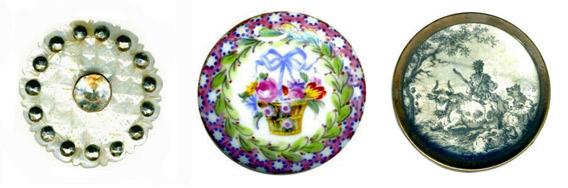
Courtesy Button Country.
Ornate buttoning among the wealthy required some help. Around this era is when buttons migrated to different sides of a shirt for men and women. Men usually donned their own shirts, so their buttons faced right for their convenience. Women with ladies’ maids wore their buttons on the left, to make it easier for the maids to maneuver while facing them.
George Washington’s 1789 inauguration gave the world its first political button. Made of copper, brass or Sheffield plate, these buttons could close a pair of breeches or a jacket while simultaneously announcing the wearer’s politics. Political buttons took on a more recognizably modern (and less functional) shape during Lincoln’s 1864 re-election campaign. (View 150 years of political buttons here.)
Poorer folks wore buttons, too, but they had to craft them laboriously by hand. In Colonial America until the early 20th century, working-class families counted themselves lucky if they owned a hand-held button-mold. You heated up the mold in a bed of hot coals, then filled it with molten lead or pewter, which set into a button shape. The sturdy metal buttons could then be covered with fabric or other embellishments.
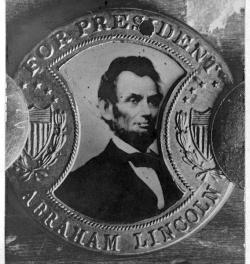
Library of Congress.
Extra buttons made at home could also be sold, which meant button-making could be hellish piecework. Playwright Henrik Ibsen channeled his own awful memories of home button-molding in a pivotal scene in Peer Gynt. Sent to fetch Gynt’s soul, the Button-Moulder explains how the very good and very bad go to heaven and hell, but the middling-good are “merged in the mass” and poured into purgatory, an undifferentiated molten stream from the Button-Moulder’s ladle.
Button-making was mercifully accelerated with the Industrial Revolution. An 1852 article from Household Words, a journal edited by Charles Dickens, marvels at the latter-day miracle that was automated button-manufacturing. The writer describes how engravers cut steel dies into the latest fashionable shape, while women and children stamped out pasteboard and cloth to cover the buttons by machine. Another machine stamped out the four holes that had become prevalent for men’s dress-shirt buttons, while another was used to “counter-sink” the button, pressing its center to form a raised outer ridge. (It’s this four-hole flat button that we regard as its iconic shape today.)
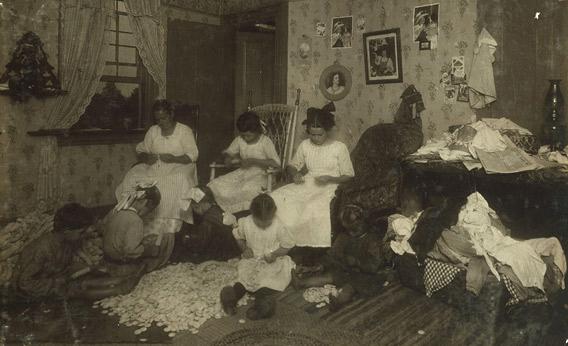
Photo by Lewis Wickes Hine via Library of Congress.
A rash of button patents during this period protected nearly every aspect of button-making, from manufacturing methods for glass or mother-of-pearl buttons, cheaper wire buttons, even improvements to button display cards for sale.
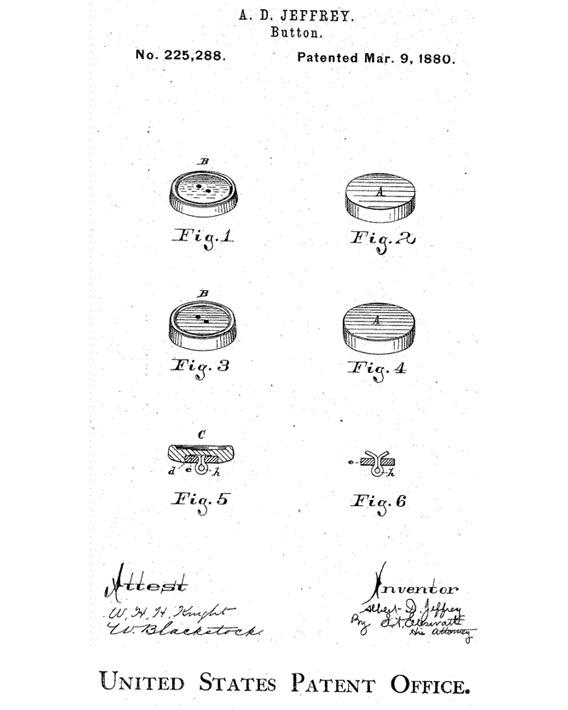
Courtesy Button Country.
With the growing number of actual buttons came a parallel growth in button metaphors in everyday speech. The OED lists several, dating from the late 1800s to the early 20th century: “to take by the buttons” is to detain someone in conversation; “dash my buttons!” is an epithet of surprised vexation; “to have a soul above buttons” indicated someone employed in a profession unworthy of them; those who “have all their buttons” enjoy sound intellect, while those who are “a button short” do not.
This grand democratization didn’t stem the tide of expensive ornamental buttons. Victorian “Tussie-Mussie” buttons pictured tiny bouquets whose flowers held symbolic messages. Queen Victoria donned mourning buttons of carved black jet upon her husband Albert’s death, kicking off a fashion among bereaved button-wearers throughout the Empire.
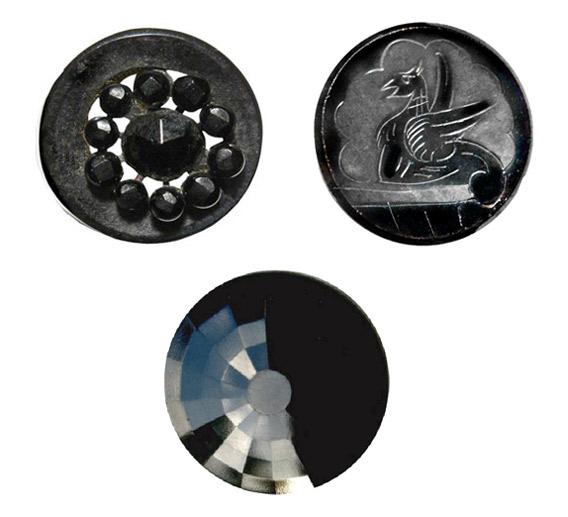
Courtesy Button Country.
Once they became cheap enough to produce en masse, buttons by the hundreds lined most kinds of tight-fitting clothing, including shoes. (More buttons, closely spaced, gave the wearer the tightest fit.) In his book The Evolution of Useful Things, Henry Petroski explains how this profusion of buttons gave rise to a parallel problem: “Fingers were not a very effective tool for coaxing the crowded buttons through small buttonholes.”
The solution? Buttonhooks, long crochethook-like devices used to draw buttons through holes rapidly. These evolved into various styles to accommodate different button sizes.
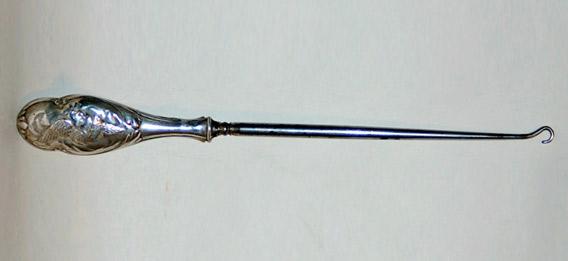
Sobebunny via Wikimedia Commons.
Tracing the body’s curves with increasing exactness, buttons have long equaled body consciousness. In the 20th century, button’s sexier side came more overtly to the fore. Buttons, in other words, designate sites of vitality, embarrassment, and thrill. When told that a certain lady wouldn’t hurt a fly, Dorothy Parker retorted, “Not if it was buttoned up.” Gertrude Stein’s slim volume Tender Buttons (1914) is winkingly named after the clitoris. Electrical devices, newly introduced, often used flat-faced “buttons” to complete a circuit, giving rise to double entrendre phrases like “press all my buttons."
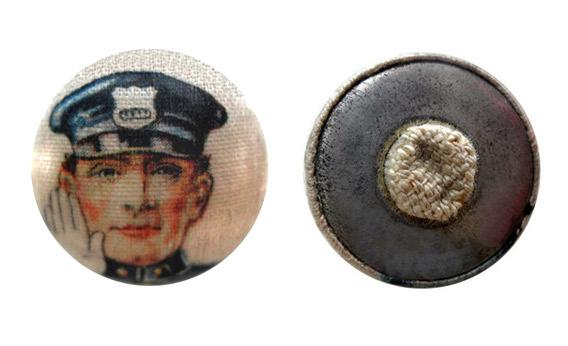
Courtesy Button Country.
Later in the century, buttons migrated as a metaphor from the mechanical world to the virtual one. Buttons now adorn screens big and small, promising to connect us to marvels with a single click. Steve Jobs said of the buttons on Apple’s touchscreens, “We made [them] look so good you'll want to lick them.”
Even though zippers entered the clothing-closure scene around the turn of the century, we still wear buttons today. Why? Reasons abound: Zippers can jam and warp or catch little children’s fingers. Velcro, another new-fangled closure, is too futuristic to be taken seriously. Hook-and-eyes and laces have their adherents, but their ubiquity is nowhere near that of the button.
Buttons, in short, offer everyday pleasures. Their little faces turn up agreeably, asking for personality to be impressed upon them. Buttoning oneself up is a slower, contemplative act; unbuttoning someone else, deliciously more so. Pressing buttons still delivers everything we love in the world to us. Why would we ever phase that out?