My Nanny Problem
How I learned to stop worrying and love The Nanny.
The Nanny
CBS; Wednesdays, 8 p.m. EST/PST
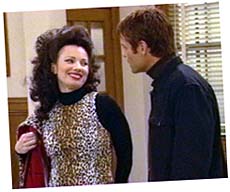
In a recent episode of the popular CBS comedy series The Nanny, nanny Fran, played by the nasal yenta Fran Drescher, is asked by her boss, the daft English millionaire Maxwell Sheffield (Charles Shaughnessy), to discourage a budding relationship between his college-age daughter and her philosophy professor.
The nanny, dressed, as ever, in polyurethane, visits the professor, played by Harry Hamlin (which answers the trivia question "Whatever happened to Harry Hamlin?"). Hamlin's philosophy professor falls immediately for the nanny, but the nanny is torn--she is in love with Sheffield, who unfortunately fears commitment. This is one of the show's running jokes.
Nanny Fine waves off the professor's requests for a date, but he persists. He suggests a Saturday date but suddenly withdraws the offer, reminding himself aloud that he must attend his nephew's bar mitzvah that day. The nanny, heretofore resistant to the professor's approaches, swoons and collapses with joy into a chair. The professor's name is Steve Goldberg.
This is a breakthrough moment for the Jewish people. It is not on par with the rebirth of the state of Israel or the discovery that Robert De Niro is half-Jewish, but it is a breakthrough all the same. There is no shortage of identifiably Jewish characters on television today, but few, if any, are romantically entangled, or shown to be interested in romantic entanglements, with their fellow Jews.
This has been a great source of concern to me as an agitator against intermarriage. I recognize that opposition to intermarriage is, to the lifestyle elite, morally distasteful. (The lifestyle elite is, of course, 62 percent Jewish, but put that issue aside for the moment.) Such opposition is, however, vital to the survival of my endangered tribe in its American exile, and so I fortify myself against the insults of the intermarried with thoughts of Bar Kochba and the Maccabees and of an America in the year 2100 in which every second Jew is not a Hasid.
I t was with great joy, then, that I watched Drescher's character express unmistakable interest in finding a Jew to marry. This, however, caused me a certain amount of internal conflict (a Jewish spécialité de la maison) because, in addition to being an opponent of intermarriage, I am also an official Defender of My People's Image on Television (self-appointed). And I have long thought that The Nanny was not Good for the Jews.
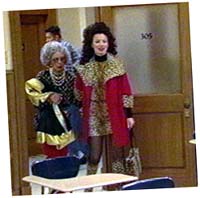
Drescher's character is a crudely drawn stereotype, a conniving, overeating, materialistic, hypersexualized fashion nightmare with a not-insignificant schnoz. Her mother, played by Renee Taylor, is even more broadly drawn: a grasping, ugly, gastrointestinally obsessed woman from the ethnic swamps of Queens. (Her grandmother, played by Ann Guilbert, is a far more sympathetic presence, which is a complicating factor, as we will soon see.)
One reason The Nanny has struck me as unhealthy for Jewish women is that it exists in a vacuum. There are few female Jewish characters on television today, at least as compared with male Jewish characters. And when female Jewish characters do appear, they are portrayed, generally, as scheming princesses. By contrast, the image of Jewish men has undergone a renovation in recent years. Nebbishness has alchemized into sensitivity. Take the Paul Reiser character on Mad About You. He's whiny and feminized, but women tell me they find him doting and caring (me, I just see the whiny, feminized part).
I believe there is an explanation for the denigration of Jewish women and the elevation of Jewish men: The Jews who dominate Hollywood (there, I said it) are, by and large, male and, by and large, avowedly assimilationist in all matters but gastronomic. There is a type of Jewish male who equates acceptance into the broader American culture with the acquisition of a blond, or at least obviously shiksa, wife (evidence: thirtysomething, Seinfeld's on-air dating patterns, and Philip Roth's American Pastoral). As a further means of cutting himself off from his ethnic roots, he scapegoats Jewish women by attributing to them all the negative stereotypes traditionally associated with Jews of both sexes, and then casts those Jewish women interested in marrying Jewish men out into the desert of New York magazine personal ads and singles weekends at Grossinger's.
According to Sylvia Barack Fishman, a Brandeis University scholar who studies popular images of Jewish women, a recent survey found that Jewish women who marry non-Jewish men get married a full three years later on average than Jewish women who marry Jewish men. Meaning, obviously, that many Jewish women marry outside the faith only when the pool of Jewish men has been drained of everyone but veterans of the plastic pocket-guard set.
B ut here's the point at which my feelings about The Nanny begin to shade positive. The show's writers do more than just exploit old stereotypes about Jewish women. In their own way, they grapple with issues that shows such as Mad About You don't touch. (There is a great controversy about Mad About You among Jewish cognoscenti, who long ago noticed that Jewish themes are entirely absent from the show--no Seinfeld-style rabbi jokes, even. We know you're Jewish, Reiser, so stop hiding.)
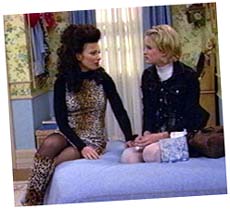
One such issue is the aforementioned dearth of available Jewish men of a certain age and socioeconomic status. After the nanny falls for Professor Goldberg, she tells Sheffield's daughter Maggie that they are both smitten with the same man. Maggie is upset, but the nanny begs her permission to date the professor. "You're so young and blond and rich, you could have a zillion goyishe guys. How many gorgeous Jewish guys that are still single at my age are there? Please, Maggie, let me go out with him."
It is an uncomfortable scene, the dark-haired Jewish woman begging the indulgence of the blond shiksa, but it's rooted in something real--the enfranchisement of Jewish males at the expense of Jewish females.
It is true, of course, that 50 percent of Jewish men still marry Jewish women. And it's true that many Jewish men adore Jewish women, even the dark-haired, complicated ones. And in a phenomenon that partially explains The Nanny's success, plenty of non-Jewish men are attracted to dark-haired and complicated Jewish women (President Clinton, for example).
It's also true that too much can be read into a few episodes of The Nanny, which is, at the end of the day, nothing more than a mediocre-to-bad sitcom. The Jewish people have survived worse things than even really bad sitcoms, which is another reason I've lately become more tolerant of The Nanny. I used to be hard-core on the subject of Jewish stereotyping, but I'm lightening up. The thing of it is, some of the stereotypes are benign, and quite hysterical. Take Yetta, the nanny's loopy yet savvy grandmother--a fine Jewish stereotype (who, in a recent episode, had "My Yiddishe Momme" sung to her by Ray Charles). She reminds me of my sainted grandmother, whose favorite restaurant, she says, is God Forbid It's Friday, and who, after seeing Titanic, issued this three-word review: "Too much water."
Drescher's character, when you look beyond the big hair, horrible voice, and terrible clothing, is actually quite appealing. She is warm, kind, and street-smart. Anti-Semites will find in her character reason to hate Jews, but anti-Semites find in El Niño reason to hate Jews. If it's a choice between secularized sitcoms such as Mad About You and The Nanny, which, while sometimes embarrassing to Judaism, are unembarrassed by it, I'll take Fran Drescher. After all, any sitcom that hires Ray Charles to sing "My Yiddishe Momme" can't be all bad.