Let's Get Those Phones Ringing!
The cunning genius of the public radio fundraising drive.
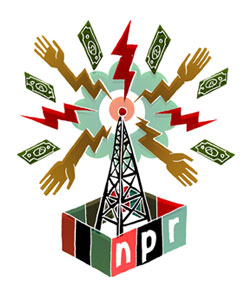
Public radio giant WNYC began its fall pledge drive this week, unleashing a battery of appeals for listeners to donate in exchange for moral satisfaction or a chance to win a trip to South Africa. In March, June Thomas explained public radio's 10 most effective fundraising strategies. The article is reprinted below.

If you're a public radio addict like me, you know the despair of waking up on a winter morning, turning on the radio, and hearing not the reassuring tones of Renee Montagne and Steve Inskeep but instead the jarring sound of your local host begging for money. At least twice a year, stations across the land withhold Nina, Cokie, and Sylvia and devote precious drive-time minutes to fundraising. It's maddening, in part because it reminds us how hopelessly hooked we are. Even after days of interrupted news shows and hundreds of requests for contributions, we still can't bring ourselves to shift our allegiance up or down the dial.
Pledge drive is last-nerve-frayingly exasperating—but it's also sheer genius. One recent weekend, I fast-forwarded through the actual programming and listened only to the sales patter, focusing on the winter fundraising campaigns of WAMU in the nation's capital and WNYC here in New York. What I found was a band of ace pitchmen who know their audience better than we know ourselves.
Herewith, a list of public radio's 10 most effective fundraising strategies.
1. The perfect gift
Over the years, the good people at public radio have discovered that there are a few choice items that listeners just cannot resist: subscriptions to The New Yorker; new releases from Bob Dylan, Bruce Springsteen, or singers of jazz standards; and commuter mugs. But perhaps no item is more fetishized in on-air promos than the eco-tote. These logo bags appeal to members' green consciousness and to their homespun sense of style. (WAMU's lovingly detailed description of its tote's dimensions—"10 inches deep!"—is oddly titillating.) The bags also smugly announce to the world that the bearer isn't a freeloader: "While you're carrying that shopping bag throughout the market, everyone will see the WNYC logo and know that you supported …"
Click on the player below to hear two odes to totes.
2. The guilt trip
In all the U.S. cities where I've lived, no mainstream media outlet has come close to the local public radio station when it comes to reporting on the lives of the urban poor. WNYC deserves $60 from everyone in New York City with an annual income over $40,000 purely on the basis of its amazing "Radio Rookies" project, in which radio pros train inner-city kids "to use words and sounds to tell true stories." So who can blame the stations for stressing this kind of coverage at pledge time? No matter how many minutes of each hour are pre-empted by pitching, WNYC always finds room for stories from the outer boroughs. On the first day of this year's winter drive, a piece about ACORN working to protect low-income Queens residents from eviction was followed by a plea for support. In other words: Hey, liberal, are you sure you'd rather spend your money on a new iPhone case?
3. We're here for you—now be there for us
Radio is the loneliest medium, the one we most often experience in solitude. Public radio pitchmen cleverly exploit this by convincing listeners that this solo activity can be a form of community service. For all the talk of membership and community, you'd think sending a check to your public radio station was a social event on a par with buying a round of drinks at the local pub. A WAMU pitchwoman promised that "there is no wall between our audience and our content. … We're in this community; we're going down this path together."
Click on the player below to hear This American Life's Ira Glass describe listening to public radio as a quest for connection.
4. Your bill is past due
The New York Jets would never let fans into the big game for free and then request donations as they leave the stadium. Public radio gives away its product and then asks listeners to pay once they're hooked, like the mythical schoolyard drug slinger. The strategy here is to remind listeners how much they rely on public radio (rely is probably the most oft-repeated word during these campaigns) and to ask them to put a price on their dependence. Most stations play it straight—"Think about how much you use WAMU and how you would quantify that in terms of your budget if you received a bill only a couple of times a year." Sometimes, however, this tactic can feel overbearing—and off-putting. When a host throws out a virtual bill ("WNYC pays over $5 million a year for NPR News and the BBC"), I want to send it back unpaid—I didn't order $5 million worth of news and information.
Click on the player below to hear WNYC's Soterios Johnson deliver an on-air invoice.
5. Flattery
As a wag once wrote, "More people are flattered into virtue than bullied out of vice." Without ever mentioning their cousins in commercial broadcasting, public radio fundraisers butter up their listeners by suggesting that writing a check makes them far more sophisticated than the sheep who suffer through the other guys' ads: "Do more than just listen—become an active participant with your public radio station through a contribution to help support the programs." Fundraisers never underestimate the value of a compliment: "A commitment to lifelong learning and a commitment to intellectual curiosity are just two of the shared values that we have in common with our entire radio community here at WAMU." That's right, public radio is for smart people—and really smart people donate.
6. Only you can save journalism
In December 2008, NPR cut 7 percent of its workforce and canceled two shows (including Day to Day). Still, member stations have used the malaise in the rest of the industry to their advantage. The 2009 winter fundraising drives featured more reflections on the sad state of for-profit journalism than ever before. WNYC's news chief reminded listeners that "we're in an environment where a lot of outlets are cutting back their coverage, cutting back on their reporters," while WNYC is launching new shows and new initiatives. Radio Lab's Jad Abumrad stressed public radio's "civil" tone—"the reason you come to public radio and to WNYC is because you want the news put to you directly … but you don't want it all sexed up with hype and with sensationalism." Another WNYC spot made a subtle political appeal: "Newspapers, radio stations, TV channels—they may be reporting the news, but they're also trying to turn a profit. That's harder than ever right now. There's so much pressure to cut corners, reduce news-gathering, and make the share-holders happy. At WNYC, we don't have share-holders. We have listeners." Don't trust the capitalist press, comrades! Now give us some money.
Click on the player below to hear three pitches that invoke the sad fate of journalism.
7. You're not just helping us—you're helping your fellow listener
Public radio fundraisers are masters of the moment, able to turn any trend to their advantage, even a dire economic crisis. This year, it's impossible to ignore the frugal tenor of the times—so WNYC's Jad Abumrad made an explicit call for still-solvent listeners to contribute on behalf of their less fortunate brethren: "A lot of WNYC members and listeners have lost their jobs, lost their businesses. So, let me just sort of put a message out to the people who, you know [raps on table], have not lost their jobs, and to say, consider making an additional pledge, an extra $20, an extra $30 to help cover those people who right now are listening, relying on public radio, but they can't—they're not in a situation where they can make that pledge just now, and they'll get there next time."
Click on the player below to hear Jad Abumrad talk his way around the recession.
8. Niche marketing
The best of public radio's weekend shows have distinct personalities: the discursive storytelling of This American Life, the self-deprecating bickering of Car Talk, and the cozy in-jokes of A Prairie Home Companion. All these shows produce special pledge editions, pitching in their signature styles. Ira Glass clearly missed his calling in sales; he is a master of the "ask." He appeals to his people in their native tongue, sarcasm, calling on them to show their love for the show rather than the station it happens to be playing on: "There is one sure way that you can send a signal to this radio station that you like this program, and that you want them to continue running this program, and that is to call right now. …. Not later, not in an hour, during that other show that comes after us."
This American Life has another approach to fundraising, one that only a secret policeman could love. They ask listeners to "turn in your friends and loved ones who consistently listen to This American Life and other public radio shows, but never pledge." Ira Glass then calls up some of these delinquents and shames them on-air. As someone who grew up with scary ads for the BBC's TV-license detector vans, I find these spots thoroughly creepy, though I'll concede that they're memorable and almost certainly effective.
Listen to Megan, Paul, and Kathleen get caught in the act of not donating; for a transcript of the Megan call, click
9. The match game
There's no math section on the public-radio-host aptitude test. I know this because every time a station announces a "2-for-1 match" in progress—that is, some beneficent superdonor has agreed to double each regular member's contribution during a set time period—they feel compelled to do the sums. Badly. "That means if you donate $60 before noon, it's worth $120 to WNYC. If you donate $75, it's worth $140, I mean …" These matches engender skepticism in public radio haters, who believe the challenges are bogus—the superdonors are going to give a set sum come what may—and suspicion in even the most loyal listener. Matches do generate a sense of urgency, but the tactic can also be counterproductive since some listeners may delay their pledge until a match is in effect, by which point second thoughts set in.
10. Stop me before I pitch again
The last day of a campaign is the best time to listen, and not just because it's almost over. The staffers are so slap-happy, they start to mangle the phone number they've repeated thousands of times, and the unintentional comedy that results can be highly entertaining. At the tail end of a weeklong pledge drive, station staff members are at their loopiest. (The backroom staffers, who only appear on-air during pledge drives, seem to get particularly punch-drunk in the final days.) Yet smart stations turn even this cabin fever to their advantage—public radio listeners are sensitive people, the thinking surely goes, perhaps they'll take pity on these poor souls and call in a pledge to spare them further embarrassment.
Click on the player below to hear a WAMU staffer's rambling but brilliant final-day anecdote.
Personally, I prefer to donate on my own schedule, rather than succumb to the nagging of a pledge drive. In other words, I'm an easy target for yet another arrow in the public radio quiver: Give early and shorten the fund drive. I'm also, however, a sucker for the right gift. This year I couldn't resist the umbrella. It's "lightweight, yet sturdy"! It has a "molded hand grip"! But most important, it's got that WNYC logo, so everyone knows I've done my part to help pay for the kind of quality, in-depth reporting New Yorkers have come to rely on from their public radio station. Shows like The Takeaway and—Oh God, I really am brainwashed.
Does your local station have a particularly effective fundraising tactic? Tell us about it in the Fray.