HOME / poem: A weekly poem, read by the author.

"The Darkling Thrush"Thomas Hardy's timely meditation on the turning of an era.
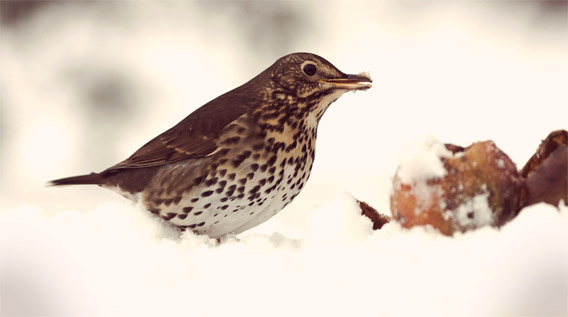
This month's classic poem is Thomas Hardy's "The Darkling Thrush," which Hardy dated "31 December 1900": the last evening of the 19th century. More than a decade ago (June 1998), as the millennial year approached, I offered Slate readers "The Darkling Thrush" as a hard-to-equal model for responses to the turn of a millennium.

Now, at what many hope is the start of a new era, and in time for the new year, here again is Hardy's vividly described little bird with its blend of comedy and pathos. The "blast-beruffled" thrush in its wintry landscape may represent Hardy's bow of his head toward John Keats and Keats' great "Ode to a Nightingale" of May 1819—when their century was much younger.

Expressively tentative or qualifying phrases like the repeated "seems," "I could think," and "I was unaware" enact Hardy's somewhat skeptical holding back from any declaration that the natural surroundings reflect his mood or the human calendar. The poet is alone, and he ends the first half of the poem with the word I: That pronoun suggests, to me, that the "fervorless" or haunted or corpselike quality of the landscape—like the bird's putative "hope" later—is something that the subjective observer at least half creates.

I leant upon a coppice gate
…..When Frost was spectre-gray,
And Winter's dregs made desolate
…..The weakening eye of day.
The tangled bine-stems scored the sky
…..Like strings of broken lyres,
And all mankind that haunted nigh
…..Had sought their household fires.

The land's sharp features seemed to be
…..The Century's corpse outleant,
His crypt the cloudy canopy,
…..The wind his death-lament.
The ancient pulse of germ and birth
…..Was shrunken hard and dry,
And every spirit upon earth
…..Seemed fervorless as I.

At once a voice arose among
…..The bleak twigs overhead
In a full-hearted evensong
…..Of joy illimited;
An aged thrush, frail, gaunt, and small
…..In blast-beruffled plume,
Had chosen thus to fling his soul
…..Upon the growing gloom.

So little cause for carolings
…..Of such ecstatic sound
Was written on terrestrial things
…..Afar or nigh around,
That I could think there trembled through
…..His happy good-night air
Some blessed Hope, whereof he knew
…..And I was unaware.

31 December 1900

…………................……—Thomas Hardy

Click the arrow on the audio player to hear Robert Pinsky read this poem. You can also download the recording or subscribe to Slate's Poetry Podcast on iTunes.

Slate Poetry Editor Robert Pinsky will be participating in the Poem Fray this week. Post your questions and comments on "The Darkling Thrush," and he'll respond and participate.

Print This ArticlePRINTEmail to a FriendE-MAILShare This ArticleRECOMMEND...Get Slate RSS FeedsRSS
Former Poet Laureate Robert Pinsky's latest book of poems is Gulf Music.
COMMENTS

Remarks from the Fray:

Let's assume that the scene reflects a mood that may strike us at any time, one in which it seems that "The ancient pulse of germ and birth/Was shrunken hard and dry". Of course, the life cycle has not ceased, children will be born, grow old, and die, just like the Century, but for the moment this is mere fact; we are not able to feel the consolation that generation affords in the face of mortality, we see only the end. Marriage bed and death bed have collapsed into one. This pulse of germ and birth may also suggest the activity of imagination, giving life to the insensate earth, so that in its dessication nature and "art" have failed together. Certainly the image of "bine-stems" as the broken strings of a lyre reinforces this notion of joint dependency and joint failure.

What, then, does the thrush offer? It is difficult not to "read" the thrush as the poet, but the distinction seems to be pointed. Yet if the thrush is not art, and not nature, what remains but the religious "Hope" that transcends both and eludes the poet? This seems obvious, but is not a satisfying last word for much of the modern audience, because it leaves the human behind. This of course may be just the point: the speaker, who cannot go beyond the human, is forever cut off from religious consolation even as it calls to him. Why, then, does the poem leave us with an impression that is not finally desolate? Perhaps because the thrush, looked at from another angle, does in fact undercut the speaker's despair, embodying the living unity of art and nature, the pulse of life, that, like the spring, will after all return, although not as a "Truth" transcending human life. Not to glide over the point: the loss of Truth is a real and permanent loss, but it is not in our nature to live in perpetual winter without an answering song, and that song will return in the face of, and even, sometimes, in the form of, the death lament.

--Leontes

(To reply, click here.)

I have loved The Darkling Thrush since I read it in school. There is such a vibrating discord between its elegant diction and sprightly rhythm and the grotesquely grim--comic and nearly crude vision of his feelings and times. I read it alongside of the one that preceeds it in his collected poems, The Last Chrysanthemum. Five of its six stanzas ask what the flower had in mind, what reason, for its heedless bloom in the time of year when "flowers are in their tombs." In the last stanza the speaker wonders why he speaks of the flower as if it "were born/ With sense to work its mind" and he concludes "Yet it is but one mask of many worn/ By the Great Face behind." It is hard to see in either of these poems Hardy in propria persona answering his real questions with either real hope for real despair or real submission to the designs of the Great Face. He often uses naive or faux naif or disingenuous speakers.

This is the poet who delights in extravagant rhetoric from early on in his career. How not love "The smile on your mouth was the deadest thing/Alive enough to have strength to die" from Neutral Tones? The "Great Face" and "blessed Hope" are not too far from this extravagance.

--Barry Goldensohn

(To reply, click here.)

I read the final stanza as expressing Hardy's apprehension of the irreconcilability of the "ecstatic" song of the thrush with the surrounding corpse-like world. The first two stanzas detail Hardy's vision of the world, and the third places the song in that world and describes it. The final stanza considers the song and the world together. Hardy characterizes the irreconcilability of the song and the world as best he can: he says that nothing in the world could "cause" or account for the song, and so (a) one might postulate that the thrush has an inner awareness of a "blessed Hope" that allows the thrush to create the song, and (b) Hardy "could think" that he hears in the thrush's song this blessed Hope, the awareness of which by the thrush is required for the song. It is not Hardy's intention, I suggest, to say that he hears, even dimly, the blessed Hope in the song or that as a result of the song he is willing to postulate the existence of the blessed Hope, Introducing the blessed hope into the poem is simply a means to express the incomprehensibility of the thrush's song in the world: it is so incomprehensible that a listener "could think" that he or she hears in the song a blessed hope the maker of the song is responding to.

--Greg Mougin

(To reply, click here.)

This poem hit me very deeply: the mix of overbearing desperation, purposelessness, and ennui with a profound longing for something more, some tentative hope or answer on the horizon -- all encapsulated in a poem that offers no true resolution but rather rests on a sense of anxiety and skepticism, an equivocation between optimism and pessimism that lacks any sheer conviction. For example, Hardy only "could think" there "trembled" through the thrush's air some hope, but he is far from sure, although it is as if he wants to be. This seems to me to be a very religious and existential poem, where the thrush represents a sense of hope and faith in the ways of the world, in imparting meaning on "terrestrial things," whereas Hardy is more skeptical of any type of faith that will bring him above his gloom. He seems to mourn for the fact that he is not privy to the almost juvenile joy of the thrush, like an atheist who is always unconsciously mourning for some lost god. Either way, Hardy seems to be a forbear of a modernist kind of skepticism and vacillation between hope in progress and desperation in the face of disaster, with no clear answers to be found.

--swimimng_icarus

(To reply, click here.)

Hardy uses subtle chafings at self-imposed limits to show his words stretching, deliberately ineffectually, towards the ineffable which can, if conditions are right, be intuited but not spoken. Perhaps that's what modern poetry is? A via negativa, a lonely haunting of once-sacred spots, an overhearing of a strange, unsanctioned music which might or might not any longer be redemptive, a "desolate" searching in the fading light for numinous signs? The authenticity of the experience in "The Darkling Thrush", as in so many Hardy poems, comes not from fulfillment but doubt, not from messages but withholdings, from a mind showing how it is possible to dwell in uncertainties, to find beauty in absences and, if they are seized hold of in language acutely enough, poetry in the very feelings of finitude, incomprehension and unawareness.

--Nicholas Jenkins

(To reply, click here.)

Tonight, I can't help seeing the thrush as a figure for "the poet" himself, the self-deluded nineteenth-century Romantic, finding his meanings in the landscape as if the landscape were all laid out for his sole benefit. And the last line is a strong anticlimax, a kind of wry punchline, at once self-deprecating and proud; by confessing that he is unaware of the hope, Hardy puts himself above that shopworn idea of poetry, and casts himself as a more sophisticated and truthful, if sadder, type of poet than the one the bedraggled thrush signifies.

If you read the poem this way, Hardy's distancing himself from that bird was indeed prophetic of the role of the poet in the 20th century. But what about the 21st?

Do we still want to be unaware of the hope? Do we still notice and hear the song of the thrush? Or is there another sound we are listening for as we lean upon our own coppice-gate?

--Annie Finch

(To reply, click here.)

(01/03)

What did you think of this article?
Join The Fray: Our Reader Discussion Forum
POST A MESSAGE | READ MESSAGES
TODAY'S PICTURES
TODAY'S CARTOONS
TODAY'S DOONESBURY
TODAY'S VIDEO
Knockout punches. 87/090709_TP.jpg
Cartoonists' take on the stimulus package.60/090709_TC.jpg
The bonds of love.23/090709_TD.jpg