Learning by Ear
The many moods of John Adams.
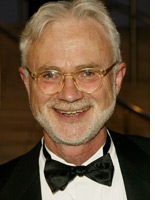
Listeners hoping to find out what kind of composer John Adams is are unlikely to get much help from John Adams. In his new memoir, Hallelujah Junction, Adams writes that composition is "fundamentally intuitive," but it is also, he says, a "rational" process that "takes time and effort." He was early on attracted to music that "embraced pulsation and repetition." He was also repelled by that music's "tiresomely uniform surfaces." Harmony, more than melody or rhythm, is the "DNA" of a composer's style—except Adams' style, which has rhythmic, "dance-like roots." In the classical-music world, Adams is seen as a sort of late-career Picasso: a star, a standby, a one-man manufactory of brilliant, audience-friendly work. Hallelujah Junction doesn't overturn these perceptions, but it adds a surprising hue of restlessness and uncertainty to the portrait. One of America's most accessible living composers turns out to be one of the hardest to pin down.
Adams leads the first generation of post-Sgt. Pepper classical innovators. A lot of lore hangs on this cultural fact. As a student in the '60s and early '70s, the story goes, Adams was spinning dizzily between 12-tone-tinged serialism and the chance music of the avant-garde. Meanwhile, he was absorbing innovative '60s rock in a way that would, a decade later, help him discover his unique "voice"—one that abandoned obscure forms for late-Romantic largesse and the toe-tapping appeal of pop and jazz. If you enjoy the Magical Mystery Tour but can't see the point of 12-tone music, this is exactly the sort of self-discovery story you want to hear.
It's an incomplete one, though, as his memoir attests. Adams finds his musical "voice" on Page 88 of Hallelujah Junction. In the ensuing 230 pages, that voice is recalibrated or significantly transformed at least five times. Ultimately, he looks less like someone who's sailed a still and steady course than an artist who's spent his career bending, swaying, and carefully rebalancing to surf inclement waves.
Adams came of age at a time when being an American composer—and a popular one—was no longer frontier territory. Gershwin, Copland, Bernstein, and Barber set the archetype so firmly that the pubescent Adams staved off loneliness by inventing an imaginary hero in their mold, a local "New Hampshire composer" called Bruce Craigmore (a name ripe for a flannel-wear label somewhere). Maestro Craigmore eventually went the way of all fantasies, but Adams' musical interests did not. He gained virtuosity on the clarinet, his father's instrument; finagled the best available education in theory and conducting; fomented various wiseass insurrections against his teachers; and, rakishly, named "my libido" his prized possession in the school yearbook. The editors, less rakishly, assumed John Adams' libido was an instrument.
Harvard, where he landed in the fall of 1965, should have borne these talents to fruition. Its composition program was first-rate. Adams shone as a clarinetist and conductor and discovered a careerlong interest in electronic music. But he reports being more musically stimulated by rock-saturated "parties of pot, scotch whiskey, and unfiltered Lucky Strikes" than by classroom technique; his only full-length composition in college was an academic requirement. By the spring of his senior year, classmates were storming Harvard's administrative building, buffeted by hostile policemen, and Adams was abusing pharmaceuticals to ensure he'd fail his draft-board exams. In 1971, after a short, halfhearted fling with graduate school, he left New England and Kerouac-ed it to San Francisco, where he eventually took a teaching job and, six years later at the age of 30, heard the premiere of what he describes as his first mature composition, a piano piece called Phrygian Gates.
The cycling, modal atmospherics of Phrygian Gates were a slap in the face to the work of his 20s, work that at one point incorporated the sound of flies on dog pooh. Where those efforts were conceptual (or aspiring in that direction), this was sensual. Where Adams' previous approaches denied the ear's expectations, this music rode them.
When he lucked into his first symphonic commission, he tried to carry the aesthetic of Phrygian Gates over to the orchestra and chorus. The result was revelatory. "The premiere of Harmonium … took almost everyone, including its composer, by surprise," he writes. When oscillating textures and sustained harmonies like those in Phrygian Gates are scored out for a Mahler-type ensemble, the result isn't just an expansion of the same idea. It's almost a different music:
This became the quintessential early-Adams sound: long brass crescendos and braided suspensions over a chattering orchestra, rhythmic counterpoint struck through with syncopation. It's a musical language that's eloquent on its immediate terms—sonorous, majestic, and kinetic—and it made Adams' career. Later, that buoyant, multitextured quality would flavor even his smaller-scale work, like the 1998 two-piano piece Hallelujah Junction. (Compare this with the piano sound of Phrygian Gates, before he'd wrestled out his symphonic style.)
And yet was this his sound? Over the next couple of years, Adams wrote the supertoothsome Grand Pianola Music, which he describes as " 'Hammerklavier' head-to-head with Liberace cocktails" and which some of his friends described as "absolute shit." (The piece was inspired by watching pianist Rudolf Serkin while on acid.) Then an aloof, hourlong electronic piece. Then Harmonielehre,a lush symphony dressed in chromatic harmony (think Wagner). Then his first opera, Nixon in China, which was none of these things. Nixon won a Grammy, an Emmy, and a Great Performances spot, and it made Adams famous:
The underlying style here—the clipped, rhythmic chugging with abrupt, often stepwise shifts in harmony—is high Minimalism, an idiom most famously pioneered by Philip Glass and one that anchored Adams through these first years of experimentation. At its worst, Minimalism of this sort can sound like the soundtrack to a Nova documentary about sun spots. Adams, at his best, set its high watermark. The style attracted him, he says, partly for its scale and openness; it also (though Adams doesn't spell this out) tends to change harmonies in a way, and at a pace, similar to a lot of the popular music he heard in college. Minimalism was Adams' lodestar until the early '90s. Then he abandoned it.
Trying to describe Adams' "voice" from that point is like trying to get a very fast bug under a jar. His second opera, The Death of Klinghoffer, a dreamlike, macabre piece about Palestinian hijackers, gave way to the Chamber Symphony, which is a Bronx cheer in the face of Phrygian Gates' broad consonance:
From here, he wrote for musicians playing simultaneously in different tempos. He composed an ill-received pop musical about an "earthquake/romance" in Los Angeles. He collaborated on a multimedia nativity oratorio with a "Hispanic flavor"—and then an opera set at the A-bomb test site (which opens at the Met this week). Adams' 2003 Dharma at Big Sur was a raga-influenced concerto for a six-stringed electric violin over an orchestra playing on a nonstandard scale. (Imagine jimmying with your piano such that the white keys are ever so slightly displaced from their usual pitches.) This elaborate gambit crashed and burned at the premiere. Still, Adams thinks he was maybe onto something. He'd used quarter-tone ensemble—a different kind of nonstandard-tuning arrangement—a year earlier in his 9/11 memorial, On the Transmigration of Souls. That piece, whose delicate score uses recorded city sounds, a libretto of found text, and a trumpet quoting Charles Ives, comes at the listener with chilling intimacy:
Adams says he vacillates between loving On the Transmigration and finding it "a dud." Readers of his memoir will get the sense he vacillates a lot about his work—and, in an equal and opposite way, about his audience. He is deeply attentive to listeners' reactions, reveling in "audience excitement." Yet he also suggests that innovative music must meet with audience resistance "before eventually being understood and appreciated." At one point, he knocks "the musical amateur" whose interests end at Bach and Mozart. At another, he knocks "listeners overburdened with good taste." Probably, readers should not overburden themselves trying to puzzle this one out.
Fickleness is often defensive. New classical music lies at the bottom of a canyon carved by hundreds of years of effluence. The risk of getting lost or buried in the landscape is acute. The trouble isn't that the art has atrophied since Bach or Mozart. The trouble is it's grown. In 1770, there was effectively one style of contemporary "high" music in the West; by the 1930s, composers as different as Schönberg, Gershwin, and Rachmaninoff were vying for the American concert hall. What classical music is—and what, if anything, that distinction preserves—gets even fuzzier in an age of high-concept rock and avant-garde jazz. What does a classical composer do that no one else does?
That question is the backbone of Hallelujah Junction. And it's a testament to the nuance and candor of Adams' memoir that the book never settles on an answer. (The closest he comes is a deeply weird conclusion urging listeners to take some "hints from evolutionary science" and resist seeing music as teleological "progress.") Instead, we find an artist hunting for the golden thread to seal a restive, uncertain career. "The 'next' piece ought to be the 'best piece,' the living proof that the disparate elements of my musical language … have once and for all come together in a single statement of confident, unblemished perfection," he writes. "But that is never the case." In the end, it is the looming sense that Adams hasn't found his voice—not quite, not yet—that makes this book so gripping and his art so real.