
Wage Against the Machine
If Costco's worker generosity is so great, why doesn't Wal-Mart imitate it?
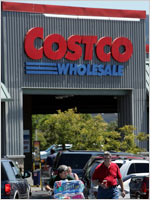
Nearly everyone who's looked at Wal-Mart's practices as an employer—its union busting, sex discrimination, low wages, and minimal benefits—has concluded that it's America's retail bad guy. By contrast, many who've examined the practices of Wal-Mart's competitor Costco—including New York Times labor reporter Steven Greenhouse in his recent book The Big Squeeze: Tough Times for the American Worker—conclude that it's the good guy. Costco CEO and founder Jim Sinegal repeatedly insists to Greenhouse that treating employees well is "good business."
That makes a pleasing sound bite, and assume for a moment that Sinegal's assertion is true. Why, then, wouldn't Wal-Mart do everything it could to make itself more like Costco? Now assume that Sinegal's assertion is false. Why, then, does Costco treat employees better if that's against the company's financial interests?
It's not hard to make a case that Costco pays employees more. The most relevant comparison is between Costco and Sam's Club, Wal-Mart's membership warehouse, since both business models rely on membership fees for a large percentage of revenues. A Sam's Club employee starts at $10 and makes $12.50 after four and a half years. A new Costco employee, at $11 an hour, doesn't start out much better, but after four and a half years she makes $19.50 an hour. In addition to this, she receives something called an "extra check"—a bonus of more than $2,000 every six months. A cashier at Costco, after five years, makes about $40,000 a year. Health benefits are among the best in the industry, with workers paying only about 12 percent of their premiums out-of-pocket while Wal-Mart workers pay more than 40 percent.
Some proponents of corporate generosity argue that better-paid workers are more productive. That may be the case here, since Costco's revenues per employee are about five times as high as Wal-Mart's. (No separate financials are available for Sam's Club.) Then again, it's also the case that Costco sells more expensive stuff—high-end French wine, triple-cream brie, and Cartier watches, all of which presumably have high margins—along with the cheap toilet tissue. Take a look at the two retailers' summer offerings: While Wal-Mart sells a $199 swing set, at Costco we find a "summer fortress play system" for $1,499.99. A set of patio furniture at Wal-Mart was $199 in early summer; a patio heater at Costco is the same price. Costco's Web site promotes a $5,000 hot tub with a stereo. On Wal-Mart's site last week, the most prominent item was a $48 bike—after all, its impoverished customers can't afford gas these days.
Another theoretical benefit is that Costco employees, being better paid, are less likely to leave the company. Again, some data back that up: Greenhouse points to Costco's low turnover rate, which is 20 percent and, among employees who stay at least a year, 6 percent. Wal-Mart's is about 50 percent. But is this a business advantage for Costco? While Greenhouse points to the costs of training and hiring new employees, a widely leaked 2005 memo from Wal-Mart offers a different perspective. In it, Wal-Mart's senior vice president of benefits argued that the company's turnover rate was too low. After all, she explains, long-term employees are more expensive and not necessarily any more productive. Such reasoning—though sinister—may actually help explain why Wal-Mart's profit margins are twice as high as Costco's (3.36 percent compared with 1.75 percent).
In an interview, Costco CFO Richard Galanti told me that by offering higher pay, Costco can hire "better-quality employees." To Galanti, workers are a retailer's "ambassadors" to the public. Costco may be able to attract people with more experience, education, or a better "attitude" (e.g., a more obliging smile or the realization that it's better not to chew gum or file your nails on the job). All of that's probably true, though tough to quantify—and tougher still to measure the effects of such worker quality on Costco's business.
Even so, investors in recent years have rewarded Costco significantly more than Wal-Mart, which may suggest that Wal-Mart's public black eyes scare Wall Street to some degree. Probably the worst publicity Wal-Mart has received for its employment practices was in 2004 and 2005. During these two years, developments in the sex-discrimination suit drew attention to its plaintiffs' charges; numerous communities blocked Wal-Mart from expanding stores; many news stories exposed child labor, overtime abuses, and exploitation of undocumented immigrants; labor and community groups were constantly picketing the retailer; and two well-funded national organizations formed with the express purpose of publicizing Wal-Mart's crimes against its workforce. All of this may have had some effect: From Jan. 1, 2004, to Jan. 1, 2006, Wal-Mart's stock was down 9.7 percent. Costco's went up an impressive 37 percent during this time. (The S&P went up 14.5 percent.)
In the subsequent two years, the discrepancy has only deepened, tending to confirm Galanti's argument that in the long term, higher wages are "a great model." Indeed, analysts' consensus on Costco's long-term growth expectations is better than their consensus on Wal-Mart: 13.3 percent as opposed to 11.7 percent, respectively. That's intriguing because Wal-Mart is more profitable and has demonstrated better earnings growth (12.47 percent five-year earnings-per-share growth as opposed to 9.8 percent for Costco). Employee relations may be part of the picture, but Galanti points out there are many other reasons for analysts' confidence in Costco. "Seventy percent of our earnings come from membership fees," he says. "We'd really have to screw up to lose that!" Costco may also be more recession-proof than other discount retailers, because its customers are richer and because it sells so much food relative to other goods. "Even in an economic downturn," Galanti says, "people still have to eat."
So why does Costco bother being nice to workers, given that it is so difficult to calculate a clear payoff for decency? One reason is old-school: a union. About 11 percent of Costco's 127,000 employees are represented by the Teamsters Union, while not one Wal-Mart employee is a union member. Not that Costco is a Swedish paradise of labor-management cooperation. "We wish they [the union] weren't there," Galanti admits, "because we don't feel we need a third party to talk to our employees." Yet the relationship shows that even a lackluster union like the Teamsters can help make life better for employees.
Another factor is the personality of the CEO. In my interview with Galanti, he mentioned Jim Sinegal every couple of minutes, attributing the company's high wages to the CEO's personal values. CFO Galanti acknowledged having at times argued with his boss, urging him to curb Costco's generosity on health care. (Sinegal eventually agreed with him, reluctantly, in 2003 but insisted that care remain affordable to employees.)
Sinegal's kindliness is impressive, but he's also 72 years old and thus won't be around forever. Perhaps he's created a corporate culture strong enough to outlast him, but that's impossible to predict. And until Costco boosters can make a concrete case that the company's generosity—however welcome—has a duplicable effect on the company's bottom line, it seems unlikely that a crowd of Jim Sinegals is going to emerge in the nation's executive suites.