Earth Chats: Bill McKibben
If we don't slow global warming through growth control, we'll have to fight its disastrous effects.
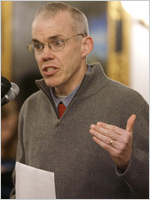
Slate invited author Bill McKibben to take readers' questions on Washingtonpost.com about solving the climate-change crisis. An unedited transcript of the chat follows. See the schedule of Slate's upcoming Earth Chats.
Stockholm, Sweden: In light of the current food crisis (partly as a cause of the wrong-headed "biofuel" solution) and with the rise of China and India to American levels of consumption, and the hemming and hawing of politicians, just how hopeless is the climate problem? For me? For my children? For my grandchildren?
Bill McKibben: It's on the edge of hopeless—the scientists are telling us now that going past 350 parts per million co2 means massive climate disruption. We're at 385 ppm right now—and what do you know, the Arctic is melting.
That's why we've just formed 350.org. May analysis is that the next round of international climate negotiations, set to conclude Dec 2009 in Copenhagen, are the last real bite at the apple. If we can somehow do the massive political lifting between now and then to get a strong treaty, well, we have a chance.
_______________________
Albany, N.H.: A small group of us have started to meet to discuss ways that we can start to relocalize our community of approximately 750 people. Roughly 5/6 of our town lies within the White Mountain National Forest, and we have little industry. Most people are employed out of town. We initially are focusing on food and energy. Any thoughts or ideas would be greatly appreciated.
Bill McKibben: Your town sounds like mine (except we're in the Green Mountain National Forest). Food and energy are the places to begin, because they're so central, and because the centralized approaches are starting to break down. But don't neglect culture either—local music is a remarkably good place to start.
Local farmers market? Small scale hydro? Check out the work that's going on in the UK with the Transition Town movement, and in this country at the post-carbon institute.
_______________________
Chicago: Isn't it true that solar activity appears to be the principal driver for climate change, accompanied by complex ocean currents that distribute the heat and control local weather systems?
Bill McKibben: No. Solar input has fluctuated very little in recent times, nowhere near enough to explain the sudden surge in temperatures. The only thing that does is anthropogenic emissions of carbon dioxide. We're taking a couple of hundred million years worth of carbon and tossing it up into the atmosphere in a century. Given what we know about the heat-trapping power of co2's molecular structure, the resulting warming should come as no great surprise—and the scientific consensus behind it is now very strong
_______________________
Vancouver, B.C.: I'm sorry, I have not read your book (give me time!), so forgive me if you've covered this previously. How do societies with large families because of religious beliefs cope with steep population growth? Changing secular policies (e.g. China) is easy compared with changing centuries of religious teaching limiting birth control.
Bill McKibben: Don't worry overmuch about religious strictures and their effect on population. The two countries with the lowest birth rates on earth, Italy and Spain, are the two most heavily Catholic countries on the planet. Ditto for Mexico and Brazil in the developing world. (to the degree that the Catholic church is an effective part of the education system in the developing world, it's probably actually contributing to cutting birth rates). At the moment, the most pressing question for climate change is how to bring consumption rates down.
_______________________
Montpelier, Vt.: Hey, Bill. I'm wondering, what do you think of Lieberman-Warner? A step in the right direction that should be supported, or a "least we can do" approach that kills the momentum toward better, more substantial policy?
Bill McKibben: It clearly needs to be much stronger—and it clearly needs to be seen as, at best, a first step in the two-step process that leads to a strong international agreement soon. A particularly important provision is that, as Barack Obama has insisted, all the carbon permits in the Lieberman-Warner bill need to be auctioned off with the proceeds for the public, not given away to industry
_______________________
Burbank, Calif.: If growth is not a good sign of economic strength, is the converse true? In other words, we generally define recession as two consecutive quarters of economic decline, but might slow growth be almost as important a warning of economic troubles?
Bill McKibben: My guess is that we may be reaching the point that people have predicted for some years, where the confluence of limits that we're reaching begin to make continued progress along our old path of economic growth unlikely. That is, one part of our current problem is the credit crunch stuff. But another is the skyrocketing price of energy, now beginning to mix in with the price/availability of food, and both of those impacted in various ways by climate change. I wonder if this won't turn out to be not just one little downturn in our economic cycles, but a break point
_______________________
Washington: There has been a lot of media attention lately focused on the question of how much it will cost to address climate change. Doesn't this assume erroneously, that the actions we need to take to reduce greenhouse gas emissions cost money, when in fact they often save money? Shouldn't we be talking about how to profit from solving climate change?
Bill McKibben: Sure, it's good to focus on that. It's also good to focus on how much it will cost if we don't take action. Nick Stern originally estimated it would be the combined cost of both World Wars and the Depression—and last week he said that was an underestimate given new data.
_______________________
Honolulu: Concerning growth, isn't the problem that we constantly try to maximize it instead of identifying and then preserving an optimal point? Doesn't anything (e.g. capitalism, democracy) that grows beyond a certain optimal point start to become dysfunctional and eventually defective?
Bill McKibben: An interesting question. It seems possible to me that economies and societies may need to grow for a while, and then need to mature. In my view, the signals we're now getting from the natural world are a sign that the maturation moment is upon us. (the tough part is that the Indian economy, say, still needs to grow—people there are too poor. How we'll manage to let that happen is going to be the bloody crux of the global negotiations now beginning)
_______________________
New York: On Sept. 11, 2005, to mark the fourth anniversary of the attacks, you published an op-ed in the San Francisco Chronicle claiming Hurricane Katrina's destruction was a direct result of anthropogenic global warming. You wrote that "Katrina marks Year One of our new calendar, the start of an age in which the physical world has flipped from sure and secure to volatile and unhinged." In the past week, prominent studies have concluded that there is absolutely no link between higher average temperature and storm intensity. Do you stand by your earlier statements?
washingtonpost.com: After Katrina, the climate just gets worse and worse(San Francisco Chronicle, Sept. 11, 2005)
Bill McKibben: Sure
In the first place, you dramatically overstate the retrenchment on hurricane data—see, for instance, Andy Revkin's talk with Kerry Emmanuel at DotEarth recently
Second, the world has become far more volatile and unhinged in the years since. For instance, the Arctic melted at a bizarre and unprecedented rate last summer, scaring the hell out of many scientists.
I imagine, in a world of rising sea levels and increased storminess, the pictures of Katrina will haunt us for a very long time, much like the pictures of 9/11
_______________________
Washington: Do you think that it's important for the U.S. to be leader in fighting climate change, even if China and other countries are slower to adapt?
Bill McKibben: We've got to be the leader. We've been pouring carbon into the atmosphere for more than a century (and co2's residence time in the atmosphere can be upwards of a hundred years); the Chinese are rank beginners. And their per capita emissions are 1/4 ours (which means they could 'solve' their greenhouse problem by splitting into 4 countries, each as large as the US but with only 1/4 the emissions). We're going to have to set a good example—and we're going to have to be willing to broker some kind of carbon Marshall plan that lets them develop without burning all that 2 cents/kwh coal.
_______________________
Washington: Would drilling for oil in Alaska help North America's environmental concerns?
Bill McKibben: Um, no.
ANWR holds at best a few months supply of oil. The place to drill is under Detroit—big increases in mileage would do endlessly more for our energy security.
Meanwhile, any oil you find in Alaska now will be a) a mess to drill but more importantly b)a mess to burn. We've got to leave as much coal and gas and oil in the ground as possible, and a good place to start exercising restraint would be at the very farthest fringe of our continent.
_______________________
Arlington, Texas: What is the biggest environmental challenge facing the planet today?
Bill McKibben: Global warming. If we don't slow it down soon, we'll be doing nothing but responding to its effects.
We've just formed 350.org, the first attempt at a global grassroots climate movement. It's kind of fun (join us!). It's also kind of a longshot.
_______________________
Latrobe, Pennsylvania: I attend a small college in the foothills of Pennsylvania, and considering that my campus is immersed in nature, we consistently endanger our beautiful landscape with ongoing construction, paving new parking lots to accommodate growth, and constantly running a parking shuttle to and from these new parking lots (which, may I add, aren't that far from campus). I'm currently working on a project proposal to "green" our campus by replanting the trees cut down by construction. What is an effective argument to compromise and balance growth with environmental awareness? Is it possible?
Bill McKibben: One way is to work the other way around. Get your college to sign on to the President's Climate Imitative (700 colleges or so have done so already). then start pointing out the things that really need to be done to get to carbon neutrality. Check out AASHE (Am Assoc for Sustainability in Higher Ed, or some such) for good help in the effort. And thanks!
_______________________
East Lansing, Mich.: Do you support state or federal regulatory regimes that encourage private development of green energy sources?
Bill McKibben: I think the key is to get the pricing of energy right—i.e., to inject a stiff price for carbon in at the federal and eventually the intl level. And once we've done that I think markets will be enormously helpful.
I think the govt's record in picking winner and loser technologies is spotty at best (cf, corn ethanol, maybe the worst idea of all time)
_______________________
Anonymous: Why do you think this issue wasn't given priority 10-15 years ago?
Bill McKibben: Well, I've had time to think about that, having written the first book about it for a general audience 19 years ago. I think most of the rest of the world did get to work—but here we were hampered by the very calculated obfuscation campaign carried out the by the fossil fuel industry. (Check our Ross Gelbspan's fine books documenting this campaign—The Heat Is On, and Boiling Point). I also think our particular form of journalism had trouble coping—it took objectivity to mean 'he said, she said', not a real effort to sift out the scientific consensus
_______________________
West Boylston, Mass.: Assuming that global warming is happening and that its causes are anthropogenic, shouldn't we still be measured in our response? In some cases couldn't the "cure" be worse than the disease? Just as an example, the current rush to biofuels is having a tremendous effect on the cost and availability of food, and could leave millions starving—and for all we know could have 0 effect on our total carbon dioxide emissions.
Bill McKibben: Ethanol is the worst idea of all time.
Which is why we need, I think, a very strong response in terms of a price signal built into carbon, and then we need to let markets work out what makes sense after that. I think they'd head for much more sensible solutions for the most part. But if we're going to get that price signal from Washington, we need real political organization—hence 350.org, our new campaign
_______________________
Montogmery County, Md.: I don't know what to truly believe about global warming, but most science seems to show that it's occurring, and that it is caused by humans at least partially. But the cause for suspicion is obvious: for decades, the political left has been focused on attacking consumption—people are criticized for having big houses, driving big cars, spending a lot of money, etc. People were told (and sometimes forced) to stop consuming so much and, instead, give their money to various causes. The reason was because it was "unfair" to have a big house and it was "compassionate" (somehow defined) to help others.
Now, we are told we shouldn't drive a big car, shouldn't have a big house and should consume less, but now the reason is ... global warming. In other words, the restrictions and requirements are the same that liberals have been demanding for decades, but now the reason is environmental, rather than political/social. Don't you see how that makes people a little suspicious? I'm not saying I'm a global warming denier, but you have to understand why this is a tough sell. Thanks for reading.
Bill McKibben: You know, one of my recent books, Deep Economy, asked the question: is the supersizing of American life actually making us happy? The data seems to indicate otherwise—the percentage of Americans saying they're very happy with their lives has been trending steadily downwards—mostly because people feel an ever-stronger loss of community. Which in turn is related to that American dream you describe—our economy has spent fifty years being about 'bigger houses farther apart.' I think it's probably time to start examining all of this in a new light—and i don't think it breaks down liberal/conservative. Is a farmers market liberal or conservative? I don't know
_______________________
Alexandria, Va.: Bill—oil companies and other big corporations run ads on TV saying how green and forward-thinking they have become. Is this sincere, or opportunistic? How can big industries be persuaded to become genuinely green?
Bill McKibben: The more penguins in the ad, the worse they're raping the planet.
The way to get corporations to do the right thing is to run up the price of carbon. We can't abdicate the regulation of lour economy—that's the chief duty of a democracy. And free markets can't solve this problem until govt. acts to give them some information, in the form of a cost for carbon
_______________________
Denver : I think the major key to combat climate change is to develop alternative energy sources that are carbon-neutral. The trick is that such technologies currently are not particularly economical, and lots of research still needs to be done to turn such potential solutions into real solutions. (Disclosure: I'm a scientist interested in working in this area.) However, private investment in energy technology has been relatively flat. My question is, other than simply granting more government funds for basic and applied energy research, how can we encourage/stimulate private investment in this area?
Bill McKibben: At the risk of repeating myself (and I can't type fast enough to keep up with this flood of good questions), the key is to change the relative balance of costs. 2 cent coal makes everything else look bad; send a signal that 2 cent coal is no more and all of a sudden the investment in everything else will burgeon.
_______________________
Newark, N.J.: Which presidential candidate is best positioned to address your environmental concerns and why?
Bill McKibben: I'm backing Obama. He's good on climate, he's been educated to a degree on coal, and most importantly I think he may actually hold the promise of being able to reopen dialogue with the rest of the world. We're hated everywhere, not least for our climate folly. So the best way to get people to re-evaluate us may be to elect a skinny young black guy with a funny name. People everywhere would have to say—there's more to American than I thought in my cartoon version. (A version too accurate in the last 8 years)
_______________________
New York: Why is there so much emphasis on raising CAFE standards for automobiles when any changes are by necessity slated far into the future. Auto manufacturers then lobby Congress with emphasis on the economic impact from the fact that customers prefer larger cars, SUVs and trucks. Why not make the "gas guzzler" tax an annual tax rather than a one-time cost? Most vehicle purchases are financed, so this tax has very little impact on the purchase decision. Additionally, buying a used vehicle completely bypasses this expense! An annual charge of several thousand dollars would reduce greatly the demand for larger vehicles, thereby having a more current impact.
Bill McKibben: that's an interesting plan. I'll pass it on
_______________________
Los Angeles: How much of a concern is wealth disparity? Does this affect overall buying power?
Bill McKibben: It's a huge problem, especially internationally. Trying to solve global warming in such an unequal world is conceptually very hard—it means that we need to do some real work to help the poor world bear the cost
_______________________
Toronto: Hi Bill. Are you an advocate of the "steady state" economy advocated by ecological economists such as Herman Daly? If so, do we know what the optimal scale might be for such an economy? A related question—do you think it's time to begin thinking again of what the optimal population might be for places like the United States and Canada? Cheers.
Bill McKibben: At the very least we need a trajectory back towards the local and away from the global, which i think will make it easier for us to imagine an economy that doesn't grow. And in terms of population that gets a little easier to think about as world pop growth starts to slow markedly—we're not going to double again, so one driver of the need for endless growth will eventually start to moderate. We need to go to work on the others now
_______________________
Front Royal, Va.: How is it possible to determine the cost-effectiveness of any measure to stop or slow global warming?
Bill McKibben: Figure out what a reasonable price for carbon should be (i.e., what it will take to drive concentrations down below the safe level of 350 ppm). Once that price is factored into the cost of fossil fuel, we'll have a good idea from the markets about what is really economical
_______________________
Washington: The most oft-ignored cause of warming, deoxygenation and low-atmosphere toxification is factory farming. Europe recognizes it. Why won't we? Are these industries more potent than even the oil industry?
Bill McKibben: They're much too potent (see ethanol). It's one big reason to back the trend towards local, diversified agriculture.
_______________________
Orlando, Fla.: Are you a dreary-eyed Malthusian? Do you have a good working relationship with that great anti-human environmentalist Felix Rohatyn? Do you believe technology has the potential to solve environmental and population problems? If so, why are you not championing those solutions rather than an a turn to a new Dark Age?
Bill McKibben: I'm extremely dreary—I wrote a book called The End of Nature. And I think technology will be a big part of the solution—high tech (like concentrated solar power) and cool tech (like bicycles). I work to get the political and economic framework that can maximize those possibilities. I've never met or corresponded with Mr. Rohatyn. He's dreary also?
_______________________
Washington: With the economy, security and immigration being big issues for the presidential election; how do you see the environment fitting to this dialogue?
Bill McKibben: though they haven't; quite realized it yet, the biggest foreign policy questions for the new president will center on climate change—the ring of economic, env. and security problems caused by a destabilizing climate will grip his or her attention almost from the start. My sense is that Obama may realize this—he's talked about meeting with world leaders to discuss climate even before the conventions this summer, I think, though that was a while ago before we entered into the dreary trench warfare of the late primary campaign
_______________________
Bainbridge Island, Wash.: Governments are very poor at evaluating risk and picking a technological fix for a problem. Carbon-trading markets already have proven to be a huge boon for lobbyists and entrenched CO2 emitters in Europe. With that said, achieving reductions in CO2 emissions will require concerted worldwide action on a scale never before achieved. Would you agree that the small government approach to the problem of CO2—and perhaps the only one with any long-term chance of success—is a carbon tax charged at the point of extraction?
Bill McKibben: Call it a tax, or a cap, or whatever—your point is correct. We need to change the cost profile of carbon, which is now free and needs to be expensive. When that happens, much will follow
_______________________
Atlanta: It seems to me that any carbon dioxide reduction plan except sequestration—which if I understand right does not work economically yet—would require reducing the amount of coal we consume for energy. The coal industry is not going to be happy about that, and will seek to find further markets for their product. How can we ensure that the American coal mining industry does not suffer unduly (a political nightmare) and that whatever further markets they find remain "green"?
Bill McKibben: I don't care particularly about the coal industry, but I do about the people who work in it. They need and deserve serious retraining. Luckily, there aren't many people in that industry anymore (not because of environmentalists, but because of mechanization). It should be doable
_______________________
Oakland, Calif.: Most politicians talk about implementing a "cap-and-trade" program for carbon emissions as the preferred method of reducing the Nation's emissions profile. Economists, however, point out that a carbon tax could accomplish the same result with substantially reduced bureaucratic overhead costs. Which do you support, a carbon tax or a cap-and-trade program? What role do the political ramifications of even oblique references to "raising taxes" play in this debate?
Bill McKibben: I think they're roughly the same (if designed right) and I understand the difficulty that American politicians have in uttering the word tax. I think that people should take a look at the Cap and Dividend system, also called Skytrust, proposed by Peter Barnes—basically, the govt. would cut us each a check annually for our share of the atmosphere. I think it makes a good deal of sense politically
_______________________
Montpelier, Vt.: Have you heard about the concept of "natural capital"? The idea is that healthy ecosystems provide us with nonmarket goods and services (clean air, water recycling, nutrient recycling, flood protection, water delivery, pollination, micro- and macro-climate moderation, ozone protection, pest control, waste absorption, etc.). Bob Costanza at University of Vermont and some other economists from around the world have made a first estimation of the value of these services, and it tops $3 trillion every year—larger than the combined GDPs of the world.
We're losing ecosystem services globally. We never have priced these services, let alone valued them at anything like their market value. What do you propose to do to stop the drawdown—the wanton destruction—of natural capital? Don't you see a role for wise policy to set limits to what the free market can do with the ecosystems that provide us with these services?
Bill McKibben: Yes—that's a key role for governments to perform. And the easiest way to do it is probably to impose economic costs on the degradation.
_______________________
Tucson, Ariz.: A recent article in Nature suggests that, given the inertia of our Western world and the rapidly growing energy demands of East Asia, energy saving strategies alone will neither keep us in fuel nor save the Earth from warming. Without massive investment or the greatest slice of good fortune since the discovery of penicillin, expecting new technologies to ride to a timely rescue is surely naive. What, in your opinion, is the realistic way forward.
Bill McKibben: I think it's fine to invest new money; my guess is that the fastest way of doing that is to impose a high enough price on carbon that private enterprise sees the possibility of a big win in new technologies. I'm not adverse to the govt. doing research directly, but am sobered by the example of the ethanol folly on the wisdom of relying wholly on their technosavvy
_______________________
Washington: Sir, global warming is a fact. The more people you have on the planet and the more things you build, the warmer it will get. But as the science clearly shows, even if we were to shut down every coal-burning plant, we wouldn't make a difference. While global warming is a fact, man's influence on it is minimal. We had two ice ages before man was even here ... the heating on cooling of the Earth is natural.
We need to working towards clean air, water and soil. The global warming industry is diverting resources away from science that could better the lives of all mankind. The money being diverted is being used for projects not based on fact, and to enrich the carbon-offset business Al Gore started. The perversion of science that makes up the modern global warming cry is a crime.
Bill McKibben: Well, then I'm a criminal. This post is unscientific. If we shut down every coal burning plant—and that should be our eventual goal—the level of co2 in the atmosphere would start to fall. Which is a good thing, because it is unprecedentedly high, and clearly driving climatic destabilization. And the idea that it's a money-making scheme by Al Gore is beneath you.
_______________________
Uniontown, Pa.: Thank you for your time Mr McKibben. I would like to know your thoughts on the current U.S. population explosion. The population has grown by about 40 percent to 300 million since the 1960s. Current U.S. population studies indicate that we will grow by another 100 million by 2050. I welcome individual immigrants, but U.S. census records and all population studies now demonstrate that the majority of the past 30 years of exploding population growth has been because of immigrants and their children. Immigration averaged a reasonable 178,000 per year from 1925 through 1964; at these levels the U.S. was projected to achieve population stability by sometime in the 1990s. Unfortunately, Congress increased immigration levels approximately sixfold beginning in 1965.
Population is in some respects a global problem that requires a global solution. We should do everything we can to help those who already have immigrated legally and do all we can to help those countries that are struggling with poverty but, isn't it environmentally destructive and counterproductive to use the U.S. as a safety valve for those countries that refuse to control their own population growth?
Bill McKibben: You can find many of my views in a book of mine called Maybe One. If single-child families were as common as two-child families in America, we could still have historically high levels of immigration and see pop. plateau in this country. the main point of the book was: if you're worried about your child being a crazy 'only', stop worrying—they turn out just fine. (and the biggest reason Americans give for having two kids is so the first won't be a single child)
_______________________
Ann Arbor, Mich.: While the U.S. long has been the world's greatest source of carbon dioxide, data now suggests that China soon will surpass us (and potentially already has) in this area. Given that economic growth and rising standards of living correspond with greater energy consumption, and that China appears to have adopted coal generation for its electricity needs, what can the U.S. do to help mitigate the effects that economic development in Asia will have on global climate change?
Bill McKibben: That's why they call it global warming.
We can't scapegoat China (see post from a few minutes ago explain why). But we can help build a global Marshall Plan that will give us some chance of reasonable burden-sharing
_______________________
Washington: Proponents of increased efforts to reduce carbon emissions often talk about the new jobs such efforts would create. Opponents argue that those efforts would destroy jobs, as industries with high carbon emissions would shut down. Please do not repeat either of those arguments. In general, the number of jobs in the economy is determined by macroeconomic factors; shifts in industries might move jobs—which can be awful for those who cannot transition—but the total number of jobs does not change.
The real question is what we want people to be doing: Every person working to reduce pollution is someone who can't be a teacher or a doctor. Is the reduction in pollution worth dedicating extra resources to that effort? Similarly, a coal miner produces both power (a benefit) and pollution (a cost). Is the net benefit positive enough and large enough to justify the resources devoted to coal mining?
Bill McKibben: If we don't get global warming under control, all we're going to be doing is deal with the consequences. Brazilian emergency rooms last week were admitting 80 dengue patients an hour in many regions—my guess is there wasn't much basic health education underway. So I think trying to prevent more such change is the wisest strategy in every way
_______________________
Bangor, Maine: In many countries where desertification is growing and lack of water has been and may be a continual problem, can large-scale greenhouses run off of solar panels, and can wart be recycled to grow some fresh vegetables or other food from seed or is the problem just too large? Quite frankly, the lighter jiffy 7 and containers are cheap and light to ship, as are the panels, etc., for greenhouses, and since ancient times some "garden" vegetables and foods have been grown in pots indoors. The problem is water. At least the seed, the peat pellets, soil, etc., is not like money or shipments of grain that suddenly can disappear without anyone knowing—either the greenhouse goes up and everything is there or you know it went elsewhere. If nothing else, wouldn't it supplement or ease some of the famine, etc., and teach how to grow and replant? Or is it too late?
Bill McKibben: Some interesting ideas here—I don't know the technical specifics, but do know that water is key. (And the warmer it gets, the more evaporates).
_______________________
Los Altos, Calif.: Do you support nuclear power as a way to de-carbonize our energy supply? How do you explain your anti-growth views to people in developing nations?
Bill McKibben: I think developing nations do need to grow. Los Altos, I'm not so sure about. I think that markets should decide, given a strong carbon sigal, whether nuclear power makes sense or not. My bet—it's pretty far down the cost curve. But I'm willing to be proved wrong by markets
_______________________
Hayden, Idaho: I believe the nation as a whole (through the Congress) should have a strong voice in controlling or steering growth, so as to avoid explosions of urban growth in desert areas like Las Vegas where water is in such short supply. State and local governments are unable to deal with the political pressures to get the job done. Why not provide incentives or tax limitations to direct growth in less sensitive areas, such as the Dakotas or the Midwest? Do you agree?
Bill McKibben: An interesting idea and one I've never heard before. I think the bigger problem in the years ahead is going to be how to deal with people streaming out of the desert southwest because they've become such difficult places
_______________________
Rockville, Md.: Greetings. People are learning and getting more sophisticated—even the president specified "cellulosic ethanol" in his speech on energy. But many argue from a position of generalization with stuff like "biofuels are evil." How can we get the discussion to an educated level, rather than just shouting slogans at each other?
Bill McKibben: I guess we need discussions like this one. Thanks to all for taking part.