Super Mario Bros.: The Lost Levels
After 20 years, I can finally play this lost gaming classic.
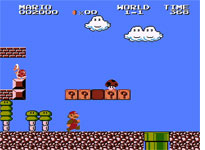
Super Mario Bros.: The Lost Levels is not quite the gaming equivalent of the missing reel of Orson Welles'The Magnificent Ambersons. But it's close. For two decades, it has been the stuff of playground legend: the "real" sequel to Super Mario Bros., the classic game that launched a thousand NES's. Wikipedia (which I trust on all video game matters) says the game, released in Japan in 1986, was originally called Sūpā Mario Burazāzu 2. Considered too difficult, too weird, or maybe too Japanese for American gamers—in Steven L. Kent's The Ultimate History of Video Games, a Nintendo executive suggests that revered game designer Shigeru Miyamoto might have been "depressed at the time"—Nintendo shelved Miyamoto's game in North America and served our continent's kids a thin gruel alternative. The American version of Super Mario Bros. 2 is an odd duck of a sequel that isn't really reviled but also isn't really remembered at all.
But starting a month ago, North American gamers can now play the Lost Levels—or, as I prefer to call it, the Real Super Mario Bros. 2—by downloading it on the Wii's "Virtual Console." My Wii says that it's already the service's second-most popular title, after the original Super Mario Bros. All I had to do was plunk down $6 (600 Wii Points, actually). I would've paid $60. (And yes, gaming obsessives, I know that a version of the Lost Levels made it into 1993's Super Mario All-Stars for the Super Nintendo. But that wasn't the Real Super Mario Bros. 2—that was a colorized Citizen Kane.)
One thing Wikipedia is definitely right about: The Real Super Mario Bros. 2 "is generally considered to be one of the most difficult video games of all time." After lulling you into complacency with the game's superficial similarity to Super Mario Bros., Miyamoto (depressed or not) signals that he intends to torment you. The first row of question-marked boxes you encounter includes that familiar mushroom, Mario's iconic power-up. Except this mushroom is different. It's deadly. As Mario was tossed from the screen, I experienced a combination of shock and puzzlement. That would become a familiar sensation over the next three hours.
Again and again, the game uses your familiarity with Super Mario Bros. to subvert the playing experience. After a few frustrating deaths, I climbed a vine and uncovered a warp zone to Level 3-1. Finally, I was making progress. Shortly thereafter, I descended a pipe, expecting to find a bounty of valuable coins, and instead was shuttled into another warp zone. Therein, my only choice was to return to Level 1 and start the game again.
The game is full of these devilish surprises.Squids float through the air. A green trampoline launches you so high into the air that you disappear for several seconds. A level in the clouds—in the first game an easy run to congratulate you for discovering a hidden area—makes you work to gather even a bare majority of the coins available.
In most games, you trust that the designer is guiding you, through the usual signposts and landmarks, in the direction that you ought to go. In the Real Super Mario Bros. 2, you have no such faith. Here, Miyamoto is not God but the devil. Maybe he really was depressed while making it—I kept wanting to ask him, Why have you forsaken me? The online reviewer who sizes up the game as "a giant puzzle and practical joke" isn't far off.
That sadistic torment, however, is central to the game's appeal. Unlike most game designers, who make sequels that are identical to their predecessors, only with better graphics, Miyamoto used the Real Super Mario Bros. 2 to do something new and dangerous, turning his original and beloved game on its head. Once you accept that mushrooms and warp zones can be punishments rather than rewards, you start to question the nature of the game and to ponder strategic gambits you would never have considered while playing the original Super Mario Bros. Upon discovering the Warp Zone to World 1, I contemplated letting the clock on Level 3-1 expire—a tactic that would have caused Mario to lose a life but would have allowed him to stay on the third level.
The game is so hard that I expect I'll never complete it, though it's perversely engaging enough to make me want to try. On YouTube, I watched a player race through the game to watch out for the torments that await me in distant lands: wind, upside-down pipes with plants that bite at you from the sky, and an end-of-the-stage flagpole that can be discovered by climbing a vine into a hidden level.
The Real Super Mario Bros. 2 is preposterously challenging, but it's not unpleasant. It's deeply satisfying, in fact, during the times when it's not so frustrating that it's enraging. This game gave me the chance to re-experience playing the original Super Mario Bros. for the first time—especially when I plugged in the Wii's Classic Controller, with its tactile similarity to the NES original—and made me remember why that first game was so revelatory. Super Mario Bros. is so familiar to me now—I know exactly when to jump, when to stop, where to find warp zones and underground levels, when to keep running with a turtle shell until I get a 1UP, and when to jump toward a flagpole so that I'll get those coveted six fireworks—that I had forgotten how, once upon a time, it was a game of exploration.
The key to excelling at Super Mario Bros.—I have no idea how to excel at the Real Super Mario Bros. 2—is to learn the game's territory, to become so deeply familiar with it that you don't even have to think about what you're doing. But to do that requires painstaking exploration. You can't just test each block of bricks—to uncover all of the game's secrets you have to test every single block of airspace, in case a hidden vine, extra life, or coin box is hiding there.
Lacking access to the back issues of the Japanese-language version of Nintendo Power, I doubt I'll be able to learn all of the secrets hidden in the Real Super Mario Bros. 2. I had time for OCD games as a child—I remember bombing every square on the map in the Legend of Zelda—but as an adult, I only have the patience to play in less time-consuming bursts.
But the Real Super Mario Bros. 2 isn't just hard—it's "difficult," like a book or a movie that initially rebuffs you but becomes rewarding as you unlock its secrets. As a standalone game, it would be a disappointment, too challenging and too impenetrable. But as a reflection and inversion of one of the few titles in the gaming canon, it provides a sort of meditation on game design and player expectations, and how to flout them. I only wish I'd had a chance to play it in 1986.