Go Ahead, Quit Us
To Idaho's dismay, America still has Larry Craig to kick around after all.

Wednesday, Sept. 5, 2007 He's Back: Last year, a South African parody of Brokeback Mountain called Bangbroek Mountain offered theatergoers the chance to choose between a happy ending and a sad ending. But one man's happy ending is an entire state's worst nightmare. Of all the things the people of Idaho ever wanted to hear from Larry Craig, the last words on earth would be, "I wish I knew how to quit you." Long before Craig's staff tried to bring him back from the dead yesterday, Jerry Seinfeld was already telling reporters in Las Vegas that the Craig scandal is "one of the greatest things to ever have happened" to comedy. Tuesday's news was a comic revival. Every few years, the long-suffering people of Idaho wonder what our politicians will do for an encore. We're never sure how they'll choose to embarrass us, but in the end, they always come through. Yet even in Idaho, we're not used to seeing the deceased get up and walk out of their own funeral. At Craig's press conference on Saturday morning, several Boiseans in the crowd cheered when he announced his plans to resign. Imagine our surprise to learn that moments earlier, he had called his lawyer claiming he was being railroaded and plotting to fight the charges. Larry Craig doesn't just know how to tap his toes. He knows how to cross them. Three months after being arrested for lewd conduct in a restroom, and three days after announcing "my intent to resign from the Senate effective September 30th," Craig seems to have decided that in both cases, intent is in the eye of the beholder. All summer, he refused to share his secret with a lawyer. Now he's hiring lawyers everywhere. Today, his legal team asked the Senate ethics committee to drop its investigation into "purely personal conduct unrelated to the performance of official Senate duties." He also has hired Minneapolis counsel to try to undo his guilty plea. Craig's Republican colleagues must be checking the schedule for the next bus they can throw him under. But if Sen. Craig needs a legal defense fund, Idaho Democrats will be happy to contribute. The state's Democrats haven't had a lucky break in 40 years. Last week's flameout seemed to follow the same pattern, as the biggest sex scandal in Idaho history quickly looked to be the shortest. After a weekend off, Idahoans are back to scratching their heads about their fallen senator. One political expert, Randy Stapilus, points to the long, sorry saga of Bob Packwood, another Republican senator from the Pacific Northwest forced to leave in disgrace. Packwood spent nearly three years fighting sexual harassment charges, until finally resigning after the Senate ethics committee recommended his expulsion. Craig may be the only politician in history to suffer from Packwood envy. Craig defense attorney Stan Brand warned the ethics committee not to "spawn progeny that even the Committee wouldn't want." The turn of phrase, while curious, was oddly appropriate. For if there has been one constant in Larry Craig's 27-year congressional career, it's that the man hates salmon. Former Idaho Rep. Helen Chenoweth drew headlines by asking how groceries can sell canned salmon if the fish is endangered. But Craig has always been the one conservatives count on to stop scientists from intervening to save the wild salmon from extinction. He has spoken out so strongly on the issue that when his own number was up, one tribal news service ran the headline, "Sen. Craig, Salmon Opponent, Guilty in Airport Incident." Craig won't last long enough to beat the salmon. But as his political career swims upstream to die, he might feel like one. ... 4:02 P.M.(link)
Friday, Aug. 31, 2007 Flushed Away: The transcriptof Larry Craig's interview with the arresting officer, Sgt. Dave Karsnia, contains a career's worth of awkward moments. At one point, Karsnia asked, "Have you been successful in these bathrooms before?" Craig's reply: "I go to that bathroom regularly." The sole bright spot for the senator was when the sergeant asked, "Have you got it on?" Luckily for Craig, Karsnia was talking to his fellow police officer about the tape recorder. In the end, another exchange may turn out to have been the most prescient. Early in the interview, Karsnia told Craig, "I don't want to get into a pissing match here"—surely the best advice ever shared between two men who've just left the bathroom. Craig answered, "We're not going to," and later added, "I'm not gonna fight you." During the two months since his fateful layover, Larry Craig has had plenty of chances to stand up for himself in the courts of Minnesota or the court of public opinion. But as he prepares to announce his plans on Saturday, he finds himself trapped, unable to fight or switch. Few Idahoans' political careers have lasted longer than Craig's, and none has ended more abruptly. Only the legendary Sen. William F. Borah served more years in Congress—and until this week, most assumed Craig would run for re-election so he could one day break Borah's record. At 62, Craig has spent most of his life in public office, since winning a state Senate seat at the age of 29. But a long public life has proved no match for an embarrassing private one. In five business days, Craig has been abandoned by most of the political allies he made over the course of four decades. He had to resign from the Romney campaign on Monday and his Senate committees on Wednesday. Republican Senate colleagues, from Minority Leader Mitch McConnell to John McCain and John Ensign, joined the chorus. Poor Craig can't read the graffiti on the wall through all the handwriting. On Thursday night, even the most disgraced Republican of our times, Tom DeLay, weighed in: "When you have members that have problems or scandals and they are found guilty, the Republican Party does the right thing and kicks them out." Oh, for the good old days when Republican congressional scandals were just about money. Across Idaho, newspapers that had regularly endorsed Craig's campaigns demanded his resignation. On Friday morning, the Republican National Committee sent word that it had drafted a letter calling on Craig to resign, but would hold it long enough for him to jump. Officials with the Idaho Republican Party leakedthat Gov. Butch Otter had already chosen Lt. Gov. Jim Risch as Craig's successor. From the Beltway to Boise, Republicans dropped Craig like what he had become—a hot potato. Idaho Democrats were hoping Craig would fight for his political life a little longer. By making Craig walk the plank and naming a new incumbent to his seat, Republicans believe they can reclaim their generic edge going into the 2008 Senate race. Friday's papers focused on what the loss of Craig's seatmight cost the state. " Idaho could lose millions," an Idaho Statesman subhed declared, reporting that Craig "sometimes boasted that he brought home $2.5 million a week to Idaho in the form of federal grants." Republicans may be under fire for anti-gay hypocrisy, but their anti-government hypocrisy is still going strong. Idahoans will happily accept the loss of Craig's clout if it means the loss of Craig's cloud. That way, residents could get back to celebrating Thursday night's season-opening victoryby 24th-ranked Boise State, which has the longest winning streak in the country. After this week, folks are even looking forward to Saturday's mismatch between top-ranked Southern California and the University of Idaho, whose coach wrote "113" on the chalkboard to motivate a team ranked 113th out of 121 Division 1-A football schools. Most Idahoans feel the way the Vandal defense will feel when the Trojans are through Saturday—not sure what all that was about, but glad to have it over. At the very end of their interview, Sgt. Karsnia told Craig, "Embarrassing, embarrassing. No wonder why we're going down the tubes." Republicans couldn't have said it better. ... 5:55 P.M. (link)
Thursday, Aug. 30, 2007
The Answer Is No:The national headquarters for fighting wildfires is in Boise, Idaho. But as they watch Larry Craig's political future go up in smoke, Idahoans have decided to let this one burn out of control. On Tuesday, an editorial in the Idaho Statesman warned against a rush to judgment. Two days later, the newspaper became the third major daily in the state to decide enough was enough. Conservative bloggers have also joined the call for Craig's resignation, and online polls up and down the state are running overwhelmingly against him. Most Idahoans feel a mixture of disgust with Craig and sadness for his family. Yet at the same time, we have our own reputation to think of. Idaho may not have nearly as much baggage as the national Republican leaders who've been so quick to distance themselves from Craig. But a series of embarrassing politicians—and high-profile interlopers like the Aryan Nations and Mark Fuhrman—has left Idahoans pretty tired of being laughed at. So, after a few days under Craig's cloud, many Idahoans seem to have concluded that rather than get laughed at for defending the guy, they'd rather be the ones leading the laughter. The Statesman editorial demanding Craig's resignation declared, "We cannot afford, as a state with but four congressional representatives, to have a senator who merely provides fodder for bloggers and late-night talk show hosts." Then the same edition of the paper gave readers a roundup of the latest Craig jokes from Leno and Letterman.
Up north, the state's self-proclaimed "Singing Columnist," Doug Clark, has skewered Craig with his own toe-tapping parody song and video. Clark has spent most of his career as an editor and columnist at two of the most conservative papers in America, the North Idaho Press and the Spokesman-Review. But far from shedding any tears, his video parody is karaoke-bar gleeful.
Set to the tune of Tony Orlando's "Knock Three Times," the lyrics include: Tap three times with your loafer if you want me. Twice on the tank – if the answer is no…. (Tap. Tap. Tap.) Means you'll meet me in the stall-way. Twice on the tank means you just gotta go. ... and later: (Tap. Tap. Tap.) He's unbuckling his beltway. White and far right means you're from Idaho. Singing Tony Orlando parodies may not seem like a great leap forward for Idaho's reputation. But a state where the license plates say "Famous Potatoes" isn't asking for much. Besides, we don't feel much like singing the state song right now, especially the verse, "There's truly one state in this great land of ours/ Where ideals can be realized/ The pioneers made it so for you and me/ A legacy we'll always prize." So, Tony-Orlando-and-john is a start. And by Jiminy, our message is clear: You won't have Idaho to kick around anymore. ... 4:52 P.M. (link)
Wednesday, Aug. 29, 2007 Don't Go Near the Men's Room: The front page of Larry Craig's hometown paper, the Treasure Valley Journal, shows an ominous full-page photoof a town car surrounded by a SWAT team of gun-toting police. Luckily for Craig, it's a monthly that has been on the stands awhile, with a photo from this summer's community relations night for the Eagle, Idaho, police. In just about every other Idaho newspaper this morning, the guns are all pointed at Craig. My hometown paper, the North Idaho Press—one of the most Republican newspapers in the state—called on Craig to resign in a scathing editorial titled, " Trust violated, there is no future, Senator." The Press said it had reached that conclusion not as a moral judgment on the allegations against Craig, nor because of "his tepid stance in the Iraq War or his unpopular support of President Bush's proposed immigration reform," but because "the people of Idaho cannot trust their most powerful representative in the nation's capital." But another story on the front page of the Press poses an even bigger hurdle for Craig: Now Idahoans might start blaming him every time they need to find a bathroom. The Press warns residents about a notorious rest stop that police have been watching for years. Here's the lede: "People are scrutinizing public restrooms in light of U.S. Sen. Larry Craig's arrest and conviction in Minneapolis this summer. And close to home, it's not a pretty sight. Motorists taking a break at the Huetter rest stop between Coeur d'Alene and Post Falls might want to think twice before venturing near the men's restroom." In the accompanying photo, the rest stop looks harmless enough. But the caption makes it sound like it should come with its own SWAT team: "The Huetter rest stop along Interstate 90 has had its share of problems with sexual deviants and an anonymous source tells The Press it's still happening." Twenty years ago, the school superintendent from nearby Post Falls had to resign after being arrested in a rest stop sting operation. Citing a confidential source, the paper says "people would be shocked to learn" that the rest stop is a "hub" for "deviant sexual behavior in North Idaho." The same source goes on to warn that perpetrators frequent several rest stops throughout the region. D.F. Oliveria, a blogger at a nearby paper, asked readers today, "Do you feel safe using public restrooms?" The first respondent says sensibly, "Not for sex!" The Idaho Statesman, which Craig blamed for his guilty plea, has yet to call for the senator's resignation. [Update: Now it has.] One Idaho cartoonist showed Craig shouting, "I am not gay. The Idaho Statesman is gay."


But across the state, man-on-the-street interviews were gloomy for the man-in-the-men's-room. Most residents told reporters that Craig's days are numbered. The most encouraging comment came from a Nampa businessman who told the Idaho Press-Tribune, "If the Catholic Church can survive what they've been through, Larry Craig'll be fine."
An overnight poll taken Tuesday showed most Idahoans believe Craig should resign. The margin was 55 percent to 34 percent, which is about how much Democrats usually lose by. The restroom panic will only add to the feeling that Craig's gotta go, so everyone else can. ... 3:24 P.M. (link)
Tuesday, Aug. 28, 2007
Jiminy God!: My first job after college was helping my friend Larry LaRocco run for Congress against a first-termer named Larry Craig. When Craig held a surprise press conference implicating himself in an emerging House page scandalby denying any involvement, our deputy campaign manager turned to LaRocco and said, "Congratulations, Congressman." We saw the press's death march around Craig and assumed Idahoans would jump to the same conclusion.
House Republicans lost 27 seats that year. But Larry Craig kept his and hasn't had a tough race since.
If Missouri is the Show-Me State, Idaho is the Don't-Show-Me State. Voters have been content to know that Craig is Republican; anything else would be too much information. If you want to know why we chose to live in our own private Idaho, this case seems like a pretty good reason.
Craig will have a much harder time keeping his job this time, after pleading guilty to a charge of disorderly conduct in a Minneapolis men's room. Senate Republican leaders have called for an ethics investigation. Idaho's top political prognosticator, Randy Stapilus, predicts that Craig will resign or decline to run again.
Other states expect a lot from government and from their elected leaders. As a result, Idaho often seems like the Lake Wobegon of American politics, where the women are strong, the men are good-looking, and the politicians are below average.
But in many ways, the Craig affair is a perfect storm of the suspicions that make Idahoans so conflicted about politics in the first place. As a rule, we don't trust government, we don't trust politicians, and we've always had our doubts about public restrooms.
The Craig case puts many of Idaho's most cherished beliefs to the test. Next to Alaska, Idaho is probably the most libertarian state in the country. Not everyone agreed with the late Rep. Helen Chenoweth that the federal government was tracking Americans with black helicopters. But Idahoans weren't looking for much else from their congressman, so while the rest of the country laughed at Chenoweth, Idaho's attitude was, "Better safe than sorry."
After the FBI wounded Aryan sympathizer and alleged illegal guns dealer Randy Weaver (and killed his wife) in a 1992 raid, an Idaho jury acquitted him and dismissed the gun charges as entrapment. In 1984, Idaho Rep. George Hansen was sentenced to prison for falsifying his financial disclosure forms and came within 68 votes of winning re-election.
As a senior in high school, I spent three months as a page in the Idaho State Senate. Female pages complained about a legislator of Strom Thurmond vintage, but young State Sen. Craig never gave us trouble. The legislature's main achievements that year were laws banning state police from using radar or requiring motorcycle helmets.
If it weren't for the guilty plea, it's hard to say what verdict an Idaho jury would give in the Craig case. Idahoans approved a same-sex marriage amendment that puts government in the bedroom. But any state that has trouble with radar and motorcycle helmets could have qualms about putting government in the bathroom.
In Washington, D.C., where I've spent the past two decades, everyone lives and breathes politics. In Idaho, people are so used to fresh air, they choke on political news, even in small doses. Yesterday D.F. Oliveria, a journalist and popular blogger in my hometown, ran an online poll asking whether Craig could survive the scandal. In the first 24 hours, a grand total of 6 Idahoans responded.
When a gay blogger ran anonymous allegations against Craig last fall, the Idaho Statesman, the biggest newspaper in the state, declined to run the rumors. The Statesman decided to conduct its own investigation—and didn't even print the results of its investigation until after Roll Call broke the story of Craig's arrest.
The newspaper interviewed more than 300 people who've known Craig—neighbors, childhood friends, and 41 of his University of Idaho fraternity brothers. In May, a few weeks before the Minneapolis arrest, the Statesman interviewed Craig and his wife, and played a tape from the man who made the online allegations.
The report is exhaustive, interesting, and inconclusive. Read it for yourself, and the one thing you can be sure of is that Larry Craig's favorite epithet is "Jiminy!" He told the Statesman, "I don't go around anywhere hitting on men, and by God, if I did, I wouldn't do it in Boise, Idaho! Jiminy!" After his wife listened to the tape and told the newspaper she was incensed it would "consider such a piece of trash as a credible source," Craig let loose with, "Jiminy God!"
At a press conference Tuesday, Craig blamed his guilty plea on the pressure he felt from what he called the Statesman's eight-month-long "witch hunt." Craig might have been better off claiming his layover was entrapment by the common enemy so many Idaho flyers love to hate, Minnesota-based Northwest Airlines.
Garrison Keillor once said that folks in Lake Wobegon believe in forgiving their neighbor, but first they want to hear details. Idahoans are in no mood to forgive Craig. But—Jiminy God!—we've heard enough details. ... 6:37 P.M. ( link)
Monday, Aug. 27, 2007
Nowhere To Go But Up: As one final coda to a warrantless career, Alberto Gonzales said Monday he has lived the American Dream. Torture, spying, and partisan conspiracy were once the province of the elite few. Now anyone can grow up to be a puppet, apologist, and laughingstock.
President Bush, Gonzales' last defender, is the only Republican in Washington even pretending to be sorry to see him go. Bush said Gonzales "did an outstanding job"—as the greatest fall guy since Michael Brown dined alone.
When Karl Rove left, the White House wondered how to replace the irreplaceable. With Gonzales, the challenge is just the opposite: how best to replace someone so easily replaceable. If the key to success in politics is choosing your predecessor, Gonzales' successor will be the luckiest person in America.
The biggest headache for the White House is that after the nightmare of Gonzales' congressional testimony, Senate Democrats will try to turn his successor's confirmation hearings into a rerun, not a sequel. The last Cabinet member to be run out of town was Donald Rumsfeld. His successor, Defense Secretary Robert Gates, spent the entire confirmation process answering variants of the same question: Are you now, or have you ever been, Donald Rumsfeld?
That was with a Republican Congress and a war going on. This time, a Democratic Congress won't worry all that much about who'll run out the string at Justice, because it hardly matters: For the most part, the next attorney general will have to serve out Gonzales' probation.
There's no rational way to predict Gonzales' successor, since under the normal laws of political gravity, he would have disappeared long ago. Democrats secretly hope Bush will find someone who can keep any thread of the Gonzales story line alive. Harriet Miers wasn't ready for the Supreme Court, but she could easily be the next Alberto Gonzales. A confirmation hearing for John Yoo might finally give Democrats a chance to appreciate the joys of torture. And if the White House has forgotten, Democrats can recommend several highly qualified former federal prosecutors who are recently out of work.
By accepting his resignation, however, the White House must have decided it has suffered the Gonzales Justice Department enough. The candidates mentioned as potential replacements fall into three much safer categories: climbers, old hands, and courtesy runners.
Climbers: Whenever the Great Mentioner speaks, the first names to leap off the wires are usually those who want the job most or have told the most people they want it. No matter what Gonzales has done with the place, attorney general has always been a job worth wanting. The name mentioned most often is a celebrated job climber, Michael Chertoff, who gave up lifetime tenure as a federal judge to become Homeland Security secretary. Chertoff has double the incentive, because his own gut tells him the DHS job is bound to end in disaster.
Another climber on the list is Securities and Exchange Commission Chairman Chris Cox, who certainly knows how to time the market. After 16 years in Congress, Cox bolted for the SEC in the summer of 2005, leaving his Republican colleagues behind to rediscover life in the minority. If Chertoff gets Justice, Cox would no doubt be happy at Homeland Security, where he could take his chances with al-Qaida after two years of dealing with Sarbanes-Oxley.
Don't count out the climber who scampered up several rungs today: Paul Clement, who moves from solicitor general to acting attorney general. Clement is only 41—younger than Gonzales, older than Bobby Kennedy—but as a former Senate judiciary committee staffer, he might receive a certain amount of congressional courtesy.
Old Hands: Law is not the world's oldest profession, but it may be the best profession to grow old in. The legal community respects its elders, who are assumed to have wisdom, judgment, independence—in short, the virtues Gonzales lacked.
The Bush administration doesn't have the same respect for those virtues—as Fred Fielding, the old hand who succeeded Gonzales and Miers as White House counsel, has discovered. But for months, several familiar names have made the rounds as possible replacements. Ted Olson has argued countless cases before the Supreme Court (including Bush v. Gore) as solicitor general and a private lawyer. Larry Thompson, who would be the first African-American attorney general, was John Ashcroft's deputy. George Terwilliger (another Bush v. Gore veteran) served as deputy attorney general and briefly acting attorney general under Bush I.
Of course, it's not clear how much any of these men would want the job under the current circumstances. After all, an old hand is a climber who never made a bad career move.
Courtesy Runners: With so much else to worry about, the Bush White House doesn't really care who runs Justice, either. They just want Gonzales to take the damage with him.
So, don't be surprised if Bush's only litmus test for the job is the ability to be easily confirmed for it. Ironically, that was the brilliance of Bush's first pick for attorney general, John Ashcroft, whose Senate background guaranteed swift confirmation even for what seemed back then like a breathtakingly conservative appointment.
These days, there must be a few Republicans who—like Chris Cox in 2005—wouldn't mind being thrown a lifeline. Two in particular come to mind. Fred Thompson is already bored with running for president before his campaign has started. He seems miscast as a presidential candidate, but he was born to play the role of attorney general. As a former senator and out-of-work federal prosecutor, Thompson wouldn't even have to audition.
Sam Brownback is a distinguished lawyer, a member of the judiciary committee, and, like Ashcroft, a principled conservative. But the race for the Republican nomination is such a circus, the poor fellow lost the Iowa straw poll to a flip-flopper and a diet peddler. Why should Brownback stick around to watch Romney outspend him 10-1 on oppo, when he could run Justice and the FBI, the largest opposition-research department in American history?
Gonzales bid farewell by saying that his worst days as attorney general—and there were many—were better than his father's best days as a migrant worker. Whoever inherits the job might feel the same way. Gonzales's best days as attorney general were worse than his successor's worst days will ever be. ... 4:55 P.M. ( link)
Wednesday, Aug. 22, 2007
Al-Qaida in Jamaica: When the State Department tried so hard not to give me a passport, I assumed that Clintonites must be the latest addition to the Bush administration's terrorist watch list. But judging from the passport horror stories readers have set me, millions of Americans must be on the same list. Almost every story has the same ending: If you need your passport before the next Ice Age, your best hope is to ask a member of Congress to intervene. The Bush era has come full circle—to prove you're not a terrorist, you have to hire a lobbyist.
The most revealing tale comes from Ashley McDowell, a law student who applied for a passport in March, three months before her departure for a summer internship in South Africa. With three weeks to go, she checked the Passport Services Office Web site and found no record of her application. Her account perfectly captures the random absurdity of bureaucratic behavior:
The first person I spoke with said that he would put an "expedite note" on my application. Days passed. The second gentleman I talked to said that my passport was in the background check phase, and would be done pretty soon. More days passed. And the third time I got through I got some really bizarre news. The man said that my passport was nowhere to be found. Nothing--not my name, SSN, or birth date--brought up any kind of status for any kind of passport relating to me. The man told me to call back in an hour. I did (and amazingly reached someone!) but I was still nowhere to be found. My passport was in some sort of Consular Neverland and no one could find it. The agent told me to go back to my post office where I'd applied and request the tracking number.
The next morning I drove into Aiken and spoke with a nice lady who said there was no such thing as a tracking number and that they kept no numbers attached to applications. She could tell that I was frustrated, distraught, and really confused. I guess she took pity on me, because she then leaned over the counter and whispered, "Now don't tell anyone I said this....but call Lindsey Graham."
Ashley McDowell didn't call Sen. Graham, but she did call House Minority Whip Jim Clyburn. The Passport Services Office sent her passport by Federal Express a few days later.
There's nothing wrong with members of Congress responding to requests to cut through red tape. But something is rotten in Washington when the federal agency responsible for the red tape is the one asking.
Chuck Slothower of the Durango Herald investigated reader complaints about the Passport Services Office and reached the same conclusion. Several Coloradans beat the system by enlisting the help of Rep. John Salazar. One woman who had waited weeks for her son's passport marveled that with Salazar's help, "The passport was here in a day and a half."
No wonder Congress couldn't finish the administration's immigration bill. Members are too busy helping people navigate their way past an administration determined to stop citizens from leaving the country.
The Herald found another Durango man who spent several days trapped in Mexico in January, after United Airlines let him travel there without a passport but refused to let him board a flight back until he had one in hand. The man "called the State Department's information line repeatedly, spending hours going through recordings and receiving false promises from staffers before finally smashing his telephone to the ground in frustration." He said he never thought to call his congressman. Instead, he found himself trapped in a foreign country, going broke, thanks to the Passport Services Office's new expedited service, Midnight Express.
As usual, the Bush administration has shown little interest in taming its own bureaucratic monster—and members are happy to take credit for saving constituents' vacations. Still, it's only a matter of time before the White House attacks Congress for undermining the war on terror. The endless backlog may seem like a lot of hassle to go through in order to make American tourists carry passports to the Caribbean. Yet as President Bush likes to say, that's why we call it the Long War. We may not be doing so well against al-Qaida in Iraq. But thanks to the Passport Services Office, we've turned the corner on al-Qaida in Jamaica. ... 2:32 P.M. ( link)
Tuesday, Aug. 14, 2007
Going Nowhere:Months after 9/11, in one of the low points in bureaucratic history, the U.S. government mailed visas to two hijackers who had flown planes into the World Trade Center. From Iraq to the home front, American intelligence may not have improved much since then. But after a summer of dealing with the U.S. Passport Services Office, I can find one consolation. If future attacks require a passport or visa, the war on terror is won: Any terrorists will expire standing in line like the rest of us.
Since 9/11, the U.S. has spent hundreds of billions of dollars building a mighty bureaucratic fortress against terror. The Department of Homeland
Security is the Great Wall of anti-terrorism, a maze so vast it is visible from space. But if the true measure of bureaucratic power is sheer inertia, DHS is a lightweight compared to its passport-stamping colleagues at the State Department Bureau of Consular Affairs. DHS needed 170,000 employees and billions in no-bid contracts to become an impenetrable monolith. The passport office is a model of streamlined inefficiency, providing unprecedented bureaucratic stasis with a workforce of just 8,000.
The passport office surged to the front lines of the war on terror in January, when the Western Hemisphere Travel Initiative began requiring U.S. citizens to carry a passport on flights to Canada, Mexico, Bermuda, and the Caribbean. Unfortunately, Americans quickly discovered the glitch: It's not easy to squeeze millions more passports out of the same old department.
The agency now admits that it badly underestimated demand, which will soar from 12 million last year to 17 million in 2007. Agency officials tried to reverse course by suspending the new requirement, but the snake had already swallowed the mouse. Passport applications that used to take weeks now drag on for months. Travelers in a hurry can pay more for expedited service, only to find that expedition, too, is best measured in seasons.
As I discovered this summer, dismal statistics don't quite capture the Kafka-esque frustration of the passport experience. Back in June, my family and I set out to renew our passports. Well-aware of the backlog, we applied in person at the Post Office, paid an extra $60 apiece for rush delivery, and spotted the agency two full months until our trip.
A few weeks after we applied, the State Department sent us a postcard with an 800 number and Web site to track our passports' progress. Both the hotline and Web site are designed to report what you already knew: Your passport isn't ready.
I had a bad feeling about our chances, so with two weeks to go before our departure, I started a daily ritual of calling the hotline for help. The agents were polite, even upbeat. A few promised to send urgent e-mails to headquarters to speed up our case. With under a week to go, one agent gushed that our passports were "looking really good!"
Agents assured me that if all else failed, I could sort everything out with a trip to the passport agency in downtown Washington. But 36 hours before our flight, an agent told me not to worry—our passports were ready and would be FedExed to our home the next morning, leaving us plenty of time to get to the airport for a Friday night departure to Australia.
When the morning arrived and the passports didn't, it finally dawned on me that I had been conned. The FedEx delivery was a figment of a beleaguered call-center agent's imagination. "They're looking really good!" was another helpless agent's way of saying there was nothing else she could do.
But the full extent of the con didn't hit me until I joined the teeming crowd at the passport office. The scene bore a passing resemblance to the fall of Saigon. Some people were crying. Others were screaming, either at agents or at the armed guards who herded us from one spot to another until the room became too packed to move. A few travelers were in more advanced stages of resignation, sitting on the floor staring at books of Sudoku or simply praying the dwindling supply of oxygen would hold out long enough.
A news ticker streamed across the wall with the message, "The average waiting time is 163 minutes." A clerk gave me a numbered ticket that said, "Upgraded Application." It said my estimated wait would be 5 hours, 41 minutes.
A young man who had already waited several hours explained that the average waiting time—by that point at 186 minutes—was just the first step, seeing a caseworker. If applicants survive that hurdle, they receive another ticket to come back later and stand for hours in another line, while the back office prints their passport.
I reached the caseworker window in a mere 150 minutes, still with a faint hope of making an evening flight. But the agent at Window 8 had other plans. She angrily questioned why I needed a passport that day, when my flight wouldn't land in Australia until two days later. I tried to explain the International Date Line, but she had already reached a verdict: Our passports couldn't possibly be done in time for us to leave, so that meant she had no obligation to complete them. And since the office was closing for the weekend, she gave me a slip to come back for them—on Monday.
The prospect of losing three days—or more, if the con continued—was enough to make us throw in the towel. I went home and asked American Airlines to cancel the trip and refund our tickets.
Then a minor miracle happened. If the agent at Window 8 had been an immovable object, the agent from American Airlines was an unstoppable force. I told her our story at 5 p.m. on a Friday in August, when Jason Bourne himself couldn't break into the federal government in Washington. Somehow, she tracked down our passports and had them in our hands by 7:30, then rebooked our flights to leave the next day. When I asked her how she did it, she just laughed, the way a weary Russian might once have done in shrugging off the labyrinthine challenges of surviving the Soviet Union.
The mystery deepened as I looked inside the passports. Just two hours earlier, the passport office had insisted our passports didn't exist and wouldn't anytime soon. But according to their "date of issuance," the passports had been issued two weeks before.
Just before we departed the next afternoon, the passport office sent me an e-mail: "We have finished your passport, and it has been mailed to you." By then, we knew better than to trust anyone who promises that "the passport is in the mail." But we had to admit that finally, our passports were looking pretty good. ... 8:12 A.M. ( link)
Saturday, Aug. 11, 2007
Red Meat: Until this week, former Bush speechwriter Matt Scully's sole claim to fame was as conservatism's most determined vegetarian. His book, Dominion: The Power of Man, the Suffering of Animals, and the Call to Mercy, made the compassionate conservative case for animal rights. George Will dubbed Scully " the most interesting conservative you have never heard of."
After Scully's devastating write-and-tell smackdown of former speechwriting colleague and press favorite Michael Gerson in the Atlantic, however, animals won't be the ones whimpering for mercy. Never underestimate the wrath of a vegan scorned. Scully doesn't just jab his fellow Bushie as a shameless publicity hound; he guts Gerson and hangs him on the mantle.
The salad days of compassionate conservatism are over. Welcome to the Romney era: If you act like a dog, get ready for a long, cold ride on the roof.
Maybe Tim Noah is right that Scully protesteth too much. But most kiss-and-tell tales are easy to dismiss because they serve one purpose – self-promotion. In this case, that's the very sin for which Gerson stands indicted. Scully seems less interested in seeking his share of the credit than in outing Gerson for taking more credit than he deserved.
While it's hard for outsiders to know the truth in family feuds, that doesn't mean we can't enjoy them. Scully's piece is one of the juiciest hatchet jobs in memory. In brutal detail, he recounts Gerson's meticulous "credit-hounding" inside the White House and with the outside world. According to Scully, Gerson took all the bows but did little of the actual writing.
Although every major Bush speech was a collaboration—usually written on the computer of a third speechwriter, John McConnell—Scully says Gerson led the senior staff and countless profile writers to believe that all the best lines were his own. Reporters and authors routinely gave Gerson credit for words that weren't his and for speeches others wrote.
By Scully's account, Gerson's oft-reported ritual of secluding himself in a nearby Starbucks produced plenty of self-serving profiles but no speeches. The Gerson legend sounds like many an address he claimed to write for Bush—it sounds better because it's made up. Scully writes:
"The narrative that Mike Gerson presented to the world is a story of extravagant falsehood. He has been held up for us in six years' worth of coddling profiles as the great, inspiring, and idealistic exception of the Bush White House. In reality, Mike's conduct is just the most familiar and depressing of Washington stories—a history of self-seeking and media manipulation that is only more distasteful for being cast in such lofty terms."
Scully's tale will be seen as the worst breach yet in the famed Bush White House discipline. With the Bush presidency in ruins, those who once served him are forced to fight for scraps on the dustbin of history.
The piece is a telling indictment of this White House, and of a classic office archetype, the climber. But it is an even more revealing portrait of speechwriting, perhaps the most awkward profession in politics.
I spent five years as a speechwriter, and two terms in the White House as an occasional collaborator. I went to Starbucks every day, but no camera crews followed.
For me, the poignancy of Scully's story is that speechwriting is supposed to be the opposite of what Gerson stands accused of doing. By definition, it's a profession based on self-denial, not self-promotion. Far from taking credit for the work of others, a speechwriter's job is to write words that others can stand to claim as their own. Most speechwriters soon learn the basic pleasure-pain principle of the craft: Satisfaction comes from finding words the boss can use, but taking credit for those words can only embarrass the very person you're supposed to be helping.
At times, it can feel slightly disingenuous to write words for someone else to deliver. But more often, the person you're writing for gives a far better speech than you wrote. For the speechwriter or any other White House aide, it is truly dishonorable to look for credit – even for words which (unlike Gerson) one has actually written.
At the end of his piece, Scully perfectly captures that sense of honor among scribes:
"That's where presidential speechwriters belong—off to the side . . . . Speechwriting is a job with many privileges, but also its own rules, temptations, and demands of conscience, obvious and nonnegotiable. The work has rewards enough without each speechwriter stepping forward to give his or her name its own permanent shine in history."
In retrospect, Scully's passionate advocacy of animal rights should come as no surprise. Trapped in cramped quarters, rarely allowed to see the light of day, speechwriters face the same miserable conditions as pigs and calves that spend their lives in crates, only to be sold as bacon and veal.
As Scully suggests, it's wrong to fawn over glory hounds who violate the speechwriter's code of honor. The whole point of the job is that in the end, the words are all that matter. ... 1:50 P.M. ( link)
Sunday, Aug. 5, 2007
Very Well, Then: Slowly but surely, Mitt Romney is winning the Republican nomination. He is virtually unopposed in next Saturday's Iowa straw poll. In futures markets and national polls, he still runs third or fourth. But in both Iowa and New Hampshire, where the race is usually decided, Romney is seven points ahead.
The other leading candidates all have good reasons why they should be beating Romney. John McCain is a more authentic conservative; Rudy Giuliani's résumé starts with 9/11, not the Salt Lake City Olympics; Fred Thompson is famously down-to-earth, not a cyborg from another planet. Yet so far, the phony, mediocre, paranormal candidate is winning.
The other Republicans may be hard-pressed to stop Romney, but Romney can. To clinch the nomination, Romney still has to persuade Republican primary voters to forgive him for switching sides on most issues they care about.
On the campaign trail, Romney is followed by a man in a dolphin costume, carrying a sign that says, "Ask Flip Anything." As his opponents keep pointing out, Romney's ideological evolution on abortion, guns, and gay rights isn't pretty. His clumsy attempts to explain himself have usually backfired, as when he tried to overcome conservative qualms about his support for the Brady Bill and the assault weapons ban by claiming to be a lifelong hunter and lifetime member of the NRA.
Romney's abortion answer is particularly unconvincing. He says he has always been "personally pro-life" but was "effectively pro-choice" until halfway through his governorship, when he decided he was wrong and "needed to be pro-life."
That explanation is far too Flip for most conservatives. So, Romney seems to be trying out a new flip-flop strategy: Instead of parsing his contradictions, he embraces them.
When a man in Eldora, Iowa, asked him about abortion last week, Romney tried to turn flip-flopping into a virtue. "If changing your mind is a problem in this country, we're in trouble," he said. "I won't apologize for changing to pro-life." Romney even invokes Reagan's history on abortion, suggesting that a change of heart is Reagan-esque, not Flipper-esque.
In Sunday's Republican debate in Iowa, Romney managed to score points by attacking Sam Brownback for attacking his abortion flip-flop: "I get tired of people that are holier than thou because they've been pro-life longer than I have."
Embracing one's contradictions is as opportunistic as explaining them. But this approach offers three distinct political advantages. It skips the embarrassing details. It sounds both humble ("I was wrong") and defiant ("I won't apologize for telling you what you want to hear"). And best of all, it's the flip that keeps on giving. A frequent flipper like Romney can't afford to spend all his time apologizing—or not apologizing. But as the most changed mind in the race, if he can persuade voters that changing one's mind is a sign of courage and leadership, he'll win in a walk.
Romney isn't just resting on bygone contradictions; he's working hard to generate new ones. Last week, he offered a trenchant critique of the Department of Homeland Security as " one big bureaucracy." But far from taming the bureaucracy, he proposed expanding it—by shifting money away from first responders and other homeland-security efforts outside Washington, and pouring it into the second-most hidebound bureaucracy in Washington, the FBI. Romney has his contradictions covered: In 2003, he told Congress exactly the opposite, praising then-DHS Secretary Tom Ridge's "stalwart" importance and pleading for more homeland-security money for the states.
Romney recently warned that Barack Obama wants "to have the government take over health care"—a remarkable charge, considering how much the plan Romney enacted in Massachusetts resembles the plans Obama and many other Democrats have put forward. Romney assures conservative audiences, "I don't want the guys who ran the Katrina cleanup running my health care system." That's a job for the FBI.
In standing up for Americans' right to change their minds, Romney may fancy himself in the high-minded company of another Massachusetts man with a soft spot for contradiction, Ralph Waldo Emerson. Emerson gave future generations of politicians comfort with his famous adage "A foolish consistency is the hobgoblin of little minds."
But Romney's real political guru may instead be Emerson's admirer and fellow transcendentalist Walt Whitman, who wrote in Leaves of Grass:
"The past and present wilt -- I have fill'd them, emptied them.
And proceed to fill my next fold of the future. ...
Do I contradict myself?
Very well then I contradict myself."
Romney and Whitman don't have much else in common, but they share a curious obsession with oceans. So, perhaps the two men would agree: If you can't beat the dolphins, why not join them? ... 3:25 P.M. (link)
Tuesday, July 17, 2007
Pan to the Ocean: With the sound off, Mitt Romney's new TV spot " Ocean" could be about climate change, The Perfect Storm, or the Bush administration's handling of Hurricane Katrina. When David Brody of the Christian Bible Network watched it, he forgot which cable channel he works for: "There are so many shots of the ocean in it, I was waiting for the crew of Baywatch to save someone." More than anything, the spot reminded me of the opening credits of the camp '60s soap Dark Shadows.
Fortunately, Romney's voiceover clears up any confusion: It's an ad for Rosie O'Donnell and Hillary Clinton.
The text of the ad comes from a speech Romney gave at a Reagan gala in April, shortly after the Virginia Tech shootings. Romney cites a Wall Street Journal op-ed Peggy Noonan wrote after the Columbine shootings in 1999, which offered an extended metaphor about our polluted modern culture as "the ocean in which our children swim." "Your child is an intelligent little fish," Noonan wrote—four years before Finding Nemo—but the Columbine shooters "inhaled too deeply in the oceans in which they swam."
Republican candidates don't normally make ads about children emerging from the sea with gills. But Romney, to his credit, says he believes in evolution—so much so that his positions are evolving every day.
Noonan's post-diluvian vision offers one horror after another: "The dark genie is out of the bottle and swims in the seas." Romney and his ad makers drag her metaphor to new depths. He says he'd like to "clean up the water in which our kids are swimming"—by keeping pornography off their computers, drugs off the streets, and sex and violence out of television and video games.
It's safe to assume Mitt Romney didn't inhale. But before they made "Ocean," the Romney team should have taken a closer look at the speech and op-ed on which it's based.
Oddly enough, the speech starts out with a different aquatic metaphor. At the same time as the Virginia Tech shooting, the entire Romney clan was gathered at the family lake house in New Hampshire, looking out the window at "a grey day with record rainfall." Romney doesn't mention which ad they were filming. Perhaps "Ocean" will have a fresh-water sequel called "Loons."
In the speech, Romney asks, "What are we to make of what happened at Virginia Tech?" In three short paragraphs, his answer goes from Cain and Abel to Hitler and Ahmadinejad to Bill Clinton reducing the size of the military after the Cold War.
Near the end of the speech, Romney rolls out the Noonan riff, followed by yet another water story from his childhood. This time, he and a friend were about to inhale too deeply in the 4-foot waves of Lake Huron, when his friend's mother waded out in her dress, grabbed them by the arm, and dragged them both to shore. Romney's conclusion: "The most important work being done to strengthen America's future is the work that is being done within the 4 walls of the American home." Or vacation home, as the case may be.
The Romney ad is awash with ironies, but the biggest come from Peggy Noonan herself. The 1999 op-ed on which the ad is based gives social conservatives plenty of reasons to run screaming. It begins with a quote from Rosie O'Donnell: "I know it's an amendment. I know it's in the Constitution. But you know what? Enough is enough." O'Donnell was calling for a ban on gun ownership; Noonan makes no effort to rebut her. Instead, Noonan writes, "It occurs to me at the moment that a gun and a Bible have a few things in common. Both are small, black, have an immediate heft and are dangerous—the first to life, the second to the culture of death."
Romney would be in enough trouble for embracing a column that puts God, Rosie, and the pope on one side and guns on the other. But in a heartfelt reaction to the Columbine tragedy, Noonan throws in a constructive plug for Romney's worst nightmare:
I'll tell you who could make some progress though, maybe. Hillary Clinton. All the big media people, the owners and anchors, the studio heads and producers, the creators and disseminators, they all admire her. They support her. She could talk to them. She could ignite a "national conversation." She could get tough. She could take names. It might cost her--they give her money. But she's an important member of the community. And you know, it takes a village.
After Columbine, the first lady did just that—hosting a White House Conference on Youth Violence with parents, teenagers, educators, religious leaders, gun manufacturers and gun safety groups, and members of the entertainment industry. Romney spent the '90s sitting on the board of Marriott, whose in-room entertainment offered plenty of deep-sea fishing.
"Ocean" has its moments. If you watch closely, the Loch Ness monster makes a cameo appearance in the 31st second. Young children and a dog walk the shore a few moments later. Happily, this time the dog escapes unharmed. But if Romney's not careful, his campaign could turn out to be just what his ad promises: a long, shaggy-dog metaphor that ends with Hillary Clinton. ... 12:45 P.M. ( link)
Wednesday, July 11, 2007
Swing and a Miss:Sometime in the next month, Barry Bonds will end Hank Aaron's 34-year reign as all-time home run king. To commemorate the occasion, baseball commissioner Bud Selig plans to be where he was throughout the steroids era: nowhere to be seen.
Amid our nostalgia for the day in 1974 when Aaron hit number 715 to pass Babe Ruth, it's easy to forget another race for the record books that went on that same season. While Aaron was hitting for the fences, Richard Nixon was trying to hit bottom – chasing Harry Truman's single-season record as the most unpopular president in the history of presidential polling.
At the time, Truman's record of 67% disapproval – set when Americans were weary of the Korean War and angry over the firing of Douglas MacArthur – had stood untouched for 22 years. Most pollsters assumed that Truman's mark, like Ruth's, could never be broken. Just as the physical wear-and-tear of baseball made 714 homers look insurmountable, the physics of politics seemed to put 67% disapproval out of reach. You could look it up in the Founders' rule book: a two-thirds majority is the threshold for impeachment by the Senate.
But Richard Nixon had spent his entire career being underestimated. By Opening Day of the 1974 season – less than two years after one of the greatest electoral landslides in history – Nixon stunned the political world by reaching 65% disapproval. Like Aaron, then at 713, Nixon began the 1974 season just two away from claiming the mark for all time.
Aaron's persistence paid off with a swing off Al Downing that launched him past Ruth on April 8, 1974. The same day, White House aides told the New York Times correspondent that far from stepping down, Nixon was abandoning his eighth counterattack (dubbed "Operation Candor") and launching his ninth. With such determination, he must have felt certain the record was within his grasp.
Yet when the last Gallup Poll of his presidency came out in August 1974, Nixon would taste the bitterness of defeat once again. His final disapproval rating was 66% -- one shy of Truman's record. By any other standard, Nixon left office the most hated president in American history. But in the record book, he had not even an asterisk to show for it.
In a remarkable historical coincidence, those same two records that were under assault in 1974 are on the ropes again in 2007. The sports world is already dreading the day Barry Bonds will pass Aaron. But the political world has scarcely noticed another milestone in the making: With 66% disapproval in this week's Gallup Poll, George W. Bush just tied Richard Nixon as the second-most unpopular president ever.
Bush has flirted with immortality before. In May 2006 and again in February 2007, he secured third place with personal bests of 65% disapproval. But each time, some random piece of less horrible news and the statistical vagaries of polling intervened to interrupt Bush's quest for the record.
For most of this year, Bush has been mired in the low 60s, unable to sustain any negative momentum. His team tried everything – mounting a hopeless surge in Iraq, botching the immigration bill, standing behind an Attorney General any other administration would have left for dead. But each week, the American people kept handing him the same verdict they gave Richard Nixon – in the words of King Lear, " The worst is not, so long as we can say, 'This is the worst.'"
Can Bush reach the goal that eluded Nixon? Or is Truman's record enduring proof that Dick Cheney is wrong: You can offend some of the people all of the time, and all of the people some of the time, but you can't offend all of the people all of the time?
Bush's challenge won't be easy. Twice as many Americans had no opinion about Truman and Nixon. With only 5% undecided, Bush has to convince supporters to jump ship.
But when all that's left on your ship is rats, all you can make is ratatouille. Clearly, the Bush White House has learned one lesson from Nixon's failed bid: There will be no Operation Candor. And the Libby pardon is the best proof yet that Bush plans to swing for the fences, even if he has to do it all himself.
In the coming weeks, from Congress to the campaign trail, Republicans will try to pull a Selig – hoping that Bush's breaking the unpopularity record won't count if they pretend not to watch.
Even so, give the man his due. Sure, Bush may have cheated and gotten lots of help in pursuing this record. But becoming more hated than Nixon is still an historic achievement. Mr. President, your own party may desert you in your time of need – but plenty of us will be rooting for you from the bleachers. ... 5:17 P.M. (link)


Thursday, July 5, 2007
The Dog That Didn't Bark: In the half-century since Teddy White invented the genre with Making of the President 1960, campaign books have become more plentiful and less revealing. As presidential campaigns grew into a massive, multimillion-dollar enterprise, they began to generate two types of books: the campaign autobiography (such as the air-brushed tract Karen Hughes wrote for George W. Bush in 2000) and the campaign post-mortem (epitomized by the newsmagazines' post-election special reports). Both types are painful to read, and neither can really be considered nonfiction.
The campaign autobiography is an inside job, the campaign post-mortem a legitimate journalistic endeavor with insider access. But both types of books—one written by handlers, the other as told to by handlers—suffer from the same conceptual flaw: the notion that the making of the president is a story about handlers. For the most part, these books gloss over or leave out the essential element that made Richard Ben Cramer's What It Takes a modern campaign classic—namely, the candidates.
The Boston Globe's impressive seven-part series, " The Making of Mitt Romney," is a refreshing reminder that the most interesting handler is always the candidate. Forget the middleman. To understand the making of would-be presidents, look at how they invented themselves.
The Globe series caused a minor flap by recounting how the family dog Seamus came down with diarrhea when Romney made him ride for 12 hours in a kennel on top of the station wagon. Romney had warned the boys he would only stop for gas, but family truth-teller Tagg made his father pull over when he saw a brown ooze coming down the window.
The Globe revelation—which presumably came from Tagg or another Romney—forced the candidate to rebut charges that he had built a canine Guantanamo. Mitt Romney insisted that the car kennel couldn't be torture because the dog liked it, and that PETA has been out to get him ever since the (only) time he went hunting. Ann Romney made a rare cameo appearance on the Five Brothers blog to attest out that whenever she wasn't around, Mitt would spend the night with Seamus.
The Romney campaign counted itself lucky to survive the seven-part series with only one nugget that went viral. Many political observers gulped at the prospect of trudging through the rest of the Globe epic, which fills 70 screens in its online version. Perhaps a few made a mental note to read the whole thing if Romney wins the nomination.
But for the dedicated Romney watcher, the Globe series is a treasure trove—the Dead Sea Scrolls of Romneology. It's a scrapbook of two centuries of Romneys, complete with family albums, private letters, and an interactive guide to the candidate's five sons, five daughters-in-law, and 10 grandchildren.
Almost every page offers another gobsmacking revelation of how Mitts are made:
When he was not yet 2, Romney's parents took him to meet Santa. Mitt stunned them by walking right up and shaking Santa's hand. The story doesn't say whether he sat on Santa's lap and asked for a campaign contribution.
Ever since he was a teenager, Mitt has consciously modeled his Guy Smiley hairstyle after his father's top aide in running the Mormon Church. He earned his first big headline—"Romney Son Helps Fight School Fire"—by holding a door open for local firefighters.
Like John Roberts, another conservative son of a Midwestern executive, Romney grew up in a leafy suburb and attended an all-male prep school. Boys at the Cranbrook School who wanted to communicate with girls at its sister school, Kingswood, had to do so by writing letters, "which the Kingswood girls lined up to receive daily." Even so, Mitt found a way to make "an informal marriage proposal" to Ann when she was only 16.
If candidate Romney appears to be campaigning in borrowed clothes, it's not the first time. At Stanford, he wore blazers and ties, and didn't own a pair of jeans. For a school prank, he had to go undercover, so he borrowed jeans and moccasins from the only radical he knew: a man who was elected student body president on a platform of legalizing marijuana and who went on to marry Joan Baez.
After college, Romney avoided the draft because the Michigan Mormon Church—which his own father had run for years—declared him a " minister of religion" for his two-and-a-half-year mission to France. His fellow missionaries were stunned that he knew all the fine French perfumes on the Champs Elysees. He didn't win any converts during his two years in France, but he did offer the French a seminar on American politics. Mitt wrote his father asking for a brief explanation of the pros and cons of presidential primaries: "The rest of our system I know pretty well—only one thing I can't understand: how can the american people like such muttonheads?"
Today, Romney loves Battlefield Earth. But in those days, his favorite book was a 1937 self-help guide called Think and Grow Rich!
His first marriage was a civil union (well, sort of). Before flying out to Salt Lake City for a formal temple wedding (which her parents couldn't attend as non-Mormons), Ann and Mitt "exchanged rings in a civil ceremony" in Michigan, overseen by the man who had inspired Mitt's hairstyle.
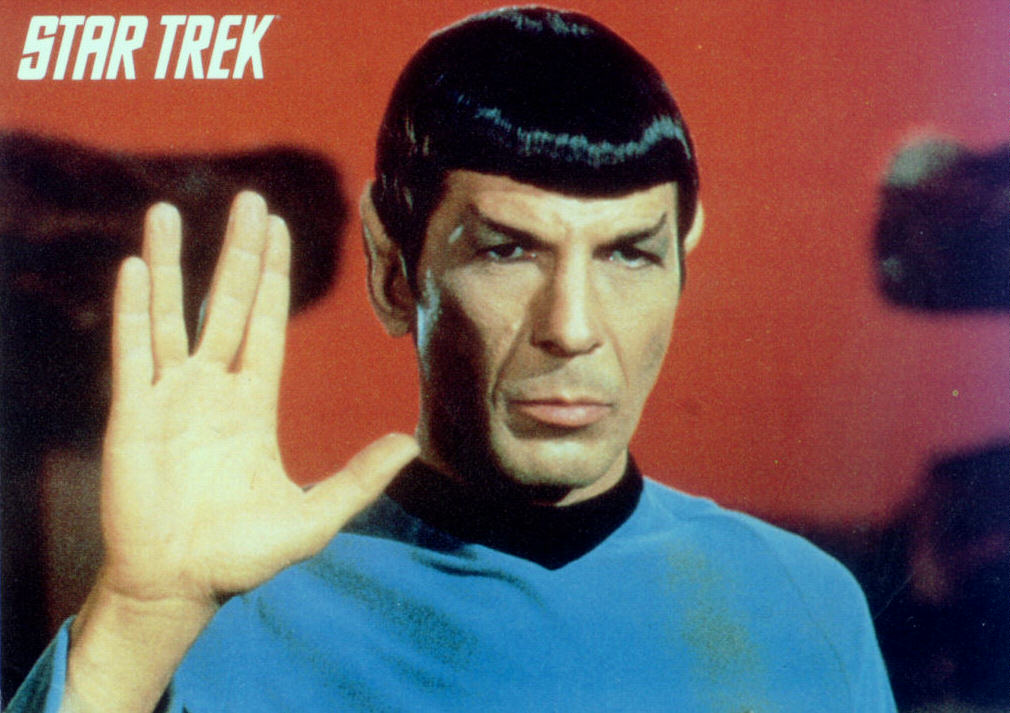
In early adolescence, Tagg Romney couldn't stand his dad. He recalls, "Everything about him bugged me." Tagg says his adolescent emotional outbursts made sense to his mother but not his father: "She runs on emotion; he runs on logic." Thanks to the Globe, we finally know which planet Mitt comes from: He's Vulcan.
Last month, the Romney campaign produced a 13-minute home video, narrated by Ann, about how Mitt decided to run for president. But according to the Globe, Mitt's decision to run for the Senate began when he and Ann were lying in bed, and she said, "You've got to run against Ted Kennedy." We can't wait for the Romney campaign to release that home video. Too bad the dog wasn't around to film it. ... 5:11 P.M. ( link)
Thursday, June 28, 2007
Brothers From Another Planet:Nobody ever won the Republican nomination by quoting New York Times stories about Scandinavian social scientists. But when the Times reported on a Norwegian study that eldest children have higher IQs than their siblings, first-born Tagg Romney posted the link on the Five Brothers blog before dawn. His exact words were, "Duh, I could have told them that!"
Being first in line to the Romney throne is no easy burden. Father and grandfather alike made a fortune in business, were elected governor, and graced the cover of Time as presidential candidates. If there were a motto over the gates of the cyborg factory on Planet Romney, it might say, "Many are cold, but few are frozen."
Is the son of a square still a square—or a cube? As the eldest son, Tagg has dutifully followed his father's path, graduating from BYU and Harvard Business School and trying his hand in the business world at McKinsey, Reebok, and the Los Angeles Dodgers.
But if Mitt Romney comes across as a polished, robotic control freak, Tagg prefers to speak first and ask poll questions later. Ann Romney once told Greta Van Susteren that all her boys were "very naughty," but "equally as naughty as each other"—prompting Mitt to insist that their behavior was "nothing serious." Tagg gives hope that some Romneys are naughtier than others.
In the Romneys' fake Christmas video, Tagg broke with the grew-up-in-a-log-cabin-he-built-with-his-own-hands convention of presidential mythology by telling his father he had to run because his life has been "so lucky."
After the Washington Post wrote about the Five Brothers' wholesomeness, Tagg blogged about how to address the Romneys' "2 Good 2 Be True" problem: "Help us out by sending me some good suggestions on things we can do to make fun of ourselves a little better!"
One reader urged the brothers to hold a farting contest on YouTube. Tagg responded, "The farting contest is a great idea, but it's a foregone conclusion that Craig (king of stink) would win that one easily. My daughter used to call him Skunkle for good reason."
Naughty boy! If Tagg weren't such a spitting image of his father, we might wonder if this impulsive former baseball executive with a frat boy's sense of humor were really George W. Bush's lost son instead.
Judging from his MySpace page, Tagg is as much a speed reader as Bush, too. Forget Battlefield Earth. Tagg's book list includes Les Miserables and Harry Potter, the Book of Mormon and the Bible. He invited blog readers to send him book suggestions. Tagg is sure to ignore the advice to read "anything by William Bennett," but he must have enjoyed the post that said, "Read anything on Lincoln. Not to overblow things, but in some degree, the way your Dad is being treated by the media is oddly similar."
In a video introduction to his blog, Tagg insists that he is "more uptight" than his brothers—"a classic Type A." Everything is relative. Tagg's favorite characters on The Simpsons are Ned Flanders and Milhouse, whom he considers family because his grandfather served in the Cabinet of "Richard Milhouse Nixon." So what if Tagg misspelled Nixon's middle name, or initially confused "Bob Woodruff" with "Bob Woodward"? His IQ is still 3 points higher than his brothers'.
Besides, Tagg is special in another way: He has an imaginary friend. In one post, he responds to a comment from "Sameera Righton," who asks, "Which one of you five is the most hilarious?" Tagg tells her, "Everyone in my family thinks they are funny, but few of them actually are."
But here's the funny part: "Sameera Righton" is herself a fictional character (nicknamed "Sparrow") from a recently released teen novel by Mitali Perkins called First Daughter, which is about the adopted Pakistani daughter of a Republican frontrunner. To promote the book, Perkins created Sparrowblog, in which the fictional Sameera fawns over the children of real-life presidential candidates.
On the surface, Sameera's life seems loosely based on the real-life story of Bridget McCain, the adopted Bangladeshi daughter of a sometime Republican frontrunner. But as a fictional teenager blogging in cyberspace, Sameera is clearly searching for something less real. The result: She's one of the biggest groupies on the Five Brothers site, and her picture is featured on Tagg's MySpace page, where she praises his "brotherhood blog."
When Tagg sought book ideas, Sameera begged him to read the book about her. She posted several comments pushing a Romney-Rice ticket. She routinely lusts after "the Five Romney Hunks." When the Christmas video came out, she urged Sparrowblog readers to "fast-forward to the end to get a peek into oldest brother Tagg's soft heart."
Sameera warned Tagg not to post photos of his children, because "loonies abound in cyberspace and they use kids' photos for all kinds of creepy purposes." (Note to candidates: To be extra safe, have fictitious children.) Tagg's response: "Sameera, I appreciate your concern for my kids!"
Most uptight Republican politicians would run away from a fictional, underage immigrant throwing herself at their feet in hopes of making a big splash on the Internet. Not Tagg Romney. His attitude is: When you write the Romneys, you're not a fake—you're family. ... 5:17 P.M. ( link)

Thursday, June 21, 2007
So Nice, They Named It Twice: If you think you've had a long week, be glad you're not Rudy Giuliani. On Tuesday, his top Iowa adviser left to become Bush's OMB director. He had to dump his South Carolina campaign chair, who was charged with cocaine possession and distribution. But for Giuliani, those headaches paled alongside the week's most excruciating spectacle: seeing his successor, Michael Bloomberg, grace the cover of Time and leave the GOP to plot an independent bid for President. Even if Bloomberg ultimately decides not to run, Giuliani may already be the Bloomberg campaign's first victim.
For Giuliani, the Bloomberg boomlet is bad news on every level. First, Bloomberg joins Fred Thompson in sucking up much of the oxygen that Giuliani's campaign needs to keep breathing. In most national and statewide polls, Giuliani's lead is slipping or has disappeared altogether. While Bloomberg explores how many billions it might take to buy an election, Giuliani suddenly finds himself in no-man's land, as a frontrunner who can't buy a headline.
On Wednesday, Giuliani gave a speech detailing the first of his "12 Commitments." Granted, no one should make too much of a commitment ceremony with Rudy Giuliani. But the plan he offered on fiscal discipline wasn't bad. The national press chose to write another day of stories about Bloomberg.
The second burden is personal. Giuliani is famously selfish about sharing the limelight. He once fired his police chief William Bratton for appearing on the cover of Time. Giuliani's attitude was, " That's my job!" Now a man he thinks he picked for mayor has done it again. Far from firing him, Giuliani has to sit there and read all about it.

Most speculation about Giuliani and Bloomberg has focused on the general election, and the marquee prospect of a Subway Series between two New York mayors and a New York senator. But for Giuliani, the real threat Bloomberg may pose is in the primaries.
Unlike most presidential candidates, who tend to embellish their hometown roots, Giuliani's campaign depends on making Republican-primary voters forget every aspect of his past except 9/11. His Web site calls him "a strong supporter of the Second Amendment," not a Brady-billing assault-weapon banner. He's not from the " abortion capital of the world"; he's for parental notification and decreasing abortions. Gay rights? He's such a traditionalist, his record boasts more straight marriages than any other candidate.
Giuliani's Escape from New York was already tough enough, but Mayor Mike makes it nearly impossible. Bloomberg is the Ghost of Rudy Past—a constant, high-profile reminder of the cultural distance from the South Carolina lowlands to the New York island.
When Bloomberg launched his gun-control crusade, he gave it a name that sounds like the headline from a GOP rival campaign's oppo piece on Giuliani: " Mayors Against Illegal Guns." For conservatives, the same accomplishments the national media loves about Bloomberg are the first signs of the Trilateralist Apocalypse: From penthouses in Manhattan, they'll come for your guns; then they'll snuff your tobacco; and in a final blow to life, liberty, and the pursuit of happiness, they'll take away your God-given right to trans-fats.
Mitt Romney looks disingenuous enough pretending that he saw Massachusetts and tried to stop it. Giuliani has no excuse. His last act as New York City mayor was to urge his people to elect Bloomberg to succeed him. Watching Bloomberg quit the party only reminds conservatives of their primal fear about Giuliani—that the GOP is not an article of faith but a way station of convenience.
You can take the mayor out of the city, but you can't take the city out of the mayor. The more coverage Bloomberg gets, the more his allies will compound the impression that one Hizzoner looks like another. In yesterday's Washington Post, Al Sharpton described Bloomberg with one of those only-in-New-York images:
"A girl in high school catches you looking at her and she starts wearing nice dresses," Sharpton says. "It doesn't mean she is going to date you. But she's at least teasing you, so it really increases your hope. This is a serious tease."
Sharpton just confirmed what they already thought down in South Carolina: Every New York mayor's a cross-dresser. ... 2:14 P.M. (link)
Tuesday, June 19, 2007
The Simple Life: Cyborgs have all the luck. For the wife of a soulless android, Ann Romney seems remarkably down-to-earth. In the captivating new campaign video, "Ann Romney, Christmas 2006," she comes across as funny, honest, and refreshingly normal. So normal, in fact, you almost forget that she's narrating one of the strangest bits of campaign theater ever produced—a 13-minute behind-the-scenes look at Mitt Romney consulting his family about whether to run for president.
The pretext for the video is absurd. Watching the Gore family debate the pros and cons of a presidential run might make for genuine drama. But the only Oscar that Romney could win is for Best Animation. He looks like he made up his mind 40 years ago, then built a family to consult about the decision.
The consultation itself is also creepy. The Romneys talk about how to protect the family's privacy, in a conversation filmed to post on the Internet. In the closing scene, Mitt Romney sits on the couch with a legal pad, dutifully taking notes as he asks his multitude of sons and daughters-in-law "to go around the room and list the reasons to do it and not to do it," and later, "How do you minimize the downsides?"
Son Matt tells his father, "I know you're not just taking notes because there's a camera here." It's a strange, self-conscious admission: Clearly, Romney is just taking notes because a camera is present, and his family is helping. They seem to think The Truman Show was about a president.
Reality shows don't lie, and Mitt Romney quickly emerges as the least interesting member of his own family. Ann marvels at his energy and hard work. He shovels snow! He washes dishes! He takes notes!
His speaking role is awkward and mercifully short. He soldiers through grace, commemorating the birth of Jesus and managing to avoid the looming evangelical-Mormon split over His return by not adding, "See you in Missouri!"
With its ridiculous premise, creepy intimacy, and hollow candidate, the Romney video ought to be unbearable to watch. But the opposite is true. When the camera's not on Romney, the video is irresistible. It's like watching a reality show set in the 1950s—in color. It's as if Jerry Mathers discovered a lost episode of Leave It to Beaver in which Ward Cleaver asks June, Wally, and the Beave whether he should challenge Vice President Nixon for the Republican nomination.
Individually, the Romney boys are as dull and wrinkle-free as their father. But put all five of them in one living room with their five wives and 10 children, and the Five Brothers' very sameness is hypnotic. The odds against having five boys in a row are 31 to 1. Five boys even more frighteningly wholesome—and shallow—than their father must be the result of extraterrestrial intervention or human cloning.
The Romney campaign released the video to coincide with Father's Day. (Over to you, Rudy and Andrew Giuliani!) But the real star of the Guy Smiley Family Hour is Ann Romney. She's something those other 1950s shows like Father Knows Best and Leave It to Beaver lacked: a compelling female character. She has a winning laugh, and unlike her husband, seems to believe what she's saying.
Ann brings the trademark Romney can-do spirit to bear on ordinary subjects, like the chore assignment wheel she uses for family gatherings (but often has to do all by herself). While others worry about their carbon footprint, she makes clear that without paper plates she could never survive the holidays. She points to a hopelessly cluttered kitchen counter she cleaned not five minutes earlier, but doesn't mind tidying again. When she admits with a giggle that for Christmas dinner she cooked the sweet potatoes in Boston and brought them with her in Tupperware on the airplane, it becomes clear that Ann Romney would have run circles around her husband in business school.
She utters a few canned lines about her husband as "a problem solver." But she also volunteers that back in high school, he was once a troublemaker. She and Mitt were arrested and "got put in the paddy wagons" for sliding down the hill on ice blocks. This, too, appears to be a hereditary trait on Planet Romney: The video shows Romney grandchildren on a mattress, repeatedly sliding down the family staircase.
Tagg Romney gets the last word, promising his father that "if you don't win, we'll still love you," but adding with aw-shucks, Beaver Cleaver impertinence that "the rest of the country may think of you as a laughingstock" when it's over. Even in this fake reality show, both the love and the laughingstock ring true. ... 6:27 P.M. ( link)
Thursday, June 14, 2007
No Idea: In the latest Rasmussen robo-poll, pre-release candidate Fred Thompson pulled into a tie with Rudy Giuliani at 24 percent. That makes Thompson the fourth Republican candidate to lead a national, New Hampshire, or Iowa poll in the last three weeks. The race is so fluid that a fifth potential front-runner, Newt Gingrich, is giving up Spanish and switching to French.
Seven months before the Iowa caucuses, polling and news organizations are cranking out an average of four nationwide and two state polls each week. Pollsters and journalists alike warn not to read too much into early polls, then read into them whatever they want.
This week, a CNN/WMUR poll in New Hampshire shed new light on how silly the media's polling obsession has become. The poll's sample size of 304 likely Republican primary voters was sketchy enough. A poll that small has a +/- 5.3 percent margin of error, which means the apparent leader (Romney, with 28 percent) is actually in a statistical dead heat with two who seem far behind (McCain and Giuliani, each at 20 percent), who in turn do not have a statistically significant lead over the man in fourth (Thompson, with 11 percent).
At first glance, the poll results imply that 92 percent support one of the GOP candidates, and only 8 percent "don't know yet" who they'll vote for. But on further inspection, the numbers are closer to the reverse. Of those 304 voters surveyed, a grand total of 18 say they've "definitely decided" to vote for their candidate. That's 6 percent. Given the +/- 5.3 percent margin of error, it's possible that nobody in New Hampshire has made up their minds. Another 37 percent say they're "leaning" to a candidate.
But the overwhelming majority of New Hampshire Republicans give an answer that puts the whole concept of "margin of error" to shame. According to the poll, 57 percent of likely Republican primary voters admit they have "no idea" who they'll for in the primary. With news organizations bombarding us with half a dozen polls a week, it's good to know they've got the margin of error down to just +/- 57 percent.
While its numbers are flimsy and meaningless, the CNN/WMUR poll may be the most revealing portrait of the Republican presidential race so far. If there's one principle that still unites Republicans these days, it's that they have no idea which presidential candidate to support. (The warning holds true for Democrats as well, although the CNN/WMUR poll found that a majority of likely Democratic voters had either decided or were leaning to a candidate.)
Of course, some flinty New Hampshirites go out of their way to remain undecided, so they can get candidates to help out around the house. But there's a big difference between flinty and clueless. The people of New Hampshire have had a front-row seat on this race for the past six months. If only one New Hampshire voter has chosen a candidate for every 10 who have no idea, that doesn't say much for the GOP field—and underscores why the press should forget the polls in favor of worthier obsessions.
The shrugs aren't just coming from New Hampshire. In last month's Des Moines Register poll, 87 percent of Republicans expressing a preference said they might change their minds.
For years, news organizations have offered margin of error as the standard polling disclaimer. In the future, they should routinely report the more revealing percentage of voters who have no earthly idea whom they'll actually vote for.
Naturally, among the 57 percent of New Hampshire voters who have no clue whom they'll vote for, the race is a toss-up. Romney is at 22 percent, McCain at 21 percent, Giuliani at 18 percent. For that subgroup, the margin of error is +/- 7.5 percent, so Fred Thompson is in the hunt with 12 percent.
But here's what makes polls so misleading: Just because voters are clueless doesn't mean they're undecided. Only 14 percent of those who have "no idea" who they'll vote for in January "don't know yet" whom they'd vote for if the primary were held today.
That explains how Republicans could manage to have four front-runners in three weeks. Asked if the election were held today, voters are willing to take a stab at it. But as for how they'd vote if the election were held the day after tomorrow, Republicans echo the Magic-8 ball: Ask again later. Pollsters are standing by to do just that. ... 11:11 A.M. ( link)
Sunday, June 10, 2007
Rabbits and Ferrets and Panda Bears – Oh, My!: Who says bipartisanship is dead? At last week's presidential debates, Rep. Tom Tancredo and former senator Mike Gravel reached across party lines to find a strange piece of common ground – agreeing that English ought to be America's official language. Gravel knows French, and Tancredo thinks Miami is a third-world country. But both men speak fringe.
Mitt Romney's tongue is a little more forked. His initial campaign strategy was to run against France. But among conservative primary voters, hating the French is yesterday's news. While Romney still decries Democrats as French socialists for old times' sake, he has learned to talk tough on immigration. He, too, believes English should be America's official language – except in his own political advertisements aimed at Hispanic voters in Florida. In Tuesday's debate, Romney said:
"I'm not anti-immigrant. I love immigrants. I love legal immigrants coming to our country. I'm happy to communicate to them, and I hope they vote for me. … I'm going to reach out to them in any language I can to have them – have them vote for me."
Memo to rival GOP campaigns: Mitt Romney has flipped again on immigration. Now he's for giving non-citizens the right to vote (for Romney).
No wonder John McCain feels lonely on this issue. He talked movingly about the Hispanic names on the Vietnam War memorial. Romney's idea of courage is being able to mislead voters in any language.
With the collapse of the immigration bill, the Republican field may discover that running against illegal immigrants is yesterday's news as well. For voters in Iowa and New Hampshire, the threat of action in Washington was more frightening than any real threat from the borders.
If, like France, Latin America begins to fade as the fall guy on the campaign trail, what foreign peril will right-wing voters chase next? Fred Thompson has already found one – China.
Thompson changed his tune on immigration as rapidly as Romney, attacking the bill on the grounds that " we're in a nation that is beset by suicidal maniacs" – apparently an all-purpose reference to terrorists, immigrants, and any legislator attempting to work with the Bush administration. Last week, Thompson opened a new front, telling the National Restaurant Association that to support its energy habit, China is "making deals with every bloodthirsty dictator they can." Soon, he'll start rewriting his own history to suggest that the only campaign finance reform he supported was for China.
At the Democratic debate, Bill Richardson raised the prospect of pulling out of the 2008 Beijing Olympics. He won't find many takers, given the failure of the 1980 boycott. But it does suggest a cheap applause line for Thompson and other Republicans: If Mitt Romney did so much to turn the Olympics around, what are they doing in China?
There are plenty of good reasons to make China an issue in 2008. Bush will be gone soon, but the money he borrowed will complicate our relationship with the Chinese for years. As a full-service bank, China even wrote Bush's climate change policy. At a time when the planet needs China to go green, the Bush deficits set a different course: Green goes to China.
Unfortunately, Thompson has yet to offer any more answers to the China question than Bush did. The next President will have to curb our financial dependence on our biggest strategic competitor, convince that superpower as well as ours to curb a dangerous appetite for carbon, toughen enforcement of trade laws, and rally Americans to study harder, learn more, and work harder to keep pace with the competitive challenge.
At the very moment we ought to be summoning the will to outrun China, the Chinese are once again conspiring to sap our strength. Hours after Fred Thompson and Bill Richardson rattled their sabers, Chinese sympathizers in our midst made a surprise announcement: The panda at the National Zoo may once again be pregnant.
Coincidence, or well-orchestrated distraction? For years, zoologists have told us how hard it is for captive pandas to reproduce. But Mei Xiang gave birth less than two years ago. The Chinese were set to repossess her last cub, Tai Shan – code name "Butterstick" – on its second birthday next month, but to avert bad publicity, China let us negotiate a contract extension. Now, with the motherland in desperate need of a public relations boost, Mei Xiang miraculously had no trouble at all getting pregnant.
Zoologists attribute the feat to improved panda sperm – from Gao Gao, another China native stationed in San Diego. But you don't have to be a good shepherd to know that pandas have been China's most effective American infiltrators for more than three decades.
Once the right-wing base finds out, of course, the China debate can only go in one direction. McCain has more pets than he can count, but the other candidates are out to bag their limit. Romney shot rabbits. Giuliani dissed ferrets. The next TV series to pilot on the GOP trail is bound to be, "Fred Thompson: Panda Hunter." ... 7:49 P.M. ( link)
Monday, June 4, 2007
Smiley Face: For decades, political consultants have dreamed of creating the Bionic Candidate, who could instantly become whatever voters want. Over the years, plenty of politicians have been willing to believe whatever the electorate wants them to believe. But mad political scientists have searched in vain for the extraterrestrial alloy that would enable a politician to transform his physical appearance so that voters could literally see what they wanted to see.
The search is over. Despite what his critics say, Mitt Romney is not just another shameless political opportunist who changes his views to match his audience. Nor is he just a scheming cyborg who can immediately spot the second-most ambitious pol in the room. Romney has a unique, superhuman capacity that transcends both those more pedestrian political talents. When people look at him, he can actually make them think they see someone else.
When Slate first proposed a Mitt Romney Look-Alike Contest, we expected a handful of entries converging around the usual suspects like Wink Martindale. Instead, scores of readers entered—and judging from the entries, Romney has even more alter egos than he has had positions on abortion.
For many readers, Romney is like Fred Thompson—a familiar, if somewhat ridiculous, figure from network TV. Reader Sharon Kelly sent photos of Romney as Henry Winkler. Howard Zilbert and Wade Williams think he's Carol Burnett sidekick Lyle Waggoner. Matt Bauer and EA Dyson manage to see Matthew Fox, who plays Jack on ABC's Lost. Mark Johnson reaches back into the archives to see Tony Franciosa, who starred in Fame Is the Name of the Game. To Chris Mishler and Timothy Carroll, he's Ted Danson—which is all the more remarkable when you try to imagine Mitt Romney in a bar where everybody knows your name.




Other entries show Romney's extraordinary range. Several readers saw an anchorman, but never the same one: Ron Burgundy, Brit Hume, Tony Snow. Others saw diverse figures from science fiction, like Data from Star Trek and Michael Rennie, who played Klaatu in The Day the Earth Stood Still.


In fact, Romney is becoming synonymous with double vision. One reader couldn't decide whether Romney looked like Laura Bush or "an ad for men's hair coloring." A few saw a president: Richard Nixon in his final days or Bill Pullman in Independence Day. One man's Lucifer (no image available) was another man's Charlton Heston.


Romney is having mixed success selling himself as a superhero who will save the world from France. Some readers see a resemblance to Bruce Wayne or Mr. Fantastic of The Fantastic Four. Jay Shuck sees Romney as a more comic authority figure: the Ranger in Yogi Bear.


But the two most common categories of entries were perhaps the most insightful: pitchmen and puppets. Kevin Miller sees the lying car salesman Joe Isuzu. Michael Stewart thinks Romney looks like Count Chocula. Sandy Fabian was unfair to suggest Rudolf Hess but came closer with the Brawny Paper Towel guy.



The most impressive entry comes from Laura (presumably not Bush), who took the trouble to showcase Romney as the 1970 Talking Ken doll, which was sold with a strikingly Romney-esque marketing slogan, " I Say Many Different Things!"
In terms of sheer physical resemblance, however, the edge goes to the puppets. The runner-up is Kerry Joyce, who likens Romney to Jeff Tracy, star of the 1960s British remote-control marionette show, The Thunderbirds. The BBC cult page describes Tracy the way many on the right would describe Romney, as " the ultimate puppet superhero."

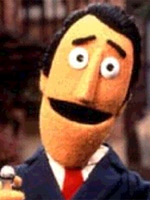
First prize goes to four readers, who will take turns sharing a copy of L. Ron Hubbard's Battlefield Earth. Matthew Williams, Lars Thomas, fellswoop13, and madeiros33 looked at Romney and saw the same iconic figure: Guy Smiley of Sesame Street. As a puppet and "everybody's favorite game show host," Smiley is Mitt Romney. It takes more than a pretty face to look like Mitt. It takes a pretty face that's flexible and easily manipulated. ... 6:35 P.M. (link)
The Mitt Who Mistook His Wife for a Hat: Two weeks ago, Mitt Romney was surging toward the Republican nomination, pulling into the lead in two polls in Iowa and three in New Hampshire. Then, the man couldn't recognize Ralph Reed at his own fund-raiser. In the latest American Research Group poll, Romney is second behind McCain in New Hampshire and third behind McCain and Giuliani in Iowa. Perhaps voters are sending Romney a message: We thought you were someone else.
In an amusing attempt to contain the damage from not being able to tell Ralph Reed from a hole in the wall, the Romney campaign told the Atlanta Journal-Constitution that it had the case of mistaken identity all wrong. The newspaper had reported that Romney saw Ralph Reed across a crowded room and called him Gary Bauer. But campaign spokesman Gail Gitcho gave the paper a different story:
According to Gitcho, Romney mistook Reed for South Carolina Lt. Gov. Andre Bauer, with whom he'd just met, and not Gary Bauer, as our sources recalled.
Gary Bauer is a friend of Romney and has been a guest in his home, so he wouldn't mistake him for Reed, Gitcho said.
That explanation will come as a great relief to Gary Bauer, who probably doesn't like being mistaken for Ralph Reed any more than I do. But it doesn't do much for Romney. With his thick eyebrows and 5 o'clock shadow, André Bauer doesn't look at all like the baby-faced Reed. If there's one thing worse than going to a state Republican convention thinking all Christian operatives look alike, it's going to Georgia thinking all white Southerners look alike.


Camp Romney might have a better case if their candidate hadn't seen André Bauer in years. But their excuse is that Romney couldn't remember the man because he had just met with him.
This would be a serious, if sometimes comical, handicap in the White House, because presidents have always just met with someone. Bush got in enough trouble talking about what he saw when he looked in Putin's heart. Imagine the repercussions if an American president came away from bilateral talks with the Russian leader saying he'd never met the man, or saw Putin across the room at the G8 and shouted, " Nick Sarkozy!"
Will Rogers said he never met a man he didn't like. Romney's campaign says he never met a pol he didn't forget.
In the meantime, the poor fellow has to endure at least another eight months of just having met people on the campaign trail. Other candidates have their own worries now that the Fred has landed. But Romney's programmers can't possibly have anticipated that taking over the planet would involve a race against two men named Thompson.
Faceless multitudes of Slate readers have already responded to the Mitt Romney Look-Alike Contest, the winner of which will be announced on Monday. Reader M. H. Dunlop wrote in to suggest that "Romney suffers from 'face blindness,' sometimes called prosopagnosia, which appears to be, or is claimed to be, an inherited defect." Two decades ago, neurologist Oliver Sacks wrote about another form of agnosia—or "nonknowledge"—in The Man Who Mistook His Wife for a Hat.
More likely, Romney's brain simply uses a different classification system than we do. André Bauer and Ralph Reed may not look alike, but their differences are mostly skin deep. Both are ambitious upstarts who ran for lieutenant governor, a job that is all prospects and no power.
Bauer won, so he gives us an insight into the kind of lieutenant governor Reed might have been. One of Bauer's main responsibilities is giving annual writing awards to fifth- and eighth-graders. The contest rewards originality but insists that in order to win, "close attention should be given to punctuation, spelling, grammar, and neatness."
If Ralph Reed entered his famous e-mail to Jack Abramoff—" I need to start humping in corporate accounts!"—whatever points he might gain for creativity, he would lose for punctuation and sloppiness. Bauer's own work wouldn't even be eligible. On his official Web site, he writes, " Let us all congratulate this years winners, they have written inspiring works."
On the same site, Bauer's description of his press page could easily be mistaken for the story of Reed's life: "A collection of press releases, my beliefs, my life and official photographs." In other words, it's hard to tell where the press releases stop and the beliefs begin. Those are two faces Mitt Romney can recognize. ... 1:40 P.M. ( link)
Friday, May 25, 2007
A Ralph By Any Other Name: From the start of his presidential bid, Mitt Romney has seemed unsure of his political identity. As governor of Massachusetts, he embraced the right to choose, paved the streets with health care, and hired illegal immigrants to mow his lawn. After climbing into the phone booth of the Republican primaries, however, mild-mannered Mitt emerged a new man—lifetime NRA member, xenophobe, pro-life, and anti-rabbit.
Mitt Romney is the Jay Gatsby of American politics—a fiction within a fiction who was born in the Midwest, made his fortune in the East, and never stops reinventing himself to impress those he meets along the way.
It turns out that in one respect, at least, Romney is consistent: He's as unsure of other people's identities as he is of his own. Last week, Romney saw Ralph Reed across a crowded room and called him Gary Bauer. But longtime Romney watcher Seth Gitell writes that it wasn't the first time. Romney made an eerily similar mistake during his 2002 governor's race, mixing up two of his general-election opponents in a televised debate. Romney got into an exchange about bilingual education with the Green Party candidate, Jill Stein. His first words to Jill were, "Carla, I agree."
"Carla" was the name of the Libertarian candidate, Carla Howell. She didn't look like Jill, or think like her, either. As Gitell wrote at the time in the Boston Phoenix, "Romney's faux pas seemed to suggest a candidate who could not be bothered to listen to the differences between the Greens and the Libertarians."
To Romney, not only all Christian conservatives look alike, but all women look alike, too. The cyborg programming must be even more primitive than we thought.
All campaign long, Romney has seemed like a serial identity thief. But perhaps he's really a serial identity jumbler. Legal and illegal, one-time and lifetime, pro-choice and pro-life—these normally bright-line distinctions aren't easy for the identity challenged. We don't criticize the color blind for not being able to tell the difference between green and orange. Should we be so quick to call a man a flip-flopper when he can't even tell one opponent from another?
Memorial Day can be an ordeal for the politician who can't remember—in this case, who he is, what he stands for, where he comes from, and to whom he is speaking. As a special tribute to his special challenge, Slate is proud to announce the Mitt Romney Look-Alike Contest. Other candidates look in the mirror and see the next president. When Mitt Romney looks in the mirror, he sees yet another face whose name he can't quite place.
What person comes to mind when you look at Romney? Some bloggers think he looks like Wink Martindale. Slate's separated-at-birth team came up with a host of other suspects, from Stone Phillips to Ricardo Montalban. Send your entry to thehasbeen@gmail.com. The winner gets a copy of Romney's favorite book, Battlefield Earth, by L. Ron Hubbard—or, as Mitt likes to call him, " Tom." ... 3:17 P.M. ( link)


Wednesday, May 23, 2007
Stranger in a Strange Land: For someone who suddenly likes to pick on foreigners, Mitt Romney is an awfully recent immigrant himself. If you want to know just how foreign Romney is to the conservative circles he now frequents, read the Atlanta Journal-Constitution's account of his fund-raiser last week during the Georgia Republican Convention:
Romney gestured to Ralph Reed and said, "Why it's good to see Gary Bauer here." Romney then caught himself. "Oh, I'm a little mixed up here," he said. But Romney still couldn't place Reed's face—and had to move on.
It's bad enough that in his rush to convert to conservatism, Romney forgot he was pro-choice, had hired illegal immigrants, and never hunted. Now the man can't even keep track of his religious-right has-beens.
The Christian right was built in large part on resentment that Eastern elites think all evangelicals are alike. This confirms their worst fears—that even the Republicans from Harvard are in on the conspiracy.
To be sure, politicians shouldn't be expected to remember every person they meet. For example, here's a photograph of another Georgia Republican, Rep. Phil Gingrey, who appears to have put on a fake mustache simply to confuse Romney.
But mistaking Ralph Reed for Gary Bauer at your own fund-raiser is like going to a Star Wars convention and mixing up Luke Skywalker and Yoda. Bauer is short, bug-eyed, and tight-lipped. No one noticed his 2000 primary bid until he fell off the stage at a pancake-flipping event in New Hampshire. Reed is lanky, with narrow, shifty eyes and a big, plastic grin. In fact, Reed's eye/grin ratio bears a much stronger resemblance to Romney's own features. At first glance, you'd think Romney and Reed would know each other well from their time together as cyborgs taking orders from the distant, politically ambitious planet that sent them.

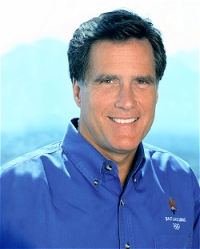

Anybody can confuse two people who look alike. Confusing two people who look different but think alike is a far more revealing error. First, it tells us Romney hasn't spent much time around either Ralph Reed or Gary Bauer. That's the good news. The bad news is that it increases the chance that Romney might be a cyborg, after all.
Politics is a people business, so most politicians file people in their minds by face, name, and place. None of those apply in this case (what would Bauer, who lives in Virginia, be doing at a Romney fund-raiser in Georgia?). That means Romney must use a different, bloodless classification system. When he studies his conservative flashcards, Romney files people by type. Bauer is a true believer, while Reed is a shameless opportunist—but to Romney, they're interchangeable evangelicals with the same carbon dating.
Of course, the episode raises other questions, like what was Ralph Reed doing at a Romney fund-raiser? Giuliani helped him in his losing race for lieutenant governor, a career move that worked out less well for Ralph than for Rudy. Yet the day before Romney forgot his name last week, Ralph went on the Christian Broadcasting Network to shill for Romney and Giuliani in equal measure. Reed dodged a question about whether his phone was ringing off the hook, but said, "I have friends who are running for president, and I talk to my friends."
I've come to terms with being mistaken for Ralph Reed. But I draw the line when the same person who gets confused with me starts being confused with Gary Bauer. I could live with Jack Bauer, or even Eddie.


Ralph Reed should know a phony when he sees one. Friends don't let friends call them Gary. ... 2:15 P.M. ( link)
Monday, May 21, 2007
Tale of Two Cities: Week before last, former New York Mayor Rudy Giuliani flew to Houston to tell conservatives at a Baptist college his latest stand on abortion. The same day, his successor, Mike Bloomberg, flew to Houston to give a very different speech—telling business leaders what the United States needs to do to save energy and stop climate change.
Both appearances were rich in political symbolism and irony. New York and Texas have long been on opposite sides of the blue-red divide, disagreeing on 11 of the first 14 presidential elections after Texas became a state, as well as all five since 1988. New York magazine called its hometown the " Abortion Capital of America." Houston is the energy capital of America, if not the world. Bloomberg's choice of venue made more sense than his predecessor's. Nearly half a century after JFK went to Houston to promise Protestants he wouldn't take orders from the Vatican, Giuliani asked the Baptists' forgiveness for not doing the pope's bidding.
If crossing paths in Houston was a coincidence, it was a revealing one. Giuliani's never-ending stumbles over such an obvious hurdle as abortion suggest that he has approached his campaign with insufficient seriousness. By contrast, Bloomberg's calculated bids for attention on climate change, education, and guns give every indication that his unannounced campaign for the presidency is running on all cylinders.
As a shadow candidate, Bloomberg is running the campaign Giuliani should have run, as a pragmatist who helped a big city take on big problems. Earlier this month, Bloomberg launched a Web site that outlines his stands on the big issues in greater detail than Giuliani can provide after five months in the race.
To add insult to irony, a Bloomberg candidacy is predicated on candidates twisting themselves into the very pretzels that Giuliani has already become. In an Air America interview with Mark Green, the man he beat, Bloomberg points out that a third-party candidacy only works if the first two parties both fail to offer a compelling choice. He admitted that when the primaries are over, "[t]he public may not feel that they don't have any choice."
In the end, the two parties aren't likely to give Bloomberg a big enough opening to win. Part of the reason that Giuliani, McCain, Romney, and Fred Thompson are struggling to claim the conservative mantle is that they're closet pragmatists by their party's standards. Apart from Mike Gravel and Dennis Kucinich, the Democratic field doesn't even have an ideologue. The energy speech Bloomberg gave in Houston is one that many Democratic candidates have already given.
In that respect, the prospect of a Bloomberg candidacy can do more good than an actual one. Any prospective third-party candidate has to consider the nightmare of becoming the next Ralph Nader, who siphoned off just enough votes to make sure none of his ideas could ever happen.
The greatest power of a third party is its gravitational effect on the other two. To have that kind of impact, Bloomberg doesn't even have to run. The most successful third-party candidacies—Teddy Roosevelt in 1912, Ross Perot in 1992—did less to determine the winner than to shape the debate. Woodrow Wilson and Bill Clinton would have won those elections anyway. But Roosevelt made Wilson earn a progressive mandate, and Perot inspired Clinton to put more emphasis on deficit reduction and reform.
Like most billionaires, Bloomberg is a firm believer in the power of markets. If market forces work in politics, his lurking presence on the sidelines should be enough. In the midst of the silly season, when some partisans are raising their hands to deny reality, the sword of Bloomberg is a useful reminder that when the primaries are over, the earth will be round again and reality will go back into effect. ... 1:38 P.M. ( link)
Thursday, May 17, 2007
Don't Know Much About History: Hillary Clinton just asked supporters to choose her campaign song, but Republican candidates already agreed on theirs. Perhaps the next debate will feature a barbershop quartet of Rudy Giuliani, Mike Huckabee, Ron Paul, and Mitt Romney singing:
Don't know much about history/ Don't know much biology/ Don't know much about a science book/ Don't know much about the French I took.
To be fair, the Republican race is a particularly difficult kind of history test. In order to pass, a GOP candidate must persuade Americans to miss the '80s, fear the '90s, and start the current decade over without Bush. For some, like Romney and Giuliani, traveling back to the Reagan era has the additional benefit of rewinding past all the positions they've taken in years since.
Once again, Republican candidates and the American people are headed in different directions. The National Assessment of Educational Progress reported yesterday that while political leaders are doing their best to ignore history, young people are doing much better at it.
The educational standards movement appears to be paying off. Between 1994 and 2006, the number of fourth-graders performing at or above basic level in U.S. history jumped from 64 percent to 70 percent. Civics scores went up, too. Jay Mathews of the Washington Post points out that scores even rose among high-school seniors, who hadn't improved in any subject in the past eight years.
Education Secretary Margaret Spellings was quick to attribute the progress to No Child Left Behind, glossing over the inconvenient fact that fourth-grade history scores rose slightly faster between 1994 and 2001 than in the years since NCLB was passed. In any case, if young Americans are making progress on these two subjects, Spellings' boss deserves the credit. At last, President Bush may have found the perfect excuse for his failures at home and abroad. The Imperial Presidency isn't a way to abuse power—it's a way to teach civics. Never mind Iraq's failures as a war—it has been a great history lesson.
If anything, the Bush administration might well be accused of teaching to the test. The NAEP report says that to perform at basic level in history, fourth-graders must be able to "interpret a presidential quotation." Give Bush credit—he has been quizzing those kids every day.
While Mickey Kaus may be despondent about where the Senate is headed on immigration, he should take heart that the next generation aces the issue. On the civics test, 75 percent of all fourth-graders correctly answered that noncitizens can't vote. If Monica Goodling were still around, those 9-year-olds would be made U.S. attorneys.
The nation's eighth-graders showed no progress on civics, but we can't fault Bush for trying. Consider this question from the eighth-grade test:
Teresia is a small country that has been invaded by its neighbor Corollia. The king of Teresia is a long-standing United States ally who has been living in exile since the Corollian invasion. Teresia is an important exporter of uranium; it sends most of its supply to members of the European Union. The king appeals to the United States and the United Nations for military help in driving Corollia from his country.
Identify two pieces of information NOT given above that you would need before you could decide whether or not the United States military should help Teresia. Explain why each piece of information would be important.
C'mon, kids! How many countries does the president have to invade before you start getting the right answer?
Only 13 precent of eighth-graders had an "acceptable" response, which is even lower than the president's own ratings. Just 3 percent of the responses were "complete"—so Bush is not the only one.
Bush can take some comfort as well from the sample answer in the NAEP report. That particular eighth-grader outperformed Bush by asking to know more about Corollia's motives and allies. But the student didn't ask anything about whether Teresia was really exporting uranium.
Of course, President Bush may be a great teacher, but how would he do on the test? The past six years have trained him well for one measure of basic fourth-grade achievement: "Students should know that the world is divided into many countries." Bush has spent enough time around the Coalition of the Unwilling to know that.
But other NAEP standards might be harder to meet. In civics, fourth-graders at the basic level should be able to "recognize that the president is an elected official" (somewhat more difficult since 2000) and "identify an illegitimate use of power" (which may have been Lynne Cheney's real objection to these standards all along).
The advanced achievement level for fourth-graders is harder still: "Given age-appropriate examples, they should recognize differences between power and authority and between limited and unlimited government." And there's just no getting past the section, "What Fourth-Graders Know." A "proficient" fourth-grader can name the two political parties. But to be considered "advanced," a fourth-grader must be able to "identify the legislative branch." By that standard, this administration could be stuck in grade school for a long time. ... 3:57 P.M. ( link)
Tuesday, May 15, 2007
Hear Me Roar: These are tough times for the newspaper business, so editors everywhere should be grateful to Slate's parent company, the Washington Post, for an ingenious cost-saving measure—the reusable headline. Saturday's Post carried a story entitled, " Giuliani Tries To Clarify Abortion Stance." No matter how many times Giuliani addresses the subject, it's the only headline any newspaper will ever need.
The savings don't stop there. Today, the Post's Dan Balz was able to recycle Saturday's lede for his curtain-raiser on tonight's debate: "Much of the focus [is] likely to be on former New York mayor Rudolph W. Giuliani and his continuing effort to extricate himself from a controversy over his position on abortion."
This weekend, Giuliani was busy clarifying his abortion stance on Fox News Sunday. "Let's start with abortion and any confusion that remains about where you stand," Chris Wallace began. The more Giuliani tried to extricate himself, the more he had left to clear up.
Wallace asked, "Most Americans would feel passionately one way or the other. Why are you so indifferent to such a deeply held issue?" Giuliani insisted, "I'm very, very passionate about the issue." He proved how much he cares about abortion by repeatedly referring to the landmark case as "Roe against Wade." Moments later, when Wallace asked him if he'd be upset if Roe were overturned, Giuliani showed all the passion of Mike Dukakis. "I don't think it's a question of being disappointed or being happy about it," he said. Vive l'indifference!
On Friday, Giuliani tried to recast his views on abortion and guns as a profile in courage. On Sunday, he once again made clear that he was brave enough to pander. He promised not to change the pro-life Republican platform. He affirmed his support for abortion limits he used to oppose. He promised conservatives what they want most on abortion—strict constructionist judges. And as an example of what he means by judges not legislating from the bench, he praised the D.C. Circuit's recent decision to overturn a 1939 Supreme Court precedent on the Second Amendment.
Giuliani did manage to clarify one issue on Sunday. In fact, he offered what may be the single most definitive statement of his campaign so far: "I'm not a woman."
Wallace wasn't even trying to clear up any confusion on that score. Giuliani just wanted to show that his passions on the abortion issue only go so far:
"I believe abortion is wrong. I believe, as a personal matter, if it were my personal choice — and of course, it will never be my personal choice. I'm not a woman."
It's hardly news when a thrice-married man clarifies his stance that he is not a woman. But Giuliani went further, volunteering that he will never be a woman. Fox viewers can rest assured: Some options are off the table.
Yet just a few sentences later, Giuliani threw even that certainty into some doubt, telling Wallace:
"If you said to me, as a woman, 'I have an equally strong view of this as you do' … I would support that."
The strict constructionist reading of "If you said to me, as a woman" is clear: Giuliani thinks he's a woman. Another flip-flop! But a more liberal interpretation might reach the opposite conclusion: Giuliani thinks Chris Wallace is a woman.
No wonder Giuliani is losing the Republican base. He has done so many Inner Circle productions, he thinks "fair and balanced" is Rosalind in As You Like It— a man playing a woman playing a man playing a woman.
Either way, Giuliani's second point is as confusing as the first. Giuliani says he would happily defer not just to Chris Wallace but to any other woman who has "an equally strong view of this" as he does. Yet as Wallace demonstrated at the outset of the interview, it would be hard to find anyone in either gender as indifferent to the subject as Giuliani.
Despite his incredibly bad week, Giuliani still leads national polls. But in the more sophisticated political-futures markets, Giuliani shares are in free fall. Between Thursday and Monday, he dropped from 31 to 27 on Intrade, while McCain jumped from 23.5 to 29.5.
If this is clarity, the Giuliani campaign can't afford much more of it. On Mother's Day, the mayor made clear he is not now nor never will be a woman. Within hours, his stock plunged 5 percent. ... 12:59 P.M. ( link)
Friday, May 11, 2007
Multiple Choice: In 1960, JFK went before the Greater Houston Ministerial Association to put the Catholic issue behind him. Today, Rudy Giuliani spoke at Houston Baptist University in yet another attempt to put the abortion issue behind him. JFK wanted to prove that in America, there is no religious test to become president. As he labors to explain his ever-changing heart on choice, Giuliani seems determined to prove that there is no history test, either.
Giuliani is not alone. Mitt Romney doesn't want a religious test or a history test. His about-face on abortion is even less convincing than Giuliani's. Sam Brownback, Mike Huckabee, and Tom Tancredo, who don't believe in evolution, want to prove there's no science test. All the Republican candidates are supply-siders, hoping to prove there's still no math test.
As a last resort, Giuliani now wants to turn his abortion stand into a badge of honor. The press will give him credit for setting up a showdown with social conservatives. Today's Times gave the Giuliani campaign the headline they want: " Can the G.O.P. Accept Giuliani's Abortion Stance?" But Giuliani's abortion stance is such a muddle, the issue is not whether a pro-choice candidate can win in a pro-life party. It's whether a campaign predicated on leadership can survive a candidate who has already said he was for Roe before he was against it.
Emily Bazelon made a good case for why voters have a right to judge Giuliani's presidential bid by his disastrous home life. Here's another reason: His presidential bid is rapidly starting to mirror his disastrous home life. Giuliani seems to have the same attitude toward his abortion positions that he has shown toward marriage—who's counting?
The Times offers a helpful interactive timeline of " Giuliani on Abortion." In 1989, he was for public funding. In 1993, he called choice a constitutional right. In 2000, he opposed a ban on late-term abortions. Last month, he divorced himself from his previous stands on public funding and late-term. This month, he sought to annul his position on choice as a constitutional right. Now he's of three minds: Abortion is "morally wrong," women should be able to make their own choice, and so should conservative judges.
Giuliani's decision to buck his party on abortion would be refreshing and courageous, if he hadn't already tried so hard to have it both ways on the issue. He tells conservative audiences not to worry about his pro-choice record because he personally "hates" abortion and will appoint judges like Scalia, Roberts, and Alito. He boasts that during his tenure as mayor, abortions dropped 16 percent—but doesn't mention that abortions nationwide dropped 15 percent over the same period or that New York City still has an abortion rate three times the national average.
The Giuliani campaign trotted out the perfect man to vouch for the mayor's credentials: Steve Forbes, who was pro-choice in his first presidential bid and pro-life in his second. "Thanks to Giuliani's success on welfare reform, where rolls were cut 60%, the abortion rate in New York City fell faster than the national average," Forbes told RealClearPolitics. "Rudy may be pro-choice—and I happen to be pro-life—but the policies he pursued help the pro-life cause."
Welfare reform has done a great deal to promote work, demand responsibility, and reduce poverty, but even ardent proponents like me have trouble crediting it with short-term reductions in abortion. Most conservative welfare reformers had the opposite worry—that a concerted effort to reduce illegitimacy might cause a spike in abortions. During the 1996 welfare reform debate, Senate Republicans rejected House plans to deny benefits to unwed teen mothers and cap benefits for mothers who had additional children on welfare for that very reason—Catholic conservatives feared those provisions would make abortion go up. A plan to reward states for reducing out-of-wedlock births was rewritten to deny the bonus to states where abortion rates increased at the same time. Of course, Giuliani urged Clinton to veto the 1996 welfare reform bill, so don't be surprised if he now claims his moral opposition to abortion as the reason.
Why does the choice issue so often manage to turn grown men into pretzels? Conservative doubts over Giuliani's abortion position were hardly a surprise attack. Yet judging from his halting response so far, the same man who knew just what to do on 9/11 would have been stumped for months if al-Qaida had simply sent him a NARAL questionnaire.
Charles Krauthammer says the fault is with Roe, not Giuliani. But that's letting him off the hook too easily—akin to Giuliani saying, "the court made me do it, and the justices I appoint may or may not undo it." Rich Lowry of the National Review offered a more persuasive explanation of Giuliani's troubles with the issue: "One of the big ironies for him is he doesn't care about abortion." If Giuliani had the courage to say that, we might start to believe him. ... 3:23 P.M. ( link)
Tuesday, May 8, 2007
Mood Ring: If malaise, like revenge, is a dish best served cold, the Bush administration is keeping Republicans exceedingly well-fed. In the latest Newsweek poll, the president matched Jimmy Carter's record low with a 28 percent approval rating. It took Richard Nixon a quarter-century to have Seven Crises. For George W. Bush, seven crises is a pretty good week.
Republican presidential candidates are trying their hardest to look on the bright side. At last week's debate at the Reagan Library, the field mentioned optimism more often than bin Laden. Giuliani chanted the word four times—three times in a single answer. Bush's favorite word, resolve, didn't come up once.
Republicans may be right to miss Reagan—not because his policies worked, but because the country has so soured on their party that only an actor could still put on a happy face. That's the role many Republicans have scripted for Fred Thompson. They don't much care what he stands for, provided he can cheer Republicans up.
If that's his goal, Thompson got off to an odd start in an address to Orange County conservatives this weekend. Jonathan Martin, who covers Republicans for the Politico, said Thompson's speech was " low key and at times meandering." Robert Novak, conservatism's biggest grump, called it " a downer." (Ironically, the best part of Thompson's speech was his joke that he'd spent the whole night trying to keep Novak from seeing his notes.)
Far from helping Republicans escape their despair, Thompson couldn't stop reminding them of it. "We've had our ups and our downs," he said, insisting that the party's post-Watergate gloom wasn't as bad as it seemed at the time. He warned that we're "even hearing that old malaise talk we used to hear," then indulged in some, noting that there's "some concern that maybe we're slipping away like all the great powers have."
Thompson echoed another actor-turned-politician by repeatedly borrowing Arnold Schwarzenegger's trademark tic, " and things of that nature." He closed his speech by inadvertently giving a good impression of Reagan's famous "Highway 1" closing statement in the second 1984 debate. In Thompson's rambling story, a group of sixth-graders in North Hollywood asked him why he went into politics. The question made him think back to Washington, Lincoln, the Revolutionary War, and our common heritage. The answer: not clear.
But the award for most surprising performance by an anecdote in a supporting role goes to two other historical cameos in Thompson's speech. In a rare turn for the 2008 Republican campaign trail, Thompson praised Wendell Willkie, the Republican nominee who lost the 1940 election in a landslide but became one of FDR's most important allies.
More remarkably, Thompson went out of his way to stick up for perhaps the greatest wimp of the 20th century: Neville Chamberlain. The Bush administration has spent the last six years trying to tie Democrats to Neville Chamberlain. Don't even ask how he got there, but Thompson was working off a different set of talking points. He didn't defend Chamberlain's record, but he did paraphrase Churchill's eulogy to say, " Neville Chamberlain marched in the ranks of honor."
Perhaps that was Thompson's indirect way of saying something nice about Bush. The next line in Churchill's eulogy fits Bush even better: "It fell to [him] in one of the supreme crises of the world to be contradicted by events, to be disappointed in his hopes, and to be deceived and cheated by a wicked man." More likely, Thompson was just making the noble point that compared with politicians today, Churchill was a class act.
In any case, it's a modern political first: Fred Thompson could go down in history as the only presidential candidate in either party to put in a good word for Neville Chamberlain.
Could this be the future of conservatism? Will Republican candidates try to prove they're not the next George W. Bush by leaving open the possibility of being the next Neville Chamberlain?
In 2000, Bush invented compassionate conservatism to distance himself from Newt Gingrich. The GOP's challenge is even greater in 2008, but Thompson may have found the answer: appeasement conservatism. With a Republican Party that loses elections as gracefully as Willkie and loses wars as pre-emptively as Chamberlain, America will forget the Bush presidency ever happened. ... 1:54 P.M. ( link)