How Blair Botched the Iran Hostage Crisis
Hint: Take a look at Iraq.
In his speech denouncing the 1938 Munich agreement, Winston Churchill said, "We have suffered a total and unmitigated defeat. ... This is only the first sip, the first foretaste of a bitter cup which will be proffered to us year by year unless by a supreme recovery of moral health and martial vigor we arise again and take our stand for freedom." Churchill has become a totemic figure for the Bush administration and the neocons, revered and continually cited, and those words might easily be quoted after the March 23 capture of the 15 British hostages and their subsequent release by the Iranian government.
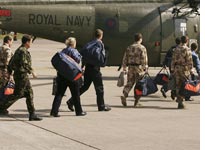
In fact, that was pretty much what John Bolton—no longer U.S. representative at the United Nations but still a regular performer on British television—did say Wednesday evening. He saw the end of the crisis as a victory for Tehran: "Win-win" for Iranian President Mahmoud Ahmadinejad. Although there is natural relief throughout the country that the British service personnel, 14 men and one woman of the Royal Navy and Royal Marines, are now home, joy has been distinctly qualified, even before today's news that another four British soldiers had been killed in southern Iraq.
"Has this been a diplomatic triumph for Blair or a humiliation for Britain?" asked the Daily Mail. Many people agree with Bolton that it was the latter, all the way through Wednesday, when the ever-unpredictable Iranian president produced his dazzling coup de théâtre and announced the release of the prisoners. "The Clemency of Mahmoud" was a brilliant performance, a good deal better, certainly, than Tony Blair's."
From the beginning, the London government was on the back foot. The first question concerns the responsibility of the Royal Navy. Vulnerable inflatable craft, little more than lightly armed dinghies, were sent into an area of acute sensitivity at a time of acute tension after the imposition of U.N. sanctions, on top of the turmoil in Iraq. The crew was put in harm's way, with no possibility that they could be rescued if anything went wrong, although the flagship HMS Cornwall and naval helicopters don't even seem to have made a gesture of resistance or assistance.
Nor have the rights and wrongs been clear-cut. Repeating the London and Washington line, Bolton says that Iran was entirely in the wrong from the start: The British boat was in Iraqi territorial waters. Period. But not only Tehran disagrees. When Craig Murray, formerly of the maritime section of the British Foreign Office, was interviewed on BBC TV this week, he was asked who was telling the truth. "Nobody," he replied.
Contentious borders used to be called "debatable land," and the whole Persian Gulf is debatable water. In the vast estuary of the Tigris and Euphrates at the northern end of the Gulf, the coastline itself continually shifts, and the notional sea boundary with it. We are credulous about modern high-tech gadgetry, including the wonderful Global Positioning System, although plenty of evidence, from automobile satellite navigation to voting machines, might be a caution against blind faith in machinery. From my own modest experience of navigating a small boat, I know it is far-fetched to think you can know your exact position on the high seas to within a few hundred yards—and that may still be true even with GPS.
When Murray was asked if there was a culprit, he said, "No. 10"—referring to the home and office of the prime minister. For all the angry venom of Iran, the row could have been defused at an early stage if it hadn't been for Blair's grandstanding. Wise people learn early on that, whether dealing with business rivals or flaky Middle Eastern regimes or merely with your own recalcitrant children, you should never utter threats you can't enforce.
Our prime minister forgot that elementary lesson. It was perfectly clear that there was nothing that London could do in military terms to chastise Tehran. Does even John Bolton think that the Black Watch regiment should have marched from Basra to Shiraz or that the Royal Air Force should have bombed Tehran? By taking the question to the U.N. Security Council and the European Union, Blair invited humiliation, which he duly received, and in the process he turned an incident into a crisis.
There have been other painful reminders of how diminished our authority is. While the pacifist left doesn't think our forces should have been in the Persian Gulf in the first place, the patriotic right have been dismayed by the conduct of those talkative hostages, with their continual expressions of penitence for having done the wrong thing and of gratitude toward their captors. That culminated when one of these brave lads told Ahmadinejad yesterday, "We are very grateful for your forgiveness."
Whatever happened to "name, rank and number"? thunder the Conservative Daily Telegraph and Daily Mail, hearkening back to the fortitude our prisoners of war displayed in World War II (or at least in subsequent flag-waving British war movies), when they were supposed to say nothing at all to their captors beyond those basic particulars. Once upon a time, or so we supposed, our chaps would have preferred death to dishonor.
That's a lot to ask, but it might not be too much to wonder why Lt. Felix Carman had to address "the Iranian people" and say, "I can understand why you were insulted by our apparent intrusion into your waters." Asked if she had her own message for the Iranians, Faye Turney said, "Thank you for letting us go, and we apologize for our actions but mainly thanks for having it in your hearts for letting us go free," which likewise seems to be taking international amity a little far.
Her tale has confirmed the view of those, not all of them sexist reactionaries, who always thought that the presence of female personnel in the front line was one of the less happy achievements of the women's movement. She is indeed "the mother of a little child," as Ahmadinejad called her. When he asked, "Why should the difficult task of searching the seas be given to a mother thousands of miles from home?" he might have sounded like a kinder, gentler Borat, but he might also have had a point.
As John Bolton says, the guy has chutzpah. But then Bolton, that noisiest of hawks, cannot admit what stares most of us here in the face: This crisis illustrated the weakness of Britain's position in the Middle East—much weaker than five years ago, before the disastrous Iraq enterprise. In 1938, Churchill attacked what he thought a needless capitulation to Hitler, but he never once advocated a pre-emptive war against Germany.
Two years later, as prime minister of his embattled country, he said, "Long and hard, hazardous years lie before us, but at least we entered upon them united and with clean hands." So many of our difficulties today stem from the fact that four years ago we were a nation divided when we went to war and that Tony Blair has anything but clean hands.