The Scottish Invasion
Who rules London?
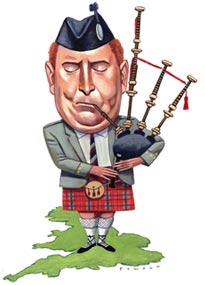
One of the great pleasures of living in London is experiencing firsthand the ways the English feel sorry for themselves. Lately, the newspapers have been chock-full of glumness about English football (the national squad was recently humbled by the Croats), and the controversy about Muslim veils. Occupying a more obscure corner of the English subconscious—one offered up for public inspection after hoisting a few pints—is a more reliable figure: the Scot. As Alexander Chancellor, a columnist at the Guardian, explains, "There's a feeling that there's just a few too many of them."
The Scot, which in the British imagination is a bluff and mumbling fellow, may seem like an unusual object of fear and loathing. But in London, it seems the city is being ruled over by a group of ambitious Scots—what Jeremy Paxman, a popular BBC presenter, has dubbed the "Scottish Raj." Prime Minister Tony Blair, who claims Englishness, was born and educated in Edinburgh. Five of Blair's 20 Cabinet ministers are Scottish, meaning that about one-twelfth of Great Britain's population has produced one-quarter of its Cabinet. The ruling Scots include Gordon Brown, who will probably succeed Blair as prime minister, and John Reid, the home secretary, Brown's only real rival for the post. Menzies Campbell, the leader of Britain's Liberal Democrats, is Scottish, as is his predecessor, Charles Kennedy.
When Scottish pols sit down for interviews at the BBC, they are increasingly likely to hear questions posed in a familiar brogue: Scottish media stars include Andrew Marr and Radio 4's James Naughtie. "At some point, it begins to sound like an intensely Edinburgh conversation," says Ian Jack, a Scot who edits the London-based literary magazine Granta. Perhaps because of this critical mass of ascendant Scots, the last year has been a noticeably tense one for English-Scottish relations. In June, London's mayor, Ken Livingstone,joked that a new rail-link system was necessary "so that we can continue to pay for the Scottish to live the lifestyle to which they are accustomed." (It is of great annoyance to the English that the Scottish receive more money per capita in public funding.) A BBC pollpublished in May revealed that 55 percent of English votersdid not think a Scot should be prime minister—a dilemma the Daily Telegraph, in an unfortunate turn of phrase, has called "The Scottish Question."
"There are few more impressive sights in the world than a Scotsman on the make," wrote J.M. Barrie, and, indeed, the upwardly mobile Scot has long been a source of low-grade grumbling. In his 1902 book The Unspeakable Scot, T.W.H. Croslandcharged that clannish Scots had begun to dominate London's literary and journalistic circles. Taking up Crosland's mantle these days is journalist Geoffrey Wheatcroft, who told me, "I've been going on about this and I'm treated like a crank." Wheatcroft recently aired his concerns in a radio debate, and emerged from it even more convinced that Home Secretary John Reid was a "complete and utter carpetbagger," and that Scots politicians were "unusually corrupt, drunken, and worthless."
Scots loathing has its roots in a legitimate political dilemma. In 1999, the British government began the process called "devolution," in which it turned over various local matters to the newly created Scottish Parliament. Scottish constituencies, meanwhile, continue to send MPs to the British Parliament at Westminster, where they are occasionally called on to vote on matters that only affect England. This has prompted an exhumation of the "West Lothian Question," which was formulated in 1977 byan MP named Tam Dalyell. The question is, if Scots at Westminster can vote on matters that affect only the English, why do English MPs have no reciprocal power over the Scots? Adding to the conspiratorial element is that the most powerful of the current Scottish pols—Brown, Reid, et al.—are almost all members of Labor.
The Scottish politician is not without his virtues. When trolling for pleasant things to say about the Scots, one often hears of the "bank-manager theory." This holds that a Scottish politician's ruralism, his very lack of London sophistication, is his greatest political asset. Like the steady hands at the Royal Bank of Scotland, the Scots politician is historically thought of as a reliable bastion of probity. "Not terribly imaginative but absolutely trustworthy," explains Allan Massie, a Scottish journalist and novelist.
Among the many attributes of Gordon Brown, trustworthiness is perhaps not the first that would come to Tony Blair's mind. (Brown has spent the better part of the last year trying to quietly ease out Blair.) At dinner the other evening, the mere mention of Brown's name brought the kind of lip-curling reaction that Al Gore's presidency inspired in 2000. In addition to making sport of his public woodenness, the Tories have taken mischievous pleasure in reminding voters of Brown's Scots heritage at every turn. Writing in the Spectatorlast year, Boris Johnson, the shadow minister for higher education, argued that Brown should be denied a term as prime minister "mainly because he is a Scot and government by a Scot is not conceivable in the present constitutional context." Johnson's blast was seconded by another Tory minister, Alan Duncan, who said the idea of a Scottish P.M. was "almost impossible." Following his usual strategy of tamping down interest in himself, Brown responded with a series of wearisome speeches on the virtues of Britishness.
The other afternoon, I went to the House of Commons to visit Michael Gove. A reed-thin, bookish character, Gove is an interesting specimen: a Scottish Tory who represents the English constituency of Surrey Heath. Gove is sympathetic to Gordon Brown's plight, though he would like nothing more than to see the Labor government fall.
Gove appeared fresh from the floor of the House in a navy blue suit, a checkered shirt, and a blue cloth necktie. I asked him to explain the emergence of what Jeremy Paxman had dubbed the "Scottish Raj." "You could make the flip point about how good the Scottish educational system is, and that's why there's so many Scots in politics and in the media," Gove said. "The truth is, Scots are a more noticeable section of the population"—he paused impishly—"even more so than, say, public-school boys, of which Jeremy Paxman is an example."
As to Brown's newly discovered Britishness, Gove said it is a carefully planned pre-emptive strike. "It's an attempt to deprive the center-right of the patriotic card," he said. "Brown talking about Britishness is a vanilla version of John Kerry turning up at the Democratic Convention surrounded by Swift Boat veterans."
The comparison with Kerry is apt. As Gove points out, with a clumsy politician, just about every gaffe can be made to seem like a product of his background—whether it's the chancellor of the exchequer from Scotland or the senator from Massachusetts. Whatever unease the English psyche may feel at the present moment may have nothing at all to do with the Scottish character. It is highly possible—probable, even—that the English just don't like Gordon Brown.