How I Learned To Pitch
A Seattle Mariners coach teaches me to throw a change-up, and much more.
Over the last two and a half years, I traveled across the country in search of life-changing teachers and mentors from all different walks. I met race-car drivers, Indian potters, ballet dancers, rappers, research scientists, law professors, Montessori teachers, aerobatic pilots, master carpenters, and many others. The book that emerged from those travels is called Guiding Lights. It tells the stories of several of these remarkable people and the ways they transform their apprentices. And it's the basis for a series of four pieces on Slate and NPR's Day to Day in which figures from the book teach me to do something new.
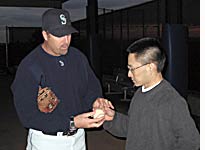
Bryan Price of the Seattle Mariners is one of the most esteemed pitching coaches in the major leagues, and one of the youngest. Only 42, he's been named Baseball Weekly's Pitching Coach of the Year and is increasingly described as manager material. On a recent afternoon I met up with Bryan at the sports complex outside Phoenix, Ariz., where the Mariners hold spring training. His job was to teach me to throw a change-up. My job, I thought, was simply not to embarrass myself. Only by accident would I discover something else in the course of our workout.
What makes a great pitching coach? Part of it, of course, is having an eye for tiny mechanical adjustments in a pitcher's delivery. Today's pitchers are the latest in a long line of men who've taken the mound as professionals, and nearly every motion they make is inherited, the accreted sum of many generations of incremental tinkering. When you see someone come along like Orlando "El Duque" Hernandez, the fabled Cuban defector and onetime Yankee whose knee-to-nose leg kick strained the groins of people watching him, you realize how conservative an institution pitching usually is. El Duque is the exception that proves the rule.
Pitching demands adherence to a rigorous and unchanging set of physical rules. But it is only the physical conclusion to a process that unfolds mostly inside someone's head. And so a teacher of pitching is ever operating on two levels, a surface curriculum about how to pitch and a curriculum beneath about how to be.
Failure, in many ways, is the default setting in baseball. A pitcher can be on a roll and cruising through a game, but he is always just one bad pitch, or one fielding mistake, away from a meltdown. The thing Bryan Price teaches is not how to win all the time. What he teaches is how to right yourself when you falter or fail.
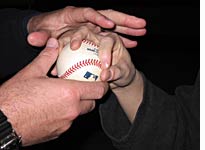
When we met, I'd proposed that Bryan teach me a curveball. But he suggested the change-up instead, because it would be easier on my elbow and because mastering a change is the first step in separating mere throwers from pitchers with craft. A change-up looks to the batter like a fastball and is thrown with all the force and conviction of a fastball. But because of the unorthodox grip—imagine making an "OK" sign and wrapping it around a ball—the pitch comes out of the hand more slowly. That slight difference and deception is enough to upset the batter's timing and balance, tricking him into swinging too early.
The timing of this lesson, it turns out, was rather apt. All my life, I've been the equivalent of a fastball pitcher—trying to use blazing speed and brute force to wow the people I face. Lately I've been realizing that it would help if I knew how to change speeds from time to time, to be less predictable.
We got to work. My first few attempts at a change-up were wobbly. I had no control, no feel for the pitch in my fingertips. Worse, I began to think about how I had no feel. I began to think how ridiculous I must look, a clueless amateur. Bryan could see a dozen things wrong with my delivery: arm slot too low, hips not turned enough, follow-through too unbalanced, and on and on. But he chose to home in on one thing only: "Keep your head quiet," he said.
This meant making sure I held my head steady and square as I pitched, so my eyes would remain fixed on the target. It also meant not overloading my brain with anxiety and data. A quiet head in the psychological sense is hard to achieve. Bryan got me there by emphasizing a quiet head in the physical sense. By worrying only about keeping my gaze steady and my skull centered, I stopped overthinking.
Sometimes Bryan will do what he calls "dry work" with a pitcher. He'll remove the ball altogether and simply work on the component motions of the delivery. Remove the ball: It's a powerful idea, because the ball is the source of the self-doubt and negative judgment. If you always practice with the ball, you will measure success only externally—by where the ball ends up. If you do dry work without the ball, you learn how to measure success by how intrinsically balanced your movements are. You learn how to listen to your body, and you learn to "self-coach," as Bryan puts it: Diagnose the tiny flaw in your delivery, and then fix it.

On this day, Bryan didn't do dry work with me, but he did a different kind of bait and switch. After a few dozen pitches, my change-up was getting somewhat better but it was still very inconsistent. So Bryan asked me to start throwing straight four-seam fastballs. The good news here was I threw my fastball to the same spot consistently. The bad news was that the spot was where a right-handed hitter's face would be. I could feel the spiral of criticism start again. Why do I keep throwing it there? Why? Can't I get out of this rut?
Just then, Bryan abruptly asked me to throw a change-up. I did, and to my surprise, I nailed it. It was the same change-up, same grip and delivery, as before. But the context was different. Now I was thinking of the change-up as an antidote to my wayward fastball. And now I was able to reel off three, then four, then five perfect change-ups, down and over the plate with perfectly deceptive presentation.
It struck me only later what Bryan Price had done. He'd used the fastball interlude as a distraction and had gotten me back onto my original objective—throwing a good change. Like any good teacher, Bryan is a master of misdirection: working on a fastball to improve a change-up, using dry work without a ball to sharpen performance with a ball, and talking about how to keep a quiet head when, in fact, we were talking about how to keep a quiet mind.
The goal for a pitching coach, ultimately, is to turn his pitchers into self-coaches. After all, there are only so many times in a game when the coach can walk out to the mound and point out a problem or suggest a solution. What Bryan Price did that afternoon was give me a taste of how I could become a self-coach. And though I am not likely to step on a major league mound any time soon, the lesson is going to stay with me for a long time.
Next week: Can a Marine drill instructor instill me with "command presence"?