Are You Sports Management or Communications?
An interactive guide to the preferred majors of college basketball stars.
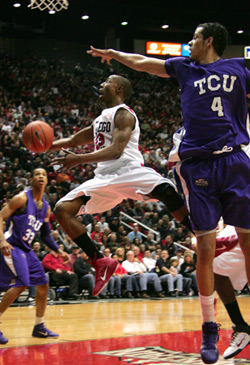
Student-athlete is one of the most misleading hyphenates in the English language. As anyone who has been to college knows, star athletes' relationship with classes is often similar to Americans' relationship with fruits and vegetables—they know they exist, and they've heard they're good for them, but they'll nevertheless take the bare minimum they need to survive (preferably in smoothie form). It's no wonder why coaches love that old line about sports teaching valuable lessons, because those lessons sure aren't being taught in America's Division I classrooms.

You can't blame the athletes. Playing major-college basketball is a full-time job, with games, practices, training, and travel leaving little time for academics. So elite athletes are often pushed to majors geared toward athletes. Blame the coaches and athletic directors for directing players to easy majors, and blame the schools for enabling this charade so that they can continue to cash the NCAA's fat checks.
So where exactly do the stars of the 2011 NCAA Tournament focus their academic attention? I researched every team that qualified for this year's NCAA men's basketball tournament and compiled data on each player's academic major. I'm missing information from seven schools (UConn, Penn State, Gonzaga, Boston University, Florida, Indiana State, and UNC-Asheville) that neither provide this information online nor responded to requests to send it. (Indiana State sent me its data too late to be included in this article.) I also restricted my list to players who have declared their majors or said they planned to major in a certain subject. And I may well have misspelled some names or mixed up some heights and weights—I majored in history, not data entry, to my everlasting regret.
With those caveats in mind, check out the interactive widget below to see the most-popular majors in college basketball.

The above chart represents the most popular areas of study on aggregate. Now let's talk a little bit about specific majors. Basketball players tend to choose majors that emphasize leadership, teamwork, and communication—basically, everything you'd need to successfully execute the flex offense. Business, or some variation thereof, is by far the most popular major. This makes sense—as the engines that drive the multibillion-dollar March Madness industry, they ought to learn how they fit in to the scheme, and how, exactly, they're getting screwed. Many players note that they want to work in business after graduation—like VCU's David Hinton, who aspires to "one day become a product manager for Nike"—or own/operate their own businesses—like Missouri guard Kim English, whose very specific ambition is "to become the president of English Concrete Contractors."
Communications is the second most popular basketball major, with 72 players studying it. Although communications and its variations are extremely popular, only four students are majoring in journalism. This is all the evidence you need to confirm that basketball players are not stupid.
Sports management is the third most popular major, with 48 players studying some version of the subject. * What do sports managers learn how to manage? At St. John's, you will study "Current Issues in Sport" and "Public and Media Relations in Athletics," where the curriculum involves things like press-release writing, press-conference training, and ticket design. After two years of general courses at Hampton, sport management majors can choose from courses like "Facilities Management" or the "Theory and Technique of Coaching." I'm not mocking these classes, which actually sound sort of interesting and which make a lot of sense for athletes. Indeed, all three of the most popular majors are very pragmatic. If your career goal is "athlete," then college ought to train you to succeed in that field. And if you don't make it as a professional athlete, well, America will always need ticket designers.
Forty-two players study sociology, that tried-and-true slackers' major. While it's possible that UCLA players are disproportionately drawn to the sociology department for the chance to study with famed Marxist theorist Perry Anderson, it's more likely that a shooting guard would choose it because, as one of the largest majors at UCLA, nobody will notice if you don't come to class. Criminal justice/criminology comes in fifth, with 24 players majoring in the subject. Six Alabama State players alone study criminal justice, although the media guide does not say whether any of them are enrolled in the Alabama Department of Corrections' joint program that allows them to train as prison guards while still enrolled as students.
Lots of schools have their own "athlete majors." At Purdue, nine teammates study something called "organizational leadership and supervision," taking classes like Meeting Management (OLS 325) and Leading with Integrity (OLS 440). Alumnus Antoine Wright slammed Texas A&M in 2007 for shunting players into the agriculture school, telling Bob Costas that "We're all in poultry science for a reason. … We're not really trying to learn about chickens." The trend continues in 2011, with four players declaring ag-related majors. (The school's agricultural leadership Web site welcomes visitors with a rousing "HOWDY!") Eight Florida State players study interdisciplinary social sciences, a loosey-goosey amalgamated social science program that is "flexible so that students may pursue individual specialized and pre-professional interests." And if you go to Cincinnati, you apparently don't have to major in anything at all—according to the player bios on the Bearcats' Web site, five out of eight upperclassmen have not yet decided on a major.
Do tall players prefer specific fields of study? Ten of the 11 players I looked at who are 7 feet or taller study either one of the five-most-popular or "athlete" majors, the exception being Akron's Zeke Marshall, who is in computer information systems. The 36 sub-6-footers are a slightly more diverse group, with majors in biochemistry, engineering technology, and radio/TV/film. The tallest player, UC-Santa Barbara's 7-foot-3 Greg Somogyi, studies business economics. The shortest player, UAB's 5-foot-8 Aaron Johnson, studies communications. The largest player, San Diego State's 300-pound Brian Carlwell, is a social science major, while the skinniest, Oakland's 155-pound Jordan Howenstine, studies journalism.
If you run across anyone who majors in something that requires a crapload of textbooks, chances are they're a walk-on. Duke's Casey Peters double majors in economics and environmental studies and policy, and averages 0.0 points a game. Kansas State freshman forward Alex "Sticks" Potuzak is a civil engineering major. ("If there was a Big 12 all-walk-on team, Sticks would be first-team, seriously," said one teammate.) And Matt Lyde-Cajuste, recruited to Syracuse not by Jim Boeheim but by the engineering department, majors in aerospace engineering.
There are a few scholarship players who resist categorization. Although five of his teammates study American ethnic studies, Washington junior forward Darnell Gant is a drama major who was cast last year in an adaptation of A Midsummer Night's Dream. (Oddly, he played himself.) Sports management, recreation, and criminal justice hold no attraction for Hampton center Milade Lola-Charles, who studies art and hopes to one day work for Disney. And God bless Tramar Sutherland of Arkansas-Little Rock, who plans to major in dentistry. (At 2.3 points per game, it's probably a better choice than the NBA draft.)
If you're the sort of person who roots for teams based on academics, you can go ahead and cheer for Princeton, Vanderbilt, and Duke. But everyone knows that those are good schools. More interesting are the unheralded institutions that defy the prevailing trends and field a roster of players with diverse interests. I found a mere two players in this year's tournament who study computer science. Both of them, Jamal Olasewere and Jason Brickman, play for Long Island University—as does sophomore forward Kenny Onyechi, who chose LIU because of its pharmacy school.
Cheer for the Blackbirds this year, or for No. 2 San Diego State, which has players majoring in history, biology, psychology, and television/film/new media, and whose senior point guard, D.J. Gay, is one of two men at the school who majors in women's studies. "I think I hesitated for about a day and then I was like, 'Screw it,' " Gay said recently. "In all the other classes, you learn numbers and [facts] and stuff like that. I felt women's studies was a class where I learned morals and life lessons."
All-Motivated Team
I wanted to see if you could actually field a competitive squad of players with nonstandard majors. Turns out you can. I'd even bet these 15 players would contend for the national title.
G: Nolan Smith, Duke, 21.3 ppg, African and African-American studies
G: Jimmer Fredette, BYU, 28.5 ppg, American studies
F: Kyle Singler, Duke, 17.1 ppg, visual arts
F: Noah Dahlman, Wofford, 20.0 ppg, history
C: Festus Ezeli, Vanderbilt, 12.8 ppg, economics
Second Team
G: D.J. Gay, San Diego State, 11.2 ppg, women's studies
G: Ben Hansbrough, Notre Dame, 18.5 ppg, American studies
F: Jamal Olasewere, LIU, 12.9 ppg, computer science
F: Cameron Moore, UAB, 14.3 ppg, philosophy
C: Zeke Marshall, Akron, 8.6 ppg, computer information systems
Third Team
G: G.W. Boon, Bucknell, 8.8 ppg, biomedical engineering
G: Trian Iliadis, Old Dominion, 6.0 ppg, biochemistry
F: Tim Abromaitis, Notre Dame, 15.3 ppg, one-year graduate MBA program
F: Jamelle Horne, Arizona, 6.2 ppg, creative writing
C: Dan Geriot, Richmond, 9.9 ppg, double major in political science and history
Correction, March 16, 2011: This article originally included Kent State among the 68 teams in the 2011 NCAA Tournament. The count of majors by category has been corrected, and a mention of Kent State's Jordan Wilds as the tourney's lone physics major has been removed. (Return to the corrected sentence.)