Nothing Doing
Are Republicans failing on purpose?

Friday, Sept. 8, 2006
Surprise Party: George Bush may have caught some in his own party off guard with Wednesday's September surprise challenging Congress to pass legislation to help him put the 9/11 masterminds on trial. Some Republicans are still using the GOP's 2004 talking points, when Bush ran ads insisting that only wimps think terrorism is a law enforcement matter. Others—like Sens. John Warner, John McCain, and Lindsey Graham—have been busy drafting an alternative because they think the administration's approach won't stand up in court.
Most congressional Republicans have a more fundamental objection to the president's challenge: The last thing they want to do is stick around here debating constitutional niceties when they need to wrap up this session of Congress and rush home to save their seats. Republicans already knew the Bush administration was running a secret prison: For embattled incumbents, the Republican Congress has become one.
But Republican members who don't want to spend the last "working" month of the 109th Congress actually working can relax: The Bush White House probably doesn't want them to get a bill done, either. According to the Rove playbook, this legislation will do more to motivate the conservative base if Republicans can blame Democrats for obstructing it.
As Ron Brownstein suggests in the Los Angeles Times, the White House may want to reprise its 2002 September surprise, when Republicans refused to reach agreement over an obscure civil service provision of the Democrats' homeland security bill so they could run attack ads claiming Democratic incumbents were against homeland security.
Mustn't Pass: In years past—especially election years—September and the first part of October have been the congressional equivalent of finals week: a brief flurry of frenzied activity after an otherwise wasted year. This trend intensified in the last few years of the 1990s, when the Republican Congress grew so tired of losing policy debates to Bill Clinton that it refused to take up anything all year except the must-pass annual appropriations bills required to avoid another government shutdown.
Ironically, this strategy put Republicans in the weakest possible bargaining position, trying to enact their conservative wish list just weeks before members had to face an electorate that wanted Congress to do just the opposite. After caving to Clinton's demands right before the 1998 midterms, Republicans figured out a way in 2000 to avoid the voters altogether, by putting off the must-pass bills until a brief lame-duck session after the election. Conservatives weren't kidding about government efficiency: Why spend a whole year on a do-nothing agenda when you can finish it in one day?
Even with one of their own in the White House, the Republican Congress seems determined to seek still greater efficiencies. Republican leaders spent August holding field hearings designed to prevent an agreement on immigration. They're advertising their own internal differences on domestic surveillance, perhaps to lay the groundwork for gridlock on that front. They'll probably postpone any tough must-pass appropriations until after the election—when a lame-duck session may have more lame ducks than usual.
Bush's Wednesday gambit was the latest adlib in this year's improvisational conservative comedy, "Whose Fault Is It, Anyway?" For the last several months, most Republican incumbents in tough races have worked diligently to distance themselves from the Bush White House. From Bush's troubles abroad to his agenda at home, the Republican message to voters is, "Don't blame me—I just work here."
Understandably, the White House has a different approach. Never mind that Republicans in Congress are the biggest obstacles to Bush's agenda on immigration and military tribunals. This White House wants voters to believe that if illegal immigration has ballooned on its watch, and Republicans can't pass a bill to address the problem, it must be Democrats' fault.
Madmen Theories: Ironically, the president might do his party's incumbents more good by accusing Republicans of obstructing his agenda. That would free the Republican leadership to carry out the Mickey Kaus ploy on immigration—by scaring voters into thinking that a Democratic Congress might pass the Bush plan.
If Republican incumbents can't persuade Bush to attack them, they could turn to their own mad scientist, Dick Morris—an old master at pitting one branch of government against another. In his column in The Hill on Wednesday, Morris gave his fair and balanced view of the 109th in action:
"This has been, truly, the do-nothing Congress of all time!"
Morris offers an excellent critique of this Congress's many failures—whiffing on ethics reform, setting records for earmarks, raising student loan rates—but focuses principally on its refusal to enact the Bush agenda of immigration and Social Security reform. As it happens, those are precisely the two issues that endangered Republican incumbents most want to convince voters they opposed.
At last, we can imagine a simple 30-second message for Republican incumbents to put in their October ad buys:
"My Democratic opponent claims she'll block the Bush agenda, but talk is cheap. If you want to make sure nothing gets done in Washington, you need a congressman with the experience to make nothing happen. Unlike my opponent, I don't have my own agenda, and I'm not afraid to drag my feet on the president's or anyone else's. Vote for me, and I won't just promise to do nothing all the time – I'll give you the do-nothing Congress of all time." ... 12:08 A.M. (link)

Friday, Sept. 1, 2006
There's No "We" in Team: If George Bush has his way, the Republican message for the fall elections will be the banner headline from this morning's Washington Times: "We Have Resolve." Republicans who are actually on the ballot this fall have a different message: "What do you mean 'we,' kemosabe?"
Frightened of Bush's unpopularity, Republican congressional leaders have spent the past year attempting to localize the midterm elections. With more than two-thirds of Americans convinced the country is going in the wrong direction, GOP incumbents are desperate for an alibi: Members say they were so busy bringing home the bacon, they were nowhere near the scene of the crime.
Until recently, Bush played along with that strategy, ducking into states and districts to raise campaign money but otherwise keeping his head low. This week, however, the White House shifted gears. Bush is giving a series of thinly veiled campaign speeches designed to nationalize the election around the administration's favorite theme—that if Democrats were in charge of the war on terror, we'd all be speaking French.
Muscular co-author Rahm Emanuel smartly parried Bush's thrust yesterday by calling for a no-confidence vote on Defense Secretary Donald Rumsfeld, the runaway winner in any secret ballot on "who lost Iraq?" Instead of just putting Democrats on the spot, the White House campaign forces Republican incumbents to make a fundamental strategic decision about whether all politics is local—or global.
Run Away!: Judging from the early returns, the smart Republicans aren't taking the White House's bait. John McCain, who said long ago he has "no confidence" in Rumsfeld, used a campaign appearance for Ohio Sen. Mike DeWine to criticize the administration's handling of Iraq. As John Dickerson reports, Rudy Giuliani—who is courting the conservative base—went out of his way to warn against waving the partisan shirt in wartime.
One of the most embattled Republicans in the country, Arnold Schwarzenegger, is running so far away from Bush that he spent the week letting Democrats give California its own foreign policy by enacting a landmark plan to cut the state's carbon dioxide emissions.
White House strategists no doubt believe their gambit will work this time because it worked before, in both 2002 and 2004. As a certain wildly overhyped book points out:
Rove invented a perpetual-motion machine: Republicans fail on national security, which invites Democratic criticism, which lets Republicans attack Democrats for lack of resolve, which buys Republicans more time to fail on national security.
Off the record, White House aides might also argue that they have no other choice—in most polls, national security is just about the only issue where Democrats don't have a substantial lead.
It's the Perfect Way to Hide: But the real reason for the White House strategy may be more basic: An all-politics-is-local campaign would leave the president with nothing to do. Bush rightly considers himself one of the best campaigners on the Republican side and doesn't want to spend his last campaign as little more than fundraiser-in-chief.
As a result, the president is like King Arthur's trusted servant Patsy in Spamalot. While Republican incumbents everywhere try to sing, "I'm all alone," Bush keeps interrupting to say, "Oh, no, you're not … I'm here, you twat!"
Individual Republicans in tough swing districts will still try to run local races and pretend they've never met either Jack Abramoff or the president. But the new White House strategy virtually guarantees that voters will see the midterms as a national election. These days, nothing could do more to test Republicans' resolve than hearing Bush say, you're either with us or against us. ... 12:33 P.M. (link)
Wednesday, Aug. 30, 2006
Tale of the Tape: Forget the Census Bureau's report on income and poverty and the College Board's report on declining SAT scores. The only one number from today's papers that George Bush cares about is in the Style section: Just weeks after the aging president's annual physical revealed that his weight, body mass index, and body fat all ballooned last year, Karl Rove is running around boasting that a liquid diet has helped him lose 22 pounds.
In the Bush White House, lying about leaking was no big deal. But one-upping this president's waistline? That's the kind of offense that could get even Rove fired.
He'll be lucky to last till suppertime. An ABC News headline after the president's physical asked, "How Much Is Too Much: Is the President Too Chunky?" and included Bush in a photo essay on "Famous 'Overweight' Men." The Washington Post headline on Rove's diet declared, "'Leaner and Meaner' Rove Has Less Weight to Throw Around."
The president wants to run a tight ship. But any empire builder like Bush must be familiar with Julius Caesar's famous words:
Let me have men about me that are fat;
Sleek-headed men and such as sleep o' nights:
Yond Cassius has a lean and hungry look;
He thinks too much: such men are dangerous.
Over the years, presidential candidates have surrounded themselves with political consultants of Caesar's description – Roger Ailes, Dick Morris, Bob Shrum—although lucrative commissions may have shaped those men more than Caesar's warning. But even in America's thinner days a century ago, the very first political consultant—Rove's lifelong hero, Mark Hanna—was widely mocked for his girth. While the phrase didn't appear until two decades after his death, Hanna may well have been the original "fat cat."
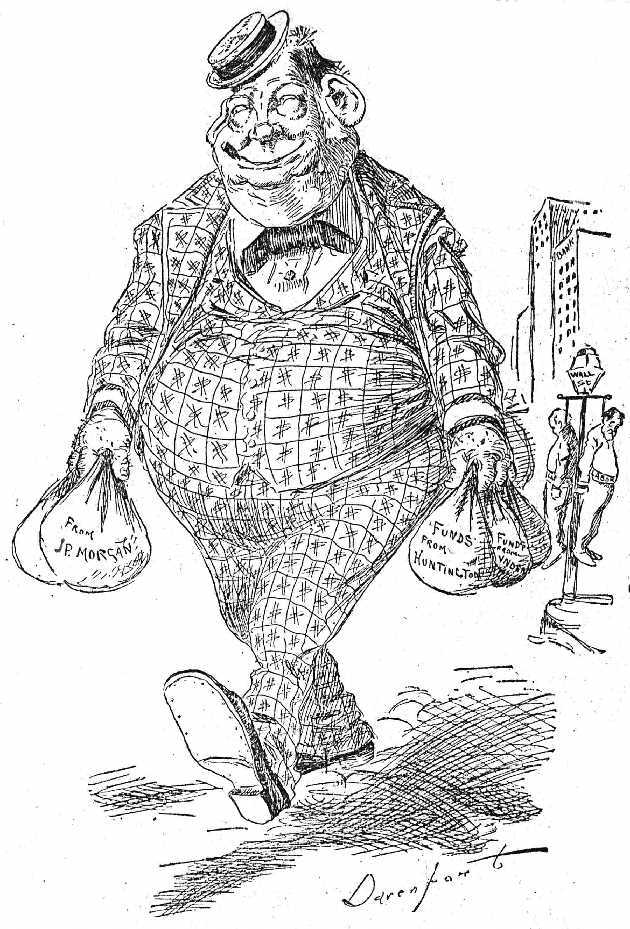
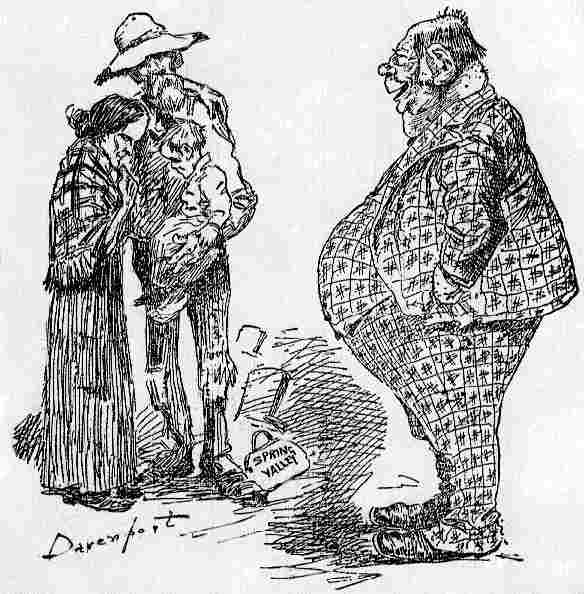
"I Shamelessly Promoted The Planand Lost 80 Pounds": Characteristically, Rove appears to have concealed key details, such as body fat, BMI, and how much he weighed before he started losing. Rove's diet claims are a bit like Bush's claims on the budget deficit: it's easy to declare victory when you get to make up your own base line. As Rahm Emanuel and I write in our new book, The Plan, "No one should take seriously a political platform that promises more and expects less, any more than a diet book that says eating more and exercising less is the way to lose weight."
But apart from the sheer cheek of Rove's weight loss, what must concern Bush most is the way he lost it: a liquid diet. Bush gave those up years ago—and you don't have to be Gail Sheehy to assume that bad experiences with drinking spurred the president to become a fitness nut in the first place. (Rove doesn't help by attributing his success to "clean living.") More to the point, Bush must sneer at liquid protein shakes—rather than exercise – as the wimp's road to weight loss.
The Architect: If Rove is Bush's guru, Rove's guru is Dr. Arthur Frank, medical director of the obesity management program at George Washington University and a widely quoted expert on weight loss. Wait till conservatives find this out: Karl Rove's diet doctor seems to support a Twinkie tax.
In a 1999 piece called "Time for a Twinkie Tax?", U.S. News reported that Dr. Frank was "joining the call for the Pillsbury Doughboy's head." "We are losing the battle," Frank said. "It may be time for a last resort." Last year, in a Washington Post online discussion, Frank appeared to agree with a questioner's suggestion about advertising restrictions and Twinkie taxes. "We have to change the world of sloth and superabundance," he said.
Frank is also treasurer of the American Obesity Association, which holds a number of policy positions that won't endear Rove to Bush. The group wants a congressional investigation into whether the No Child Left Behind Act increases childhood obesity, supports making federal projects submit "Human Physical Impact Statements" similar to Environmental Impact Statements, and worries that American culture is making immigrants fat.
Rove's only hope: tell Bush that in 2002, the association helped convince the IRS to allow tax breaks for obesity treatment. So in the long run, the Twinkie tax is actually revenue neutral.
Keep Your Mouth Shut: Of course, if Dr. Frank had his way, Rove would never have blabbed about his weight loss to begin with. As Frank told the Post's "Lean Plate Club" just last month, many patients make the mistake of advertising their success because "they think it will help to keep them on the straight and narrow," then can't handle the pressure once everyone around them starts judging their every bite. "It's better not to get other people involved unless they have to know," he says—proving that Rove's diet doctor might have done an even better job as Rove's lawyer.
Frank and his colleagues direct successful patients to what sounds like another conservative nightmare, the National Weight Control Registry. Indeed, Rush Limbaugh may already be on the airwaves with the warning, "If food is outlawed, only outlaws will have food."
But so far, the National Weight Control Registry only wants to know your weight if you've lost more than 30 pounds and kept it off at least a year. They're not interested in Karl Rove; they have their eye on Arkansas Gov. Mike Huckabee.
The registry uses its members to conduct studies on what separates dieters who put weight back on from the one in 20 who succeed in keeping it off. Last year, Oprah magazine reported on the registry's "potentially groundbreaking study" into how dieters think. The study found that success depended on which quadrant of the dieter's brain was dominant.
Rove is often called "Bush's brain," but which quadrant? Judging from the study's description, he's clearly not the upper right ("strongly visual and easily bored, attracted to new ideas, fun, and risk taking") or lower right ("emotional, spiritual, and focused on people and human connection"). He would seem to be closest to the upper left ("analytical, mathematical, logical problem solvers" who are "drawn to statistics and the workings of machinery").
Scales of Justice: The study suggests that the quadrant successful dieters need is the lower left: "Punctual and neat, they always have a plan, timetable, and calendar with appointments penciled in." That's bad news for Rove. The only way he dodged indictment was by claiming to forget which reporters he talked to when. If he keeps the weight off, we'll know he hid his lower left quadrant from the special prosecutor to save his own skin.
But just in case Rove was telling the truth, the Oprah article spells out how absent-minded dieters can train themselves to become lower-left-brained, through a three-week regime to "bolster your inner bookkeeper."
Step One: "Begin with organization. Alphabetize your CDs, then, a few days later, your spices. A few days after that, rearrange your closet, then your tax papers." Step Two: "Keep a time log of your daily activities." No wonder the Fitzgerald report sold so well—it doubles as a diet.
But poor Karl Rove may never get that far. The president may want to help his old friend stay slim by giving him a little extra work on Step One: clean out your desk and organize your walking papers. ... 3:31 P.M. (link)
Friday, Aug. 25, 2006
Self-Promotion Is Its Own Reward: After less than a week of relentless horn-blowing by Rahm Emanuel and me, our book The Planhas already caught Albert Camus' The Stranger on its way up the charts. Dotty Lynch's review at cbsnews.com called The Plan "hilarious and insightful." The consensus on The Stranger: strange.

A kind review in The Economist includes what could become the celebrity poster of the season: Rahm as Rahmbo, with a submachine gun, bulging Stallone biceps, and a donkey tattoo. You loved the movie. Now read the book.
Last night, an overflow crowd turned out to hear Bill Clinton introduce us at a book event at Barnes & Noble in New York. Yet another reason we love the guy: You don't see George Bush showing up at book-signing events with Albert Camus.
The Man Without a Language: Far from improving his SAT score, a month of reading Camus seems to have left George Bush more linguistically challenged than ever. On Monday, at what Fred Kaplan politely called, "What a Moronic Press Conference!," the president's meaning was clear, but his words were often nearly impossible to deconstruct. "I see the challenge to what these threats pose to our homeland," Bush said, "and I see the challenge—what these threats pose to the world."
For years, we have dismissed these Bushisms as the struggles of a congenitally inarticulate Texan. Yet just as Bush's stubborn pride betrays a secret passion for France, could his abuse of the English language reflect a deeper problem: that his mind is trying to speak English while his heart is speaking French?
Isn't It Pretty To Think So?: In The Sun Also Rises, Hemingway describes the American expatriate, "Mrs. Braddocks, who in the excitement of talking French was liable to have no idea what she was saying." Bush is the same way with English.
Here's Bush at Monday's press conference, reflecting upon his administration's impotence abroad:
Sometimes I'm frustrated. Rarely surprised. Sometimes I'm happy. This is—but war is not a time of joy.
Here's Georgette Hobin, a Frenchwoman reacting to Jake Barnes's impotence in The Sun Also Rises:
Isn't anywhere else [like Paris] … Happy, hell! … It isn't bad here. ... Oh, that dirty war!
Let's face it: "This is—but war is not a time of joy" is not how American presidents talk. It's how confused French leading ladies talk in Cary Grant films.
The back and forth at a Bush press conference is just a high-stakes version of the scene in the remake of The Pink Panther, when an American linguist tries to teach Inspector Clouseau to say hamburger and the best Steve Martin can do is amber guerre.
Don't Let My Legs Fool You: As Inspector Clouseau would be the first to say, don't let Bush's accent fool you. His Texas patois may not be elegant, but there is no denying its nasal undertones.
In Britain, Tony Blair has endured years of unfair criticism as Bush's "poodle." Fleet Street is wrong about Blair, but they may be onto something with Bush. The most screamingly French thing about this president has been right in front of us all along: He calls himself an American, yet everywhere he goes, Bush carries his dog.
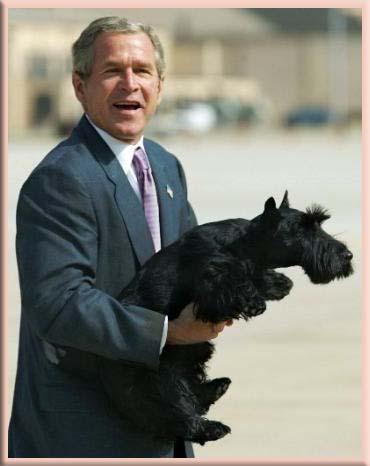
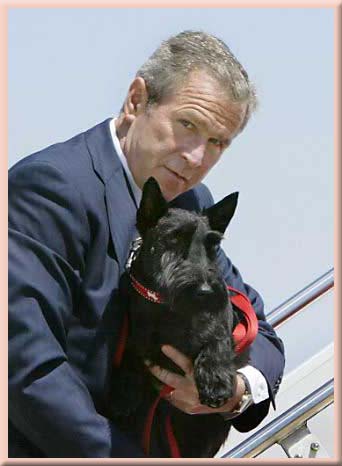
Mr. President, this isn't Paris. Here in America, we walk on our own two feet. Or four, as the case may be. ... 10:47 A.M. (link)
Sunday, Aug. 20, 2006
Buy One, Get One Free: In our White House days, Rahm Emanuel and I made a pact. I promised to tell him everything I knew about policy, and he agreed to turn me into a shameless self-promoter.
It worked! Now he's one of the most thoughtful, innovative members of Congress—and I'm shamelessly hawking our book, The Plan: Big Ideas for America, which is just out this week.
The Plan is full of the breathless, shocking revelations that sell books: Tom DeLay is still secretly running the House of Representatives from a bunker in Sugar Land, Texas; Bob Woodward is wrong—Karl Rove was Deep Throat; and the real reason Gunter Grass joined the German S.S. was to get closer to young Ann Coulter.
Sneak Preview: The Has-Been is offering a special bonus to loyal Slatereaders—free excerpts from the first chapter:
Strip away the job titles and party labels, and you will find two tribes of people in Washington: political Hacks and policy Wonks. Hacks come to Washington because anywhere else they'd be bored to death. Wonks come here because nowhere else could they bore so many to death.
After two decades in Washington, we have come to the conclusion that the gap between Republicans and Democrats is as nothing compared to the one between these two tribes. We should know. When we began working together in the Clinton White House, we came from different tribes—one of us a Hack, the other a Wonk. (We're not telling which.) We made a deal to teach each other the secrets, quirks, and idioms of our respective sects.
Throughout history, Hacks and Wonks have been the yin and yang of politics. But in the last few years, something terrible has destroyed our political equilibrium. The political world suffered a devastating outbreak of what might be called Rove Flu—a virus that destroys any part of the brain not dedicated to partisan political manipulation. Now, Hacks are everywhere. Like woolly mammoths on the run from Neanderthals, Wonks are all but extinct.
Although Hacks have never been in short supply in our nation's capital, the rise of one-party rule in Washington over the past four years unleashed an all-out Hack attack. Every issue, every debate, every job opening was seen as an opportunity to gain partisan advantage. Internal disagreement was stifled, independent thought discouraged, party discipline strictly enforced—and that's just how they treated their friends.
The Bush White House was so obsessed with how to profit politically from its agenda that it never even asked whether its policies would actually work. It should come as no surprise that they didn't.
Perhaps the best recent example of paint-by-number politics was the Medicare prescription drug bill. One prominent Hack, Tom Scully—then an assistant secretary at HHS, later a health care lobbyist—allegedly threatened to fire Richard Foster, a career government actuary, if he revealed how much the prescription drug bill would explode Medicare spending.
Remember the good old days when Republicans went to jail for covering up burglaries and conducting covert wars against communism? Now they're under fire for covering up massive social spending. No wonder conservatives are unhappy. It's as if Oliver North were running a secret Head Start program in the White House basement.
President Bush served as Hack-in-Chief even when he studiously pretended not to be doing so. He came into office promising to be a compassionate conservative, soon left us yearning for a competent conservative, and seems destined to be remembered for presiding over the heyday of the corrupt conservative.
Republicans have learned the hard way that the American people are a lot smarter than either the Hacks or the Wonks imagine. For all the talk in both parties about the urgent need to win one constituency or another, most Americans apply the same political yardstick: They vote for what works. There aren't enough Hacks, even in Washington, to sell policies that don't work—although that never stopped Bush from trying.
Yet as Americans survey the damage from six years of Hacks Gone Wild, bad policy is only the beginning. In his Farewell Address, another Republican president, Dwight Eisenhower, warned of an "iron triangle" of legislators, bureaucrats, and private contractors eager to increase arms production. Today's Republicans have created a kind of Hack triangle from the White House to Congress to K Street lobbyists.
Tom DeLay may be gone, but those in office will still do anything to stay there; those who make their living off those in office stop at nothing to keep them there. And with so many private interests at stake, the country's problems have had to wait in line.
In the old days, a popular American business model was planned obsolescence: making products that wouldn't last long so that consumers had to buy a replacement. The Republican political model is planned incompetence: When bureaucrats screw up or government programs don't work, that only reinforces public skepticism about government.
Hack government could get by in the old era, when one party's Hacks simply had to outwit the other's. Now, the challenges government faces are too hard to fake it, and the consequences of failure too dire.
We knew Hack fever had gotten out of hand when the producers of Fear Factor proposed a reality show called Red/Blue, modeled after American Idol, to find the next Karl Rove. But we've known enough Hacks to realize how little the nation stands to gain from churning out more of them.
Adapted from The Plan: Big Ideas for America, by Rahm Emanuel and Bruce Reed, PublicAffairs Press, © 2006.
Of course, you can also buy the book. You never know—your name may already be in the index. … 9:13 A.M. (link)
Friday, Aug. 18, 2006
Le Plan: The White House has been quick to laugh off any deeper meaning behind President Bush's strange decision to spend his vacation reading Albert Camus' The Stranger. If John Dickerson and Maureen Dowd go after him again, Tony Snow may have to pretend that there was a mix-up between Bush and his new neighbor Cindy Sheehan at the Crawford Public Library.
Like most men, my first reaction was that Laura Bush must have finally convinced her husband to join a book group. But in the spirit of Emily Bazelon, I've tried to remember the advice educators give parents about their children's summer book list: No matter what they choose, just be glad they're reading.
To be honest, I was a little hurt that the president wasn't reading The Plan, the new book that Rahm Emanuel and I have just written and will be plugging shamelessly all fall. We're no Camus. But even though Bush might not enjoy all the fun we have at his expense, the book is full of ideas about how to fix the mess he has made.
The French Connection: Unlike Bush, Dickerson, and Dowd, I could never stick with Camus long enough to find a deeper meaning that might explain the president's interest. Like the Bush we thought we knew, I figured it was enough to recall that the author's full name was Albert Camus, not Bullwinkle K. Moose.
But before Paul Begala dashes off a quickie book called Is Our Presidents Reading?, let's agree that the literary implications of Bush's choice are beside the point. The discovery of Bush's secret passion for Camus raises a more disturbing question: Is our president French?
L'Affaire Camus is the last straw in the Frenchification of American politics. Last week, we uncovered circumstantial evidence of Bush's hidden interest in the Tour de France. In the meantime, the Bush administration encouraged France to take the lead in negotiating the cease-fire in Lebanon. A few weeks ago, the House of Representatives—the supposed Bastille of Francophobia—dropped "freedom fries" and went back to french fries. All year long, House members have shown an inexplicable, French-like affection for a troubled colleague named Jerry Lewis. It's only a matter of time before the House cafeteria starts serving Perrier and pommes frites, and Republicans stop pronouncing the final "t" when they refer to Speaker Hastert.
In retrospect, we should have seen the tell-tale signs of Frenchness all along: Bush's Parisian refusal to work in August, Cheney's snooty contempt for American culture, Condi's flair for haute couture, Bolten's Marie-Antoinettish tax cuts, and Rumsfeld's penchant for les head-butts. All this time, we've mistaken W for the Peter Sellers in Being There, when in every aspect of his job, Bush is actually Inspector Clouseau.
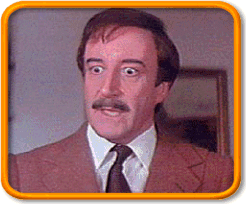
Liberté, Egalité, Fraternity: Naturellement, the White House kept its latent Gaullist tendencies under wraps until a second term. Karl Rove, a Norwegian holdout in a bastion of Franks, knows he can't sell his party down on the farm after they've gone Paris.
The incessant bickering with France over Iraq, as well as the smear campaign to dub John Kerry a Francophile, were all just another cover-up from an administration desperate to disguise its true affections. Bush's stubborn, disastrous effort to show tout le monde that we don't care what they think is really an ill-informed Texan's attempt to affect every tired French stereotype—Lyndon Johnson imitating Charles de Gaulle.
The Bush Doctrine is simple: When federal judges start saying there are "no kings in America," it's time to reclaim our lost destiny as the New France.
Of course, the French will never tolerate this arrangement if they find out—and the Camus revelation may have blown Bush's cover. Already, Jacques Chirac has scaled back the French commitment of peacekeeping troops. Bush had better go back to The Da Vinci Code. It's America's favorite book about France—and leaves the French thinking that their country gets the grail. ... 11:31 A.M. (link)
Monday, Aug. 7, 2006
Juiced: Why does everything President Bush touches turn to steroids? When he bought the Texas Rangers two decades ago, they appeared—like their team namesake—to be an honest, law-abiding squad. Drug scandals were for teams with roguish names, like the Pittsburgh Pirates, whose favorite dealer was their mascot, a parrot. But in Bush's brief span as owner, Texas apparently became the Colombia of performance-enhancing drugs, exporting users and peddlers throughout the national pastime.
As president, Bush broadened his interests beyond baseball. After a jogging injury, he took up biking. In no time, the once-noble sport of cycling tested positive for synthetic testosterone—of which Bush is perhaps the political world's proudest supplier.
Of course, we can't be sure that President Bush is responsible for the testosterone in Tour de France champion Floyd Landis' urine. So far, Landis' lawyer has offered much fishier explanations for the drug bikers call "T." Landis claims variously that he was dehydrated, took thyroid pills, or drank too much the night before the test.
He Said, Pee Said: But consider the mounting circumstantial evidence against the president. Bush and Landis are both known bikers. Bush has a bad knee; Landis needs a new hip. Bush is old friends with seven-time Tour de France winner, Landis defender, and fellow Texan Lance Armstrong, himself long the subject of unsubstantiated doping rumors. Bush's last Texan friend to find himself in this position, Rafael Palmeiro, told Congress he never used steroids, just weeks before a urine test said he had.
Then there are Landis' Bush-like explanations to the press. "I was the strongest man in the Tour de France, and that is why I am the champion," he said Saturday, apparently straining to prove that he's dripping with real "T." With Bush on vacation, Landis offered his own candidate for Bushism of the Day when he said the testosterone was "natural and produced by my own organism."
What's more, Bush had a clear motive to tamper with the race. At this stage, Bush's best hope for a legacy was to become the first U.S. president in its 100-year history never to lose the Tour de France. Nor can we discount his unquenchable desire to beat the French. Bush may give German leaders backrubs, but long before the World Cup, he had conveyed to the French more or less the same sentiment that the Italian Marco Materazzi used to goad that fatal head butt from Zidane: "I wish your mother and sister an ugly death." Just as Zidane had a history of head butts, Bush has a long history of flexing an unnatural level of synthetic "T" in the Frenchs' general direction.
Mr. T: Unfortunately, voters have no way of knowing whether testosterone is natural or synthetic. We now have anti-doping agencies for every championship except the one where we need it most.
Before cable television turned bicycle racing into a sport for couch potatoes, there was a time when even caring who won the Tour de France was proof positive of a testosterone deficiency. John Kerry might be president today if "Talledega Nights" meant as much to him as "Pyrénées étages." But Lance Armstrong's heroic triumph over cancer inspired millions of men to wear bracelets, in hopes of one day being dumped by Sheryl Crow.
So far, the White House has been as mum as Barry Bonds' trainer. But sooner or later, Team Landis—desperate to salvage his title—will drop its lame explanations in favor of the one excuse the French always believe: Bush did it. ... 12:15 P.M. (link)
Tuesday, Aug. 1, 2006
Heat Wave: As Washington braces for another August of record-breaking heat, the Republican leadership has at last decided on its response to global warming: From now on, Congress will begin its August recess in July.
The success of Al Gore's documentary, An Inconvenient Truth, has prompted a flurry of articles on how global warming will transform our politics. Michael Grunwald imagines "a climate-conscious politics … where a policy's atmospheric costs would be evaluated along with its fiscal costs, a politics of inconvenient truths." Clive Crook suggests a long-term plan to lower the long-term impact of climate change, but points out that we'll need policies to adapt to it as well: "Whatever happens, we will have to live with higher temperatures."
Every night since they saw the Gore movie, my children have followed its cue to pray that people have the courage to change. But as both Grunwald and Crook observe, the long term is something Washington just doesn't do. If we want action on climate change, we need to put it in terms that, even in these deeply partisan times, the political world can understand.
Never mind the impact of global warming on the migratory patterns of the black-throated blue warbler. Those concerned about the long-term survival of the Republican species should worry that climate change may fundamentally alter the migratory patterns of the American voter.
Southward, Ho!: One of the defining trends of the past 40 years has been the dramatic shift in population from the Frost Belt to the Sunbelt. In 1960, the three largest northeastern states of New York, Pennsylvania, and Massachusetts had a combined 93 electoral votes. Now they have 64. People voted with their feet, and we know where they went: In 1960, Texas and Florida had a total of 34 electoral votes; now those two states have 61.
Climate wasn't the only reason the U.S. population shifted from north to south, but it was a significant one. For Arizona to grow from 4 electoral votes in 1960 to 10 today, while Iowa shrank from 10 to 7, plenty of people must have been willing to brave the desert summer to escape another winter on the plains.
The southern migration of American politics has brought on a long, painful drought for the Democratic Party. For a century, the South had been a Democratic stronghold. But the Sunbelt's population began to explode just as the South was turning away, punishing Democrats for doing the right thing in the '60s by standing up for civil rights and opposing the war in Vietnam.
Apart from a few states on the Pacific Coast and in the mid-Atlantic, Democrats are now a captive party of the Northern Tier. We haven't won an electoral vote in the South so far this century.
Seeing Red: In fact, the electoral map looks increasingly like the weather map in USA Today: Most red and orange states are red; most blue and green states are blue. If you chart the average temperature since 1960, you might as well be looking at Karl Rove's list of target states.
By my calculations, 21 of the 27 states with an average temperature over the last half century of more than 50 degrees Fahrenheit voted for Bush in 2004, providing 241 of his 286 electoral votes. In the 23 states with an average temperature below 50 degrees, by contrast, Democrats cleaned up in the electoral vote, 141 to 45.
The political climate is the same in the House of Representatives. Democrats actually have a 10-seat majority in cold states—and Democratic hopes for reclaiming the House in 2006 rest in large part on seats in Pennsylvania, New York, and elsewhere in the Northeast.
Republicans owe their current House majority to a nearly 40-seat advantage in hot states, as symbolized by two notorious sons of the Sunbelt, Newt Gingrich and Tom DeLay. The margin would be even more lopsided if not for California, the Democrats' one significant inroad into milder climes.
Flying North: Republican strategists will no doubt try to persuade themselves that global warming is good for them—that if the country gets hot enough, every state will hurt red. But what will happen to Americans' migratory patterns if northern winters become easier to bear and southern summers become unbearable? After half a century, will all the snowbirds who've flocked to Florida, Texas, Arizona, and California suddenly turn around and head north?
If temperature alone is not enough to tip the balance, hurricanes might. Let us hope that we never see another forced resettlement like the aftermath of Katrina. Yet it's not hard to imagine the next wave of retirees foregoing the drama of Florida and other southeastern coastal states in favor of colder but calmer places up north.
A significant population shift to higher latitudes would help offset a current hitch in Democrats' northern strategy: We have to carry nearly every northern state (and most of both coasts) to win.
Of course, turning the North back into the center of electoral gravity won't save Democrats if we don't do a better job of winning over Americans who vote with their feet. For two decades in the '70s and '80s, we consistently lost suburban voters until Bill Clinton won them back. In this decade, we've lost voters who moved from the suburbs to the exurbs – although some, like Virginia Gov. Tim Kaine, have shown how to win them back.
High Hopes: While Democrats have lost ground in most growing areas, the party has won big in the coldest ones—ski towns. Sun Valley, Idaho, made the highest donations per capita to John Kerry of any community in America. Aspen was the only county where Kerry ran ahead of Colorado's popular new Democratic senator, Ken Salazar. Kerry's snowboard strategy worked, after all—there just weren't enough snowboarders in Ohio.
Demographics aren't destiny, and neither is climate. As even Rove realizes, the Republican species cannot survive in its current form. And Democrats certainly shouldn't wait to win an election until the North stops freezing over.
Still, with the thermometer running 60 points higher than Bush's popularity, it's worth reminding Republicans to change now, before their margins melt away—not to mention their planet. We won't see Tom DeLay's like again once folks have surfboards in Sugar Land, Texas. ... 10:39 A.M. (link)
Tuesday, July 25, 2006
Losers Walk: By the time the polls closed in Georgia last Tuesday, I had come to terms with either possible outcome. If my evil twin Ralph Reed lost the Republican primary for lieutenant governor, I would lead the national sigh of relief, from Democrats as well as thoughtful conservatives alarmed at the moral drift of the Republican Party. If he won, I would await the results of the general election before deciding whether to colonize another planet.
Naturally, I was hoping to remain on Earth and take my chances with global warming. Yet leaving had its own logic. I had always assumed that Ralph and I looked alike so people could make jokes at our expense, the way Brian Williams did by suggesting that we both had necks so skinny, he worried our heads would fall off. But perhaps our resemblance revealed a larger truth. Since the two political parties often appear to exist in parallel realities, it seemed possible that Ralph and I could be the first glimpse behind the curtain of the political universe. Maybe every person in a blue state has an identical red twin, and Ralph and I are just the first to realize it.
Happily, the voters of Georgia spared me from having to lead the exodus to a blue planet. In fact, Ralph's stinging defeat was a rare triumph for both parties. Democrats need no longer fear the Republican spin that scandal means only having to say you're sorry. Republicans can take heart that even in conservative strongholds, the tide may have turned against the soulless hardball that empowered Lee Atwater, Karl Rove, and Ralph Reed to doom all three terms of the two Bush presidencies.
Despite my overwhelming sense of relief, I couldn't enjoy the spectacle of Ralph's defeat as much as I'd hoped. Watching the public political death of my mirror image, I felt like a character being given a glimpse of his alternative destiny—a dire warning from the Ghost of Christmas Future: There, but for the ground game of God, go I.
So far, I have avoided Capitol Hill, for fear of the averted glances, hushed whispers, and mad Republican rush to cross the street to avoid awkward encounters with a loser. At first, I flinched at headlines that blared, "Reed Beaten." Luckily, none of the election analyses singled out looks as the reason for Ralph's defeat.
He's Back: But after a week of coming to terms with the loss of the twin I never wanted, I now live in perpetual fear of the one scenario I wasn't prepared for—Ralph Reed's political comeback.
By any objective standard, Ralph should be a dead man walking. Despite a national following, years of political chits, and a lifetime spent building a machine of evangelical voters, he lost in a landslide to a state senator you've never heard of. Casey Cagle won nine of the 10 largest counties in Georgia and two-thirds of the counties overall. The head of the Georgia Right to Life PAC told the Atlanta Journal-Constitution, "We haven't seen this much conservative disaffection in—well, I would say this is a new experience."
Yet the Reed squad scarcely let three days pass before setting out to resurrect Ralph's political career. "Friends say it is too soon to write off Mr. Reed," David Kirkpatrick of the New York Times reported Saturday in a piece menacingly called, "What Next for Ralph Reed?" Kirkpatrick pointed out that while Ralph had promised in his concession speech that he was "not focused on being a candidate in the future," he hinted otherwise in an interview. "First bids for elected office are always tough, and I am not the first to lose a first campaign," he said, citing Jeb Bush and Newt Gingrich as Comeback Kids.
According to the Associated Press, Ralph may be "simply too young and talented to stay off the ballot for long." The chair of the Christian Coalition urged him to "come back to fight again another day" because "he is far too bright and has far too much promise to count him out." Stephen Hess of Brookings told AP, "You never count out anybody who has got politics in their DNA. And certainly Ralph Reed does."
Upon closer inspection, Ralph may have been laying out his path to redemption even as he was losing on the campaign trail. "God uses our mistakes to draw us closer to him," he said, looking for a more sympathetic Co-Conspirator. Unfortunately, Ralph hadn't sent God as many e-mails as Jack Abramoff.
I Am Not a Ralph: When Richard Nixon lost the California governor's race in 1962, Nixon look-alikes who had suffered since the 1940s probably let their guard down, thinking that their long nightmare was over. I won't make that mistake. We don't know how many crises it will take to end Ralph's political career—so if any gambling interests out there are looking for an overpaid strategist to champion their cause behind the scenes, start sending Ralph your money now. He may be reluctant to sin again so soon, but remind him that transgression is the first stop on the road to forgiveness and redemption.
It would be too easy to say you won't have Reed to kick around anymore. He's still alive, so keep kicking! When the worm turns, and the Republican Party is once again hungry for a leader with the naked ambition, cunning, and hypocrisy to lead it out of the wilderness, we want to make sure Ralph is sinned, rested, and ready. ... 1:50 P.M. (link)
Monday, July 17, 2006
Doubletake:The other day, a Republican acquaintance introduced me to his wife the same way Republicans almost always do. "Honey," he said, "This is Ralph Reed."
For the past 15 years, I have lived under the ultimate political curse: I think like Bill Clinton, but I look like Ralph Reed.
When politicos first started confusing Ralph and me, it was merely a glitch in their mental Rolodex. With the same last name, we were political homonyms, like John Kerry and Bob Kerrey. When a pundit wrote about "Bruce Reed's Christian Coalition," he didn't even know what I looked like; his mind just pulled up the first entry under the right last name.
But after Ralph's face appeared on the cover of Time in 1995, it became harder to deny the similarity. We met for the first time at a White House Correspondents Dinner—both of us guests at the same table and dressed in black tie. It was a little like the scene in The Parent Trap when twins separated since birth meet at summer camp—except that in the movie, the same actress plays both characters. Ralph and I looked at each other with absolutely no desire to see the resemblance.

Over time, I got used to being accidentally called Ralph whenever I accidentally wandered into conservative territory, especially in the South. I even thought we could try debating each other on cable, to see what happens when you cross a Doublemint commercial and Crossfire. Still, I was secretly delighted when Ralph left the Christian Coalition to start his own consulting firm, accepting a lower profile in return for higher pay.
The Shadow: Alas, Ralph did not go quietly. He worked so hard making money—"humping in corporate accounts," he called it in an e-mail to Jack Abramoff—that he became a profile in scandal. Then he decided to double his bet by becoming a scandal-plagued candidate for lieutenant governor in Georgia, which holds its primary tomorrow.
By any objective standard, the evidence mounting against Ralph Reed should be enough to stop him in the primary and doom him in the general. So far, his campaign has been one long apology for smarmy, hypocritical avarice that in retrospect he regrets.
When you're Ralph Reed's doppelganger, however, you lose no matter what. If somehow Ralph wins the primary and rides the incumbent Republican governor's coattails to victory in November, he'll be the odds-on favorite to become governor of Georgia in 2010 and seek the Republican presidential nomination in 2012 or 2016. That's bad news for Georgia, the country—and me. It will only be a matter of time before I snap after some youngster sees me hiding behind a newspaper and shouts, "Mommy, there's President Reed!"
But the shadow of Ralph will dog me even if he loses. Every day, I live in fear that one of the tribes that Ralph Reed and Jack Abramoff shafted will come settle their debt with me by mistake.
Or, let's say that as the Abramoff probe continues, Ralph is convicted of a crime. When my children watch the news or read the paper, they'll think their father is marching off to jail. The same politicians who rushed to shun Abramoff will rush to shun me, denying that they've ever met me—which in this case, will be the truth.
Don't Look: Win or lose, indicted or unindicted, it's the physical descriptions that will hurt the worst. When you bear a passing resemblance to a well-known figure, you can't help noticing the adjectives used to describe the person. Unlike, say, Brad Pitt, Ralph Reed is hardly the archetype of physical beauty that many would choose to resemble. For $4 million, you might be able to get someone to say he's handsome, but to me, he just looks average.
As a result, the adjectives that reporters use to describe Ralph have less to do with his actual appearance than with his apparent political fortunes. For Ralph and his look-alikes, the trend is not good. Consider Sean Flynn's profile, "The Sins of Ralph Reed," in the August issue of GQ.
At the outset of his article, Flynn writes that when Ralph was a Time magazine cover boy, journalists covered him like this:
He was young and smart and erudite, and he had that face, that unlined diamond under a swoop of Big Boy hair that had writers struggling for something, anything, other than choirboy or altar boy or angelic to describe it.
Compare that with the words Flynn uses at the end of the piece to describe Ralph today:
Reed morphs into a lizard, a big, grinning lizard.
At this rate, in another 10 years, Ralph will have us looking like eels.
In A Tale of Two Cities, Sidney Carton achieves literary immortality by sacrificing his life to spare the life of his look-alike, Charles Darnay, as a way to prove his devotion to Darnay's wife, Lucie Manette. Rest assured: If I ever have a far-far-better-thing-that-I-do-than-I-have-ever-done moment, it won't be with Ralph Reed. ... 4:48 P.M. (link)
Monday, July 10, 2006
John Sparrow: As Mexico's disputed election heads toward constitutional crisis, nobody's asking the big question: How will the U.S. Supreme Court decide this one?
So far, the most striking aspect of John Roberts' performance as chief justice is that we still have another quarter century or two to mull it over. At 51, he's a boy king who has yet to show whether he's Prince Hal on his way to becoming Henry V or George W. on his way to being George W.
The early report cards on the Roberts Court are all over the lot. In the New York Times, Adam Cohen writes that this term, Roberts reserved his much-ballyhooed "judicial modesty" for cases when Democrats and criminal defendants wanted judicial action. Whenever conservative principles were on the line, Cohen says, Roberts became "a raging judicial activist."
Here in Slate, Rodger Citron credits Roberts for honoring his pledge to be a process-oriented minimalist by reducing dissent and by resolving more cases without deciding them. Give Roberts time, and perhaps eventually he can persuade the entire court to agree to decide nothing.
Back at the Times, longtime court reporter Linda Greenhouse cites legal praise for Roberts' real passion, which is not modesty but punctuation. As proof, Yale professor Akhil Amar points to one line from a recent Roberts opinion: "The state did—nothing." Amar tells Greenhouse, "That little dash is brilliant."
Happily, I don't read Supreme Court opinions for a living, so I'm in no position to judge whether that little sentence is above average. But the next 30 years could be a long slog if the measure of judicial success is doing nothing, and the measure of judicial literary brilliance is a pause for effect that means—nothing.
Dash of Brilliance?: To check on the boy king's progress, I decided to read his opinion in the case of the brilliant dash.
The only explanation for how this matter ended up on the court docket is that conservative clerks couldn't resist taking up an inconsequential Arkansas case named Jones v. Flowers. The case involves an Arkansas man named Jones who failed to pay property tax for several years on a Little Rock house that he no longer lived in because he'd left his wife. The state twice sent him notice by certified mail that his house would be sold to pay back taxes, but no one was home to sign for the letters, and no one showed up at the Post Office to claim them. The state then sold the house to a woman named Flowers, and Jones sued, claiming he hadn't received sufficient notice. The Arkansas Supreme Court ruled for Flowers, citing a U.S. Supreme Court precedent that actual notice is not required so long as the state makes a reasonable effort.
In a rare break with his conservative allies on the court, Roberts joined a 5-3 majority in asserting that Jones deserved "a bit more" notice. The "new wrinkle" in this case, he writes, is that because Arkansas used certified mail, the state knew its notice never reached Jones.
The issue sounds more like a boring hypothetical in Civil Procedure than a burning question for the Supreme Court, but Jones does at least have a claim. Unfortunately, Roberts doesn't have much of an answer. He writes that Arkansas should have sent the letter a third time by regular mail or addressed it to "occupant" on the theory that the same ex- who twice ignored notice of a certified letter for Jones would be more likely to read it if it were disguised as junk mail.
Keeping Up With the Joneses: Those hoping that Jones v. Flowers might usher in a new era for due process will have their hopes—dashed. Roberts says it would be too much of a burden to expect the state to actually find Jones by looking up his new address in the Little Rock phone book. Apparently, he shared the state's view that "there are a lot of Joneses in the phone book, and a lot of phone books." The chief justice doesn't care whether state agencies find their man, as long as state bureaucrats cover their bits and pieces. His opinion suggests that there is a third way between judicial modesty and judicial activism: judicial nudginess.
You'd think that if anyone were leaping to defend property rights from bureaucratic overreach, justices Thomas and Scalia would go first. But those two join Justice Kennedy in arguing that their new colleague's scheme is "burdensome, impractical, and no more likely to effect notice than the methods actually employed by the State."
Shockingly, they could be right. Far from clearing anything up, Roberts' opinion is so narrow that it will probably just produce more confusion about how much nonnotice is enough—and force more judges to step into bureaucrats' shoes.
Greenhouse cites another case in which Roberts second-guessed the bureaucracy, ruling that a federal narcotics law didn't apply to a Brazilian religious group that imported hallucinogenic tea: "The government's argument echoes the classic rejoinder of bureaucrats throughout history: If I make an exception for you, I'll have to make one for everybody, so no exceptions." Roberts seems to like one-off cases where the exception proves to be the ruling.
We may wait decades to learn whether Roberts will keep his promise not to use his judicial perch to be a legislator. He never said he wouldn't be a bureaucrat. In the meantime, those concerned about judicial activism may begin to wonder which is worse: legislating from the bench—or punctuating. ... 11:09 A.M. (link)
Thursday, July 6, 2006
The Big 6-0: On his 55th birthday, reporters asked President Bush if he would shoot his age in golf. This year, as he turns 60 today, the question is whether his age will keep up with his disapproval ratings.
In an apparent sign of human progress, not a single newsmagazine marked the president's 60th by putting the Baby Boom generation on the cover. There was a time when you didn't need a calendar to know the year ended in "6." Time told us when the Baby Boom turned 40. Life told us when Boomers hit 50.
Of course, the case for human progress might be stronger if Newsweek hadn't jumped the gun back in November 2005, with a cover called "Ready or Not, Boomers Turn 60." If one newsmagazine can commemorate the Baby Boom's conception, perhaps another ought to preview its demise. U.S. News could save its cover on "The Baby Boom at 100" for 2046, but why wait and run the risk that neither newsweeklies nor our generation will still be around? Boomers are the target audience for these covers, so we should have the chance to read them before we've forgotten which generational cohort we belong to.

One newsmag cover per decade hardly does America's largest generation justice. As the Milwaukee Journal-Sentinel points out, "Every seven seconds, a baby boomer turns 60—a phenomenon that will continue for the next 18 years." Boomernet.com says you're not getting older—after 21,915 days, you've lost count.
Self-Hating Boom: Not to be outdone, Slate skips ahead to the long overdue question, "Was the Baby Boom a Hoax?"
Obviously, the Baby Boom was an irrefutable demographic fact. But as a political matter, was it ever really the generational movement that endless commentary has imposed upon it? Or was it just simulated to look that way, like the moon landing?
As a late-model Boomer, I should know the answer, but I don't. I'm too conflicted by my membership in an even iffier generation, the Baby Bust. We were born between 1958 and 1964, missed out on the idealism of the '60s, and went straight to the disillusionment of the '70s. Our cohort has produced Jeffrey Dahmer, David Koresh, and Timothy McVeigh—and we're still in our 40s.
One demographer told USA Today, "Bush and Clinton, both leading-edge boomers, show the diversity of opinions and philosophies of the baby boom generation." Another described the current divide between red and blue states as the direct result of boomers: "The culture wars of today are a boomer vs. boomer phenomenon, and Bush and Clinton are good examples of that generation."
In other words, the Baby Boom generation is 78 million people born over a span of 18 years who live in the same country, grew up watching the same TV shows, suffer the same aches and pains, and disagree about almost everything else.
Middle Kingdom: A generation so big that every member felt like a middle child was bound to grow up craving attention. But the Baby Boom's political self-consciousness may have saddled it with more burdens than it deserved. George W. Bush tried to exploit that self-image in the snarkiest, most disingenuous passage of his 2000 convention speech, when—after years of pretending not to have been part of the Baby Boom generation, he signed back up simply to criticize Bill Clinton for letting boomers down: "Our current president embodied the potential of a generation—so many talents, so much charm, such great skill. ... So much promise to no great purpose."
Let us hope that there is never a president who embodies squandered purpose as much as George W. Bush. But those shortcomings are all his own, not his generation's. The New York Times may be right to call Bush "America's most powerful baby boomer," but there is little evidence that he ever really identified with his generation, or that most Americans between the ages of 42 and 60 even still think of ourselves as a generation, if we ever did. After two baby-boom presidents born six weeks apart 60 years ago whose records and world views could scarcely be more different, we can safely eliminate generation as a dominant political factor.
The torch has been passed—no, wait, that's not a torch, just an awful lot of birthday candles. ... 12:28 P.M. (link)
Friday, June 30, 2006
Flying Saucers: If the Founders got together for a reunion this July 4, they'd have much to celebrate. Trading King George III for George Washington turned out to be the greatest straight player swap of all time. Bailing on the British Empire in favor of the American experiment showed investment foresight worthy of Warren Buffett. The Declaration of Independence changed the world, and even if the current administration sometimes forgets it exists, the Constitution is still going strong, too.
But if the Founders could do it all over again, might they look at the House of Representatives today and wonder, "What were we thinking?"
The Founders had high hopes for the House's contribution to democracy. They made House members stand for election every two years so they would reflect popular opinion. Senators were given the luxury of six-year terms so they could deliberate with less eye to electoral whim. The Senate was the saucer to cool the House's coffee.
For better or worse, that's more or less how Congress behaved for the first couple centuries. Fifty years ago, the biggest obstacle to social and political progress in America was the U.S. Senate. Back when it took 67 votes to break a filibuster, the Senate was less the saucer than the little round hole in the Starbucks trash bin where the House's coffee was thrown out.
In the last decade or two, however, the House and Senate have reversed roles. Because Senators are elected statewide and Senate rules force members to work out their differences, the Senate tends to more accurately reflect the broader public's view. Because House members are elected in increasingly polarized districts and House rules forbid members from working out their differences, the House has become the world's greatest deliberative trash bin.
Red Card: To make matters worse, in recent years, the political ethos of the House has infected the rest of the body politic. Take-no-prisoners politics began wrecking the House in the late '80s. It sank to unimaginable depths with impeachment in the late '90s and evolved into a brass-knuckled shakedown under Tom DeLay in the early '00s. When House members graduated to the Senate, some of them brought its harsh partisan instincts to the upper chamber.
In the House, DeLay launched an unprecedented and successful effort to redraw congressional districts year after year to maximize partisan advantage. If DeLay had gone on to the Senate, he no doubt would have tried to rewrite state boundaries every few years to achieve the highest possible number of red states.
The Supreme Court's refusal this week to overturn the DeLay gerrymander in Texas suggests that another firewall has fallen. From now on, both parties will feel compelled to take the same politics that has brought down the House to every state capital in America. Instead of doing the job people elected them to do, state legislators will spend all their time fighting over how to write safe congressional districts so that members of Congress don't have to do the job people elect them to do.
Redistricting was at the root of DeLay's downfall, and may well be at the root of Washington's as well. In recent years, redistricting has made districts more polarized, homogenous, and friendly to entrenched incumbents. Competitive districts in which incumbents actually have to earn re-election are becoming an endangered species.
What Would Thomas Jefferson Do? As Juliet Eilperin noted, Rep. John Tanner, a thoughtful Democratic congressman from Tennessee, has proposed legislation to require every state to take the politics out of redistricting. Under Tanner's plan, each state would have to appoint an independent commission that couldn't take partisan outcomes into account.
Stopping the spread of DeLayism may demand even more far-reaching measures. When Delegate Eleanor Holmes Norton and Rep. Tom Davis proposed a bipartisan plan to give new House seats to both the District of Columbia and the state of Utah, they suggested avoiding a middecade redistricting battle by having the new Utah member run statewide.
Why not go all the way and turn half of all House seats into at-large districts? If half of every congressional delegation had to run statewide, it would sharply reduce the potential for gerrymandering, and every member would have to compete in a bigger, less homogenous district.
Such a system would likely have little or no predictable impact on the partisan breakdown of the House. In the seven small states with at-large members today, both parties have done proportionally better at breaking the red-blue barrier in the House than in the Senate. Two of the five at-large members from red states are Democrats, compared to just 16 out of 62 Senators from red states. One of the two at-large members from blue states is Republican, compared with only nine out of 38 Senators.
Running statewide or in larger districts would make all candidates work harder to earn their keep. This year, Democratic Senate challengers face an uphill battle, but they have Republicans on the run in tough states like Missouri and Tennessee. In the House, Democrats could end up running a great campaign, win the popular vote, and still fall short of a majority because of the way districts are drawn.
In the new journal Democracy, former Rep. Brad Carson reviews a new history of the House, which he says "reads like a chonicle of degeneration, a well-wrought record of the decay of American politics and, perhaps, of American character." Carson proposes another solution: Send members home for good, let them vote electronically from their districts, and increase the size of the House to reflect that the nation has tripled in population since the House reached its current size.
Anyone who thinks we can just beat DeLay at his own game is only playing into the hands of DeLayism. Despite the Founders' best efforts, the game is rigged. It's time to give the people their House back. ... 12:32 P.M. (link)
Tuesday, June 27, 2006
Moose and Squirrel: Stop the presses—Karl Rove is switching parties.
For a quarter-century or more, Rove has been telling friends that he would be the next Mark Hanna—the industrialist turned political boss who elected William McKinley president, only to see his successor, Teddy Roosevelt, become a reform crusader. Three years ago, an old friend of Rove's told Ron Suskind of Esquire, "Some kids want to grow up to be president. Karl wanted to grow up to be Mark Hanna. We'd talk about it all the time. We'd say, 'Jesus, Karl, what kind of kid wants to grow up to be Mark Hanna?' "
When George W. Bush ran for president, Rove used his fancy for McKinley and Hanna to distract reporters from more obvious historical parallels—such as that Bush's father was a failed, one-term president, or that the elder Bush would nickname his son "Quincy" in honor of two other failed, one-term presidents.
In Rove's mind, McKinley was the first compassionate conservative. "He saw that the issues that had dominated American politics since the 1860s had sort of worn themselves out," Rove told the Washington Postin 2000. "Neither party could successfully appeal upon the basis of their Civil War allegiances." Bush and Rove weren't in any rush to put the Civil War behind them, so compassionate conservatism was the next best thing: flying the Confederate flag, but at half mast.
The urge to elect another McKinley (and to be the next Hanna) was a strangely mediocre ambition. It's hard to imagine the late Lloyd Bentsen winning a debate by declaring, "I knew Bill McKinley. Bill McKinley was a friend of mine. And governor, you're no Bill McKinley."
Nonetheless, Rove stayed loyal to the 1896 analogy. As James Traub noted last week in the New York Times, Rove gave a speech in 2002 about how much McKinley had done to draw new voting blocs to the Republican Party. Earlier this month, Rove's eye wandered a bit, when he told the New Hampshire GOP that his favorite presidential quote was from Warren Harding. Yet Harding was in the McKinley-Hanna mold—all three were undistinguished Republicans who might have done more damage had they not died in office.
But as Jacob Weisberg foresaw last November in a piece called "Karl Rove's Dying Dream," you can't party like it's 1896 forever. Instead of the Republican realignment Rove had promised, Bush began dragging his party down with him. In effect, conservatives were telling Bush the cruelest words Rove had ever heard: "You're no Bill McKinley."
Bullies: This week, we have proof that Rove's dream is as dead as McKinley. In fact, Rove wrote the obituary himself.
In a fawning Time essay that would make Mark Hanna roll over in his grave, Karl Rove finds a new hero—Hanna's nemesis, Teddy Roosevelt, who left the Republican fold in 1912 to found the Bull Moose Party. Rove sounds as Bully as Marshall Wittmann: "Theodore Roosevelt is one of the most remarkable figures in America's story. ... He was among our most consequential Presidents."
Rove tries hard to portray TR with the official White House talking points about Bush: character, leadership, animated by big ideas, "makes ardent friends and bitter enemies." But as even Rove must realize, that moose won't hunt. Roosevelt is consequential for all the reasons Bush is not: Unlike the current president, TR stood up for the common man, took on established interests, and showed a boundless energy for solving the nation's problems.
Why, nearly a century after McKinley's and Hanna's deaths, would Karl Rove suddenly throw them over? Unlike Roosevelt, Rove never stopped any bullets, but he has been sweating plenty of them. Perhaps all those grand jury appearances made Rove see the light and realize that Hanna was wrong to worship what goes on behind closed doors.
More likely, Rove is enough of a history buff to know that he's on the wrong side of it. TR-ism, not W-ism, is the only viable future for the Republican Party. Rove wants historians to give Bush credit for a new Republican era, even if—like Hanna—Rove himself became one of its greatest obstacles. With the primaries coming up, Karen Hughes is already working on Bush's new slogan: He's not an enemy of reform; he's a "Roosevelt with results." ... 11:11 A.M. (link)