Duty, Honor, Lobby
Andrew Card challenges America's youth to give something back.

Friday, July 29, 2005 Ask Not: Since 9/11, many of us have criticized President Bush for asking nothing more of the American people than to fly and shop. At last, the administration has responded. As the Washington Post reported earlier this week, Chief of Staff Andrew Card challenged 2,000 interns at a public service job fair to do more: I don't think that everyone who is looking for a job should expect or even want a job with the federal government or one of our agencies. In fact, our economy would not do very well if people just worked for the government. We can't afford to waste the best and the brightest in keeping America safe, finding cures to chronic diseases, or winning the war on terror. Youth of America, if you love your country, set aside your selfish desire to enter public service and heed the private sector's call! Card's career is a testament to that noble sense of duty. All his life, this son of Massachusetts has longed to be a bureaucrat. He studied at the Kennedy School. He spent a decade in the federal government under Reagan and Bush, eventually reaching the bureaucratic pinnacle with a brief Cabinet stint as secretary of transportation. With Card's résumé, he could have qualified for any career job in the federal government. But in 1993, at great personal sacrifice, he left government to serve his country as head of the automakers' trade association. Later, he volunteered to become chief lobbyist at General Motors, where he hoped his inside knowledge of government could help save the nation's ailing auto giant. Card believed deeply in what another generation's role model, former GM CEO Charles E. Wilson, said at his confirmation hearing to become Eisenhower's defense secretary: "What was good for the country was good for General Motors and vice versa." Card has returned to government, so his own years of sacrifice for his country are over. Now he wants to pass the torch of private sector service to the next generation. Small-minded cynics have criticized Card for championing the interests of an industry that used to pay him $600,000 a year. As Card showed again this week, he's just looking for a way to give something back. Pay Any Price, Bear Any Burden: All of us honor Andy Card's patriotic sacrifice as an advocate for America's auto industry. But as we take up his call to private-sector service, we have to ask: Is lobbying really part of the private sector? Corporate lobbyists advocate for private interests, and arguably create jobs—the more lobbyists one interest hires, the more lobbyists other opposing interests have to hire. On the other hand, a lobbyist's entire job is to influence the federal government—and as Card told the interns, "our economy would not do very well" if everybody worked here in Washington. Yet at $600,000 a year, we can't lump business lobbyists in with non-profit lobbyists for causes like protecting the environment or opposing immigration. You owe it to your country to come up with a name for this booming sector of corporate lobbyists in the seam between private and public. Send your suggestions to thehasbeen@gmail.com. ... 11:45 A.M. (link)

Thursday, July 28, 2005
The Firm:John Roberts may soon become a Supreme Court justice, but he isn't a lawyer. He's "a lawyer's lawyer." Editorialists say so. The Christian right says so. People who should know say so.
As a "lawyer's son" and "lawyer's husband," I've spent enough time around lawyers to know that "lawyer's lawyer" is like "congressman's congressman": not always the compliment that it might seem. When firms can tout themselves as "lawyer's lawyers," such words become cheaper than the hourly rates might suggest. One congressional floor speech went so far as to praise "a lawyer's lawyer's lawyer."
Law students learn early on that "a lawyer who represents himself has a fool for a client." But a "lawyer's lawyer" isn't a lawyer who represents another lawyer. It means a lawyer so devoted to the profession that he or she can argue either side of any question and take on any fool for a client.
In other professions, even lesser ones like politics, such moral flexibility would be dismissed as an abject lack of principle. In the law, the ability to argue for it before arguing against it is sometimes lionized as the highest form of principle.
The phrase "lawyer's lawyer" has the ring of money, and a rich, ironic history to go with it. In 1930, when Herbert Hoover returned Charles Evan Hughes to the Supreme Court as chief justice, Time's cover profile dubbed him "Lawyer's Lawyer." Like Roberts, Hughes had spent his younger days in Republican politics: In 1916, he actually resigned as an associate Supreme Court justice to become the GOP's presidential nominee against Wilson.
Lawyer's Lawyer is also the title of a biography about John W. Davis, the Democratic nominee who lost to Coolidge in 1924. He earned the label by going on to oppose the New Deal on behalf of big corporate clients and to represent the losing, segregationist side in Brown v. Board of Education.
Echo's Echoes: The phrase isn't new to John Roberts. In 2003, Sen. Orrin Hatch praised Roberts' record at Hogan & Hartson: "He has argued on different sides of a variety of different issues, firmly establishing his reputation as a lawyer's lawyer." By that point, thanks to such nimble minds, Hogan had passed the half-billion-dollar mark in annual revenues—just behind the firm John W. Davis founded: Davis, Polk & Wardwell.
Ironically, the phrase is the subtitle of a 2003 treatise from the right-wing Committee for Justice extolling the virtues of one of the most conservative ideologues Bush has put on the bench: "Jeffrey Sutton: A Lawyer's Lawyer." Before his narrow, party-line confirmation to the 6th Circuit, Sutton took on several cases to weaken federal civil rights and disability laws. The Committee for Justice insisted that "Sutton does what all good lawyers do: subordinate his interests to those of the client, and do everything possible, within the bounds of the law, to win."
Moral Dodge: By that standard, calling someone a "lawyer's lawyer" is just a high-minded way of saying "don't judge a lawyer by his clients." But if we can't judge a man by his works, and he won't tell us his views, we don't have much to go on.
There's no point denying that John Roberts is "a lawyer's lawyer." The question for nimble minds to ponder is whether that's really the highest praise the profession has to offer. ... 3:40 P.M. (link)
Wednesday, July 27, 2005 Player-Coach: From the start, John Roberts and his supporters have sought to portray him as a modern-day Oliver Wendell Holmes, too smitten with justice to dirty his hands with political calculation. "I always got a lump in my throat whenever I walked up those marble steps," he said when Bush announced his Supreme Court nomination. Harvard pal Larry Tribe called him "someone quite deeply immersed in the law, and he loves it. He believes in it as a discipline and pursues it in principle and not by way of politics." Now it turns out Roberts sought to be a political force in his Reagan years. Judge Roberts didn't just help pick judges for the Reagan White House, as the Has-Been pointed out last week. Earlier, as a special assistant to Attorney General William French Smith, he actually helped coach Sandra Day O'Connor for her Supreme Court confirmation. That means that apart from clerkships, which were essentially paid internships for the aspiring justice, Roberts' first job was providing political advice on how to get the Supreme job he's now after. Duck and Cover: At his 2003 confirmation, Roberts said, "I would not hew to a particular 'school' of interpretation, but would follow the approach or approaches that seemed most suited in the particular case to correctly discerning the meaning of the provision at issue." He'd given O'Connor the same advice 22 years earlier: "Avoid giving specific responses to any direct questions on legal issues likely to come before the court." O'Connor not only followed Roberts' advice at her 1981 hearing—you can make a good case that she continued to avoid giving specific responses to legal issues before the court for a quarter century once she got there. Here's one question John Roberts' sure not to answer: How can we tell the difference between a lawyer's lawyer and a hack's hack? ... 10:34 A.M. (link)
Tuesday, July 26, 2005
Reality Bites: Even with thousands still standing in line to vote in Ohio, Diebold can project the winner of yesterday's ideas-or-donuts referendum. The results are in: The donuts have it.

With eerie echoes from the 2004 presidential race, the campaign came down to a simple question: Should we pick a president based on ideas, or on who looks most like a pile of donuts? Despite a late surge by Bob "The Thinker" DeLay, Dan "The Homer" Johnson cruised to victory with an estimated 93 percent of the vote.
Our panel of election analysts, the Has-Been Gang, gave Bob credit for running a positive campaign about ideas but said that in the end, voters couldn't pull the lever for anyone named DeLay. Dan's carefully orchestrated image as "just a guy who likes donuts" played well with every major demographic group, especially those who voted around breakfast. Voters praised him as "brilliant," "pure genius," and "a man of integrity." Voters who have met Dan personally used different terms (such as "crowbar" and "Scott Baio") but supported him anyway.

Reached for comment, Dan tried to claim a mandate: "Ideas will always lose a head to head battle with fat-laden pastry." But the electorate was sending a different message. Dan's plan to replace the nominating process with a donut sculpture viewing contest marked him as a true reformer—in the words of one voter, "clearly the only candidate with new ideas." As Bill Clinton might say, voters believe it's time to move beyond the false choice between donuts and ideas, and build a cause larger than ourselves.
Homer's Odyssey: It remains to be seen whether the Democratic National Committee will adopt the Homer Plan. A 40-member DNC commission on the nominating calendar, chaired by Rep. David Price, D-N.C., and former Labor Secretary Alexis Herman, has until the end of this year to recommend changes for 2008.
The commission is almost certain to keep the Iowa caucuses and New Hampshire primary first in the queue. With luck, it also will scrap the ill-fated changes from the last cycle, when a frontloaded calendar made primaries fall like dominoes for the early frontrunner, John Kerry. Former DNC Chair Terry McAuliffe thought frontloading would protect the nominee from finishing the primaries bloodied and penniless. Instead, thanks to the Internet, Kerry had more money than he could spend—while frontloading gave the GOP three extra months to destroy him before he had time to catch his breath and figure out how to spend it.
The commission can keep the race going longer by putting a two- or three-week window between major primaries, so the contest is about more than momentum. It could also give some prominence to a red-state primary in the Eastern time zone, such as Ohio, Florida, and South Carolina.
While Dan Johnson didn't win over Slate readers in time to present it at the Price-Herman Commission's recent meeting, the Homer Plan may still have the inside track. Secretary Herman once received a prestigious award from Sara Lee, a leading producer of fat-laden breakfast pastries. David Price, one of the smartest members of Congress, is no Homer Simpson. But guess where many of his North Carolina constituents work: the world headquarters of Krispy Kreme donuts.
Geese Love Ganders: Sen. Rick Santorum announced on washingtonpost.com that he won't run for president in 2008 because he wants to spend more time with his children. The Has-Been applauds the senator's commitment to family, but wonders if the Homer Plan has claimed its first victim. ... 6:18 P.M. (link)

Monday, July 25, 2005 Often Running: Three weeks ago, The Has-Been asked the question on every Democrat's mind: Is it 2008 yet? With an open seat in both parties for the first time since 1952, the race could get crowded. Today, my organization holds its annual National Conversation in Columbus, Ohio – epicenter of the 2004 race – where more than 300 Democratic elected officials from 40 states will hear from four rising stars: Senators Hillary Clinton and Evan Bayh and Governors Tom Vilsack and Mark Warner. The AFL-CIO meeting in Chicago will hear from two others: Senator Barack Obama and former Senator John Edwards. What's a retread-in-waiting to do? Luckily, The Has-Been has even more readers than the Democratic party has presidential candidates. Their emails prove Shrum got out just in time: Why pay millions for consultants when people will fill your inbox with better, fresher ideas for free? Last week, The Hotline and True Entertainment (from the same corporate family as "Big Brother" and "Fear Factor") announced a new political reality show called RED/BLUE. Hotline says the series will "exhibit the best that politics has to offer": 12 contestants drawn from a nationwide search who will set up camp in a Georgetown townhouse, design attack ads against each other, and perhaps fall in love along the way. In other words, just another Sunday brunch with Carville and Matalin at Stephanopoulos's place. The prize: the chance to run a $1-million 527. It will take more than a cool million to drag The Has-Been to Georgetown – how about a place to park? But for a modest finder's fee, I can recommend three finalists: The Climber: First, meet Scott Josephson, fresh out of law school at Villanova, whose advice for 2008 is simple: either pick a candidate and make sure you never say anything so bad about the others they won't hire you if you guess wrong, or "join a Democratic think tank, offer vague platitudes to all the candidates, and wait to see who wins." Scott says, "The best way to stay loyal is to completely hedge your bets." A master has-been, and he's only 26. It brings tears to my eyes to think that Holbrooke, Sperling, and I have been such an inspiration to America's idealistic youth. But Scott, you're off the show for revealing our trade secrets. That leaves two: The Thinker: Bob DeLay ("no relation to Tom") is a law student who plans to run for local office and perhaps one day Congress. He says personal ambition should have nothing to do with political affiliation: "The 2008 race must be about the good of the party and the nation. … Push your candidate to speak to America about the big ideas in the legacy of the great Democrats – FDR, Kennedy, and Clinton." Hear, hear. The Homer: Dan Johnson is a young Chicago lawyer who once told Joe Biden that the Judiciary Committee should approve judges based on a Founders trivia quiz, a Rubiks Cube competition, and a staring contest. (There's more to life than getting 100s, Judge Roberts.) Instead of taking the expedient path by picking "the candidate that will most dramatically increase your station in life," Dan says go with your gut: "Make a sculpture out of donuts, and whomever the sculpture ends up resembling, well, that's your candidate." Dan explains, "I'm just a guy who likes politics and donuts, and I don't see why the two can't work together." The last guy to think that way: Bill Clinton. Cast your vote for Bob or Dan at thehasbeen@gmail.com. The winner will receive an '88 Gore campaign button, and the chance to raise $1 million for their own 527. The choice is yours: ideas or donuts? You might not find either one at brunch in Georgetown, but out here in Columbus, they're hungry for both. ... 6:06 A.M. (link)


Friday, July 21, 2005
Been There, Done That: As John Roberts breezes through a flawless first week under the national spotlight, there's a reason he looks likes an old pro. Long before he was picked as a judge, he picked judges for a living.
From 1982 to 1986, Roberts served as an associate counsel in the Reagan White House. Today's Washington Post offers a fascinating look at the young staffer's memos, which reveal an intriguing balance of legal activism and political hesitation.
But as former Associate White House Counsel Cliff Sloan points out, White House legal eagles have a far more important job than writing strategist-wannabe memos: vetting, selecting, and prepping judicial nominees. That's what Roberts did for Reagan.
Enterprising reporters take note: The best window into what kind of justice Roberts will become may be what kind of judges he helped Reagan pick.
How to Behave and Why: In perhaps the most revealing exchange of his 2003 confirmation hearing, Roberts explains how the process worked:
Senator Leahy. I was wondering, when you worked in President Reagan's White House on judicial selection, did you ever ask potential nominees about his or her views on any issues such as political or ideological views?
Mr. Roberts. No, Senator, not at all. If I remember—I'm trying to remember specific questions—one thing we tried to do was pose hypotheticals, the purpose of which was to put a situation where the legal answer was A, but what this candidate might think we would regard as the politically more appealing result was B, and if that candidate said B, that would raise concerns with us because we think somebody wouldn't follow the law, but would instead follow politics. Sometimes we would tend to, at least I did when I would sit down with the folks, focus on particular things in their resume. If they had written an article or a book, we'd say, "Tell us about that. What's that about?'' really just to see how their way of reasoning went, but I, at least, never asked about particular cases or issues that might come before the court.
Senator Leahy. Did you have many candidates give you the political versus the legal answer?
Mr. Roberts. Some, yes.
Senator Leahy. Did they make it through?
Mr. Roberts. No. I don't know of a single case where they did. You know, it wasn't—you know, a number of people would do—I, obviously, was fairly junior, and I don't know that my views were regarded as determinative, but we would meet and discuss it, and we would say this is what he did, and he said he'd do this, and you know that would raise concerns because, at least in that situation, we weren't looking for people who were going to follow politics; we were looking for judges who were going to follow the rule of law.
Senator Leahy. Even if the political result might be something that the Reagan White House might have liked.
Mr. Roberts. Well, that's what we tried to come up with in the hypothetical so that they would think-
Senator Leahy. It is a good way to do it.
Mr. Roberts. Oh, you know, they want me to say this-
Senator Leahy. That is an impressive way of doing it.
Mr. Roberts. Well, I don't know how effective it was, but it was I think effective in weeding some people out.
Roberts makes Reagan's judicial selection process sound so high-minded and apolitical it could have been designed by the American Bar Association. Unfortunately, the judges Reagan chose and the boasts Reaganites made at the time suggest just the opposite.
Reagan ended up appointing the lowest percentage of appellate judges with an "exceptionally well-qualified" or "well-qualified" ABA rating of any administration except Ford's brief term. Reagan's 59 percent compares with 79 percent for Clinton, 75 percent for Carter and LBJ, 73 percent for Nixon, and 65 percent for Bush 41. (The current Bush administration abandoned the practice of consulting the ABA altogether.)
Welcome to the Club: Reagan's appellate appointees were the youngest and least diverse of the last 30 years: 95 percent male, 97 percent white, 24 percent Ivy League. In that respect, at least, Roberts and his colleagues knew one thing they were looking for—judges like Roberts.
Stephen Markman, who oversaw judicial selection for the DOJ in Reagan's second term, called it "the most thorough and comprehensive system for recruiting and screening federal judicial candidates of any administration ever" and the most sweeping attempt "to assert the president's prerogatives over judicial selection." The ideological screening was so effective that many conservatives regard the 358 judges Reagan put on the federal bench ( about 300 of whom are still there) as his chief legacy.
Roberts says he helped weed out candidates who gave "political" answers because "we weren't looking for people who were going to follow politics; we were looking for judges who were going to follow the rule of law." Maybe. But it seems just as likely that the process was designed for another purpose: to weed out candidates who'd never get past the Judiciary Committee because they gave their politics away with every answer.
In 1987, the year after Roberts left the counsel's office for a stint in private practice, Reagan chose a Supreme Court nominee who could have used a little weeding: Robert Bork. The Judiciary Committee will have a much tougher time weeding out John Roberts.

Those hearings may not tell us what kind of judge Roberts will be, but one thing's for sure: He knows how to pick 'em. ... 2:39 P.M. (link)
Thursday, July 21, 2005
The Has-Been From Hope: The Has-Been just thought of an overlooked reason to cut Roberts some slack: Until recently, he too was a has-been. In 1992, after nine years under Reagan and Bush, Roberts was nominated to the D.C. Court of Appeals—which would have been a sure stepping-stone to the Supreme Court for a man at the tender age of 37. When time ran out on his nomination, Roberts could have cashed in and given up his dream. He never stopped dreaming—he just cashed in. Unlike his old boss, Ken Starr, Roberts refused to accept fate's cruel whim that history might never make room on the Court for another Republican white guy. Countless hours with junior associates in the dining room at Hogan & Hartson can sap the soul from a man. But John Roberts never lost faith that in this great country of ours, there's always hope for the has-been who won't quit. ... 2:39 P.M.

Sunny Side: After reading the NYT's glowing 4,000-word profile, I'm willing to stipulate that John Roberts is a nice guy. His charmed life suggests that he's no John Edwards. But so far, the search for skeltons has instead produced another favorite American archetype—the portrait of a nerd made good. "He's ultra-collegiate," one "image strategist" told the New York Sun, "I look at him and I think: stalwart Republican." In fact, Roberts' sunny personality leads me to amend my original prediction: He's Rehnquist in a good mood. Rehnquist may be a happy man in private, but the only time I can recall seeing him smile in public was during impeachment. Even Fox News describes Rehnquist's sense of humor as "dry and ornery." As an Associated Press profile pointed out last month, Rehnquist has written that he looks for clerks "who seem to have a sense of humor, and who do not give the impression of being too sold upon themselves"—a description that sounds a lot like the CW on Roberts. Then again, the important question isn't, why is this man smiling? Of course Roberts is in a good mood: He's rich, he inspires sonnets, and he's the only 50-year-old in America who knows he'll never have to polish his résumé again. Happy v. Grumpy: If Roberts is the Happy Rehnquist, the real question is, will he still be in a good mood 30 years from now? In middle age, Rehnquist still had some skip in his Hush Puppies—laughing at light-hearted operas and wearing pink shirts that inspired Richard Nixon to say he looked "like a clown." But old age has not been so kind, saddling him with debilitating back pain and now thyroid cancer. Will John Roberts still be smiling after a few decades alongside Thomas and Scalia, who were angry middle-aged men? O'Connor's departure brings the average age of the current court down to 70. Soon justices will routinely live to be 100. The far right, which otherwise refuses to believe in evolution, fears that Supreme Court justices always soften over time. After Rehnquist, perhaps the rest of us should fear the opposite. ... 1:36 P.M. (link)


Bonus Quiz: Would John Roberts be the first Supreme Court clerk to go on to serve alongside the justice he clerked for? Send the answer to thehasbeen@gmail.com. Ambitious former clerks want to know.
It may never happen again. Now former Supreme Court clerks have their own blog. Career advice from Judge Roberts: Don't make it interesting!
Extra credit quiz points: Invent a word for online paper trail. ... 8:10 A.M.
I Heard That, Too: The Has-Been wins this week's Robert Novak award for passing along now-baseless rumors that the new Supreme Court nominee would be Edith Clement. My White House sources are even worse than his ... But Bush's real nominee, D.C. Circuit Judge John Roberts, still managed to prove Novak wrong again, anyway. At first glance, the justice Roberts may resemble most closely is William Rehnquist. Not only did Rehnquist decide not to retire—Bush decided to put another Rehnquist on the bench for the next 30 years. Roberts is only 50 years old. Rehnquist joined the court at age 47. Until his recent appointment to the bench, Roberts spent his career in corporate law and Republican politics. Rehnquist did the same. Roberts was deputy solicitor general at the Justice Department in the first Bush administration. Rehnquist was head of the Office of Legal Counsel at DOJ under Nixon. Rehnquist grew up in Wisconsin; Roberts in Indiana. (Strangest first-day spin: Roberts' D.C. law partner touting his "Midwest calm.") Roberts received his undergraduate and law degrees from Harvard. Rehnquist received his undergraduate, masters, and law degrees from Stanford—and a masters degree from Harvard. Rehnquist was first in his law school class and then clerked on the Supreme Court. Roberts was managing editor of the law review and then clerked on the Supreme Court—for Rehnquist. Like Rehnquist, Roberts appears to have earned his nomination the old-fashioned way: as a loyal soldier in Republican political circles. His credentials are too solid to dismiss him as a hack, but he certainly played the game: Fred Fielding's associate counsel, William French Smith's special assistant, Ken Starr's deputy, then a trip through the revolving door as a million-dollar corporate lawyer-lobbyist between judicial nominations. There's a reason 106 out of 110 justices have been white guys, so perhaps we shouldn't be surprised to see a Washington insider end up as the 107th. Although Rehnquist's confirmation battle in 1971 was contentious, he ended up being confirmed 68-26. Thanks to three decades of technological innovation in the art of battle, Roberts' confirmation will be loud and contentious. But when I asked a liberal veteran of past court fights for the early money on this one, the spread sounded a lot like Rehnquist's. Who Shot Edith?: The Thursday tick-tocks will probably tell us that Tuesday's early buzz about Edith Clement was just idle speculation in a city where the CW is always wrong. But if her name really made it to the finals, who did her in? Did the President disagree with his wife's advice about "another woman"? Did the far right veto Clement as another Souter? Did business conservatives demand a real corporate lawyer, not a maritime specialist? Or did the White House float the Clement balloon, count the yawns, and conclude that her nomination wouldn't be interesting enough to bump their other troubles off the front pages? Overturning Rove: Laura Bush can keep her day job, because Karl Rove may have gotten his way after all. This nomination should hold his GOP coalition together, and Roberts will become the left's new punching bag. Roberts is enough of a Washington player to earn a respectful hearing in the Senate, but enough of a known conservative to ensure that the groups for and against him will launch their $100 million arsenal. The Republican business wing will be thrilled to have one of their own; the pro-life wing will be relieved not to have a doubting Gonzales; and pro-choice groups will come out swinging. Roberts, meanwhile, is a savvy conservative who knows the drill. At the Senate hearings, his answer to every probing question will be straight from the Rove playbook: "I've already said too much." ... 11:35 P.M. (link)
Tuesday, July 19, 2005
Another Woman: Washington is abuzz with unconfirmed, unsubstantiated, irresponsible, and well-sourced rumors that Bush will nominate 5th Circuit Judge Edith Brown Clement of New Orleans for the Supreme Court this afternoon. The Has-Been refuses to believe it until Novak says it isn't true.
It's too early for an off-the-cuff reaction that Judge Clement is "not so bad." First, she hasn't been chosen yet. Second, most of us had either never heard of her until this morning – or forgotten that we'd read her name somewhere.
Nevertheless, with so much at stake, everyone must be prepared. Here are a few safe off-the-cuff reactions that won't get you into trouble with HQ: Judge Clement is "not so Latino," "not so male," "not so well-known," and at least based on her 99-0 confirmation vote in 2001 and her fondness for maritime law, "not so interesting."
From there, it's not hard to draw three sweeping conclusions about the politics behind the Clement pick.
First, Bush watchers have been predicting for quite some time – days even – that he wouldn't nominate the Court's 107th white guy. Based on Karl Rove's assiduous political strategy of courting the Latino vote, some of us thought Bush wouldn't be able to resist picking the first Latino. The credit for a Clement nomination would go instead to First Lady Laura Bush, who went on morning television from South Africa to urge her husband to replace O'Connor with another woman. That can mean only one thing: Rove is on his way out, and has already been replaced as chief political strategist by Laura Bush.
Second, the biggest political question about Bush's choice has been whether he would defy the pro-life base of his party or coddle them. With a Clement nomination, Bush would have chosen to answer that question with, to borrow Emily Bazelon's phrase, a question mark. Clement has only been on the bench for four years and has little or no paper trail on abortion. The next question: how long will it take for the right wing to say that Clement is Cajun for Souter?
Third, while hearings about the nominee may produce a bitter fight – and after arming themselves for battle, both sides may choose to have it, anyway – Clement is not the obvious choice if Bush wanted to pick one. She's "not so Edith."
Why would a President known for rolling the dice choose a question mark over a long list of nominees guaranteed to provide just-add-water controversy? Perhaps Bush is already feeling under siege from his record-low approval ratings and a pesky criminal prosecutor. More likely, the White House is in such a hurry to get the Rove scandal off the front pages that it doesn't have time to lay the groundwork for a two-front nuclear war on the Court and the Plame probe.
I'll wait for Bush to actually choose Clement before asking Jurisprudence to determine how much of a threat she poses. But if the White House picks Clement to change the subject, I doubt her nomination will do much to knock Rove from the headlines. The early tip sheets say Clement is not pro-defendant in criminal cases. Neither is the White House press corps. ... 9:44 A.M. (link)
Monday, July 18, 2005 Confidence Men: After the 1994 elections, Mickey Kaus wrote a New Republic cover story called "They Blew It," explaining how history might have been different if the Clinton administration and Congressional Democrats had pursued welfare reform first, instead of health care. He argued that fixing the broken welfare system was the only way Democrats could build enough public confidence in government to take on other sweeping challenges. Now it turns out we weren't the only ones to make that mistake. According to Matt Cooper, when he appeared before the grand jury, special prosecutor Patrick Fitzgerald grilled him about "of all things, welfare reform." Karl Rove's lawyer claims that his client wanted to talk to Cooper about welfare, but Cooper changed the subject changed to Joe Wilson. Cooper says he may have left Rove a message about welfare reform earlier in the week, but only remembers speaking with him about Wilson. It's easy to see why Rove prefers to recall having a high-minded conversation about social policy in which Joe Wilson's wife just happened to come up. After all, a grand jury is just a very powerful focus group, and welfare reform polls better than lawbreaking. But in a larger sense, Rove's account of the conversation is an even more damning indictment of the Bush White House. Cooper says he might initially have called Rove for a piece on the impact of the 1996 welfare reform law. How sad is that? The 1996 law is one of the most ambitious and closely studied social policy experiments in modern history. A full-time wonk on speed couldn't read all the good books that have been written about it. Yet when Cooper needed a comment, the most prominent policy expert he could find in the Bush White House was Karl Rove. Worse, if the subject of welfare reform did come up, Rove had nothing to say. One of the few redeeming aspects of Bush's candidacy was his promise to be a Republican who cared about the poor, a compassionate conservative who might try to emulate the strides Clinton made in lifting Americans out of poverty. As soon as Bush was elected, however, he dropped that crusade, and dedicated his presidency to concentrating wealth instead of expanding opportunity. The job of welfare reform is far from over. Low-income women made real progress in the 1990s, but low-income men lost ground. The next round of welfare reform needs to do more to expand opportunity for men, and demand a great deal more responsibility from them, so that women don't have to carry the whole load of the war on poverty. But Bush has done nothing at all on welfare reform. Although the 1996 law expired in 2002, a Republican Congress and the administration have failed every year since to enact a new law to build on its successes and shore up its shortcomings. While Bush keeps handing the rich a new tax windfall each year, poverty is up three years in a row, after falling by a quarter in the '90s. Right Again: No wonder Rove and Cooper had little, if anything, to say to each other about welfare, and talked about Valerie Plame instead. A decade later, the Kaus theory still holds: If only Bush had taken action on welfare reform, history – not to mention Rove's future – might all have been different. Imagine how much the Bush White House could have done to build public confidence in government if it had tried solving real problems, rather than dishing dirt and then lying about it. The real crime in the Bush White House isn't that they've "already said too much." It's that they've done too little. ... 10:48 A.M. (link)
Saturday, July 16, 2005 Knowing Who's Boss: The Washington Post agrees with The Has-Been: First Ladies come first. ... Rehnquist may not believe the Constitution includes a right of privacy, but he wants one for the Supreme Court. His decision to stay proves Robert Novak wrong on all counts. For some reason, Novak's sources aren't as good as they used to be. … 5:42 A.M.
Friday, July 15, 2005
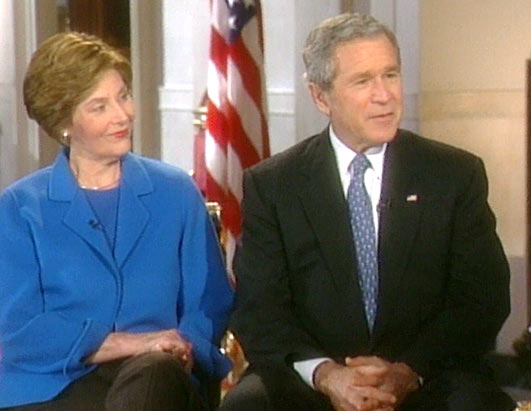
First Ladies Club: President Bush is serious about his promise to consult widely before naming a Supreme Court nominee. This week, for example, he reached out to First Lady Laura Bush, who said on the Today Show, "I would really like for him to name another woman." The President gamely told reporters, "We're considering all kinds of people – judges, non-judges" and presumably, women and non-women. Bush treated his wife's suggestion the way he might any other Republican interest group: 'Listen, I get her advice all the time." But Laura Bush isn't just another Republican interest group. Four years ago, she went on the Today Show to say she didn't think Roe v. Wade should be overturned. Most Americans see her as just a mild-mannered librarian. For the far right, Laura Bush is a bigger threat to human life than Alberto Gonzales. It will be even harder for the President to dismiss his wife's idea, now that Rehnquist says he's not going anywhere. After sending his lieutenant to apologize for Republicans being an all-white party, Bush won't want to waste his only draft choice on the Supreme Court's 107th white guy. Laura Bush didn't say who's on her shortlist, but one highly qualified candidate seems to fit her description. In January 2001, Laura Bush broke with her party to say that instead of focusing on Roe, "We should try to limit the number of abortions." In January 2005, this potential nominee broke with her party to say we should go further, and try our best to reduce that number to zero. George W. Bush might have a hard time selling the right wing on Supreme Court Justice Hillary Clinton. And judging from their respective comments, the current First Lady might prefer someone with a slightly less conservative stance on abortion than her predecessor's. But faced with her husband's other choices, Laura Bush might decide Hillary is "not so bad." ... 4:52 P.M. (link)

Thursday, July 14, 2005
Love Means Never Having to Say You're Sorry: Today, RNC chair Ken Mehlman will apologize for the Republicans' divisive, racist Southern strategy: "Some Republicans gave up on winning the African American vote, looking the other way or trying to benefit politically from racial polarization. I am here today as the Republican chairman to tell you we were wrong." Even in what is fast becoming the sorriest year in American politics, Mehlman's apology may be the most galling. If not for its Southern strategy, Ken Mehlman would be stuck in Baltimore and the modern Republican party simply would not exist. From 1880 to 1948, when Dixiecrat Strom Thurmond invented the Southern strategy he would take with him to the GOP, Democrats won every Southern electoral vote in every presidential election except 1928, when they nominated Al Smith, a Catholic. In 2000 and 2004, Al Gore and John Kerry didn't win a single electoral vote in the South. In 1964, when LBJ courageously signed the Civil Rights Act of 1964, Democrats controlled both houses of Congress because of the solid South. Today, Republicans control both houses of Congress and all three branches of government because the South is in their column. Who's Your Daddy?: Racial polarization is no longer the reason Republicans win in the South. But for two decades, the race card was the GOP's loss leader. If not for his father's divisive 1988 campaign and Willie Horton ad, we would never have heard of George W. Bush. The President deserves credit for changing the Republican party's tone on immigration and education. Mehlman deserves credit for recruiting African-American and Latino candidates. But if we've learned anything from the GOP's Southern strategy, it's that cynicism and expedience are themselves a form of evil. In the 1970s and '80s, the GOP turned crime and welfare into racial code words, but did nothing about either underlying problem. Republicans raised the specter of racial quotas to win middle-class votes, while their agenda offered opportunity only for the wealthy. The GOP's Southern strategy collapsed in the 1990s, when Bill Clinton gave Democrats a better one: take the race card out of politics by giving African-Americans, Latinos, and whites what they wanted all along – real progress on wedge issues like crime and welfare. Immigrant-bashing, a California cousin of the Southern strategy, collapsed after Pete Wilson's Prop 187 helped Clinton win 72% of the Latino vote in 1996. Polarization 2.0: The reason Republicans are abandoning the race card isn't that they've changed their mind on civil rights or affirmative action. Mehlman and Rove have just made a business decision that in an increasingly diverse nation, they can no longer build a majority on racial wedge issues. In his speech, Mehlman comes right out and says as much: "If my party benefited from racial polarization in the past, it is the Democratic Party that benefits from it today." The new GOP has perfected a strategy to replace racial polarization: universal polarization. While Mehlman is busy apologizing for decades of race-baiting, Senate Republican Rick Santorum won't even apologize for saying decades of liberalism caused child abuse. Thanks to Mehlman and Karl Rove, the firewall for Bush's 2004 campaign was the most divisive issue of our time – same-sex marriage. For Republicans, same-sex marriage is the perfect wedge issue, because it divides African-Americans and Latinos as well as whites, and it works in every part of the country, not just the South. Of course, most Democrats oppose same-sex marriage, just as they opposed racial quotas. And George W. Bush has no more intention of ever actually passing a Constitutional amendment to ban same-sex marriage than his father did of reforming welfare or signing a crime bill. But the key is staying true to your principles: win first, apologize later. ... 11:47 A.M. (link)
Wednesday, July 13, 2005
My Kingdom for a Department: Today, Homeland Security Secretary Michael Chertoff announced another plan to reshuffle his 180,000 employees. According to Scotland Yard, last Thursday's devastating attack in London was the work of four suicide bombers with backpacks. Whose organization chart would you rather have?
There is no better symbol of what's wrong with Washington's uninspired response to Sept. 11 than the Department of Homeland Security. DHS is another example of that old political standby: Don't just stand there; do something that will keep people from noticing that you're just standing there.
The blue-ribbon experts who designed DHS meant well, as did the Democrats who championed it in Congress. That's more than we can say for George Bush, who reflexively opposed the notion because it wasn't the administration's idea, then flip-flopped to embrace it when he was under fire for doing too little, then demanded minor changes in work rules so Democrats would reflexively vote against it, then used their opposition to take back the Senate so he could spare the country from Democratic ideas.
Like many well-meaning, blue-ribbon proposals, DHS has a fundamental flaw: it's about how government works in theory. Terrorists with backpacks have a tendency to work in practice.
Chertoff is a step up from Tom Ridge, a bumbling bureaucratic infighter with a Bush-like gift for looking firm and clueless at the same time. You don't even have to read the details to know that Chertoff's reorganization scheme will make sense, because DHS is like the New York Mets lineup – every reshuffle makes at least as much sense as the last. In just two short years, DHS has clearly found its core mission – reorganization.
With admirable understatement, the Washington Post sums up Chertoff's plan: "Many Americans will notice no immediate impact from the changes." Except those who work for the Federal Air Marshal Service, which will switch agencies for the fourth time in three years. Before Sept. 11, we were vulnerable because warning memos from the front lines sat unheeded in higher-ups' mailboxes. Now a terrorist who wanted to send us a detailed warning directly would have a hard time finding the right email address.
Women and Children First: DHS has 22 "component agencies," in addition to 180,000 employees. The department is just a start-up, yet it's growing faster than GE. In its first term, the Bush administration proved it was possible to mismanage the smallest Cabinet department, Education, which has about 4,000 employees. But as a failsafe, DHS doesn't have to rely on top-down mismanagement: it has subdivisions like Immigration and Customs Enforcement (ICE) that were impossible to manage even in a smaller organization.
As the official leaker told the Post, this isn't another plan "to rearrange the deck chairs." DHS already has a full-time staff 180,000 to do that.
Chertoff says he is still "fine-tuning" DHS's famous color-coded warning system, which is now Orange if you're riding the Yellow or Red line, but Yellow if you're riding JetBlue. The DHS secretary did agree today to one color change: Passengers flying into Washington National can finally leave their seats to go to the bathroom.
I wish Chertoff well. Organization does matter, and I'd rather go into the war on terror with the DHS we want, not the DHS we have.
But confronting a new problem like terrorism requires us to take on tasks we didn't do before, not just write memos on letterhead we didn't have before. Instead of stealing the Democrats' idea for DHS, Bush should have borrowed the British idea for a domestic security agency like MI5, which is helping the U.K. respond with inspiring swiftness to last week's attacks.
Until recently, Bush has caved to bureaucratic pressure from the FBI, which wants to keep doing things the way it always has, only with a new flow chart. A few weeks ago, Bush's homeland security advisor at the White House announced baby steps that could take us closer to developing the capability of MI5.
Book Group: Some CEOs have been known to give their workforce copies of The Seven Habits of Highly Effective People. If he can find them, Chertoff might want to email his 180,000 employees the chapter on "the Whole Science of Government" from Charles Dickens's Little Dorrit:
The Circumlocution Office was (as everybody knows without being told) the most important Department under Government. No public business of any kind could possibly be done at any time without the acquiescence of the Circumlocution Office. . . . If another Gunpowder Plot had been discovered half an hour before the lighting of the match, nobody would have been justified in saving the parliament until there had been half a score of boards, half a bushel of minutes, several sacks of official memoranda, and a family-vault full of ungrammatical correspondence, on the part of the Circumlocution Office.
This glorious establishment had been early in the field, when the one sublime principle involving the difficult art of governing a country, was first distinctly revealed to statesmen. It had been foremost to study that bright revelation and to carry its shining influence through the whole of the official proceedings. Whatever was required to be done, the Circumlocution Office was beforehand with all the public departments in the art of perceiving--HOW NOT TO DO IT. ... 1:35 P.M. (link)
Look Who's Talking: Over the past four years, the press has written hundreds of articles describing the Bush White House as "tight-lipped." How do reporters know this? The Bush White House told them. "It's not our job to be sources," Andrew Card told Ken Auletta of the New Yorker last year. "The taxpayers don't pay us to leak!"
I guess we should ask for our money back. According to Karl Rove's lawyer, it depends on what the meaning of "leak" is. As always, Rove is on message: He's still fighting for freedom.
Whatever happens to Rove, Matt Cooper's e-mails prove that the Bush White House spins the press every bit as hard as past administrations. The Rove affair should put to rest the self-congratulatory nonsense that Bush officials are too disciplined to leak to the press. What sets this White House apart is that so few officials actually know what's going on, the top brass has to do all the leaking.
All the News That's Fed to Print: Here's a little secret that no White House—and no White House press corps—wants you to find out: Most leaks are on purpose. With rare exceptions, White House leaks don't come from whistle-blowers or staffers with scores to settle. They're deliberate, carefully planned, and signed off on at the highest levels. For every Deep Throat, there are a hundred Karl Roves.
White Houses orchestrate leaks for the same reason Rove talked to Cooper: They want to shape or drive the story. In the Clinton White House, we didn't endanger the lives of secret agents by blowing their covers. But we routinely gave selected reporters a sneak peak at upcoming presidential policy announcements. The Bush White House did the same thing just the other day.
No reporter will win a Pulitzer for being spoon-fed these scoops—and the White House official who does the talking will get a pat on the back, not a trip to the woodshed. (Special bonus: No jail time, either!) But White House officials and White House reporters are tight-lipped about them because these leaks are fake and somewhat ridiculous, like teleprompters or the congressional auto-pen.
The Rock: Michael Deaver, who practically invented the fake White House, told the New Yorker that the Bush crowd is "the most disciplined White House in history." But that discipline isn't because the President walks the halls of the Old Executive Office Building with a cattle prod. It's because they don't know anything.
When I started in the Clinton White House in January 1993, I received 20 press calls a day. By March, my phone had stopped ringing altogether. I wish I could say my iron discipline, dedication, loyalty, and love of country were the reason. But the truth is, like most staffers in the Bush White House, I was too far out of the loop even to fake it. ... 11:31 A.M. (link)