
Movies

He Got Game (Buena Vista Pictures). Critics rank Spike Lee's Oedipal basketball drama--starring Denzel Washington as a convict and the NBA's Ray Allen as his estranged son--at the top of his oeuvre. After paying Lee's recent films scant attention, they declare him "underrated" and "overlooked" (Janet Maslin, the New York Times). They're pleased to find that Allen can act, that Washington has a mean streak, and that Lee critiques capitalism more than he does racism. Dissenters gripe about cheap high-mindedness, especially the caricatures of money-grubbing sports agents. (Click here for David Edelstein's review in Slate and here for the official site.)
Les Misérables (Columbia Pictures). The 18th film version of Victor Hugo's novel, this one from Danish director Bille August, wins modest praise despite its familiar story and conventional telling. Strong performances are credited: Geoffrey Rush uses the prosecutor Javert as a portrait of zealotry, and Liam Neeson makes the prisoner Valjean, a character without a "recognizable human flaw," seem complex (Jay Carr, the Boston Globe). Others praise the film's slow European pace as an antidote to Hollywood's manic style. Detractors complain it's just plain boring. (Here is the official site. And a recent "Summary Judgment" has an item on Hugo chic.)
Summer Movie Roundup. Few summer movies are even trying to duplicate Titanic's success, the Hollywood press reports. "The studios sensibly scaled down" in the wake of the Christmastime smash hit, says Time's Richard Corliss. Variety's Dan Cox forecasts fewer action flicks and "more offbeat weepies than usual." Highly touted are Steven Spielberg's World War II drama Saving Private Ryan (starring Tom Hanks and Matt Damon) and Peter Weir's satiric The Truman Show, about a man (Jim Carrey) whose entire life is televised. The exception is a remake of Godzilla from the creators of Independence Day; critics predict it will be the summer box-office champ.
Television
Newsmagazine Roundup. Rumors that ABC and NBC may replace their nightly news shows with prime-time newsmagazines trigger laments about the genre's decline. NBC's tabloidy Dateline, already on four times a week, is called "as close to local TV news as anything the networks have yet come up with" (Richard Zoglin, Time). Meanwhile, a highly praised PBS documentary about 60 Minutes producer Don Hewitt prompts critics to note that show's downfall as well. Citing Andy Rooney's dithering commentaries and a story bashing gay studies, Entertainment Weekly declares the once high-minded CBS show "alarmingly behind the times."
Books
Easy Riders, Raging Bulls: How the Sex-Drugs-and-Rock 'n' Roll Generation Saved Hollywood, by Peter Biskind (Simon & Schuster). As 1970s American cinema enjoys a critical renaissance, reviewers lap up the gossip in a book about its groundbreaking directors. Reviewers share the author's view that these auteurs--including Francis Ford Coppola, Martin Scorsese, William Friedkin, and Paul Schrader--reinvented American cinema with their gritty dramas but arrogantly overindulged in drugs and sex. Some critics rant about present-day Hollywood: "[F]ew of the films of the earlier era would get the green light today," says USA Today's Susan Wloszczyna. (Excerpts are available here.)
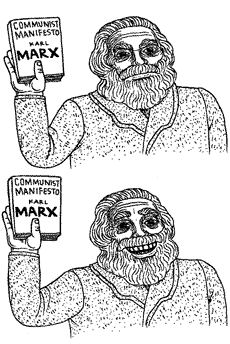
The Communist Manifesto, by Karl Marx and Frederick Engels (Verso). The left-wing publishing house Verso has reissued the classic of political philosophy on its 150th anniversary, marketing the book at chic clothiers as "an accessory, a stocking-stuffer, a badge of consummate capitalist cool" (Barbara Ehrenreich, Salon). Left-wing reviewers stress the tract's continued relevance as a critique of labor relations, while conservatives redefine Marx and Engels as prophets of capitalism who respected the economy's dynamism and strength. Scholarly reviewers honor it as "an enduring masterpiece that immediately catches up readers in its transpersonal force and sweep" (Steven Marcus, the New York Times Book Review).
Theater
The Judas Kiss (Broadhurst Theatre, New York City). Liam Neeson brings Oscar Wilde chic to Broadway in a new play by British playwright David Hare, but critics are unimpressed. The brawny Neeson "is a calamity" as Wilde, says New York's John Simon. Hare's script is faulted for making Wilde inhumanly noble and for blaming Wilde's celebrated fall entirely on his lover, Lord Alfred Douglas. The revival of interest in Wilde--another play about him (Gross Indecency) and a new movie (Wilde)--continues to delight critics. "All that's missing ... are the dashboard statuettes and the black velvet portraits," says Time's Walter Kirn.
Recent Summary Judgment columns
Movie--Two Girls and a Guy;
Movie--SlidingDoors;
Book--DamascusGate, by Robert Stone;
Book--Other Powers: The Age of Suffrage, Spiritualism, and the Scandalous Victoria Woodhull, by Barbara Goldsmith (Knopf); Notorious Victoria: The Life of Victoria Woodhull, Uncensored, by Mary Gabriel (Algonquin).
Television--Merlin (NBC);
Art--"Alexander Calder: 1898-1976";
Opera--Kirov Opera.
Movie--Wild Man Blues;
Movie--ObjectofMyAffection;
Movie--ChineseBox;
Television--Seinfeld (NBC);
Book--Bitch: In Praise of Difficult Women, by Elizabeth Wurtzel;
Book--Closed Chambers: The First Eyewitness Account of the Epic Struggles Inside the Supreme Court, by Edward Lazarus;
Art--"Shadows of a Hand: The Drawings of Victor Hugo."
Movie--My Giant;
Movie--City of Angels;
Movie--The Big One;
Television--Brave New World (NBC);
Book--Flawed Giant: Lyndon Johnson and His Times 1961-1973, by Robert Dallek;
Book--Nat Tate: An American Artist, 1928-1960, by William Boyd;
Book--Quarantine, by Jim Crace;
Theater--Wait Until Dark.
Movie--Lost in Space;
Movie--The Butcher Boy;
Movie--TheSpanishPrisoner;
Music--Left of the Middle, by Natalie Imbruglia;
Television--Push (ABC);
Television--Frontline: From Jesus to Christ--The First Christians (PBS);
Book--An Instance of the Fingerpost, by Iain Pears;
Book--Cavedweller, by Dorothy Allison.
--Franklin Foer