Movies

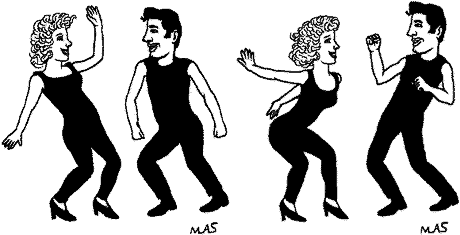
Grease (Paramount). The 1950s nostalgia film, panned when it was released in 1978, fares better on re-release as a 1970s nostalgia film. The remastered version takes in $13 million its first weekend, just behind Titanic at the box office. Critics also come around. "As timeless as its bad-boy-meets-good-girl plot" (Susan Wloszczyna, USA Today). Most reviewers celebrate the career of its star John Travolta, then 23: "an invaluable cultural icon ... an important and enduring movie star" (Roger Ebert, the Chicago Sun-Times). And Entertainment Weekly's Lisa Schwarzbaum discovers latent homosexuality in the "intense boy-boy communion" within Travolta's gang. (Click here for the official site.)
The Newton Boys (20th Century Fox). A lukewarm response to Dazed and Confused director Richard Linklater's first venture beyond Gen X. His western about the most accomplished bank robbers in American history is faulted for lacking the conventions--exciting chase scenes, gunfights, and black-hatted villains--that give the genre its enduring appeal. The characters played by young hunks Matthew McConaughey, Ethan Hawke, and Vincent D'Onofrio are said to suffer in comparison to the real-life characters, clips of whom Linklater weaves into the film. "It's the Bland Boys almost all the way" (Amy Taubin, the Village Voice). (A trailer is available here.)
Television
From the Earth to the Moon (HBO; click here for schedule). Apollo 13 star Tom Hanks produces a $68 million, 12 hour docudrama about NASA, from the first Mercury launch (1961) to the last moon voyage (1972). Critics declare it a noble failure. They're taken with its enthusiasm for space exploration, which has lost its mystique since the '70s. But they also say the series is "too long, too prolix, too cable" (Ken Tucker, Entertainment Weekly) and gets bogged down in irrelevant details. In one episode, notes Time's James Collins, "the only source of suspense ... is a worry over the winds on the day of lift-off." (HBO plugs the show here.)
Teletubbies (PBS; click here for schedule). Controversy over this British show, just reaching the United States, which bills itself as the first program for 1-year-old children. Is the show, about the picaresque adventures of futuristic toddlers, bad for babies? U.S. News & World Report cites psychologists who argue that it will addict babies to television, hindering their mental development. The magazine calls Teletubbies a marketing ploy cloaked as education. Others find camp virtues in the "sublimely ridiculous experience" of the show (Tucker) and note that in England it has a large following with gay men.
Theater
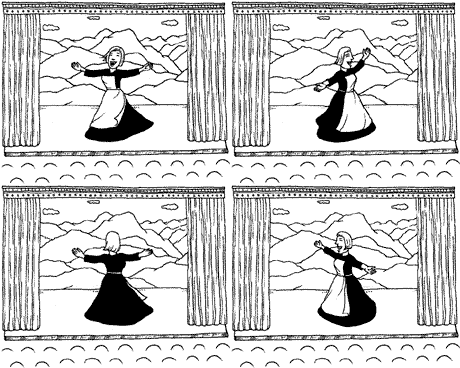
The Sound of Music (Martin Beck Theater, New York City). Critics find no reason for this revival of the treacly 1959 musical. "The most saccharine of the Rodgers and Hammerstein" collaborations, says New York's John Simon. Although reviewers grant that this production benefits from some nuanced performances, they still conclude that "The Sound of Music isn't really for grown-ups" (Ben Brantley, the New York Times). They predict audiences will continue to devour the show's sentimental story anyway.
Books
The All-True Travels and Adventures of Lidie Newton, by Jane Smiley (Knopf). After writing a polemical 1996 essay attacking Huckleberry Finn as immoral, Pulitzer Prize winner Smiley sets out to improve on Twain with a novel about an abolitionist woman in antebellum Kansas Territory. Critics don't like the book any more than the essay. In the New York Times Book Review Thomas Mallon faults Lidie Newton for "dutiful caricatures of white degeneracy and black nobility ... the purest P.C." Slate's Sarah Kerr says that "for someone so bent on unmasking pieties, Smiley is not above her own kind of sanctimony." (To read the first three chapters, click here.)
Consilience: The Unity of Knowledge, by E.O. Wilson (Knopf). The famed Harvard sociobiologist argues that all phenomena--art, economics, science--can be understood by studying the brain's neural pathways. Critics line up on opposing sides. Some praise his emphasis on biology as "a strong antidote to the trendy campus fatalists who hold truth to be subjective" (R.Z. Sheppard, Time). Skeptics renew old attacks on sociobiology's all-encompassing view of human nature. "He is the Mr. Magoo of scientific theory, genially oblivious to everything he can't or won't see" (Daniel Mendelsohn, the New York Observer). (In Slate, Steven Pinker praises the book. Click here to read the first chapter.)
Fashion
Fall Lines. The unveiling of fall lines in Milan, Paris, and New York City over the last three weeks--accompanied by unprecedented cable TV coverage--leads the New York Times' Ruth La Ferla to declare runway shows "the spectator sport of the decade." This year's lines are noted for representing a backlash against feminism--"fashion's new womanliness," Time's Ginia Bellafante calls it--with a return to pinks, pleats, and furs. Some critics fault the younger designers for not taking risks, preferring the continuing inventiveness of such veterans as Karl Lagerfeld, Valentino, and Jean-Paul Gaultier. (Slate's Anne Hollander explains the pleasures of the runway show.)
Update
In the Los Angeles Times, Oscar-winning Titanic director James Cameron savages the paper's chief movie critic, Kenneth Turan, for panning his movie on two separate occasions. "Nobody's interested in the vitriolic ravings of a bitter man who attacks and rips apart movies that the great majority of viewers find well worth their time and money."
Recent "Summary Judgment" columns
Event--70th Academy Awards;
Television--Sitcom Roundup;
Movie--Primary Colors;
Movie--Wild Things;
Movie--Taste of Cherry;
Theater--Cabaret;
Opera--Lohengrin.
Movie--The Man in the Iron Mask;
Movie--Love and Death on Long Island;
Movie--Men With Guns;
Television--Lateline (NBC);
Television--SignificantOthers (ABC);
Pop--Pilgrim, by Eric Clapton;
Book--SpinCycle: Inside the Clinton Propaganda Machine, by Howard Kurtz;
Book--TheChildren, by David Halberstam.
Movie--The Big Lebowski;
Movie--Primary Colors hype;
Movie--Twilight;
Movie--U.S. Marshals;
Theater--The Beauty Queen of Leenane;
Book--One Nation, After All, by Alan Wolfe;
Book--A History of the American People, by Paul Johnson.
Movie--An Alan Smithee Film: Burn Hollywood Burn;
Movie--Krippendorf's Tribe;
Movie--Lolita;
Music--Ray of Light, by Madonna;
Book--The Smithsonian Institution, by Gore Vidal;
Theater--Art;
Art--"Chuck Close" (Museum of Modern Art).
--Franklin Foer