Movies
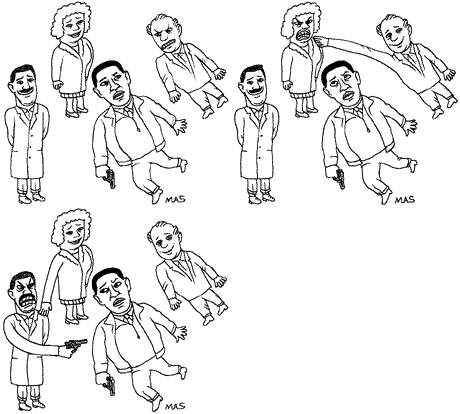

Fallen (Warner Bros.). The new Denzel Washington crime thriller is said to suffer from an overwrought screenplay and a far-fetched conceit: A detective battles a demon that jumps from one person to another when they touch. It's "what happens when too many mystics attend a Hollywood pitch meeting" (Lisa Schwarzbaum, Entertainment Weekly). Critics also dislike the hackneyed plot twists and "embarrassingly silly dialogue" (Emanuel Levy, Variety). They find Washington his usual charming self, but some reviewers wonder why his characters never have romantic relations with white women. (The studio trumpets the movie here.)
Sundance Film Festival (Park City, Utah). Robert Redford's annual independent-film festival continues to lose its luster. Noting that the hits from last year's competition flopped at the box office, critics declare the independent-film boom over. They lament a glut of Quentin Tarantino knockoffs and speculate that the ski-vacation atmosphere intoxicates the judges. "Movies look better at high altitudes," suggests Entertainment Weekly's Rebecca Ascher-Walsh. Meanwhile, the studios' dominance at the Golden Globe Awards--Titanic won four awards--is offered as evidence of their restored hegemony. "Does this prove once and for all that size matters?" Titanic director James Cameron quipped at the Sunday-night ceremony. (Click here for the snazzy Sundance site.)
Live Flesh (MGM-UA). Reviewers praise Spanish director Pedro Almodóvar for abandoning his campy proclivities to make a film noir with social bite. Live Flesh, about a man who accidentally shoots his lover's husband, is deemed the director's "most mature film yet" (Jack Mathews, Newsday). While the critics like Almodóvar's foray into political commentary--he indicts the Franco regime and Spain's ruling conservative party--they wax most enthusiastic over his signature touch: kinky sex scenes. "Almodóvar is eros's last true worshiper" (David Denby, NewYork). (A trailer is available here.)
Musical
Ragtime (Ford Center for the Performing Arts, New York City). New York critics prove more skeptical than their Los Angeles counterparts, who raved about this musical during its run there. They say that E.L. Doctorow's 1975 novel about turn-of-the-century America gets saddled with forgettable tunes by Stephen Flaherty and Lynn Ahrens and a book by Terrence McNally that is "thuddingly didactic," especially on race (Lloyd Rose, the Washington Post). The show has "the aura of something assembled by corporate committee," says the New York Times' Ben Brantley. Some label producer Garth Drabinsky a megalomaniac bent on besting Disney and dominating Broadway.
Books
Pillar of Fire: America in the King Years, 1963-65, by Taylor Branch (Simon & Schuster). The second of three volumes chronicling the civil-rights movement is deemed as magisterial as the Pulitzer Prize-winning first, Parting the Waters (1988). Critics gush over Branch's wide-ranging narrative, which they say does justice to the mythic dimensions of the struggle. King, the book's central figure, emerges as "our century's epic hero" (Alan Wolfe, the New York Times Book Review) despite revelations about his Kennedyesque libido. "The remarkable thing about the struggles of the King years is that there now is no struggle over [their] historical significance," says the Wall Street Journal's David Shribman.
Shadows on the Hudson, by Isaac Bashevis Singer, translated by Joseph Sherman (Farrar, Straus & Giroux). A posthumously published novel by the Nobel laureate garners mixed reviews. Some critics say the 40-year-old novel, about an adulterous Jewish refugee in New York, illustrates the Yiddish master's wry humor and enchanting storytelling. It has "a strong claim to being Singer's masterpiece," says the New York Times' Richard Bernstein. Others say it's no coincidence the novel didn't appear until seven years after Singer's death. "Chaotic, rambling, repetitive and parochial," judges Lee Siegel in the New York Times Book Review, suggesting that the translator and editor also did poor jobs. (See Jonathan Rosen's review in Slate, and click here for an excerpt from the book.)
Television
South Park (Comedy Central; Wednesdays; 10 p.m. ET/PT). The cable network's animated show about third graders obsessed with violence and bodily emissions "has replaced Beavis and Butt-head as America's premiere gross national product" (Ken Tucker, Entertainment Weekly). Critics attribute the show's cult following to the timeless power of bathroom humor and to its dark and clever plots, such as a thwarted assassination attempt on Kathie Lee Gifford. Some predict the jokes will wear thin soon, while others call it "definitively depraved" (Tom Shales, the Washington Post). (Download a clip from South Park here.)
Art
"Arthur Dove: A Retrospective" (Whitney Museum, New York City). Critics rediscover the virtues of Arthur Dove (1880-1946), the first American painter (and arguably the first painter anywhere) to abandon representation. "Dove's visionary abstraction was of such strength, originality and integrity," says Time's Robert Hughes, "that it deserves its special place in the history of American art." This esteem reverses the judgment of Abstract Expressionists who denied Dove's paternity of their movement and dismissed his landscapes as simple-minded.
Recent "Summary Judgment" columns
Death--Sonny Bono;
Book--A Prayer for the City, by Buzz Bissinger;
Book--Cold Mountain, by Charles Frazier;
Book--The World According to Peter Drucker, by Jack Beatty;
Movie--Afterglow;
Movie--Arguing the World;
Movie--Ma Vie en Rose.
Movie--The Apostle;
Movie--Oscar and Lucinda;
Movie--The Boxer;
Television--Seinfeld (NBC);
Book--Truman Capote: In Which Various Friends, Enemies, Acquaintances, and Detractors Recall His Turbulent Career, by George Plimpton;
Book--Paradise, by Toni Morrison;
Music--"Northern Lights: The Music of Jean Sibelius."
Winter Movie Roundup
"The Year in Review in Review"
--Franklin Foer