Movies

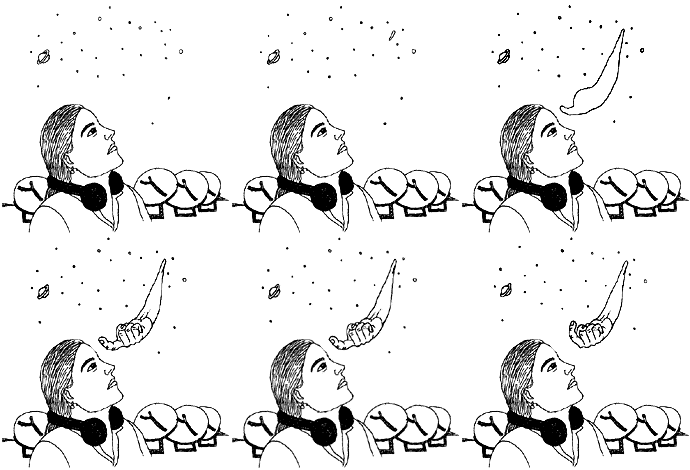
Contact (Warner Bros.). A movie made by Robert Zemeckis (Forrest Gump) from a Carl Sagan novel about the search for extraterrestrial life is declared pretentious. "People magazine's mail seems penetrating in comparison," says the WashingtonPost's Rita Kempley. Reviewers deem most vapid the heavy-handed exchanges about the meaning of life between Jodie Foster's obsessed scientist and Matthew McConaughey's New Agey priest. Foster, as always, is "fiercely intelligent" but her character is "grindingly sincere" (David Denby, New York). The New Yorker's Anthony Lane: "[She] does not need a long trip into space. She needs to get (1) a square meal inside her, (2) some rest, and (3) laid." (See Sarah Kerr's review in Slate and the Contact site.)
Shall We Dance? (Miramax). Critics foresee art-house success for this film about a buttoned-down Japanese accountant whose midlife crisis drives him to take dance lessons. Reviews praise the movie's depiction of the repressed Japanese middle class and its "Fred and Ginger sweetness" (Janet Maslin, the New York Times). But some critics complain it's too languid and drawn out. "Even when the catharsis we yearn for arrives, it's tinged with restraint," says Entertainment Weekly's Owen Glieberman. (Kerr reviews the movie for Slate.)
Books
Lawyerland: What Lawyers Talk About When They Talk About the Law, by Lawrence Joseph (Farrar, Straus & Giroux). St. Johns law professor and Sunday poet Lawrence Joseph's anthology of conversations with New York attorneys is deemed humorous but "pointless" (Rob Long, the Weekly Standard). Reviewers say Joseph is "good at catching the way people talk" (Christopher Lehman-Haupt, the New York Times) and his characters "are first cousins to David Mamet's or Eric Bogosian's ranters" (Philip Lopate, Esquire). But beneath the froth the book offers little insight into the way lawyers work, Long says; it's really about "what colorful New Yorkers talk about when they're trying to be colorful."
Straight Man, by Richard Russo (Random House). Critics applaud Russo's sendup of life at a small western Pennsylvania college, in which an English professor loses his job, becomes unhinged, commandeers a local TV station, and threatens to murder a goose. According to reviewers, Straight Man, like Russo's earlier novel Nobody's Fool, comically but sympathetically plumbs "the American working class in the age of downsizing" (Dan Cryer, Newsday). Others just like its humor. The book, raves Tom de Haven in the New York Times Book Review, has "pitch-perfect dialogue, persuasive characterization and a rich progression of scenes ... crackling with an impudent screwball energy reminiscent of Howard Hawks's movies." (Random House plugs the book here.)
Television
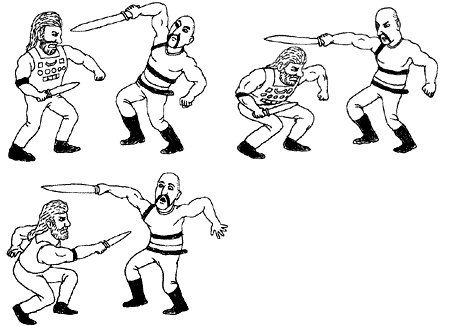
Roar (Fox; Mondays; 9 p.m. EDT/PDT). Fox's knockoff of the popular syndicated 5th-century warrior adventure show Xena is said to lack the camp irony of the original. The most "shamefully derivative hour in recent network history," says Roy Richmond in Variety. "Unintentionally laughable," says the New York Times' Caryn James. Tom Carson of the Village Voice suggests the only reason to watch is "because you're dying to know how the black guy got in the cast." Other critics predict that Roar, like Xena, will be a cult hit.
Theater
Amy's View (National Theatre, London). British playwright David Hare, criticized in the past for his "preachy politics," is said to have finally found "his way beyond polemic" (John Lahr, The New Yorker). Hare's new play about a self-centered film critic, his wife, and his mother-in-law is hailed as a "coup de théâtre" (Matt Wolf, Variety), both for its social critique (of the amorality of the news media) and for its sensitivity "about such personal matters as loss, grief and stoical survival" (Benedict Nightingale, the London Times). Hare's enthusiasts declare it time for canonization.
Recent "Summary Judgment" columns
Movie--Men in Black;
Book--Women With Men, by Richard Ford;
Book--American Scripture: Making the Declaration of Independence, by Pauline Maier;
Book--Man Without a Face: The Autobiography of Communism's Greatest Spymaster, by Markus Wolf with Anne McElvoy;
Art--"Keith Haring" (Whitney Museum of American Art);
Television--Oz (HBO);
Music--Lilith Fair.
Movie--Batman & Robin;
Movie--Face/Off;
Movie--La Promesse;
Musical--Ragtime;
Book--The Puttermesser Papers, by Cynthia Ozick;
Book--How Proust Can Change Your Life: Not a Novel, by Alain de Botton;
Book--Bright Angel Time, by Martha McPhee.
Movie--Hercules;
Movie--Speed 2;
Movie--My Best Friend's Wedding;
Architecture--Shakespeare's Globe Theatre;
Book--News of a Kidnapping, by Gabriel García Márquez, translated from the Spanish by Edith Grossman;
Book--The Diving Bell and the Butterfly, by Jean-Dominique Bauby, translated from the French by Jeremy Leggatt;
Book--The God of Small Things, by Arundhati Roy;
Book--The Perfect Storm, by Sebastian Junger;
Art--"Venice Biennale."
Movie--Con Air;
Movie--Ulee's Gold;
Movie--The Pillow Book;
Music--Wu-Tang Forever, Wu-Tang Clan;
Book--Without a Doubt, by Marcia Clark, with Teresa Carpenter;
Book--Firewall: The Iran-Contra Conspiracy and Cover-Up, by Lawrence E. Walsh;
Book--Promiscuities: The Secret Struggle for Womanhood, by Naomi Wolf;
Theater--Gross Indecency: The Three Trials of Oscar Wilde.
--Compiled by Franklin Foer and the editors of Slate.