Art

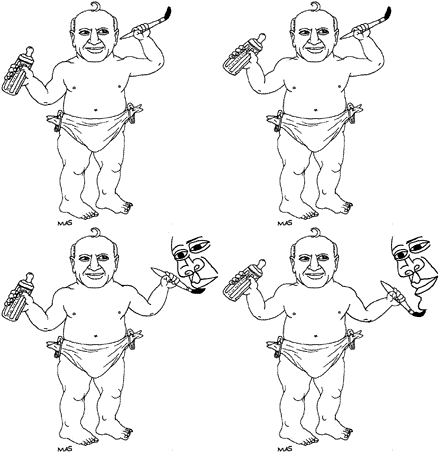
"Picasso: The Early Years, 1892-1906" (National Gallery of Art, Washington, D.C.). The artist's "Wonder Bread years"--age 11 to 25--ending in his cubist period. The question is whether the world needs another Picasso show less than a year after the Museum of Modern Art's grand exhibition of his portraiture. Most critics are happy to reconsider the maligned "blue period," which is now deemed "Picasso at his most accessible" by the Wall Street Journal's Deborah Solomon ("you don't need to know the first thing about line or form to be deeply moved by them"). The New York Times' Michael Kimmelman, on the other hand, says the curators confuse "precociousness with originality" and quantity with quality: These "endless shows ... numb people to Picasso's art, making obeisance routine, like genuflecting in church." (The National Gallery plugs the show at its site.)
Movies
Anaconda (Sony Pictures). A classic example of the high-low two-step, Anaconda is both No. 1 at the box office and earning a qualified critical approbation for its self-referentially campy chic. Playing an obsessive dedicated to trapping a 40-foot-long snake in the middle of the Amazon, Jon Voight leads a group of unsuspecting documentary filmmakers (Jennifer Lopez, Eric Stoltz, and Ice Cube) to their deaths. The movie "has, like the killing-machine beast itself, the brutal efficiency of single-mindedness" (Terrence Rafferty, The New Yorker). Voight's overwrought performance has a "kitschy glory" (Joe Morgenstern, the Wall Street Journal). It all harks back to the "kind of retro, eek! eek! production that studios don't often make anymore, now that movies about tornadoes and invasions by aliens have become too expensive to be taken humorously." (Lisa Schwarzbaum, Entertainment Weekly). (The Anaconda site serves up stills and clips.)
Grosse Pointe Blank (Buena Vista Pictures). Heaps of praise for the movie's preposterous premise: An introspective hit man returns home for a high-school reunion. The film itself "doesn't always make a whole lot of sense," says the Los Angeles Times' Kenneth Turan, "but seeing a vehicle this outlandish is reward enough by itself." Credit goes to co-writer/star John Cusack, who "brings his droll intelligence to bear on a worthy comic invention, ... turning every dialogue scene into a colloquy for ardent obsessives" (Morgenstern, the Wall Street Journal). But Cusack can't sustain the freshness of the original idea: The film "isn't nearly as clever as it thinks it is" (Rafferty, The New Yorker).
Theater
An American Daughter (Cort Theatre). Mixed reviews for Wendy Wasserstein's comedy based on the Zoe Baird and Kimba Wood incidents, with recognizable caricatures of Hillary Clinton, Naomi Wolf, and Andrew Sullivan. Newsday's Linda Winer says Wasserstein has matured into "her own bright, eloquent and great-hearted version of George Bernard Shaw." The New York Times' Ben Brantley says Wasserstein "may be saying something about a world that reduces people to sound bites ... [but] is also working principally in bite-size slices of sound, sentiment and humor." The Washington Post's Lloyd Rose says that "[t]he play is antic as all get-out, but it doesn't go anywhere--it just hops frantically up and down in one place."
Books
Naked, by David Sedaris (Little, Brown and Co.). Commercial and critical success for the gay housecleaner-turned-humorist's collection of essays--seventh on this week's New York Times best-seller list. Critics applaud Sedaris' tendency to mock both himself (the title essay is about his stint at a nudist camp) and others (he titles a piece about people who picked him up hitchhiking "Planet of the Apes"). The book is a "wedding of funny and mean, and Mr. Sedaris does have a way with venom" (Craig Seligman, the New York Times Book Review).
The Blue Flower, by Penelope Fitzgerald (Houghton Mifflin). Adulation for the Booker Prize-winning British author's historical novel about the romantic life of the German Romantic poet Novalis (1772-1801). "It is quite an astonishing book, a masterpiece," says the New York Times Book Review's Michael Hofmann. "I can think of no better introduction to the Romantic era." "She is the finest British writer alive," says the Los Angeles Times' Richard Eder. Praise also goes to Fitzgerald's command of dialogue: "The conversations are many-voiced, sharp-witted and finely tuned enough to allow the reader to hear plangent undernotes and to feel the intoxicating buzz that good talk emits" (Lucy Hughes-Hallett, the SundayTimes).
Gut Symmetries, by Jeanette Winterson (Knopf). Critics previously considered Winterson (Written on the Body, Sexing the Cherry) the rising superstar of British fiction, but her latest novel prompts a re-evaluation. Reviewers call it pretentious and filled with inaccurate references to theoretical physics, Walt Whitman, and the Kabbalah. There is "too much flexing of stylistic muscle," says the New Republic's Robert Alter. "It is a notable example of what happens when writers discount the centrality of narrative to fiction," says Newsday's Dan Cryer.
Inventions of the March Hare: Poems 1909-1917, by T.S. Eliot, edited by Christopher Ricks (Harcourt Brace). Last year the British publication of these never-published 39 poems occasioned accusations of misogyny, sordidness, and racism (one of the poems is titled "King Bolo and his Big Black Kween"). Reviewers predict that the collection's American publication will kick off a wave of Eliot-bashing. In the New York Times Book Review, Nicholas Jenkins says the poetry "articulates with dreamlike clarity not the perfections of European and American culture, but its chronic anguish ... of fascinations and sicknesses widely shared." In the New Republic, Richard Poirier attacks Ricks' annotations to the poems as "adventurism." The notes, says Poirer, are unnecessarily complicated and obscure; Ricks "ignores or distorts the plain evidence. ... Such annotative energies are generated not out of Eliot's need to be explained [but] from Ricks's need to dazzle."
Television
Gun (ABC, Saturday, 10 p.m. EST/PST). Praise for the idea behind director Robert Altman's six-episode dramatic series: Each installment has a different premise, a different big-name director (including Altman and James Foley), and different big-name actors (Rosanna Arquette and Carrie Fisher)--but the same prop: a pearl-handled semiautomatic. Pans for the outcome. Howard Rosenberg of the Los Angeles Times calls the recurring gun conceit "ridiculous." Episodes reviewed so far are dismissed as failed attempts at Hollywood and Washington satire. (Clips from Gun are available at ABC's site for the show.)
Fired Up (NBC, Thursday, 9:30 p.m. EST/PST). Yet another undeserving sitcom takes the coveted slot between Seinfeld and ER--the fourth in two years to do so. NYPD Blue's Sharon Lawrence plays a newly unemployed publicist forced to move in with her former secretary. The Washington Post's Tom Shales says the "whole premise is achingly unlikely." "Once again, we find barely-scraping-by Manhattanites living in a posh pad" (Matt Roush, USA Today). (Click here for the Fired Up site.)
Updates
The second wave of reviews of Inventing the Abbotts accords the film more merits than the first wave did. "This is an intelligent and absorbing romantic drama, beautifully mounted, emotionally saturated," says New York's David Denby. The New Republic's Stanley Kauffmann says performances by Joaquin Phoenix and Liv Tyler make the movie: "All the actors caught me up so warmly that I stopped feeling guilty about liking this corny picture." ...New York's John Simon objects to raves about the latest A Doll's House revival, especially those that praise Janet McTeer's Nora: "She lets her hands flutter like Tibetan prayer wheels in a gale, outcoos a turtledove in heat, and flings herself about as if playing racquetball with her own six-foot-plus body. This is what is known nowadays as rethinking the classics." ... The Kiss controversy continues. The Washington Post's Jonathan Yardley defends his attack on Kathryn Harrison's incest memoir against novelist Tobias Wolff's claims that he was motivated by his animus toward memoir as a genre: "The truth, as opposed to Wolff's self-serving fantasy, is that my objections to 'The Kiss' have absolutely nothing to do with its being a memoir per se, or even with its being one of those 'personal writings that have recently found favor with readers.' My objections are based entirely and exclusively in the simple, inescapable reality that 'The Kiss' is an irredeemably rotten book. Per se." Yardley adds that when he said eight years ago that Tobias Wolff's memoir was not as good as his brother Geoffrey's, that was also a purely literary judgment.
Recent "Summary Judgment" columns:
Theater--A Doll's House;
Movie--The Saint;
Movie--Paradise Road;
Movie--Inventing the Abbotts;
Movie--That Old Feeling;
Book--Allen Ginsberg (1926-1997);
Book--After the Madness: A Judge's Own Prison Memoir, by Sol Wachtler;
Book--The Big Picture, by Douglas Kennedy.
Book--Texaco, by Patrick Chamoiseau, translated by Rose-Myriam Réjouis and Val Vinokurov;
Book--John Wayne's America: The Politics of Celebrity, by Garry Wills;
Book--The Divorce Culture, by Barbara Dafoe Whitehead;
Book--When the Sons of Heaven Meet the Daughters of the Earth, by Fernanda Eberstadt;
Movie--The Devil's Own;
Movie--Chasing Amy;
Theater--The Young Man From Atlanta.
Event--The 69th Academy Awards;
Art--"1997 Biennial Exhibition" (Whitney Museum of American Art, New York City);
Art--Willem de Kooning (1904-1997);
Movie--Liar Liar;
Movie--Crash;
Movie--Selena;
Movie--The Godfather;
Book--The Coming Conflict with China, by Ross H. Munro and Richard Bernstein;
Book--Radical Son: A Journey Through Our Times, by David Horowitz.
Movie--Return of the Jedi: Special Edition;
Movie--City of Industry;
Opera--Jackie O;
Theater--Antony and Cleopatra;
Book--Arkansas: Three Novellas, by David Leavitt;
Book--Deadly Feasts: Tracking the Secrets of a Terrifying New Plague, by Richard Rhodes;
Book--Resurrection: The Struggle for a New Russia, by David Remnick;
Book--The Three-Arched Bridge, by Ismail Kadare, translated by John Hodgson.
--Compiled by Franklin Foer and the editors of Slate.