Books

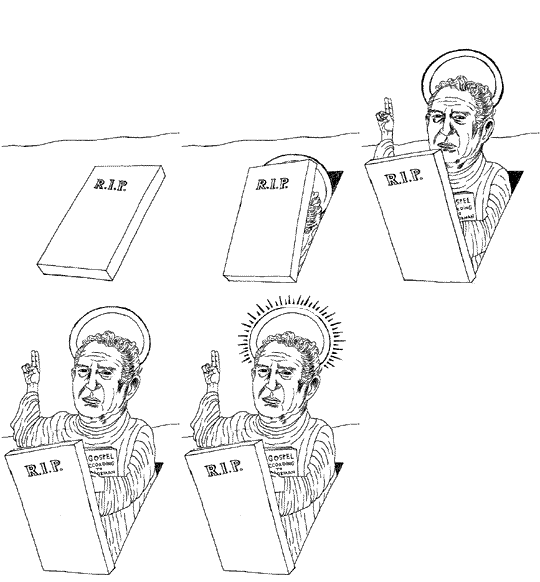
The Gospel According to the Son, by Norman Mailer (Random House). Norman Mailer's latest act of literary chutzpah--an autobiography of Jesus--fails spectacularly. The New York Times' Michiko Kakutani calls it a "silly, self-important and at times inadvertently comical book." Criticisms: The language is stilted and predictable, with Mailer's only additions to the Christ story being the lust Jesus feels in his heart and the hard time he has with celebrity. Only Frank Kermode defends Mailer; in an erudite reading of the book in the New York Review of Books, he attributes to Mailer the subtlety of a theologian--whose "powerful mind," however, "works in a specialized way, not by theological argument but by telling or retelling a story."
American Pastoral, by Philip Roth (Houghton Mifflin). The best of the three novels published this spring by postwar Jewish-American novelists (Bellow, Roth, and Mailer). Some say it is Roth's best ever. "Never before has Roth written fiction with such clear conviction. Never before has Roth assembled so many fully formed characters or shuttled so authoritatively through time" (R.Z. Sheppard, Time). Narrated by Roth's fictional alter ego Nathan Zuckerman, it is the story of an assimilated Jew whose life is shattered in the '60s by his daughter's Weathermen Underground-style rebellion. He has "created a resonant parable of American innocence and disillusion" (Kakutani). In the New York Times Book Review, however, Michael Wood calls the book a "little slow," lacking the manic energy of the other Zuckerman novels. (Roth's publisher plugs his book.)
W.B. Yeats: A Life. 1: The Apprentice Mage, 1865-1914, by R.F. Foster (Oxford University Press). Coming after a long line of mediocre biographies of the Irish poet, the first volume of a two-part biography by Oxford historian Roy Foster is greeted warmly. It "integrates Irish history impressively into the complex fabric of the great poet's life" says the Washington Post's Karl Beckson. Yeats "would be relieved to know ... that the biographer is himself a fine writer, bearing with grace his knowledge of Irish history, and writing with wit, authority and, when appropriate, considerable eloquence," says Thomas Flanagan in the New York Times Book Review. (See James Wood's enthusiastic review in Slate.)
Purple America, by Rick Moody (Little, Brown, and Co.). As with Moody's last two novels (Garden State, Ice Storm), reviewers can't decide whether the young novelist is a hip Updike or a Pynchon wannabe. (This novel deals with a decaying suburban Connecticut nuclear family and a decaying suburban Connecticut nuclear power plant.) The New York Times Book Review's Janet Burroway calls him "a chronicler of the middle class for the millennium." Time's Sheppard says that the novel's "characters are emotionally intricate, and its tensions adroitly controlled." Others think he overwrites. "This is a novel that doesn't seem written, but declaimed, in a WASP Jesse Jackson style, from a Darien pulpit" (Dwight Garner, the Village Voice).
Television
In the Gloaming (HBO, click here for a schedule). Who would criticize quadriplegic actor Christopher Reeve's directorial debut? Almost nobody. Reviewers concede the made-for-TV tawdriness of this AIDS movie starring Robert Sean Leonard, Glenn Close, Bridget Fonda, and Whoopi Goldberg: pat characters and a tear-jerker plot. But the screenplay is said to redeem the melodrama. It is "artful and literate" says the Washington Post's Tom Shales. Entertainment Weekly's Ken Tucker says it "is superior to any domestic drama Hollywood has released in theaters in at least a decade." Newsweek's Rick Marin is the only critic to brave a negative judgment: "That [Reeve] can direct at all is impressive. Too bad the movie isn't." (A trailer for the show is available on HBO's site.)
Opera
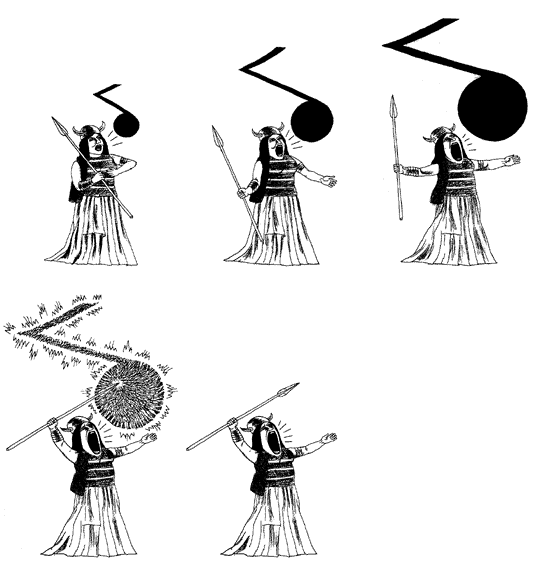
The Ring of the Nibelung, by Richard Wagner (Metropolitan Opera Company, New York City). High praise for an all-star rendition of Wagner's four-opera cycle (the third installment was performed last week). Kudos mostly for conductor James Levine's "thrilling reading of Wagner's emotion-magnifying score" (Allan Kozinn, the New York Times). Also lauded are the singers, an ensemble of the world's greatest that includes tenor Placido Domingo, soprano Deborah Voigt, and bass James Morris. "This was Golden Age stuff--a reminder that not all greatness lies in the past, that not all the best performances are contained on crackly old recordings adorned with sepia photographs," says the Weekly Standard's Jay Nordlinger.
Movies
Murder at 1600 (Warner Brothers). Another White House murder mystery and a chance to bash the genre. Gripes: 1) It' a product of classic Hollywood opportunism, cashing in on widepread cynicism about presidential ethics. 2) This particular instance of it stinks. "A whole Lincoln bedroom full of clichés," says Newsday's John Anderson. Not even star Wesley Snipes' considerable charisma can compensate for the ridiculous plot. "Serviceable at passing the time, if nothing else is available," says the Los Angeles Times' Kenneth Turan. (For stills, clips, and the like, see the Murder at 1600 site.)
Kissed (Orion). Critics mostly applaud this movie about a female necrophiliac who works in a funeral home. "Delicacy and lyricism ... underscore the mystical rather than gruesome aspects of ... a consuming addiction," says the New York Times' Stephen Holden. But Michael Sragow, writing in the New Times Los Angeles, calls Kissed "ridiculously earnest. I kept hoping that John Cleese would appear out of nowhere, and say, in the high dudgeon of his Dead Parrot routine, 'They're dead! They're deceased!' " (See the Kissed site.)
Updates:
Conservatives weigh in: In the National Review, Jonathan Foreman bashes novelist Patrick Chamoiseau's highly praised Texaco, calling it "ponderous, self-indulgent, and overwhelmingly mediocre." Westerners only like it, he says, because they are obsessed with "getting into the minds of 'primitive' ... people."
Recent "Summary Judgment" columns:
Art--"Picasso: The Early Years, 1892-1906" (National Gallery of Art, Washington, D.C.);
Movie--Anaconda;
Movie--Grosse Pointe Blank;
Theater--An American Daughter;
Book--Naked, by David Sedaris;
Book--The Blue Flower, by Penelope Fitzgerald;
Book--Gut Symmetries, by Jeanette Winterson;
Book--Inventions of the March Hare: Poems 1909-1917, by T.S. Eliot, edited by Christopher Ricks.
Theater--A Doll's House;
Movie--The Saint;
Movie--Paradise Road;
Movie--Inventing the Abbotts;
Movie--That Old Feeling;
Book--Allen Ginsberg (1926-1997);
Book--After the Madness: A Judge's Own Prison Memoir, by Sol Wachtler;
Book--The Big Picture, by Douglas Kennedy.
Book--Texaco, by Patrick Chamoiseau, translated by Rose-Myriam Réjouis and Val Vinokurov;
Book--John Wayne's America: The Politics of Celebrity, by Garry Wills;
Book--The Divorce Culture, by Barbara Dafoe Whitehead;
Book--When the Sons of Heaven Meet the Daughters of the Earth, by Fernanda Eberstadt;
Movie--The Devil's Own;
Movie--Chasing Amy;
Theater--The Young Man From Atlanta.
Event--The 69th Academy Awards;
Art--"1997 Biennial Exhibition" (Whitney Museum of American Art, New York City);
Art--Willem de Kooning (1904-1997);
Movie--Liar Liar;
Movie--Crash;
Movie--Selena;
Movie--The Godfather;
Book--The Coming Conflict with China, by Ross H. Munro and Richard Bernstein;
Book--Radical Son: A Journey Through Our Times, by David Horowitz.
--Compiled by Franklin Foer and the editors of Slate.