Movies
Return of the Jedi: Special Edition (Lucasfilm Ltd./20th Century Fox). Critical response to Jedi is subdued compared with the frenzy over the first two films in the restored Star Wars trilogy. Critics deem the movie less metaphysical and more theme-parkish than its predecessors. Its faults: the Ewoks, teddy-bearish-looking Rebel allies, are ubiquitous and annoying; Mark Hamill and Carrie Fisher are too old for their parts. "You can also feel the technological revolution in movies that Star Wars ushered in beginning to turn on itself," says the New York Times' Stephen Holden. (Click here for the re-released trilogy's official Web site.)

City of Industry (Orion Pictures). Director John Irvin's (Widows' Peak) City of Industry is praised for not being a hyperstylized Tarantinoesque crime movie. Its deadpan attitude and traditional plot--thieves heist jewelry and then double-cross one another--are said to hark back to classic film noir. "What's refreshing, and even sort of charming, about this thriller is that it's so obviously the work of diehards--of talented traditionalists who are dedicated to taking care of business" (Terrence Rafferty, TheNew Yorker). Also lauded: the cast, which features Timothy Hutton, Stephen Dorff, and Harvey Keitel; and the movie's refusal to glamorize the criminal life. (Orion serves up stills and clips on its site.)
Opera
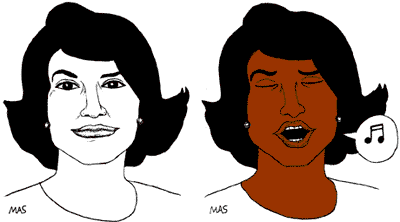
Jackie O (Houston Opera Studio). Mixed reviews for a campy rock-opera about Jackie Onassis' ascent to iconhood. The Washington Post's Carl Cunningham says it's a "mindless 100-minute cult fantasy"--a third of the opera is set at a 1968 New York loft party where the first lady schmoozes with Maria Callas, Grace Kelly, and Andy Warhol. Newsweek extols the "poetic" libretto by Wayne Koestenbaum, author of Jackie Under My Skin: Interpreting An Icon, as well as its "brilliantly eclectic score" and its general irreverence (Jackie is played by Nicole Heaston, who is short, stout, and African-American).
Theater
Antony and Cleopatra (Joseph Papp Public Theater, New York). The New York Times' Ben Brantley calls this production of the Shakespeare play, directed by Vanessa Redgrave, "jaw-droppingly bizarre." Redgrave's portrayal of the queen of the Nile as an aging, cigarillo-smoking ditz, obsequious to Antony, is judged daffy but charming, except by NewYork's John Simon, who wishes Redgrave would be "seductively womanly." Critics are skeptical of anachronistic touches in the production, including loud sirens, camcorders, and video projections of political speeches. Newsday's Linda Winer calls Redgrave's decision to play Antony's suicide scene as a joke "unforgivable." (The Public Theater site plugs the play.)
Books
Arkansas: Three Novellas, by David Leavitt (Houghton Mifflin Co.). Reviews of Leavitt's collection of novellas focus on the first, The Term Paper Artist, which caused a scandal when Esquire pulled it at the last minute. The fiction editor quit, claiming the editor in chief had been afraid that Leavitt's explicit gay sex scenes would alienate advertisers. The New York Times' Michiko Kakutani says that Leavitt's take on sex is "adolescent" and "does nothing to illuminate its heroes' lives." Others find the collection uneven. The Term PaperArtist does earn some praise, though, for its playful reference to another crisis in Leavitt's life: the British poet Stephen Spender's allegation that Leavitt plagiarized Spender's memoirs in an earlier novel.
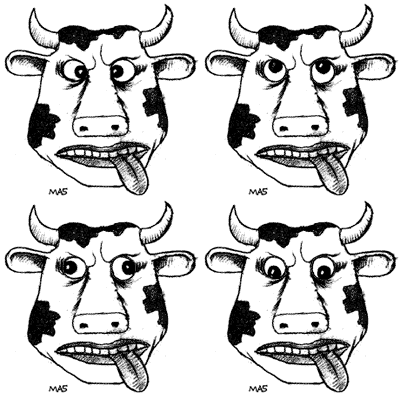
Deadly Feasts: Tracking the Secrets of a Terrifying New Plague, by Richard Rhodes (Simon & Schuster). A history of mad-cow disease by veteran science writer Richard Rhodes (The Making of the Atomic Bomb). Critics praise Rhodes' lucid explication of complex virology as well as his range--the book includes digressions on political and literary themes and a section on the scandal surrounding a Nobel Prize-winning expert on the disease who recently pleaded guilty to molesting a little boy. The book is said to degenerate into a jeremiad when Rhodes anoints mad-cow disease "the new Black Death."
Resurrection: The Struggle for a New Russia, by David Remnick (Random House). New Yorker writer Remnick's sequel to his Pulitzer Prize-winning Lenin's Tomb is a "compelling postscript" (Walter Laqueur, Los Angeles Times). Reviewers focus on Remnick's access to political insiders, especially his extended interviews with Mikhail Gorbachev, Vladimir Zhirinovsky, and Gennady Zyuganov. Critics also welcome his ambivalence on Russia's future: Unlike most Russia watchers, "Mr. Remnick does not manage his material so as to prove that Russia is bound to succeed, or doomed to fail" (the Economist).
The Three-Arched Bridge, by Ismail Kadare, translated by John Hodgson (Arcade). High praise for a newly translated 1981 novel by Albanian author Kadare, about a medieval village at the dawn of capitalism. "Translated ... into prose of crystalline clarity and grace, it is ... a slim, dark tale that bears some kinship to J.M. Coetzee's Waiting for the Barbarians" (Patrick McGrath, New York Times Book Review). High praise also for Kadare, a perennial nominee for the Nobel Prize. The New York Times says his defection to the West in 1990 helped topple Albania's Communist regime. However, the Weekly Standard attacks the author, calling him an apologist for dictator Enver Hoxha. (Albania.com provides a biography of Kadare and a list of his published works.)
Updates:
More attacks on Kathryn Harrison and her adult-incest memoir, The Kiss. In the Weekly Standard, Mary Eberstadt implies Harrison is making it all up. "Mrs. Harrison has written a failed--that is to say, an unconvincing--memoir. ... For all we know, she did all these things and more. Any speculations to the contrary would be indecent." In the New Republic, James Wolcott speculates that Harrison wrote The Kiss to invite "humiliation upon her [own] children ... as misery was invited on her." ...New York's David Denby refuses to board the Howard Stern train, condemning the shock jock for his megalomania, his "fifties idea of sexual humor," and his crimes against "dignity" and "high-mindedness." ... The backlash against the backlash against David Helfgott has begun. An editorial in the Wall Street Journal argues, "Mr. Helfgott babbles and probably makes more mistakes per evening than the famously unentertaining Alfred Brendel has made in a lifetime. So what. Here's someone whose fierce love of music is making thousands of others listen to classical music."
Recent "Summary Judgment" columns:
Movie--Private Parts;
Movie--Jungle 2 Jungle;
Theater--A Funny Thing Happened on the Way to the Forum;
Book--The Kiss: A Memoir, by Kathryn Harrison;
Book--Giovanni's Gift, by Bradford Morrow;
Art--"Exiles and Émigrés: The Flight of European Artists from Hitler";
Television--The Practice.
Movie--Donnie Brasco;
Movie--Smilla's Sense of Snow;
Music--David Helfgott World Tour;
Television--Crisis Center;
Television--Feds;
Television--Arsenio;
Television--Just Shoot Me;
Book--Crazy Rhythms: Richard Nixon and All That Jazz, by Leonard Garment;
Books--First Novel Roundup;
Theater--The Last Night of Ballyhoo.
Movie--The Empire Strikes Back: Special Edition;
Movie--Lost Highway;
Movie--Rosewood;
Television--Schindler's List;
Television--Miss Evers' Boys;
Book--Monster: Living Off the Big Screen, by John Gregory Dunne;
Book--American Sphinx: The Character of Thomas Jefferson, by Joseph J. Ellis;
Book--Whittaker Chambers: A Biography, by Sam Tanenhaus;
Theater--Stanley.
Television--Thomas Jefferson;
Television--Emma;
Movie--Absolute Power;
Movie--Blood and Wine;
Book--Gladstone: A Biography, by Roy Jenkins;
Book--Asylum, by Patrick McGrath;
Book--Hungry Ghosts: Mao's Secret Famine, by Jasper Becker;
Art--"Henry Darger: The Unreality of Being."
--Compiled by Franklin Foer and the editors of Slate.