Television

Thomas Jefferson (PBS, Feb. 18 and 19, 9 p.m. EST). Unlike Ken Burns' other epic documentaries (Civil War was nine hours long and Baseball, 18), his biography of the third president is a brief three hours. In every other respect, however, critics find it numbingly familiar. "The usual skillful Burns package of period music ... lush photography ... almost prurient avidity for the grainy feel of sacred relics ... and delighted-to-be-here voice-overs" (John Leonard, New York). "At times you may feel you've tuned into a commercial for Colonial interiors or an online flower show" (Walter Goodman, the New York Times). Burns earns muted praise for his evenhanded if inconclusive portrait of Jefferson, particularly for his treatment of the Sally Hemings question and Jefferson's contradiction-riddled approach toward slavery. (For more on the scholarly debate surrounding the current Jefferson craze, see David Greenberg's "High Concept." Also see the PBS page touting Thomas Jefferson.)
Emma (A&E, Feb. 21, 9 p.m. EST). Critics exempt the latest Jane Austen adaptation from the general backlash against Jane Austen adaptations. Kate Beckinsale's Emma is judged superior to Gwyneth Paltrow's in the movie released last year. "The Beckinsale version is darker and less accessible," says the New York Times' Sarah Lyall.
Movies
Absolute Power (Castle Rock Entertainment). Despite a screenplay by William Goldman and performances from acting heavyweights Gene Hackman and Judy Davis, reviews of Clint Eastwood's latest directorial effort are mixed, at best. A plot in which Eastwood, as a cat burglar, spies Hackman, as the U.S. president, murdering his mistress is deemed cartoonish and incredible. "Frankly, Mars Attacks! had a better handle on the White House," says the Washington Post's Rita Kempley. Eastwood's character "would have to be telepathic to keep popping up, as he does, whenever the plot needs him," says the Wall Street Journal's Joe Morgenstern. On the other hand, Eastwood's performance is said to have saved the movie from itself. Eastwood makes "the most of his vibrant geezerhood," says Morgenstern. "This time he even pokes fun at it." (Castle Rock has stills and clips.)
Blood and Wine (20th Century Fox Films). Director Bob Rafelson's follow-up to his 1970 classic, Five Easy Pieces, bombs. "Doggedly sincere," says New York's David Denby. Bad-tempered and "bad for you," says The NewYorker's Anthony Lane. Rafelson's take on a Miami family's lust, rage, and greed--"the usual trio of forties-noir emotions"--is "too straight, almost TV movieish" (Denby). "The characters keep laying into each other, as if to slam home the message--for what it's worth--that everybody hurts sometime" (Lane).
Books
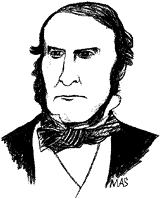
Gladstone: A Biography, by Roy Jenkins (Random House). Across the Atlantic, Lord Roy Jenkins' biography of the Victorian prime minister was universally applauded. The Economist called it "quite simply, a masterpiece of the biographer's art." American critics have been less fulsome. "A very decent try at an immensely difficult subject," writes Norman Stone in the New York Times Book Review. Common complaints: Jenkins, a retired British politician, projects onto Gladstone such pet concerns as European unity. He also writes confusing prose. "It is something of a lazy book. (As in 'if I had more time, I would write a shorter letter')," says the Los Angeles Times' Richard Eder. The New Yorker's Adam Gopnik is the lone American enthusiast: "Part of the fun, of course, lies in the hair-raising displays of Victorian energy. Gladstone, in the midst of his political career, produced a three-volume study of Homer, two long books on Church and State, and a new translation of Horace's Odes."
Asylum, by Patrick McGrath (Random House). "We don't usually associate Gothic novels with elegance and discretion, but these are the defining features of Patrick McGrath's work," writes Michael Wood in the New York Times Book Review. Asylum is credited with achieving new levels of restraint. The story of a psychiatrist's wife who falls in love with a murderous patient, it culminates in "a departure into madness that is perfectly pictured but beyond analysis," says Wood. McGrath earns extra plaudits for suppressing his usual fondness for the fantastic: Asylum "is closer to Hardy than Poe," says Phil Baker in the London Times. (See the Random House site for excerpts from Asylum.)
Hungry Ghosts: Mao's Secret Famine, by Jasper Becker (Free Press). Becker, Beijing bureau chief for the South China Morning Post, describes in gory detail how Mao Tse-tung's industrialization program, the Great Leap Forward of 1958, created a devastating famine--30 million dead, more than the combined tolls of Hitler and Stalin. Becker succeeds in establishing the famine "as one of the worst atrocities of all time" (Richard Bernstein, the New York Times). He does this despite the Chinese government's continued effort to cover up the incident, and by way of "interviews with survivors [that] provide us with a chilling view of the famine as it was experienced by ordinary villagers" (Paul Pickowicz, the Wall Street Journal).
Art
"Henry Darger: The Unreality of Being" (The Museum of American Folk Art). These bizarre (some say grotesque) watercolors by the reclusive (some say mad) Chicago janitor Henry Darger (1892-1973) receive unanimous acclaim. The appeal lies partly in the weirdness of his obsessions (scantily clad little girls with penises), "so pungently suggestive of an imagined world," says New York's Mark Stevens. There is also "his power of formal arrangement and his sense of color" (Robert Hughes, Time). Critics disagree, however, on Darger himself--was he a psychopath or an undiscovered genius? "He is not better than a trained or 'insider' artist," writes Stevens, "but he taps sources of power now lost to sophisticated art." (See Slate's review by Larissa MacFarquhar.)
Updates
In the New York Times Book Review, Kathryn Harrison, the author of a forthcoming memoir about incest with her father, accuses Mia Farrow of cashing in with a memoir "that will satisfy a Peeping Fan readership."... Reviewing When We Were Kings, New York's Denby says, "For younger viewers, there will be two revelations--not only the mercurial Ali but Norman Mailer at his most sympathetic and brilliant."
Recent "Summary Judgment" columns:
CD--Pat Boone in a Metal Mood: No More Mr. Nice Guy, by Pat Boone;
Movie--Dante's Peak;
Movie--When We Were Kings;
Movie--Prisoner of the Mountains;
Book--What Falls Away: A Memoir, by Mia Farrow;
Book--Before the Dawn: An Autobiography, by Gerry Adams;
Book--A Supposedly Fun Thing I'll Never Do Again: Essays and Arguments, by David Foster Wallace;
Television--The Chris Rock Show.
Book--Personal History, by Katharine Graham;
Book--What It Means to Be a Libertarian: A Personal Interpretation, by Charles Murray;
Book--Do the Windows Open?, by Julie Hecht;
Movie--Gridlock'd;
Movie--Waiting for Guffman;
Art--"Willem de Kooning: The Late Paintings, the 1980s";
Theater--Men Are From Mars, Women Are From Venus;
Event--"On Cultural Power: The Wilson-Brustein Discussion."
Art--"Giambattista Tiepolo, 1696-1770";
Event--Halftime at Super Bowl XXXI;
Movie--Kolya;
Book--Island of the Colorblind, by Oliver Sacks;
Theater--The Steward of Christendom;
Movie--Fierce Creatures;
Book--Le Divorce, by Diane Johnson.
Book--Behind the Oval Office: Winning the Presidency in the Nineties, by Dick Morris;
Movie--The Whole Wide World;
Event--The Inauguration of William Jefferson Clinton;
Book--One World, Ready or Not: The Manic Logic of Global Capitalism, by William B. Greider;
CD--Idomeneo, by Wolfgang Amadeus Mozart, performed by Placido Domingo and the Metropolitan Opera Orchestra and Chorus, conducted by James Levine;
Movie--Albino Alligator;
Television--The Naked Truth.
--Compiled by Franklin Foer and the editors of Slate.