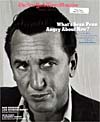
New York Times Magazine, Dec. 27

(posted Thursday, Dec. 24, 1998)
Two articles and a photo essay chronicle Russia's bleakness. The grimmest piece describes how Russians in a small city survive without money: They skip rent payments, grow food in garden plots, and go without butter and meat. (The local shoe factory employs 800 people and makes only 3,000 pairs a year.) Underlying theme: Moscow is a Potemkin village of prosperity, and the rest of Russia is dying. ... The magazine publishes a sublime guide to America's doomsday prophets and other assorted millennialists. Among the many highlights: Morningland, whose high priestess preaches that Christ will land a UFO "the size of Texas" in Long Beach, Calif.; Richard W. Noone, who says the Earth's crust will shift on May 5, 2000, turning oceans into "maelstroms of death"; and Meade Ministries, which believes the "world will soon be engulfed in a sticky white substance." ... The cover profile of Sean Penn gushes over his cowboy independence, his gruffness, and his refusal to compromise his artistic principles for high-paying roles.
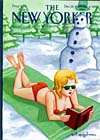
The New Yorker, Dec. 28 and Jan. 4
(posted Thursday, Dec. 24, 1998)
The winter fiction issue includes short stories by Richard Ford, Ken Kesey, and Annie Proulx. ... Vladimir Nabokov reviews his own autobiography. (He wrote the review of his book in 1950 but never published it.) It is a superb review, though he's a bit too fulsome in his praise for himself: "Mr. Nabokov is to be congratulated for having performed a very capable and very necessary job," writes Mr. Nabokov. ... A fascinating article tells the real story of Billy the Kid. He was not "William Bonney" and was not a killer of Indians and Mexicans. Instead he was "Henry McCarthy," and he was a soldier in a vicious war between Irish and English ranchers in New Mexico. A convert from Catholicism to Presbyterianism, Billy took the English side and murdered fellow Irishmen. ... The annual Christmas poem closes with the wish "may our inmost selves aspire/ to higher things, like Mark McGwire!"
Harper's, January 1999
(posted Thursday, Dec. 24, 1998)
A prosperous writer spends a month in the low-wage work force, waitressing at a cheap hotel's bleak restaurant. She describes how difficult it is to survive on $7 an hour and how nasty working conditions for low-wage service employees are and explains why it costs more to be poor than to be rich (e.g., her co-workers can't save enough for a security deposit on a monthly apartment, so they must rent week-to-week at exorbitant rates).
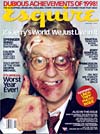
Esquire, January 1999
(posted Thursday, Dec. 24, 1998)
The much-previewed profile of Michael Huffington reveals that he is--surprise, surprise--gay. The former congressman and ex-husband of conservative glamour-puss Arianna Huffington says he never liked politics and is glad he lost his Senate race (on which he dropped $30 million). The article leaves the impression that Huffington is quite confused and a bit dull. ... The annual Dubious Achievement Awards celebrate 1998 as "the worst year ever": Linda Tripp wins the "Man of the Year" title over Leonardo DiCaprio, Osama Bin Laden, Lucianne Goldberg, Ken Starr, and others.
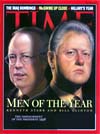
Time, Dec. 28 and Jan. 4
(posted Tuesday, Dec. 22, 1998, 1998)
Bill Clinton and Ken Starr are Time's "Men of the Year" for their "shared obstinacy." Time's view of both is dim: "One man's loss of control inspired the other's, and we are no better for anything either of them did." In a long accompanying profile, Starr says he is the "tortoise" to Clinton's "hare." In Starr's defense, Time notes that he told Clinton the results of the dress DNA tests in advance. On the other hand, Starr let his aggressive deputies hijack his investigation. Oddly, there is no profile of Clinton himself, but there is a long piece about Hillary Clinton. (She was bumped as "Woman of the Year" by the successful impeachment.) "The Better Half" says that the Clinton marriage is rocky but that Hillary believes Clinton's infidelities mean only that he is weak, not that he doesn't love her. ... Slugger Mark McGwire is dubbed "Hero of the Year" for his modesty and generosity. ... An impeachment ticktock recounts the crazy events of the week in Washington.
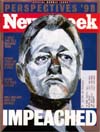
Newsweek, Dec. 28 and Jan. 4
(posted Tuesday, Dec. 22, 1998)
Newsweek's impeachment cover chronicles the terrible week. Curious scoop: Despite claims that they were voting only on evidence in the Judiciary Committee report, at least 40 House Republicans examined documents containing "old, unsubstantiated allegations unearthed by Kenneth Starr about Clinton's relations with women besides Lewinsky." ... A piece says that impeachment won't hurt your stock portfolio: Wall Street has already taken into account the political disruption. ... An essay contends that the Iraq attack made no sense strategically, and it won't aid our efforts to stop Saddam Hussein's weapons development. ... Baseball's 1998 comeback was a mere respite from its overall decline, argues the magazine. Salaries are too high, attendance is spotty, and the chasm between rich and poor teams is widening. ... The annual "Perspectives" roundup recalls the year's best cartoons and quotes: "If I ever want to have an affair with a married man again, especially if he's president, please shoot me," says Monica to Linda.
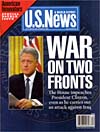
U.S. News & World Report, Dec. 28 and Jan. 4
(posted Tuesday, Dec. 22, 1998)
The highlights of the impeachment cover package: A piece predicts the august, rule-abiding Senate will hold a trial, and a column argues that "We're all Hillary now." Americans, like the first lady, support the president because they have no choice, and the alternative is too awful to contemplate. ... The year-end package celebrates "American innovators," arguing that the United States produces the best new ideas because it charges little for patents, doesn't punish business failure, and superbly transfers technology from the public sector to the private. The innovators saluted include: the creator of "talking books" for the blind, an architect who designs friendly houses, a biochemist pushing for-profit science, and incoming Minnesota Gov. Jesse "The Body" Ventura. (Which of these is not like the others?)
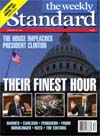
Weekly Standard, Dec. 28
(posted Tuesday, Dec. 22, 1998)
The magazine, which has been pushing impeachment for months, celebrates the House's "Finest Hour." The editorial declares that "History will smile on these Republicans; they may never live a nobler moment." ... A piece nominates House Judiciary Committee Chairman Rep. Henry Hyde, R-Ill., as "Man of the Year" for refusing to cave to poll pressure. ... A short profile of probable House Speaker Dennis Hastert, R-Ill., says little about Hastert except that he's a quiet conservative. Mostly it disses Rep. Chris Cox--who also considered bidding for speaker--as "arrogant and cold."
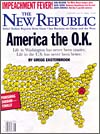
New Republic, Jan. 4 and 11
(posted Friday, Dec. 18, 1998)
The triumphal cover story marshals an army of statistics to prove that "life in the U.S. has never been better." Crime, accidents, fires, drinking, smoking, drugging, air pollution, water pollution, racism, and divorce are declining. We live longer, happier, wealthier lives than ever before. Credit American pragmatism: We really can fix our problems if we try. ... An article says impeachment-crazed Rep. Bob Barr, R-Ga., lied about his association with the racist Council of Concerned Citizens. Barr, despite his claims to the contrary, spent a long time at the group's conference, never denounced its views, and knew about its loathsome ideology when he spoke to it. ... The editorial says the Iraq bombing proves America's strength, not its weakness: "In the middle of the greatest political excruciation in its modern history, the United States is doing the noble and necessary thing."