I Ate Every Variety of Pepperidge Farm Cookie
What I learned about baked goods—and the human condition—from the Milano, the Verona, the Geneva …
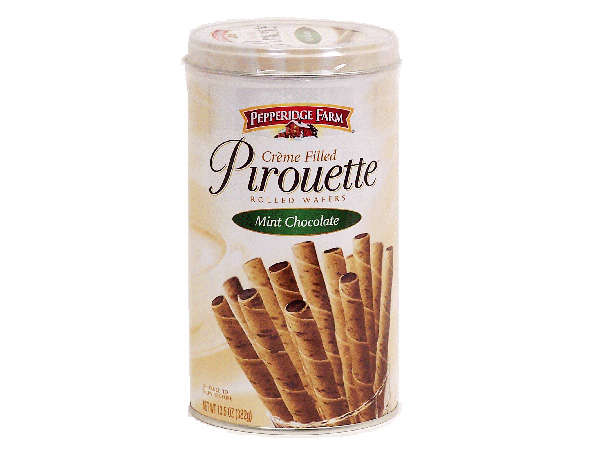
People think I’m weird because I like Chessmen. But they’re my favorite cookies, and I defend them with vigor whenever I encounter a Milano-lover who wants to fight me about it.
 Leon Neyfakh
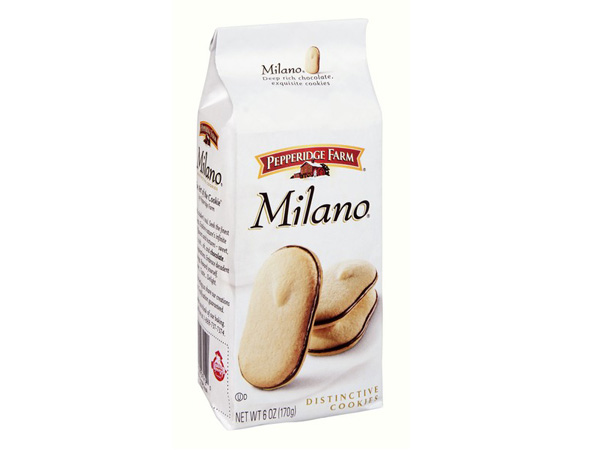
Invariably, the complaint about Chessmen is that they’re “boring.” But frankly, if you’re bored by these handsome, buttery things, it says more about you than it does about the cookie. And if it’s Milanos you prefer, consider that Milanos are basically everyone’s favorite Pepperidge Farm cookie. It’s like saying your favorite band is The Beatles.
A few months ago, a friend said to me, with disconcerting severity, “There’s something perverse about enjoying such a boring cookie.” I was moved to wonder: Is there something perverse about me? What kind of person am I, and how am I different from people who prefer, say, Veronas or Genevas?
It was then that I decided to sample every cookie in the Pepperidge Farm family and figure out what was what. I would try to understand what made each cookie special and seductive—and what it might mean to be drawn to one of them more than another.
My timing turned out to be perfect. Seventy-five years after a New England mother by the name of Margaret Rudkin started the company with a loaf of special bread baked for her allergic young son, Pepperidge Farm was getting ready to celebrate its Diamond White anniversary. It was also undergoing a transition that would see its longtime president, who has been with the company for more than 30 years, succeeded by a young new leader. And most thrilling of all, I learned that this month, Pepperidge Farm will be opening a $30 million Innovation Center at its headquarters in Norwalk, Conn., which will allow its team of cookie specialists to invent more new cookies each year than ever in its history.
Courtesy of Pepperidge Farm, Inc.
By the time I found myself standing in a room full of metal machinery, surrounded by bakers in white aprons and staring at a tray of freshly baked cookie prototypes that I was not even allowed to photograph, it was clear that my task was no longer just a glorified taste test. What had begun as a narrow inquiry into my own peculiar inclinations had turned into an occasion to reflect on a company that is a pillar of the American pleasure industry—and to consider how we, as cookie-eaters and human beings, ought to feel about it as it marches into the superabundant future.
* * *
One day this summer, I received a package from Pepperidge Farm the size of a laundry basket. I opened it immediately. Inside I found more than 30 varieties of cookies, including all the classics, as well as a bounty of Milano spin-offs—toffee and almond Milano Slices? Dark classic crème Milano Melts?—I’d never even seen before.
I was dying to dig in but forced myself not to indulge my gluttony. I’d need a notebook and a real chunk of time to do this right. I did, however, examine my haul—turning the bags over in my hands and reading the lyrical descriptions printed on each. I learned that Gingermen are an occasion to “take pleasure in the simplicity of a cookie well baked,” while the Raspberry Milanos channel the “baker’s soul” and implore the consumer to “embrace decadent cravings.” Several of the bags promised “velvety soft hearts.” The Shortbread boasted of its “dreamy, biscuit like-crisp.”
Setting the cookies aside for the time being, I placed a call to outgoing Pepperidge Farm president Pat Callaghan, who was preparing to retire just a few weeks later, after more than three decades in the post. Cookies have been part of the Pepperidge Farm arsenal since 1951, Callaghan told me, when founder Rudkin decided to expand her business beyond bread and try her hand at sweets. The initial results were not impressive—“pedestrian,” to use Callaghan’s word. Facing her failure, Rudkin decided she needed to look beyond her kitchen for inspiration.
That, according to the Pepperidge Farm origin myth, was when Rudkin boarded the Queen Mary and set off on a “tasting trip” of Europe. As part of her tour, she visited Delacre, a cookie plant in Brussels, where she found exactly what she was looking for. “She said she wanted ‘cookies that would be delicate in flavor and texture’ that the discriminating hostess could serve with tea, ice cream, or fruit compote on her best china,” according to the historical materials provided to me by PF’s publicity team. After taking a tour of Delacre, Rudkin negotiated a licensing agreement that would allow Pepperidge Farm to make and sell the bakery’s fancy European cookies in America. “She was a very persuasive woman of Irish descent,” said Callaghan. “She convinced them to give her the [recipes], and she convinced them to let her bring over some of their master bakers to the United States.”
Courtesy of Pepperidge Farm, Inc.
At the time, Delacre did not have any distribution in the United States. The company has since brought its “exquisite European biscuits” to the American market, and according to Mieke Vansevenant, Delacre’s marketing manager, the Belgian company now considers Pepperidge Farm a competitor. (“We ... know that many of the Pepperidge Farm biscuits that are now on the market have indeed been invented and created by Delacre,” Vansevenant wrote in an email, adding, “There are a lot of comparable elements between our brands and products. ... I am not convinced that, if the Delacre bakers would have known this 50 years ago, that they would still communicate their recipes so openly.”)
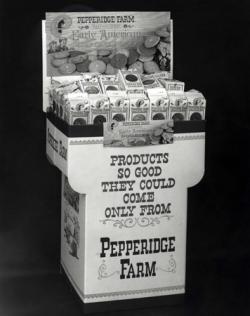
The first line of “distinctive” Pepperidge Farm cookies hit stores in 1955. They came in six varieties—Biarritz, Bordeaux, Brussels, Venice, Dresden, and a brownie crème sandwich cookie called the Capri—and they resembled with deliberate precision the Delacres that inspired them. At first, Rudkin sent the cookies out to grocery stores on the same trucks that delivered her bread, and according to Callaghan, they were stocked in the bakery aisle rather than with the other cookies. Then, in early 1956, Rudkin showed off her new wares at a New York food convention, and before long, customers throughout the Northeast were seeking out PF’s now-iconic white bags. Compared with Nabisco and Keebler, both of which had been around for decades by the time Pepperidge Farm’s new line debuted, Rudkin’s cookies exuded an air of European sophistication and delicateness. “It was different than all the cookies in boxes and cellophane, to put them in those bags,” said Callaghan. “It felt like a special cookie, or a special gift.”
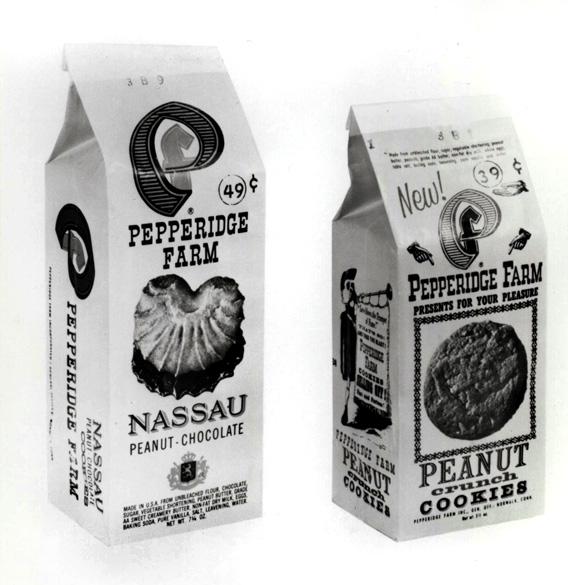
An important moment came in 1957, when an accident resulting from Pepperidge Farm’s speedy growth led to the invention of Milanos. At that point, PF was doing brisk business with an open-faced chocolate cookie called the Naples. But when the company’s operation expanded into the South, it quickly discovered that the Naples wasn’t built to withstand heat. “The chocolate started to melt,” Callaghan said. “So instead of having an open faced cookie, we put a top on it, if you would. And so was born Milano.”
By 1960, the cookies were being sold nationwide, and in 1961, Margaret Rudkin sold her company to the Campbell Soup Company. She stayed on as president for five more years, presiding over the brand during the pivotal introduction of the Goldfish cracker line, before retiring in 1966.
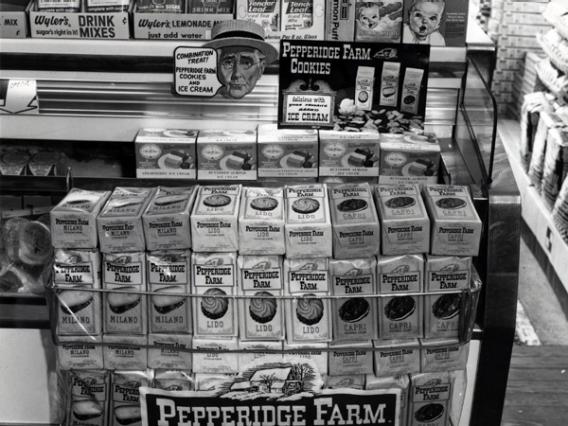
Courtesy of Pepperidge Farm, Inc.
Callaghan himself made way for his successor this past summer, but not before making the decision to build a massive new testing facility at PF headquarters that is expected to define his legacy for years to come. Roughly two years and $30 million later, the gleaming, glass annex known as the Innovation Center is less than a month from being operational.
* * *
When I arrived in Norwalk in my rented gray Hyundai, the first thing I saw was a poster for a high school production of Willy Wonka, which made me wonder how heavily Pepperidge Farm figures into the local imagination. Driving alongside a nondescript shopping complex, I realized I didn’t know what I was looking for. Then I saw it: a huge sign, which I recognized instantly from the Pepperidge Farm bag, with that snowy, idyllic drawing of the old red mill in Sudbury, Mass., where Rudkin used to buy flour for her loaves. I turned into the driveway and parked.
As I made my way through the building on a guided tour led by Geri Allen, the company’s head of publicity, and Kirk Ringkamp, the engineer who oversaw the construction of the new wing, I saw cubicles piled high with cookie bags, signs identifying locations like the “Loaves Conference Room” and the “Layer Cake Area,” a bookshelf containing binders full of archival photos of the bakery’s early employees and advertising tear-sheets, even an old mixing bowl from Margaret Rudkin’s day. But as large as the past loomed as we walked the corridors, it was the future that demanded my attention as I made my way down from the corporate offices to the grand, sunny warehouse space in which a team of engineers in hard hats was putting the finishing touches on the Innovation Center.
An engineer named Jack Weinstein explained that what I was looking at was a miniature Pepperidge Farm plant: A more or less exact replica of the eight plants the company runs around the country, but scaled down to about a tenth the size. Weinstein pointed out the 200-pound mixer into which a team of five R&D people in the company’s cookie division will pour their ingredients; the “forming” apparatus that will be used to give the cookies their shape; and the make-up area where they will be adorned with nuts, chocolate chips, and powdered sugar. He showed me a set of metal rolling pins that are used to engrave Chessmen. I took a picture.
Jared Konstanty, senior vice president and general manager of PF’s snacks division, had explained to me earlier that once the Innovation Center is up and running, PF’s inventors and engineers—who currently work out of a rather cramped, windowless space—will be able to produce new ideas at a more rapid clip than ever before. “Our plants are quite pressed for capacity, so every time we dream up a new sweet snack ... we have to stop the production line in one of our plants,” he said. “The supply chain team does not love when we do that.” Starting in September, “instead of having to schedule something in a plant three weeks away, [the R&D team] will be able to walk down the hall.”
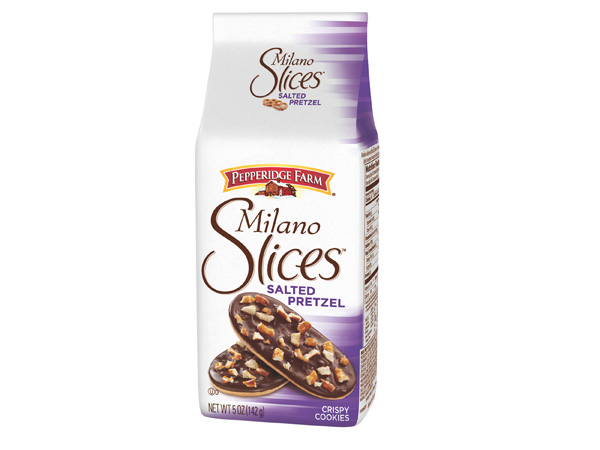
In the next six months, PF is planning to issue a new line of dessert-inspired soft cookies, including a pumpkin cheesecake variety and a caramel apple pie one. The Milano Slices line, an open-faced number dressed with crunchy toppings, is also going to debut new models: Any day now you should see Salted Pretzels ones on shelves, and around Christmastime expect the arrival of crushed peppermint.
With all these new products in mind, I asked Konstanty—who spent his high school summers baking for Pepperidge Farm—if he thought the role that cookies play in people’s lives is changing. “Consumers are always looking for new ways to satisfy similar needs,” he said. “Generally most people between lunchtime and dinnertime start to look around for a little something to snack on, and generally in the afternoon that need is satisfied with a sweet treat. It also comes back after dinner, several hours after eating. Generally the sweet snack world exists in those two places. The human condition is not a new one, right?”
* * *
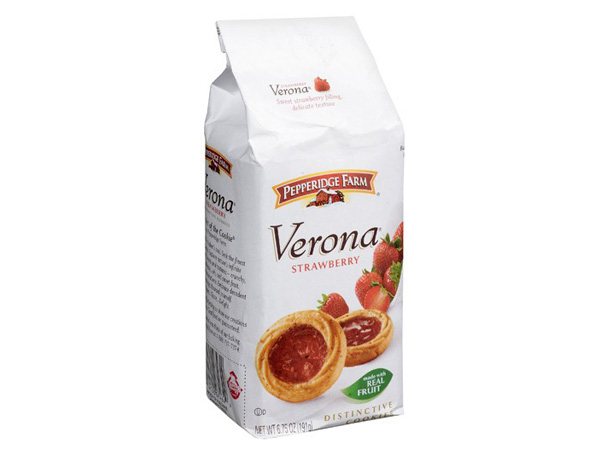
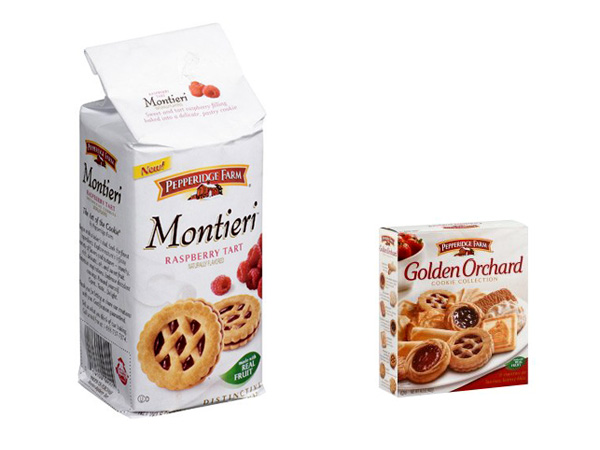
On a recent Saturday afternoon, after fasting all morning, I spread out the contents of the cardboard box Pepperidge Farm had sent me on the floor, arranging the bags Periodic Table-style, in hopes of being somewhat systematic about my consumption. My first move was to separate the new from the old, which required opening my sampler packs, where some vintage cookies (the Lido, the Orleans) that have apparently stopped pulling their weight as stand-alone items are now huddling together for survival. I found it was surprisingly easy to divide the Pepperidge Farm family into branches based on their basic elements. Some are driven by their use of chocolate (Lisbon, Brussels), while others are built around creative fruitiness (Verona, Montieri). Some foreground texture or shape over flavor (Melbourne), while others are all about the subtlety of the aftertaste (Bordeaux). Some are spartanly stripped down, and demand to be appreciated for their improbable potency (Lemon), while others are baroque and busy with nuts (Geneva). And though there is definitely a lot of overlap between varieties, there are nevertheless meaningful distinctions to be made, and I suspect all of us have some taxonomy in mind, however subconsciously, when we’re standing in the cookie aisle and deciding which bag to bring home.
The Pepperidge Farm people have some sense of the dilemmas their products present. In the 1980s, they aired a TV commercial in which a charming old spokesman, played for decades by the late radio actor Parker Fennelly, is preparing a tray of cookies for a small party. He goes through his guest list: Charlie likes Milanos, Terrence likes Bordeaux, and Gladys likes Genevas. “Pepperidge Farm Distinctive Cookies inspire fierce loyalty,” he says. “Everybody thinks their favorite is the best. They’re right.”
In my experience, people tend to have the strongest, most personal feelings about what we might call Pepperidge Farm’s classics: the dainty, proudly idiosyncratic ones that are packaged in slender bags and named for European locales. By contrast, the bigger, more generic varieties—the round and chunky cookies that come in the squat bags and are named after American vacation spots, like Nantucket and Maui—are more straightforward in terms of their appeal: A cookie-lover who’s into oatmeal raisin is definitely going to like Santa Cruz, and that’s pretty much all there is to say about that. On the other hand, a person who loves Montieris—the mellow, dense fruit tarts dusted with powdered sugar and built like tiny little pies—is going to have to dig a bit deeper in order to explain his preference.
When I began my investigation, I was hoping to learn that Pepperidge Farm targets particular demographics with each cookie—that there are Verona people, Geneva people, and so on. But though there is a five-question, multiple-choice quiz on the official PF website that helps customers decide which cookie they’re in the mood to eat (when I described myself as being into skydiving, alternative rock, Italian leather boots, and traditional Ethiopian cuisine, I was informed I should try a Sausalito) it would seem that PF does not actually possess such granular data on the people who love their cookies. At least none they were willing to share: When I asked Konstanty to describe the different taste profiles of his customers, he answered in disappointingly broad strokes.
“People either love chocolate or they love non-chocolate,” he said. “Generally we find that slightly older consumers tend to prefer the non-chocolate options.”
But Konstanty did deliver one surprise: It turns out that most of Pepperidge Farm’s customers are women, and more specifically, moms.
“All of the cookies within our distinctive cookie range—Geneva, Milano, Chessmen, everything in a small white bag—are about ‘mom’s moment,’ ” he said. “The distinctive range is all about that delicate, special moment of reward and a little bit of escape—just a wonderful experience at the end of the day.”
More than two-thirds of the “distinctive” cookies are purchased by women, according to Konstanty. With Sausalitos, Nantuckets, and the rest of the chocolate chunk line—“a different kind of experience from an eating perspective”—it’s more like half.
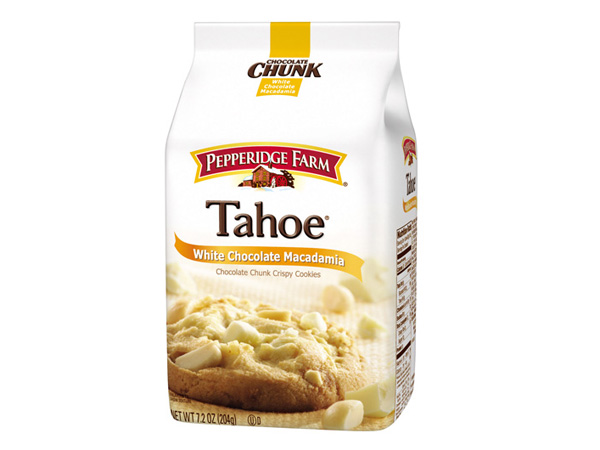
I kept all of this in mind as I sat on my floor and ate my cookies. The idea that I was behaving in a womanly manner in cherishing the taut jelly center of the Verona, or that I was being somehow mom-like in feeling delighted by the tawny, tempura-like surface of the Brussels, made me self-conscious at first. To compensate, I tried the Tahoe, a crispy, tough number with white chocolate and macadamia nuts, and the Chesapeake, which is shot through with dark chocolate and pecans. Maybe there really was something a little more masculine about them, I thought, before reaching defiantly for a Pirouette and breathing through it like a straw, as one does.
All told, it took me about six hours to get through everything I’d been sent. By the time I was done, I had tried one of the forthcoming “soft dessert cookies,” three fruit cookies, all four entrants in the down-to-basics “simply scrumptious” line, five butter cookies, six chocolate-based “distinctive” cookies, eight types of nonstandard Milanos, and 10 varieties of chocolate chunk. Having done so, I felt an arguably unearned sense of accomplishment—as though I’d educated myself somehow and now knew more of the world than I used to.
In truth, all I’d done is confirm a few long-standing intuitions about the Pepperidge Farm brand. The first of these is that PF cookies are great because they manage to be refined without coming off as pretentious. This is not a trivial accomplishment. It’s hard to imagine a better example of middlebrow philistinism than an elaborately crafted cookie that’s been randomly named after a fancy European city—the kind of cookie that Nabokov’s Charlotte Haze would keep in her cupboard and nibble while listening to the vulgar ringing of her wind chimes. But something rescues Pepperidge Farm cookies from evoking such lowly associations. And having eaten them all, I think that thing is that … they’re cookies. By their very nature, they are guileless and eager to please, and insofar as they play at sophistication, they do so with jauntiness, and without desperation. The Montieri, for instance, is not trying to fool anyone with its fancy lattice patterning—it just wants you to think it’s pretty.
I am not saying Pepperidge Farm cookies do not take themselves seriously. On the contrary—and this is the other intuition I ratified in the process of my research—I believe that the very best Pepperidge Farm cookies, above all my beloved Chessmen, require focus, patience, and maturity on the part of the person eating them in order to truly fulfill their potential. Unlike most other cookies—I’m thinking of Oreos and Chips Ahoy, but even Lu’s supposedly upmarket Petite Ecolier—they shine brighter under scrutiny. Just go ahead and put a Chessman, a Bordeaux, or a Gingerman in your mouth and start chewing. It might strike you as unremarkable at first. But soon the hard, crunchy cookie will turn into a pleasing goop that resembles melted ice cream or sweetened condensed milk. The flavor will make itself known gradually, growing more intense with time. The goop will get dense but you will be able to swish it around freely—an extraordinary feeling. In the end, it will feel like you are saying goodbye to something you’ve fought for. You will hesitate to swallow until you remember there are more in the bag—a fact that is easy enough to forget thanks to PF’s unique approach to packaging, with the cookies neatly divided into three vertically stacked paper cups.
Unfortunately, I cannot sincerely rhapsodize in this manner about any of the next generation cookies Pepperidge Farm sent to me. Putting aside the fact that I don’t quite understand how a Milano Slice is really a Milano—it would seem an open-faced Milano would be a contradiction in terms, seeing as the sandwich structure of the original is its defining feature—I’m afraid the new class, though bold and good and occasionally even thrilling, just didn’t pull me in like my old favorites do. I say this with some reluctance, well aware of the possibility that I’m just being a cranky “kids these days” reactionary—that I’m reacting to these new cookies the way my dad reacted when, as a teenager, I made him listen to ska punk in the car.
The reality is that Pepperidge Farm has to keep up with the moment, or else risk turning into a nostalgia act, doomed to die out with the generation to which it has committed itself. But as the Innovation Center hums to life this fall, and the new models start coming faster than ever, possibly displacing some of the golden age cookies on grocery store shelves, I hope Pepperidge Farm realizes it must take care of the past as well as the future—that they must not confuse mere change for evolution.
This is especially important because there is such a thing as cookie extinction in the world of Pepperidge Farm. Flipping through the old black-and-white magazine ads collected in the Pepperidge Farm archives, I saw alluring, long-gone lines like “Little Fingers,” a chocolate brownie nut cookie, and “Distinctive Cappuccino,” a little coffee-flavored guy with chocolate praline filling, and I imagined a future in which my Chessmen looked as foreign to America’s cookie-eaters as these relics did to me.
That said, as I sit here on my bed with no fewer than three kings and horses swishing around sweetly in my mouth, I’m confident Pepperidge Farm will never stop making them, or even relegate them to the retirement home that is the “classics” sampler pack. And if one day it is determined that the line needs a shot in the arm, I suspect some genius in the Innovation Center will be able to come up with something. May I suggest dipping them in chocolate? “Chocolate Chessmen” has quite a nice ring to it, and they would be pretty good, I think.