The Jury Is Out on the Euro
Severe mismanagement by European politicians has caused damage that will last for decades.
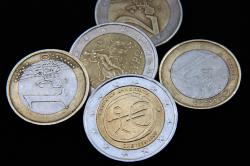
Photo by Louisa Goulimaki/AFP/Getty Images.
The creation of the euro just over a decade ago was a courageous and unique experiment. Today, the outcome—whether the euro will survive, and whether the Europeans are right to keep it—is very much in doubt. But, if the eurozone does survive, it promises great advantages for member countries—and perhaps for the world.
The euro is an ultra-fixed currency among members: Participating countries locked themselves into an initial exchange rate vis-à-vis their pre-existing currencies and then threw the keys into the long grass. Nowadays, an increasing number of Europeans are combing that grass, quietly looking for those keys.
The euro shares important features with versions of the old gold standard, under which countries fixed their exchange rates relative to each other by setting the price at which domestic currency could be redeemed in gold. Today, some people espouse the view—often loudly—that the gold standard was synonymous with economic and financial stability. But that is completely at odds with the historical record: The era of the gold standard is replete with boom-bust episodes fueled by over-\borrowing by governments, firms, individuals, or all of the above.
There are three differences between the euro and the gold standard—none of which is particularly reassuring at this moment.
First, the gold standard’s central premise was a finite quantity of gold in the world; more of it cannot be created or discovered, at least not quickly. By contrast, the European Central Bank can create more euros if so desired. Countries cannot run out of liquidity, because the ECB can always provide more cash.
But governments and investors know this, and the result has been much higher debt-to-GDP ratios than would have been possible under the gold standard. The eurozone as a whole has a debt-to-GDP ratio of 90 percent, which is high by any standard.
Such debt levels are sustainable as long as investors continue to assume that another bailout is just around the corner. But if the ECB is threatening to cut off support—for example, because a government will not comply with what the Germans regard as good economic policy—the whole house of cards can come tumbling down.
Second, financial markets have become huge relative to anything seen under the gold standard. European banks could bulk up in large part because it was assumed that their respective governments backed them. Not only are these banks now large relative to some national economies, but the quality of government credit is now in question across the eurozone periphery, up to and including Italy. The term “risk-free asset” has become an oxymoron in contemporary Europe.
European banks have been operating on a great deal of debt and very little shareholder capital – the essential buffer against potential losses. Any shock to sovereign debt or further downturn in local economies will be transmitted through an overleveraged and undercapitalized banking system to other European countries and—quite possibly—elsewhere, including the United States.
Finally, for all the talk today of the discipline that the gold standard supposedly provided, countries that adhered to it regularly suspended convertibility—meaning that the domestic currency could no longer be converted freely into gold. But today’s Europeans have no domestic currency—just the euro. If any country—for example, Greece—left the euro, all contracts in that country would have to be rewritten. The disruption, particularly to credit, would be profound.
The proper functioning of the gold standard required a high degree of flexibility in wages and prices. If exchange rates cannot depreciate, wages and prices need to fall when a country has an unsustainable current-account deficit. But, as peripheral Europe can now attest, this is a cumbersome, painful, and politically unpopular form of economic adjustment. Expect the backlash against it to grow in the months and years ahead.
The news focus today is on how hard it is for the eurozone periphery to adjust and return to growth, owing to the combination of high public debt and actual or perceived austerity measures. But there is a flip side to the problem: capital is flowing to Germany as the regional safe haven, making credit more readily available there. The dynamics of adjustment within the eurozone exacerbate the underlying imbalances—Germany is becoming more competitive while the periphery remains uncompetitive.
The recent Greek elections have brought more radical parties to the fore. Alexis Tsipras, the head of the Coalition of the Radical Left has a valid point: “internal devaluation” —cutting wages and prices—is failing as a strategy. His alternative appears to be to abandon the euro. If Greece can’t do better than this, he argues, then it should leave.
But this is not about Greece any longer. Italy, Spain, Portugal, and even Ireland face the same issues, but are at an earlier stage in the backlash. Unemployment is rising, their economies are not becoming more competitive, and the interest rates on their debt continue to rise. These countries may eventually decide to leave. And, even if they don’t make that choice, fear of such exits can easily become self-fulfilling.
The euro system was designed to deliver prosperity and stability for all. It has clearly failed for some countries, and it may fail for many. Severe mismanagement by European politicians has caused damage that will last for decades.
Perhaps a stronger fiscal union, a central ministry of finance, and debt sharing would reduce the difficulties and imbalances enough to allow the euro to survive. Perhaps adjustment will start to work just in time.
There is a lot of shouting in the jury room. Expect a verdict soon.