

Negotiators in Northern Ireland reached an agreement to end three decades of bloody political and sectarian strife. The accord must still be ratified by voters in the Irish Republic and Northern Ireland, and legislation must be passed by the British and Irish parliaments to transfer powers to a new Belfast Assembly and to set up a North-South council of lawmakers. Analysts noted that while the support of the most militant elements in Northern Ireland was not assured, the pact offered key concessions to all sides. Catholics will be rid of the hated "British rule," can strengthen ties with the republic through the cross-border council, and are protected by supermajority voting requirements in the new assembly. Protestants will be rid of the Irish Republic's constitutional claims on Northern Ireland's territory and will likely control the new assembly, which must ratify any council decisions. White House spinners rushed to highlight President Clinton's late-night phone calls to the negotiators, but the president modestly said he had only done "what I was asked to do." Clinton gave major credit to the participating political parties and to former U.S. Sen. George Mitchell, who presided over the talks for 22 painful months. It is, he said, "a day to celebrate." Most commentators agreed. (For British and Irish newspapers' reactions to the emerging pact see Slate's "International Papers.") (4/10)
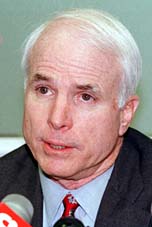
Tobacco companies renounced their negotiations with Congress and said they will kill the bill drafted by Sen. John McCain, R-Ariz., which would charge them $500 billion without offering immunity from lawsuits. Their spin: 1) the bill would have bankrupted them; 2) nothing can be passed without their support; and 3) Congress has blown its chance to resolve the issue amicably. Pundits are splitting into three camps. Camp A says: 1) the companies were right to walk out, and Congress was stupid, because the bill offered the companies nothing (click here for James Surowiecki's take in Slate's "The Motley Fool"); 2) it was unfair of Congress to twist the original settlement into a purely punitive bill; and 3) if anti-smoking zealots keep overreaching, they'll ignite a backlash. Camp B says: 1) the companies are bluffing; 2) they don't deserve to be treated fairly; and 3) Congress can pass most of the bill with or without them. Camp C says: 1) if the companies are crying foul, we must be on the right track; 2) McCain is a piker, let's raise the ante even higher; 3) let's tax and regulate their brains out. (4/10)

Tornadoes killed more than 40 people in Alabama, Mississippi, and Georgia. Winds reached 250 mph, injuring hundreds of people and destroying at least a thousand homes. Meteorologists blamed El Niño for steering this year's tornadoes away from their usual killing ground: Texas, Oklahoma, and Kansas. The media scrambled for an instant spin, settled on Southern religion, and recounted numerous "miracles" in which this or that congregation or worshiper survived a tornado. God received credit for those who survived; nature took the blame for those who died. Meanwhile, in Mecca, scores of old people perished as Muslim pilgrims trampled each other during a religious ritual. (4/10)

Prime Minister Ryutaro Hashimoto announced $30 billion in income tax cuts to pump up Japan's deflating economy. U.S. officials and economists welcomed the move but worried that the cuts were 1) still unspecified and so unlikely to prompt a fast outbreak of consumer spending; 2) not part of a larger plan to deal with Japan's structural problems and so insufficient to spur long-term recovery; 3) embraced only after much pressure from foreign governments and so emblematic of Japan's hidebound political system. "It's yesterday once more in Japan," said the Washington Post. (4/10)
Microsoft has planned a media blitz aimed at state attorneys general and politicians, according to the Los Angeles Times. The campaign would allegedly include "spontaneous" letters to the editor and opinion articles commissioned from free-lance journalists and others. A Microsoft spokesman told the Times the plan was merely a proposal and "not something we are moving on." State officials termed the plan "arrogant." "When it comes to knowledge of computer technology, I take my hat off to Mr. Gates," said one attorney general, "but if he wants to enter the field of political intrigue, I say welcome to my world, Mr. Gates, I'm ready to do battle." (For more on Microsoft's antitrust problems, see the 4/6 item below.) (4/10)
Former Sen. Bob Packwood, R-Ore., is attempting a political comeback. He's giving speeches and floating the idea of a run for the Oregon legislature. His explanation: He's testing the "climate." Cynics' translation: He wants to see whether Clinton has made the world safe for politicians who grab women and then cover it up. (4/10)
Clinton administration officials say they will chastise Afghanistan about its repression of women. During his current tour of South Asia, U.N. Ambassador Bill Richardson will tell Afghanistan's ruling Taliban militia that world powers won't help or recognize its regime until it stops mistreating women, e.g., by preventing them from working and refusing to educate their daughters. Skeptics suggested that this is only a minor aspect of the trip and that the administration is playing it up to repair the domestic political damage caused by Clinton's sex scandals. (4/10)
President Clinton kicked off his series of forums on Social Security reform. Choices include raising the payroll tax (Clinton ruled this out--except maybe for higher-income workers), taxing more benefits, raising the retirement age, pouring the budget surplus into the Social Security trust fund to pay back its IOUs, and privatizing the system (a 1996 Slate piece by Michael Kinsley argues that this last option is no solution). Analysts are most impressed by the growing mainstream support for some degree of privatization, and Clinton is receptive to it, as long as the system still guarantees a minimum retirement benefit. Pundits are frustrated by Clinton's refusal to specify his solution. Clinton's spin: I'm letting the public discuss all options. Cynics' translation: He's conducting a nationwide focus group and postponing the decision until after the November elections. Republicans' translation: He's making sure we can't do to him what he did to us on Medicare. (4/8)
The Dow Jones industrial average closed above 9,000 for the first time. This was hardly acknowledged in most papers because 1) business reporters fixated on the Citigroup merger (see 4/6 item, below) and 2) 1,000 point milestones have become a yawner. Analysts explained once more that the market is overvalued but that you should stay in it anyway, because every time they persuade you to get out, you lose money. (4/8)
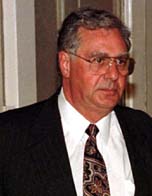
House Majority Leader Dick Armey denounced President Clinton. Armey told a high-school audience: "If it were me that had documented personal conduct along the lines of the president's, I would be so filled with shame that I would resign. This president won't do that. His basic credo in life is, 'I will do whatever I can get away with.' " Religious conservatives and political-warfare reporters cheered the GOP's newfound boldness. Clinton's response: "I hope he has a nice day." Meanwhile, Clinton's surrogates used the attack to cement their message that 1) Ken Starr is in cahoots with the GOP and therefore 2) any congressional investigation based on Starr's report would be bogus. (4/8)

Tara Lipinski is turning pro at 15, two months after winning an Olympic gold medal in figure skating. Agents estimate she can make between $13 million and $15 million in endorsements. Lipinski says she is going pro so she can spend more time with her family (see item on Federico Peña below and Jack Shafer's take in Slate on this growing trend); pursuing another gold medal would, by contrast, have been "greedy."(4/8)
Columbia University is coughing up a near-$300,000 salary and extravagant perks to snare economist Robert Barro from Harvard. This surpasses previous records for academic economists by 50 percent and doubles the amount at which elite universities have capped faculty salaries in the arts and sciences. The New York Times observed that "the market for top economists is starting to look like those for movie stars, basketball players and bond traders"--just as many economists' theories would predict. (4/8)
Country singer Tammy Wynette and Milli Vanilli co-star Rob Pilatus died. Energy Secretary Federico Peña announced he is resigning to spend more time with his family. Wynette was mourned. (4/8)
Citicorp and Travelers Group agreed to merge. The combined entity will have $140 billion in net worth and more than 100 million customers in 100 countries, making this merger dwarf all previous ones. This is the most recent in a string of megamergers for Travelers Group, including last year's acquisition of Salomon Bros., one of Wall Street's biggest firms, which it joined with the previously acquired Smith Barney brokerage. The first-minute spin: Holy cow, the merged company will have a huge global foot in every financial service. The second-minute spin: Every other banking, credit, investment, and insurance company will have to merge similarly in order to survive. The third-minute spin: Regulators around the world had better wake up and figure out what to do about this. (4/6)
The Palestinian Authority cleared Israel of responsibility for the murder of Hamas' chief bomb maker. Palestinian security officials say their investigation shows the man was killed by a rival within Hamas. The Palestinian minister who had blamed Israel for the killing now agrees "Israel is not responsible." Israel had demanded to be cleared so Hamas wouldn't seek revenge by attacking it. But Hamas rejects the PA's findings and continues to insist Israel is to blame. The optimistic scenario: Hamas' defiance of the PA's findings will aggravate the conflict and give Yasser Arafat an excuse to crack down on Hamas, thereby advancing the peace process. The pessimistic scenario: Hamas will blow up more civilians in Israel and will defeat the PA if it comes to that. (International Papers updates you on the latest reactions from the Middle East and elsewhere.) (4/6)
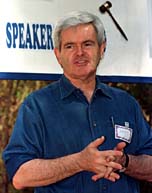
Newt Gingrich launched his new book tour. In Lessons Learned the Hard Way, he reviews his speakership and, while blaming his lawyers for his 1997 ethics reprimand, takes responsibility for other fiascoes such as the aborted Republican coup against him. He will appear on four network TV shows and in 18 cities, including visits to Iowa and New Hampshire. The fully naive theory: He wrote the book to repent his sins and help other Republicans avoid his mistakes. The naive cynical theory: He's using the book tour to launch a presidential campaign. The fully cynical theory: He's using the media's suspicions of a presidential campaign to attract attention and sell more books to pay off his ethics fine. (See Jacob Weisberg's take on the speaker in Slate.) (4/6)

Mitchell Johnson, the older of the two boys charged with murdering their classmates in Arkansas, is blaming the younger boy for planning the attack. Johnson's mother told Time: "Mitch told me he never meant to hurt anybody, and he didn't take specific aim. ... But then something went terribly wrong." She added that her son has lost weight and looks "thin, sallow and dehydrated, with very dry, cracked lips. ... I begged him to drink." The younger boy's grandfather says Johnson instigated the plan. (4/6)
The Justice Department is preparing a broader antitrust case against Microsoft, according to the Wall Street Journal. The case reportedly rests on internal Microsoft documents, including a 1996 plan against Netscape. DOJ prosecutors are rushing to put their case together and file for court restrictions on Microsoft's marketing practices before the May 15 release of Windows 98. According to the Journal, many of the Microsoft tactics challenged by DOJ are legal, but DOJ will argue that Microsoft's dominance renders them impermissible. (4/6)