
America's passion for Viagra is swelling. Doctors are writing between 15,000 and 40,000 new prescriptions each day for the anti-impotence pill, which costs $10 and has just begun to appear at pharmacies. Analysts call the demand "insane" and speculate Viagra could become the most lucrative drug in history. Critics' chief worries: 1) Men who aren't clinically impotent are seeking the pill just to enhance their performance. 2) In response, irresponsible purveyors are offering the pill to all comers. 3) Concerned it will be used indiscriminately as an aphrodisiac, health insurers are withholding its approval as a medical expense and are pondering how many pills a month a patient should be allowed. 4) Ethicists wonder whether this means that HMOs will get to define the proper frequency of sex. (4/22)


The tobacco debate escalated into partisan warfare. President Clinton and the Democrats attacked Speaker Gingrich for 1) calling Senate-passed tobacco legislation "big government" and 2) saying that Joe Camel is a less pernicious influence on children than is smoking in movies. Democrats accused the Republican Party of mimicking tobacco industry ads. Gingrich, in turn, accused the White House of condoning illegal drug use by endorsing the provision of clean needles to junkies (to stop the spread of AIDS). The Wall Street Journal joined the tobacco industry in warning that the health lobby, after killing off Joe Camel, will go after Big Booze and Ronald McDonald. Republicans joined the industry in denouncing the Senate bill as a regressive tax hike. The Washington Post accused the industry and its allies of changing the subject. The White House spin: Clinton wants to use GOP fears of a 1998 election defeat to force passage of anti-smoking legislation. The cynical spin: Clinton wants to use the defeat of the legislation to win the election. (4/22)
Clinton and the Republicans also declared war over education. Clinton promised to veto a GOP bill giving tax breaks to parents with kids in private schools. Meanwhile, Republicans killed Democratic bills providing federal aid for teacher recruitment and school construction. The Democrats' spin: The tax-break bill favors the rich and "siphons" resources from public schools. The Republican spin: Democrats are beholden to a failed education bureaucracy bent on stifling freedom of choice. Pundits agreed the clash of bills underscores an important philosophical difference: Democratic emphasis on resources, inequality, public responsibility, and federal aid vs. Republican emphasis on parental rights, free markets, and local control. (4/22)
Critics and rivals of Microsoft announced an alliance to lobby for antitrust action against the software maker. The star spokesmen are ex-Senate majority leader Bob Dole (hired by the alliance) and ex-Judge Robert Bork (hired by Netscape, currently engaged in a Slate"Dialogue" on megamergers). Reporters noted with irony that both are former skeptics of antitrust regulation and that Microsoft has its own hired advocates, including anti-tax activist Grover Norquist Jr. and former members of Congress. Meanwhile, Microsoft 1) appealed a judge's injunction against forced bundling of Internet Explorer with Windows 95; 2) debuted Windows 98 (headlines clucked that the program crashed during the demo); and 3) said it will let computer makers omit Microsoft's business-partner Web sites from its Windows 98 desktop. Sophisticates shrugged that the second development renders the first irrelevant. (4/22)
Rwanda sentenced 33 citizens to death for genocide in the 1994 massacre of 800,000 people. The government invited the public to view the executions "as a lesson to people who do not respect the life of others."(4/22)

Octavio Paz, Terry Sanford, and Linda McCartney died. Scribes remembered Paz as Mexico's most culturally influential writer and recalled Sanford's pioneering leadership for civil rights as governor of North Carolina in the early 1960s. Meanwhile, television fawned over McCartney, brushing aside the "modesty" of her musical skills and marveling at her heroic struggle against breast cancer and the exemplary stability of her 29-year marriage to Paul McCartney. (4/22)

China exiled dissident Wang Dan to the United States. He had been in prison on and off for "subversion" after he helped lead the democracy movement that culminated in the 1989 Tiananmen Square massacre. The official reason for his exile is health problems. The real reason is to ease the way for Clinton's June visit to Beijing. U.S. officials are touting his expulsion as a triumph of constructive engagement. Critics reply that 1) he will be less of a nuisance to the Chinese government as an exile than as a prisoner; 2) in exchange for his expulsion and other concessions, the United States recently stopped sponsoring the U.N. resolution condemning China's human rights policies; and 3) the United States will further repay China by refusing to air Wang and other dissidents on U.S. government international broadcasts. ("International Papers" gives you the Asian spin.) (4/20)
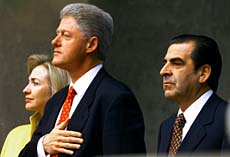
President Clinton joined other Western hemisphere leaders in Chile for the Summit of the Americas. (An earlier installment of "International Papers" recaps regional coverage of preparations for Clinton's visit.) The big story was an agreement to begin talks on a hemispheric free trade zone. The countries also announced an alliance against drug cartels and a collective drug-fighting-certification process. American conservatives condemned this as an assault on U.S. control of certification. Cynics viewed Clinton's emphasis on partnership rather than U.S. dominance as a symptom of his lingering humiliation from Congress' refusal to give him fast-track trade negotiating authority. Optimists spun the same behavior as more friendly, respectful, and effective. (4/20)
The Teletubbies are coming. The colorful British toy characters, designed to appeal to 1- and 2-year-olds, speak in baby talk, smile, hug, and roll on the ground. PBS is airing their TV show and will earn a percentage of profits from sales of their merchandise. Critics protest the Teletubbies are corrupting PBS, addicting children to the idiot box, and robbing kids of what's left of their pre-consumer innocence. An Associated Press reviewer gagged at the prospect of "the In Utero Channel." PBS defenders countered that toddlers are already addicted to televised toy characters (e.g., Winnie-the-Pooh, who was the subject of a Slate"Assessment") and that if they can't watch the Teletubbies, they'll rot their brains watching soaps. (4/20)

Former Cambodian dictator Pol Pot died. According to his wife and Cambodian captors, he died of heart failure in his sleep. Skeptics noted the convenient timing of the report--the Cambodian army was closing in on him and the United States was building international support for a war crimes trial--but journalists saw the corpse, confirmed his death, and broadcast video of him to prove it. Everyone agreed he was one of history's worst butchers, having killed between one-fourth and one-seventh of Cambodia's population. The spins on his death: 1) It cheated Cambodians of an explanation of his atrocities. 2) It cheated justice. 3) It prevented him from testifying against his ex-lieutenants who remain at large--which is why they may have orchestrated his death. President Clinton has promised further efforts to bring them to trial. 4) Some of these ex-lieutenants serve current dictator Hun Sen, on whom the world must maintain pressure to restore democracy and human rights. (Last year, David Plotz wrote this appreciation of the much-misunderstood tyrant.) (4/17)
Independent Counsel Kenneth Starr launched a PR counterattack on the White House. First, he renounced his job offer from Pepperdine University, saying it would be wrong to make Pepperdine wait for him to finish his investigation. Pundits theorized Starr's true motive was to distance himself from right-wing Clinton conspiracy theorist Richard Mellon Scaife, a major donor to Pepperdine who is accused of funneling money to Clinton Whitewater accuser David Hale. Second, Starr suggested the Justice Department could not credibly investigate the Hale allegations because of two conflicts of interest: the threat posed by Hale to Clinton, and DOJ's efforts to prevent Secret Service officials from giving testimony sought by Starr. Third, Starr blamed the slow pace of his investigation on Clinton's invocation of executive privilege. The White House spin: Starr's withdrawal from Pepperdine is a confession of a conflict of interest. The short-term spin: Clinton's surrogates have succeeded in focusing media attention on Scaife. The long-term spin: Starr is finally getting the hang of the PR game. (4/17)
Paula Jones will appeal the dismissal of her suit against President Clinton. Nobody was surprised. Jones said she was initially reluctant to appeal because it would put "stress on my family" but that she decided to go ahead for the sake of women everywhere. The media's spins on her press conference: 1) She cried. 2) She appeared to be coached and directed by her friend/Svengali Susan Carpenter-McMillan. 3) Carpenter-McMillan seems to have been demoted for being a loose cannon. The legal consensus: The appeal is doomed. The political consensus: The public has stopped paying attention, and the media will follow suit, because the appeal is confined to matters of law rather than salacious subpoenas and depositions. (4/17)

Republicans are hammering Vice President Gore for having donated only $353 to charity last year. His income was $197,729. The Republican National Committee called him "Scrooge" and peddled the story to radio talk show hosts, who dubbed him "Cheap Al." Gore aides pleaded that he has given $85,000 to charity over five years, and they accused the GOP of trying to "slash money for education, health care, and the environment." The backspin: Gore's rivals and critics, such as Bill Bennett, Newt Gingrich, and House Minority Leader Dick Gephardt, won't even divulge their charitable donations, as Gore has done. Commentators who deemed Gore innocent of parsimony faulted him anyway for permitting the appearance of parsimony. (Slate's "News Quiz" asked participants what $353 referred to: Click here to read their speculations.) (4/17)