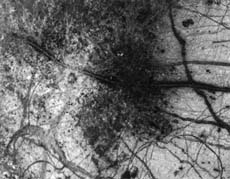

New satellite pictures substantially increase the probability that life exists on Europa, a moon of Jupiter. Scientists are now convinced that a vast internal ocean is, or was recently, roiling the surface and providing the heat and chemicals necessary to create life. Ironically, much of the optimism that life could exist in Europa's ocean arises from the recent discovery that microbes are thriving in an even less hospitable environment: volcanic vents on the Earth's ocean floor. (4/11)
A federal judge struck down the Line-Item Veto Act, saying it gives the president legislative powers constitutionally reserved to Congress. The ruling is seen as a victory for constitutional purists and a political blow to President Clinton, who had hoped to use the threat (if not the reality) of a line-item veto as leverage in budget negotiations with Congress. (4/11)

China unveiled plans to restrict civil liberties in Hong Kong. Tung Chee-hwa, the Beijing-appointed executive who will take over Hong Kong in less than three months, announced measures to register all organizations with the police and authorize police to prevent demonstrations on "national-security" grounds. He will also outlaw any organization that receives foreign money, which includes Hong Kong's Democratic Party and possibly human-rights groups. President Clinton's spokesman warned China will face "some consequence" if it abuses Hong Kong. The Washington Post urged Clinton to show displeasure by meeting with Hong Kong Democratic Party Chairman Martin Lee, now visiting the United States. Meanwhile, China and the United States are in a showdown at the United Nations over a resolution criticizing China's human-rights record. While scoffing at Tung's assertion that the new restrictions were necessary to prevent foreigners from using Hong Kong to subvert Chinese totalitarianism, foreign pundits held out hope that Hong Kong would subvert Chinese totalitarianism. (4/11)
Newt Gingrich is back. On the heels of his widely acclaimed trip to China, the House speaker has delivered high-profile speeches bashing Clinton, Yasser Arafat, taxes, unions, the IRS, and government-funded art. Conservatives are heartened, though a few winced at his boast that Republican ideas are carrying the day--in Mongolia. (See Slate's Jacob Weisberg on "Newt Descending.") The contrary theory is that Gingrich is flaming out in a final, futile attempt to regain his authority in the GOP. The Wall Street Journal editorial page urges him to crown his comeback by announcing that he will pay off his $300,000 ethics penalty using campaign funds and other donations instead of his own money--exactly the step that many analysts think will turn him back into a pariah. (4/11)
 William Saletan

The CIA admitted it had evidence of chemical weapons in an Iraqi bunker years before the Persian Gulf War, but failed to give the armed forces clear warning before they blew up the bunker. The admission contradicts the CIA's previous assurances that U.S. soldiers couldn't have been exposed to nerve gas, and (after that assurance proved false) that the agency had been unaware of chemical weapons in the bunker. Editorialists still doubt that the bunker's destruction accounts for the putative "Gulf War Syndrome," but scoff that the government has lost all credibility on the issue. Analysts agree that the new disclosure throws a wrench in confirmation hearings for CIA Director-designate George Tenet, who was involved in providing the misleading assurances. (4/11)
President Clinton announced the federal government will hire 10,000 people off welfare in the next four years to do its share in putting welfare recipients to work. There are nearly 4 million adults on family welfare and 2 million jobs in the federal government. (4/11)
A federal appeals court upheld California's Proposition 209, which prohibits affirmative action in public institutions. A panel of the 9th Circuit Court of Appeals ruled that a lower judge's obstruction of Prop. 209 (on the grounds that it treated race-based discrimination differently from other kinds of discrimination) perverted the 14th Amendment, trampled democracy, and embarrassed the entire judicial system. Proponents of affirmative action will ask the full 9th Circuit to reverse the decision. Analysts see this as a war between liberal and conservative judges that only the Supreme Court can ultimately resolve. President Clinton conceded that supporters of affirmative action will have to "find new ways to achieve the same objective."(4/9)
Underplayed: Scientists at Rutgers University claim to have identified a chemical that causes female orgasms. The chemical, known as the vasoactive intestinal peptide, appears to trigger the orgasm sensation in the brain. Researchers found that three of 16 paraplegic women were able to achieve orgasm, evidently by receiving the peptide through the vagus nerve (which connects the brain directly to the cervix) rather than the spine. The researchers envision turning the chemical into a pill, which they claim would be used for pain suppression. The director of the Kinsey Institute says that while he respects the Rutgers team, it would be hard to stabilize the chemical in a pill. (4/9)

Foreplayed: The White House announced that President Clinton will soon issue an apology from the U.S. government for the infamous Tuskegee experiment, in which hundreds of poor black men were deliberately left untreated for syphilis from the 1930s to the 1970s. On April 30, comedienne Ellen DeGeneres' TV character will confirm she is a lesbian, consistent with DeGeneres' own (already well-known) sexual orientation. Scribes and pundits are already reacting to both events, although neither has happened yet. (4/9)
American girls are reaching puberty much earlier than previously thought. A study finds that 48 percent of black girls and 15 percent of white girls begin developing pubic hair or breasts by age 8. Three percent of black girls and 1 percent of white girls begin acquiring these characteristics by age 3 (yes, 3). This contradicts textbooks and previous studies that placed the average age of puberty at 11 or 12. The authors of the new study cite flaws in previous studies (they were done long ago, were confined to British white girls, and didn't include girls younger than 9). But they concede that the new study might also be skewed, because girls who develop early sexual traits might be more likely to be brought to their doctors and hence included in the study. (4/9)

Update from Zaire: 1) The Clinton administration is pressing President Mobutu Sese Seko to end the war by resigning and leaving the country. The logistical problem here, as with the Shah of Iran, is finding a country that will accept him in exile. U.S. officials, while complaining that Mobutu is too selfish and stubborn to quit, have refused to let him into the United States. 2) Mobutu declared martial law and ousted the nation's new prime minister, Etienne Tshisekedi, who had seized political control. 3) Rebels in the east were said to have captured the nation's second-largest city. 4) The new boss may not turn out much different from the old boss: A U.N. report says the rebels have massacred hundreds of Hutu refugees and civilians. (For background on the Zairian conflict, see Slate's "The Gist.") (4/9)
Celebrity rites of passage: Two flamboyant icons died. Beat Generation poet Allen Ginsberg was remembered as a courageous and lovable nut who spearheaded the counterculture by letting it all hang out. George Will called him a third-rate artist but a first-rate self-promoter. (You can hear brief clips of Ginsberg reading from "
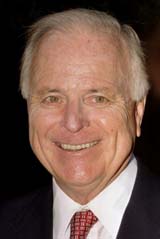
Election results: Los Angeles Mayor Richard Riordan crushed challenger Tom Hayden with more than 60 percent of the vote. The Los Angeles Times emphasized that Riordan won support from almost every ethnic group (overcoming the city's reputation for racial conflict) and did better than any Republican candidate in the city's history. The Times called Hayden's meager tally a "hard slap" from the voters. Meanwhile, the party of former Haitian president Jean-Bertrand Aristide claimed victory in that country's Senate and local elections. However, all but a small fraction of Haitians boycotted the vote. (4/9)
Update on the Democratic fund-raising scandal: The Washington Post, having criticized the White House and the Democratic National Committee for not screening out sleazy foreign donors from fund-raising events, ran a front-page story implicitly criticizing the White House for screening out an allegedly sleazy Latvian businessman by supplying classified information to the DNC. Clinton says his attorneys have found no evidence "that any sensitive information was improperly transmitted to the DNC."(4/9)
The Social Security Administration hastily abandoned a Web site it had created that allowed workers to check their earnings records and benefit entitlements. Critics, fearing that snoopers could access the data, called it another illustration of the Internet's threat to privacy. Defenders of the system argued that it's cheap (saves the taxpayers money), gives Social Security recipients an easy way to access their own records, has never been abused, and is safer than the mail. (4/9)
President Clinton met with Israeli Prime Minister Benjamin Netanyahu in Washington. Netanyahu urged Clinton to host a Camp David-like summit, the climax to Netanyahu's proposed shortcut negotiations with the Palestinian Authority. Clinton said such a commitment might be "premature." Hours before, Netanyahu had given a speech insisting that Israel would not halt the rapid construction of a controversial housing project in East Jerusalem or make further concessions to halt terrorism. But Palestinian leader Yasser Arafat told U.S. officials that negotiation was impossible as long as the construction continued. Clinton called his talks with Netanyahu "specific," "frank," and "candid." The media's translation: They had it out. (4/7)