
A suicide bomb in Tel Aviv killed at least three people and wounded dozens more. A caller to Israeli Radio claimed that the Hamas fundamentalist group was responsible. Israeli security forces were already on maximum alert following Israeli Prime Minister Benjamin Netanyahu's refusal to halt an inflammatory Jewish settlement in Arab East Jerusalem. Israel's justice minister, regarded as Netanyahu's closest aide, had warned that if Palestinians reacted violently to the settlement, there might be a "war to the finish" in which "our response will reach Arafat himself." Earlier in the week, Jordan's King Hussein had apologized in person to the families of seven girls massacred by a Jordanian soldier. Accompanied by Netanyahu, Hussein went to the families' homes, knelt before them, and asked their forgiveness. Israelis were moved, and commentators concluded that Hussein is repairing his relations with Netanyahu. (3/21)


The tobacco industry suffered a potentially catastrophic defection. The smallest of the major tobacco companies, the Liggett Group, agreed to a settlement with attorneys general from 22 states who had sued to recoup money spent on health care for smokers. The media focused on Liggett's admissions of the obvious--that cigarettes are addictive and cause cancer and heart disease--and its agreement to pay the states a quarter of its (relatively small) pretax profits for the next 25 years. The more important concessions, however, were 1) Liggett's admission that the industry had consciously marketed tobacco to minors (which will increase congressional support for stiff regulation of the industry) and 2) its release--temporarily blocked by a North Carolina court--of documents from strategy meetings among lawyers for the five biggest tobacco companies, which industry critics believe will prove a conspiracy of deceit. Also, the tobacco executives who told Congress they didn't consider nicotine addictive might now be prosecuted for fraud and perjury. As for Liggett's motive, industry and financial analysts speculated that Liggett's CEO hoped to make the marginally profitable company a more attractive merger partner by eliminating its exposure to possibly huge jury awards. (3/21)
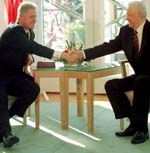
President Clinton joined Russian President Boris Yeltsin for a summit in Helsinki. The big issue is NATO's plan to extend membership to Poland, Hungary, and the Czech Republic--but not to Russia, which fears that NATO is thereby creeping dangerously close to its border. After making threatening noises about the expansion and being rebuffed by U.S. Secretary of State Madeleine Albright, Yeltsin suddenly took a conciliatory tone just before the summit. The betting is that he's been inflating the controversy in order to wring arms-control concessions and a NATO role from Clinton in exchange for accepting the expansion--and that he'll get them. Clinton's aides called it the "summit of the invalids." (For a primer on NATO expansion, see Slate's "The Gist.") (3/21)
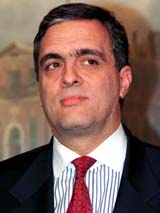
President Clinton nominated CIA Deputy Director George Tenet to become CIA director. Tenet replaces the previous nominee, Tony Lake, who withdrew earlier in the week. Lake's reasons: The Senate's demands for his FBI files, new questions about the CIA's role in the foreign-money scandal, and further unpleasant hearings on top of the pounding he's already taken. Lake said Washington had gone "haywire" and worn out his patience and dignity. Pundits noted the echoes of Vince Foster's suicide note, but weren't buying the martyrdom in Lake's case. Their reactions: 1) Lake had shown poor ethical judgment and would have been lousy at the CIA job anyway. 2) He's a wimp for succumbing to a couple of right-wing punks (Sens. Richard Shelby and James Inhofe). 3) His martyr pose is pretentious and self-serving. 4) Nominee-stoning is what the two-party system and separation of powers are for. 5) The Democrats are reaping what they sowed (after torturing Robert Bork, John Tower, and Clarence Thomas). 6) It's Clinton's fault for creating the foreign-money scandal and thereby bringing suspicion and scrutiny on everything Lake did. 7) Once again, Clinton failed to "go to the mat" for a nominee in trouble. 8) Labor Secretary-nominee Alexis Herman, who was closer to the fund-raising mess, will now be confirmed easily because the Senate is satisfied with having killed Lake. (3/21)
The House passed the partial-birth-abortion ban, as expected. The vote was 295-136--better than a two-thirds majority--which means that opponents of the ban must once again depend on the Senate to sustain a presidential veto. Despite all the hoopla over a pro-choice advocate's confession that he had lied about the circumstances under which the procedure is generally used, only five lawmakers switched their votes from "no" to "yes." (See Slate's "Abortion Apostate" on the partial-birth abortion debate.) (3/21)
The Democratic fund-raising scandal has a new shadowy ethnic figure: Roger Tamraz, a Lebanese-American businessman and accused embezzler with past ties to BCCI (of the S&L scandal). A National Security Council official wanted to keep Tamraz out of the White House, but he got in to four events after giving big donations to the Democratic National Committee. DNC Chairman Don Fowler personally lobbied the NSC official, telling her the CIA would send her a report on Tamraz. Intelligence officials say the report that the CIA subsequently sent omitted the embezzlement charges and other damaging information. The Wall Street Journal broke the story. Pundits say it adds the CIA and NSC to the list of national-security and foreign-policy agencies (including the FBI and INS) that the White House was willing to prostitute for domestic political advantage. (3/19)
Other news on the scandal: 1) The New York Times reported that a company owned by James Riady paid Webster Hubbell about $100,000 within a week of spending five days visiting the White House in 1994. 2) The Los Angeles Times reported that federal banking regulators are about to slap the Riady-owned LippoBank with a sanction (a "cease and desist" order against loan practices that are weakening the bank's condition) for the third time in seven years. 3) House Minority Leader Richard Gephardt is returning $22,000 in campaign donations, mostly from Lippo-connected contributors. 4) The Senate expanded its investigation to include "improper" as well as illegal conduct in the 1996 elections. This brings soft money and other much criticized practices under scrutiny. It is seen as a rebuke to Senate Majority Leader Trent Lott and a victory for Democrats, Sen. Fred Thompson (who will chair the investigation), and campaign reform. (3/21)
Republican fund-raising hypocrisy watch: 1) A former Washington lobbyist for Pakistan says Rep. Dan Burton, who is chairing the House investigation of the Democratic money scandal, threatened to deny him access to Burton's "friends or colleagues" last year because he failed to satisfy Burton's demand for $5,000 in campaign money. 2) The Washington Post reported that a Republican House committee counsel hit up investment firms for $100,000 contributions to the GOP shortly after working on financial-deregulation legislation. 3) Democrats released documents indicating that Republicans sold big political donors meals with the party's leaders in federal buildings in 1995. (3/19)
News from the NCAA basketball tournament: Wild overtime games highlighted the third round. After fighting back from a 12-point half-time deficit, UCLA's Cameron Dollar drove the length of the court and banked in a floater with two seconds left in overtime to beat Iowa State by a point. Stanford came back after trailing Utah by 14 at the half and nailed an impossible three-pointer with seven seconds left to force overtime before succumbing. Clemson rushed the ball down court in the final seconds and scored a bucket at the buzzer to force Minnesota into overtime, then survived into double-overtime before giving out. (3/21)
ABC News president David Westin is the latest star in the network news soap opera. USA Today implied that Westin's predecessor, the legendary Roone Arledge, is being kicked upstairs because ABC is losing the ratings war to NBC. The rap on Westin is that he's a lawyer and corporate boss who has no news experience. The counter-arguments are: 1) neither did Arledge (he came from the sports division) and 2) Arledge will tutor Westin for a while. The substantive issue at stake is hard news vs. soft news: Each network is accusing the others of going soft in pursuit of ratings. Westin says he wants ABC to get back to hard news. Instead, the media are swarming over Westin's alleged relationship with ABC's PR chief, Sherrie Rollins, who not only was his direct subordinate but is still married to multiply disgraced political consultant Ed Rollins. (3/19)
The World Health Organization announced that a new strategy for treating tuberculosis could save 10 million lives over the next decade. The treatment, known as DOTS, consists of four drugs taken daily under meticulous supervision. The organization's director calls it "the biggest health breakthrough of this decade."(3/19)

President Clinton tore a tendon in his knee. It happened when he fell down the steps outside golfer Greg Norman's house in Florida March 14 at 1:20 a.m. Surgeons put him under local anesthesia while they reattached the tendon to his kneecap. Pundits rehashed the rules of succession in the event of something worse. For now, Vice President Gore is shouldering/indulging in the president's less essential duties. Follow-up reports focused on what sort of painkillers Clinton is taking. Doctors say Clinton could be on crutches for up to eight weeks. The widely noted irony is that Clinton is the invalid at his meeting with Boris Yeltsin this week. (3/17)

Dr. Jack Kevorkian has opened an exhibit of his paintings. Among the images reported on by the New York Times are "two hands holding up a severed head by the hair," "a man confronting his own severed head on a plate," and "a man's brain and the upper end of his spinal column ... ripped from his body and hang[ing] from chains." Kevorkian says he stained one of the frames with his own blood. (3/17)
The anti-anti-cloning backlash is underway. At a Senate hearing, Republican senators worried that a ban on human-cloning research might prevent lifesaving medical breakthroughs, and researchers and ethicists said there is no need to legislate hastily, since it will take a while to refine the sheep-cloning technique to work in humans. This comes after President Clinton banned federal funding of human-cloning research and two lawmakers filed bills to ban human cloning. The New York Times reported that through in vitro fertilization, "tens of thousands of embryos are steadily accumulating in tanks of liquid nitrogen" in the United States, and their lives can be started at any time in the future. An elderly Milwaukee couple are soliciting women to conceive and bear their grandchild using frozen sperm from their dead son. (3/17)
Newsweek reports that Timothy McVeigh confessed to the Oklahoma City bombing. This is the third such report in recent weeks. The first two appeared in the Dallas Morning News and Playboy. Newsweek's account, citing "anonymous sources close to the investigation," says McVeigh confessed during a lie-detector test administered by his attorneys. (3/17)

Albania is imploding. (Primer: It's between Italy and Greece.) Nine pyramid investment schemes collapsed, which wiped out the life savings of thousands of Albanians, which led to protests, which led to rebellion, which led to police giving loyalist civilians assault weapons, which led to gunfire, looting, and roving bands of robbers. Inmates are escaping from jails, and the president has lost control of the army. The European Union has agreed to send in a few dozen military and police advisers, but not a big force. The United States wants Albania's president to step down, but he refuses to do so. "Albanians themselves were unsure whether to call the violence a civil war, a revolution, a popular uprising or just plain chaos," said the New York Times. (3/17)
Rebels in Zaire easily captured Kisangani, the country's third-largest city, and are expected to head for the capital soon. Everyone is now convinced that the loyalist army is a joke, and President Mobutu Sese Seko is finished. The only catch is that Mobutu can't be physically deposed, since he's hiding out in France. (3/17)
Julius Rosenberg's former KGB contact has come forward. Alexander Feklisov says 1) that Rosenberg passed U.S. military secrets to the Russians but 2) supplied no useful information about the atomic bomb, contrary to the assertions of J. Edgar Hoover, and 3) that Ethel Rosenberg, who was executed along with her husband, did no spying for Feklisov. The bottom line, according to Feklisov, is that the executions were unjust. (3/17)
Other news from abroad: 1) British Prime Minister John Major announced that a new national election will be held May 1. Polls show the opposition Labor Party leading by nearly 2-to-1. 2) A Church of England priest has ignited a furor by arguing that it's OK to shoplift from chain supermarkets because they're driving local stores out of business. 3) A Pakistani woman won a historic court victory allowing her to remain married to the man she loves (and with whom she eloped) despite her parents' insistence that under Islamic law, they have the sole authority to choose her husband. Her father is appealing to the country's supreme court. (3/17)