
O.J. Simpson's civil jury ordered him to pay $25 million in punitive damages to the families of Ron Goldman and Nicole Brown Simpson, on top of the $8.5 million in compensatory damages already awarded. The $25 million figure is based on Simpson's assets and potential lifetime earnings, and is designed to make sure he can't keep any money he makes from his notoriety in the case. Analysts point out that the jury neglected to deduct Simpson's debts in calculating his net worth, so the judge or an appeals court will probably reduce the damages accordingly. The Washington Post used the occasion to reopen the debate over excessive punitive-damage awards. Ron Goldman's father offered to renounce his claim for damages if Simpson would publish a detailed confession. (2/12)
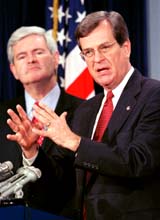
President Clinton met with congressional leaders of both parties. The meeting produced an agreement to try to agree on five issues: education, juvenile crime, family tax cuts, tax credits for businesses that hire people off welfare, and experimenting with urban-renewal ideas in the District of Columbia. Pundits were impressed by the cordial atmosphere, which was in contrast to last year's. But they pointed out that the two sides 1) left out campaign-finance reform; 2) blocked each other's pet initiatives (e.g., the balanced-budget amendment and health insurance for poor kids); and 3) disagree sharply even where they ostensibly agree (e.g., the federal role in education, and the size of tax cuts). (2/12)
Independent films dominated the Academy Award nominations. ("Independents Day," declared both the Los Angeles Times and the Washington Post.) The English Patient got 12 nominations. Shine and Fargo got seven apiece. Several big Hollywood studios were shut out of the top categories. Evita and its star, Madonna, got stiffed. Milos Forman blamed no best-picture nomination for The People vs. Larry Flynt on hostile lobbying by feminists. A best actress nomination went to Kristin Scott Thomas in The English Patient, which 20th Century Fox executives had dropped because they wanted Demi Moore to play the role. Consensus spin: The nominations are a signal that people are sick of big-budget action flicks and hungry for good, well-written stories. Consensus prediction: The big studios will be embarrassed for a few weeks and then will go back to churning out mindless blockbusters. (2/12)

Authorities in New Hampshire agreed to spare the life of a dog that killed a rooster. Prince was sentenced to die under a "three strikes" ordinance against vicious dogs. Strike One was the rooster. Strikes two and three were escapes from home. The case inspired outcries throughout the country and was widely covered by national television and the foreign media. New Hampshire's governor hinted she would pardon Prince if necessary. Eventually, prosecutors buckled and agreed to reduce Prince's penalty to exile. (2/12)
U.S. fighter jets dogged passenger planes in two incidents. First an F-16 followed a 727 descending into New York--setting off the 727's alarms and causing its pilot to attempt violent evasive maneuvers. Then another commercial pilot reported that several F-16s flew dangerously close to him. The two reports played big on television, with dark hints that top-gun pilots might be joyriding. But the scare was deflated by reports that 1) air-traffic controllers and the 727 crew bore the blame for the first incident; 2) the pilot who alleged the second incident still hasn't filed a report; and 3) near-collision reports between military and civilian planes have actually fallen sharply in this decade. (2/10)
The New Yorker reported that Clinton Whitewater partner Jim McDougal is now claiming (contrary to his previous story) that Clinton knew about an illegal $300,000 loan issued to McDougal's then-wife, Susan, in 1986. But Susan McDougal isn't corroborating the story. The juicy part of the saga is a quarrel between the McDougals, conducted through the press, over whether she was "intimate" with Clinton. She says she's too moral to have done such a thing, and her lawyer says Jim McDougal is sick, bitter, and desperate to avoid jail. (2/10)
Treasury Secretary Robert H. Rubin observed that "we have had a strong dollar for some time now." Finance ministers and central bankers interpreted Rubin's Delphic utterance as a sign that the United States would stop its two-year effort to push the dollar higher against other currencies. A more expensive dollar has allowed Germany and Japan to undercut American producers, but it also makes it harder for them to attract capital investment. The Group of Seven industrialized nations, meeting in Berlin, decided that the dollar should go neither higher nor lower. (2/10)
Foreign-policy experts worried that if Zairian rebels defeat government forces, this could lead to the disintegration of other Central African nation-states whose boundaries are the arbitrary products of the colonial era. What the experts didn't explain was why, if the boundaries are artificial, their disintegration should be of concern. (2/10)
Straws in the wind: America now has more than 5 million illegal immigrants. The New York Times reports that as environmental concerns have waned, disposable diapers are driving cloth diapers into extinction. A subsidiary of Wrigley has developed a more biodegradable chewing gum. In two months, spy satellites will be available for commercial hire. America Online, having offered refunds to pacify users who couldn't get online, is now under fire for failing to tell users about other phone routes that are less jammed but cost the company more money. High-school officials are requiring students to undergo Breathalyzer tests at dances, proms, football games, and other after-school events. Hollywood is giving female stars bigger roles in action movies in order to attract women to see them. France, once the exemplar of citizen solidarity, is trying to replace its old universal-military-service rule with a week-long seminar on volunteerism and civics (its Clintonian title: "citizen rendezvous"). (2/10)
NBC won the right in a Texas court to air a movie Monday about the murder of a teen-age girl by two lovers--also teens--even though the accused have yet to be tried. The network said the movie would provide instructive lessons about the "issues teen-agers face." Yeah, sneered a New York Times editorial, everyday lessons like whether "a newly engaged couple should cement their relationship by exterminating former lovers."(2/10)
Bill Bennett said Newt Gingrich is "cozying up to the left" and "should change course or step down." Bennett's specific gripes are that Gingrich 1) honored Jesse Jackson by inviting him to sit with Gingrich's wife in the speaker's box during the State of the Union address and 2) apologized to Jackson for Rep. J.C. Watts' reference to Jackson and other liberal black leaders as "race-hustling poverty pimps." (Watts, a black GOP congressman, delivered the party's reply to the State of the Union.) Bill Kristol says Bennett is speaking for other conservatives who worry that Gingrich's image is so tattered, he's being forced to soften his partisan edge. The Los Angeles Times sees it as the latest sign that Republicans, having made sure that Democrats didn't oust Gingrich, may do so themselves. On the bright side, Bennett's attack compelled the New York Times editorial page to defend and praise Gingrich. (See Jacob Weisberg's "The Conservative Collapse.") (2/7)
President Clinton officially released his 1998 budget. He says it will boost investment in education, cut taxes, and eradicate deficit spending for more than 20 years. Press reviews unanimously portray his budget balancing as a sham: It doesn't specify where programs will be cut. (Budget Director Frank Raines dismissed such details as "boring.") Also, it offers no long-range solvency plan for Medicare, assumes there won't be a recession, and defers three-fourths of the cuts and revenue-raising measures till Clinton is out of office. The Wall Street Journal pitifully observed that Al Gore will be left holding the bag. The political consensus is that the Republicans are ready to deal this year and will work out a compromise budget, which won't balance either. (2/7)
Switzerland's three biggest banks announced they will donate $70 million to establish a "humanitarian fund for the victims of the Holocaust." This is an attempt to resolve the scandal over whether the banks ingratiated themselves to the Nazis and stole deposits made by Holocaust victims. Commentators agree that the Swiss haven't really repented and are just trying to restore their trustworthy-banker reputation and stave off a boycott organized by Jewish groups. The boycott has been called off, but demands persist for full disclosure of records of Holocaust victims' assets, and there's little sign the Swiss will recover their pristine image any time soon. (2/7)
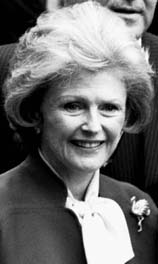
Pamela Harriman, the U.S. ambassador to France, legendary Democratic Party financier, and serial wife and lover to great men of the 20th century, died of a brain hemorrhage at 76. Obituaries focused on her pattern of gaining influence and prestige by romancing rich and powerful men (Winston Churchill's son, Edward R. Murrow, the heir to the Fiat fortune, etc.). Critics chalk it up to sluttish ruthlessness; defenders argue that, like most women of her day, she had been socialized to build her plans around men. Intent on proving that she was more than a seductive dilettante, friends are touting her success as ambassador. The French, meanwhile, are praising her seductive charms. (2/7)
The Washington Post revealed to the world, and to Madeleine Albright herself, that the new secretary of state is Jewish. Albright's parents were Czech diplomats who fled the Nazis and raised their daughter as a Catholic. Her grandparents died in concentration camps. The media were eager to absolve Albright's parents for abandoning their heritage, but were unable to find anybody making the accusation. (2/7)