
The O.J. Simpson civil jury began its deliberations. Observers declared the closing argument by plaintiffs' lawyer Daniel Petrocelli a theatrical masterpiece that boosted the chances of a huge judgment against Simpson. Pundits agree that 1) Petrocelli is succeeding brilliantly at everything that prosecutors Marcia Clark and Chris Darden botched, but 2) his victory in the civil case won't redeem their defeat in the criminal case. The media doubted that Simpson would ever pay the possible damages: Although he's reportedly earned more than $8 million in the last couple of years, much of it from murder-related notoriety, he seems to have spent it all on lawyers and will probably declare bankruptcy if he loses. His hefty retirement savings are untouchable. The early line on the civil jurors is that they'll take at least a few days to reach a verdict, since they don't want to appear as cavalier as the criminal jury. (1/29)

Stock-market index funds made Page One news in the New York Times and Wall Street Journal. Mutual-fund investors are increasingly shifting their investments from traditional managed funds--which try to outsmart the whole market at picking stocks--to index funds, which distribute their assets evenly and ride the market's rising average. In recent years, the index strategy has triumphed because 1) stock-picking managers charge more in fees than they've added in above-average performance, and 2) fund managers often keep some money in steadier cash and bonds to protect investors in the event of a market plunge. The news accounts portrayed managed-fund managers as unproductive leeches in comparison with index-fund mangers. (1/29)
President Clinton answered reporters' questions about the Democratic campaign-finance scandal, repeatedly invoking President Reagan's Iran Contra-era passive-voice excuse:"Mistakes were made." The president confessed that officials in his party had raised money improperly, and that his top banking regulator shouldn't have been at a White House meeting with bankers who were big Democratic donors. But he also insisted there was no quid pro quo, indicating that he would continue to meet with such donors, sans regulators. The president's apparent sincerity and thoughtfulness impressed all, yet no one could determine whether he was apologizing or defending himself or just seducing the press. The political betting line is that if Clinton doesn't act to stave off the scandal, Tennessee Sen. Fred Thompson, the Republican in charge of the Senate campaign-finance investigation, will take it over. (1/29)
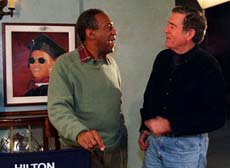
The media downgraded Bill Cosby from America's father to America's adulterer. Cosby drew universal sympathy when his son was shot dead; more sympathy came when a young woman whose education he had financed was accused of trying to extort money from him with the charge that he was her father. Cosby gave a television interview about his son and admitted to a long-ago "rendezvous" with the woman's mother. Within two days, radio talk-show callers were reportedly souring on Cosby, and the affair was supplanting the son's slaying in headlines. "The moral taught by this new drama is the flip side of the one that came before it, and equally pleasing: The rich and famous are as sinful as we are and cannot escape punishment for their transgressions," wrote the New York Times' Frank Rich. "The angrier the public is at having swallowed whole the previous, idealized Cosby myth, the nastier its dethronement will be." Cosby's wife issued a statement assuring reporters that the couple had patched up hard feelings over the affair long ago and urged them to turn their attention back toward finding her son's killer. (1/29)
Chechnya held a presidential election. The campaign drew foreign attention because the breakaway republic is groping for direction after years of devastation. All the major candidates are invoking Islam; analysts say that while the Chechens, unlike the Afghans, aren't really keen on fundamentalism, they might resort to it as an antidote to the country's epidemic of chaos and crime. (1/27)
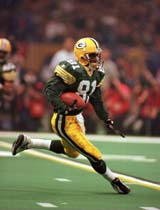
The Green Bay Packers defeated the New England Patriots to win their first Super Bowl in 29 years. Commentators celebrated the Packers as exemplars of all that is right with America: Midwestern values, communal ownership, and sacred football tradition. "The Lombardi Trophy is going home," wrote the Washington Post's Tony Kornheiser. "It's like Excalibur is returning to the rock." The Packers' roster offered numerous tales of heroism: Quarterback Brett Favre as a rural-Mississippi Horatio Alger; defensive lineman Reggie White as the God-fearing, hard-working veteran who finally gets his reward; receiver Andre Rison and kick returner Desmond Howard (the game's Most Valuable Player) as castoffs who proved their true grit with decisive big plays. Meanwhile, commentators dismissed the Patriots as congenital chokers who will resume their sad mediocrity as soon as coach Bill Parcells quits the team. In postgame interviews, numerous Green Bay players, led by White, the quarterback-sacking ordained minister, praised Jesus Christ for guiding their careers to Green Bay and making them champions. (1/27)
President Clinton announced a bipartisan summit on volunteer community service to be held in April. Former President George Bush and retired Gen. Colin Powell joined Clinton for the announcement, exchanging flattery and invocations of American idealism. Clinton touted the summit as a hybrid of his AmeriCorps program and Bush's "thousand points of light." Pundits portrayed it as another maneuver by Clinton to elevate himself above partisanship; the Washington Post noted it was the second time this month Clinton has embraced a Republican whose career he torpedoed (the other occasion was awarding the Medal of Freedom to Bob Dole). (1/27)
Meanwhile, on the partisan front, the press feeding frenzy over Democratic campaign money continues to grow, with reports that 1) controversial fund-raiser John Huang arranged almost half-a-million dollars in donations to state Democratic parties; 2) the Democratic National Committee arranged a White House meeting in which bankers discussed policy with Clinton and top Treasury officials; and 3) at least 30 big donors made their contributions shortly before or after attending Clinton coffee klatches at the White House. Republicans were outraged that Clinton, while calling for bipartisanship, told a Democratic audience that Republicans' campaign-finance sins were worse than his. (1/27)
Israeli television reported a scandal that could bring down the government. According to the report, Prime Minister Benjamin Netanyahu appointed an attorney general who would arrange a plea bargain for the leader of a religious party (in a bribery case) in exchange for the party's support on the Hebron deal. All three principals deny the story, but several Cabinet ministers say that if it's true, the government must be dissolved. (1/27)

Electronica, a genre of dance music created with electronic instruments, is being heralded as the next wave in popular music. The New York Times argues that electronica has the rare combination of aesthetic merit, creative energy, stylistic variety, and seasoned musicians necessary for a once-in-a-decade musical revolution. The other reason to bet on electronica is that "fans and executives alike are bored with most everything else." On the downside, the Times worries that clumsy music-industry executives and greedy establishment bands will do to electronica what they have done to other potentially revolutionary genres: commandeer and ruin it. (1/27)
Cities across the United States were consumed by a war over cable-TV programming. Earlier this month, Tele-Communications Inc. (TCI) ousted music channels MTV and VH1 from its lineup in dozens of markets, affecting some 2 million viewers. Fans of the two channels fought back with angry phone calls, letters, newspaper ads, radio campaigns, and a press conference headlined by rock stars. On Jan. 22, TCI capitulated and reinstated the channels. Originally, TCI had suggested it was dropping the channels out of concern for community moral standards; later, leaders of the rebellion touted their triumph as a vindication of democracy. On closer inspection, reporters concluded that the fight was really about money: TCI wanted to replace the channels with others it either owned or could shake down for big fees, while the putative grassroots uprising was orchestrated by MTV and Viacom, the parent company of VH1. The issue of local cable monopolies looms behind the controversy: A third music channel dumped by TCI gave away satellite dishes to scare TCI into reinstating the channel. Meanwhile, two other wars over alleged cable-operator tyranny rage on: Rupert Murdoch is trying to force Ted Turner's Time Warner system to air the Fox News Channel in New York, and C-SPAN is siccing its notoriously aggressive viewer-callers on TCI for slashing or eliminating C-SPAN in more than 50 markets. (1/24)
The buzzards are descending upon Russian President Boris Yeltsin. He got pneumonia two months after his quintuple heart bypass, and while he recovers, the Russian Parliament has overwhelmingly passed a resolution to impeach him because of his infirmity. The measure carries no legal force, but it is seen as evidence that he has lost so much public support that his enemies no longer hesitate to exploit his illness. Reports from Russia describe pervasive poverty, crime, and corruption. Meanwhile, would-be successor Alexander Lebed swung through Washington and New York this week to reassure businessmen and politicians that he'll safeguard Russian democracy, military restraint, and hospitality to foreign investment. Jim Hoagland of the Washington Post concludes that Yeltsin remains "gravely ill," and Lebed's visit is part of a campaign to replace the old man. On the bright side, Hoagland notes, "Americans should find it reassuring" that sucking up to the United States has become a staple of Russian presidential campaigns. (1/24)
A jury ordered ABC to pay the Food Lion grocery chain $5.5 million in punitive damages for fraudulently obtaining evidence that Food Lion stores were selling rotten meat, fish, and produce. The case is regarded as a landmark because Food Lion didn't challenge the accuracy of ABC's report--only the means by which the video was obtained. (The producers used false résumés to get jobs at Food Lion and then used hidden miniature cameras to capture the unsanitary practices.) The media unanimously denounced through the media this costly and ominous verdict against the media. Television news executives warned that it might force them to give up the honorable tradition of muckraking and devote more of their air time to celebrity fluff. (1/24)

A government medical panel decided not to recommend that women in their 40s have routine mammograms. The panel concluded that each woman should decide for herself, because the evidence so far does not clearly show that the benefits (one life prolonged for every 2,500 women screened) outweigh the risks (one false positive result for every 10 women screened, leading to unnecessary tests, anxieties, and some mastectomies; one false negative result for every four women screened, leading to a false sense of security; and one new case of breast cancer, caused by the mammography itself, for every 10,000 women screened). Some consumer advocates praised the decision, but many cancer specialists and radiologists were outraged--one called the panel's conclusion "a death sentence" for patients. The scientific spin is that a new trend toward brutally rational cost-benefit analysis has persuaded many experts that mammography has been oversold. The political spin, however, is that passionate demands for an all-out war on breast cancer will force the government to overrule the panel and recommend mammograms anyway. (1/24)