(posted Friday, Sept. 27)
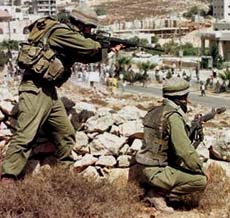

Fighting between Palestinians and Israeli soldiers claimed more than 50 lives and injured 1,000 in the West Bank and Gaza Strip. The bloodshed was triggered Tuesday, when the Israelis opened a tunnel entrance in Jerusalem's Muslim quarter. Among the early story lines: The rioters were sending Prime Minister Benjamin Netanyahu a message that he must negotiate or pay a price; relations between the Israeli army and Palestinian police--who fought alongside the rioters--have collapsed; Netanyahu was not a decisive ideologue but a aimless dawdler; concessions to the Palestinians, said the Likud government, would signal weakness and invite further attacks; and the conflagration placed Egypt in a precarious position as it tried to facilitate reconciliation amid Arab rage over Israel's actions. By Friday, the spin shifted from chaos to order as NPR reported that both sides seemed "shocked" by the violence and hoped "to pull back from the brink."
The Federal Reserve's decision to not raise interest rates reflected both campaign politics and internecine struggles at the Fed. Although the Fed rarely changes rates during campaigns, the move was interpreted as benefiting Clinton by denying Dole and Kemp an excuse to a) decry government constriction of the economy; and b) blame Clinton for incipient inflation. Some speculated that the Fed's regional bank presidents, who wanted a rate hike, had leaked their preference to pressure Chairman Alan Greenspan; others worried that the leaker might help friendly investors get a jump on imminent Fed actions. Either way, Greenspan asked the FBI to investigate the breach of security.
British police raided five Irish Republican Army hideouts in London, killing one suspected terrorist, arresting five others, and confiscating 10 tons of explosives. The raids apparently thwarted a truck bombing akin to those that killed two people and injured 200 earlier this year. The Los Angeles Times reported that many observers had expected the IRA to commit such an attack as a final gesture of defiance before slinking back to a cease-fire. Prime Minister John Major said the discovery discredited the IRA's professions of interest in a peaceful resolution of the conflict.
The United States was the subject as the United Nations opened its 51st General Assembly. America is delinquent on $1.64 billion in dues and has angered other U.N. nations by promising to veto a second term for Secretary-General Boutros Boutros-Ghali. The Los Angeles Times noted that U.S. opposition to Boutros-Ghali has only endeared him to other governments. Editorialists warned that the United States is in no position to demand reforms in the U.N. bureaucracy until it pays its dues. In a visit to the United Nations, President Clinton and officials from the world's other major nuclear powers signed the Comprehensive Test Ban Treaty. Clinton also triangulated off the GOP, contrasting his warm feelings for the United Nations with the anti-global hostility of Republican isolationists and opponents of the treaty.
Astronaut Shannon Lucid returned to earth after six months on the Russian Mir space station, setting an American record and a world record for women. Fire rescue workers expected to carry Lucid from the space shuttle, since the weightlessness of space tends to confuse the body's sense of balance and deplete blood, bone, and muscle strength. Instead, she stood up and walked away, with some help. Her strength was credited to a rigorous workout regimen on the space station. President Clinton called her "a terrific inspiration" for "young girls who may have nontraditional aspirations."
Bob Dole left the campaign trail to cram for the October presidential debate. Dole pal Tom Korologos explained that by "sitting on the beach," Dole "shows confidence. ... If he thought it was over, he'd be frenetically running around." Dole's rhetorical talents were so pitied that when Clinton spokesman Mike McCurry tried to raise expectations for Dole's performance, he was accused of cruelly mocking the senator. Meanwhile, Jesse Jackson joined the legal challenge to the debate commission's exclusion of Ross Perot, calling its behavior "awfully close to corruption." Perot and his followers continued to blame and hound Dole for keeping Perot out the debates.
Iran re-emerged as a focus of American anxiety. The Wall Street Journal disclosed that U.S. Navy commanders in the Persian Gulf are more worried about Iran in the long term than Iraq: Iran's beefed-up navy is capable of cutting off one-fifth of the world's oil supply, and its nuclear, biological, and chemical weapons make it a threat even beyond the Gulf. The New York Times reported that some of the 4,000 men sent to Bosnia by Iran and other Muslim states to defend Muslims have remained, and that they have apparently threatened NATO troops. Western officials link the forces to Iranian intelligence, saying they've have been trained as terrorists. In other southcentral Asian news, Islamic fundamentalists solidified control of three-fourths of Afghanistan and seized Kabul.
Boris Yeltsin's health gave the world palpitations. First, Yeltsin's surgeon suggested that the Russian president's heart had suffered so much damage that it might not survive an urgently needed bypass operation. Then London's Financial Times claimed that Yeltsin had suffered an almost totally debilitating stroke. Other reports asserted that his kidneys and liver were failing, perhaps due to steroids he had allegedly taken during his re-election campaign. The Russian stock market plunged. Opposition parties called on Yeltsin to resign. Would-be successors, led by national security chief Alexander Lebed, rushed to position themselves for Yeltsin's job. Then a Russian-American medical team led by renowned heart surgeon Michael DeBakey examined Yeltsin, pronounced his condition "not bad at all," and predicted that although his surgery would be delayed a few weeks, he would probably serve out his term. Stocks recovered, and governments around the world breathed easier. Russian citizens, long accustomed to evasive and deceptive reports on their leaders' health, took the news of Yeltsin's illness with typical stoicism. "Think of all the awful healthy leaders we could have," said one doctor.
John F. Kennedy Jr. married longtime girlfriend Carolyn Bessette, on a secluded island off Georgia. Gossip columnists congratulated Bessette and consoled every other woman in America. The Washington Post called it "one of the best covert operations in a decade"; Kennedy didn't inform many of his friends and relatives (his cousin, Rep. Patrick Kennedy, was among those not invited), and the few who did attend (estimates ranged from 40 to fewer than a dozen) weren't invited until four days in advance. A Post source indicated that Kennedy had deceived colleagues at his magazine, George, about his travel plans. Even the caterers had to sign confidentiality agreements. After years of being hounded by paparazzi, the Kennedys and their guests reportedly exulted in their escape. "We were so excited to have fooled everybody," said one attendee.
The House divided a landmark immigration-reform measure into two bills, then passed them both. The larger bill would fortify the Border Patrol, facilitate deportations, and restrict the benefits available to illegal aliens; the detached bill would let states exclude children of illegal aliens from public schools. The second bill was dismissed as veto bait, but Republicans were deemed to have scored a victory by detaching it and thereby removing Clinton's excuse to veto the larger bill. Liberal interest groups and the White House scrambled to find new objections to the larger bill: Among other things, they warned that it threatens legal immigrants with deportation and diminishes their safeguards against job discrimination. Bob Dole issued a letter pretending to have spearheaded the GOP's separation of the two bills, but the Washington Post disclosed that congressional Republicans had actually forced the idea on Dole. A further Post article suggested that ultimately, the joke was on the GOP: Its crackdown on legal immigrants is scaring them into becoming American citizens, and they're overwhelmingly registering to vote as Democrats.
The Seagram Co. expanded plans to advertiseliquor on television, defying President Clinton's plea to honor the half-century-old voluntary ban. Seagram's sympathizers pointed out that the product is legal, and dismissed Clinton's warning as a political stunt designed to endear him to parents. (Stations running the ads claimed that they wouldn't air them during children's normal viewing hours.) The Wall Street Journal noted that liquor-industry executives are disgruntled with the ban because it prevents them from competing on the tube with beer companies.
The birth-control pill is reportedly making a comeback. A comprehensive international review of 54 studies concluded that the pill doesn't heighten a woman's long-term probability of getting breast cancer. Researchers also discounted previous concerns that the pill contributed to cardiovascular trouble, and touted studies indicating that it reduces the risk of ovarian and endometrial cancer. Meanwhile, a new survey by a contraceptive pharmaceutical company suggested that the pill has surpassed sterilization as the country's most popular birth-control method. The breast-cancer scare was cited as an apparent factor in the pill's previous decline in popularity.
The First Wives Club, a revenge-comedy about three abandoned wives, grossed more on its first weekend than any other women's film in history. Critics were equivocal; the Washington Post's Rita Kempley called it "stale feminist fluff." Pundit Margaret Carlson of Time pronounced it "an antidote to the zeitgeist of the '80s, when middle-aged tycoons and their acolytes could suddenly drop an inconvenient first wife without social opprobrium," and predicted the film would spark the kind of debate provoked by Thelma & Louise. The Los Angeles Times envisioned a reversal of Hollywood's bias toward male actors: "Could it be that being middle-aged and female has become a Hollywood box-office asset?"