Repeat After Me
I watched every Pedro Almodóvar movie. Here’s what I learned.

Photo by José Haro/© El Deseo, Courtesy of Sony Pictures Classics
In Pedro Almodóvar’s new film The Skin I Live In, a character announces that “stories repeat themselves.” If, like me, you spent the last month watching each one of Almodóvar’s 18 feature films, the only possible response to that statement is, “No shit, señora!” Experiencing the Almodóvar filmography is like stepping into one of those endlessly repeating M.C. Escher paintings.
 June Thomas
Some motifs recur so frequently that I feared for my sanity. You know how, in police procedurals, the cops search a conspiracy-crazed suspect’s home and find the walls obsessively covered in newspaper clippings and photographs? That was me, totting up the number of movies in which Almodóvar characters use aliases (12), visit pharmacies (4), or keep unusual pets (3). Did you know, for instance, that six films involve characters who live outside the city, but only one of those country-house residents lives to the end of the movie? (He was a renter.)
I’d seen all but one of Almodóvar's films before, some several times, and in those casual viewings I hadn’t been bothered by the echo effect. Recognizing a reference is a reward for making frequent visits to Pedrolandia. In Broken Embraces (2009), for example, it soon becomes clear that Chicas y Maletas, the movie being made by the director-protagonist, is a bizarro-world version of Almodóvar’s first international hit, Women on the Verge of a Nervous Breakdown (1988), right down to its distinctive retro aesthetic and quirky plot points—a burning bed, a batch of gazpacho laced with sleeping pills, a visit from a funny friend in trouble.
Anyone who has seen Women on the Verge would recognize that tribute, but other repetitions are more difficult to spot, especially if you experience the movies “organically,” seeing them as they are released, one every couple of years. Few people watching the scene in All About My Mother (1999) in which Manuela searches for her ex-husband by having a taxi drive around the neighborhood of Barcelona where transsexual prostitutes do business will recall an almost identical passage in Labyrinth of Passion (1982), in which the former empress of Tiran tours Madrid’s gay cruising areas in the back of a cab, looking for her stepson. Would movie-goers who see a priest enjoying a song performed by his favorite schoolboy in Bad Education (2004) flash back to Dark Habits (1984), in which a nun is serenaded by a torch singer on whom she has a crush? Will the audience of The Skin I Live In realize that its most disturbing scene is a replay of an incident in Kika (1993)? (To avoid spoiling the new movie, I won’t describe it beyond saying it involves bondage and rape.)
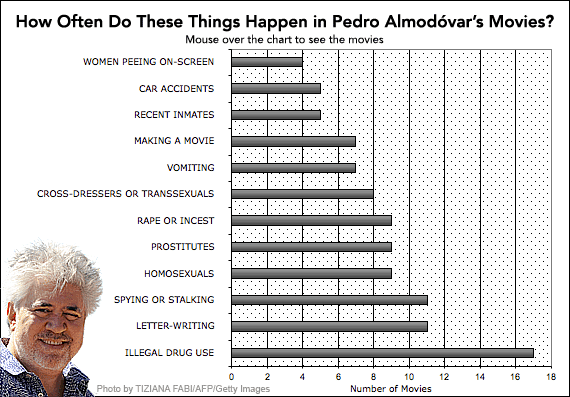
This is not to suggest that Almodóvar is a copy-and-pasting self-plagiarizer. Instead, he worries at topics and situations, rehearsing them over and over until he figures out what he really wants to say. The Flower of My Secret (1995), the story of Leo, a romance novelist who needs to make some big changes in her life, begins incongruously with a scene of two white-coated doctors attempting to convince a mother that her son is brain dead and she should permit his organs to be donated. It turns out to be a role-playing exercise led by Leo’s best friend, and although the themes of sorrow and second chances resonate with the movie’s storyline, it still feels slightly out of place. Two films later, in All About My Mother, the scene is replayed almost exactly: At a seminar, two white-coated doctors must attempt to persuade a woman that there is no hope for her husband but that his organs could help others to live. Here, though, the grieving widow is the movie’s main character, and the dilemma she faces—how to accept a hideous loss and move on to a new life—is the movie’s main focus. In Law of Desire (1987), Tina, a transsexual played by Carmen Maura in the performance of a lifetime, returns to the chapel where she was a choirboy and meets the priest who was her first love. It’s a powerful scene, but it lasts three minutes, after which Father Constantino is all but forgotten. Seventeen years later, in Bad Education, the consequences of a priest abusing a boy under his care—the choir’s star soloist—play out at the center of the movie.
Almodóvar's habit of picking up threads years after he dropped them is also on display in The Flower of My Secret, when Leo’s outraged publisher describes the completely unsuitable manuscript the romance writer has sent her way: “A woman … discovers that her daughter has killed her father, who had tried to rape her, and so that no one finds out, she hides the body in the cold-storage room of a neighbor’s restaurant.” That may not be the romance novel the publisher was hoping for, but it is an astonishingly accurate description of the first 30 minutes of Volver (2006), released 11 years later.
The director explained this process of revisiting and revising in a 1998 interview with French film magazine Positif. After he filmed Carmen Maura performing a scene from Cocteau’s La Voix Humaine—a monologue in which a woman speaks into a phone—in Law of Desire, he couldn’t leave it behind, and as he continued to think about the story, it evolved into Women on the Verge. “The basic situation remains the same: a woman is waiting by the phone with a suitcase full of her lover’s belongings. But, as I kept writing, everything was fading. All that was left at the end was the desperate woman, the phone, and the suitcase.”
Of course, this dogged persistence doesn’t quite explain why he is so compelled to return to the same scenes and situations over and over again. It doesn’t completely clarify why 11 of Almodóvar’s protagonists are writers; why 11 of his movies feature characters getting wet in showers, baths, fountains, rainstorms, or via street-cleaners’ hoses just before a decisive event; and why they have a tendency to don red outfits for key scenes (as they do in pretty much every film); why 12 of his movies show men watching television; why 11 have scenes set in hospitals; and why 15 of them pause for a live performance.
I am confident, though, that all will become clear some day, because the greatest sin in Almodóvar’s universe is a failure to communicate. His films are packed with missed phone calls, letters than didn’t arrive, the living reading dead people’s diaries, and people telling each other that they really need to talk. When characters say this, they mean they want to talk until they’re understood. The same goes for the viewers: If they don’t get what Almodóvar is trying to tell them, they just need to keep listening.
If Almodóvar has an agenda, it’s the gospel of perseverance. That’s the message of his films’ frequent scenes of transformation. Putting on special clothes (a priest’s surplice, the bullfighter’s traje de luces, the female impersonator’s padding and wig, a nice dress) or makeup (13 of the films show someone primping in front of a mirror) can provide a new identity, and with it a second chance to connect.
Almodóvar also repeats his tendency to shock. He has a reputation as a director who traffics in the outrageous—and, for the most part, that's well-deserved. Look at his two Oscar-winning movies: All About My Mother, which won the Academy Award for best foreign-language film, concerns lesbian junkies, prostitutes with tits and dicks, and an HIV-positive pregnant nun; Talk to Her, for which Almodóvar took the award for best original screenplay, involves coma patients, stalking, rape, and suicide.
At the beginning of his career, this outrageousness had a political and commercial purpose. Almodóvar started filming his first feature release, Pepi, Luci, Bom and Other Girls From the Heap, in 1978, just three years after the death of Franco. Would-be Almodóvar completists, take note: The director did make a feature-length Super 8 movie called Fuck, Fuck, Fuck Me Tim earlier that year, but according to his production company, it is not available in any format. Pepi, Luci, Bom, for its part, was shot on 16 mm and serves as a record of the movida Madrileña, the flowering of Spanish democracy and cultural liberation. It’s a disjointed mess, in the way that early films shot on a minuscule budget usually are, but the shock elements—a masochistic housewife who enjoys being peed on, a teenage lesbian punk, a cross-dressing drug dealer—struck a blow for freedom. Almodóvar had to include those things in his movie just to prove that he could. For his second release, Labyrinth of Passion, he was commissioned by the Madrid art-house cinema that showed Pepi, Luci, Bom to create another cult hit using the same scandalous recipe of nymphomaniacs, junkies, and women whose laxatives take effect before they reach the bathroom. Gradually, and especially after 1993’s Kika, the shocking elements started to seem less gratuitous. It’s not that rape, incest, and child molestation disappeared from his films, but they served a clearer purpose, which was to tell viewers that if the people on the screen could endure these terrible travails and still communicate, so could they.
Of course, some of his recurring motifs are simply creepy. The Almodovarian trope that makes me most uncomfortable is that of the loving kidnapper/stalker/rapist. In 1990’s Tie Me Up! Tie Me Down!, for example, Ricky stalks Marina, hits her in the face, keeps her tied to the bed in her apartment, and … eventually wins her love with his devotion, his sad life story, and his excellent skills in the sack. Twelve years later, Talk to Her’s Benigno is an incredibly loving partner, tending to Alicia with astonishing dedication; the problem is that she is in a coma, and he is the nurse entrusted with her care. (Perhaps the clearest indication of Almodóvar’s maturity is his decision to cut to a black-and-white silent short when Benigno has sex with Alicia; a welcome contrast to the grotesque scene in Kika, where a crazed rapist continues to thrust away even as two cops attempt to pull him off the woman he is assaulting.) Of course, these men are all psychopaths, albeit charming, likable psychopaths; Almodóvar has produced cinema’s most loving portraits of the criminally insane.
I suspect the outrageous storylines cause less offense than their descriptions would lead us to expect because they’re told with love and humor. Almodóvar is famous for his sympathetic portrayals of women, and while he has worked with some of Spain’s most celebrated female talents (Carmen Maura, Victoria Abril, Marisa Paredes, Penélope Cruz), his greatest gift is for hiring comedic actresses and writing wonderful scenes for them to perform. (I’m sorry to tell you that if you don’t speak Peninsular Spanish, you’re missing half the laughs. Subtitles can’t possibly do justice to the linguistic playfulness of these comedic character sketches.) Quick, think of an iconic Almodóvar face. Odds are you conjured up funny women Rossy de Palma, Chus Lampreave, María Barranco, or Loles León. These actresses show up in Almodóvar’s casts with such regularity—Lampreave eight times, Maura seven times, and Paredes six times—that they start to seem like family. In fact, members of Almodóvar’s birth family show up even more frequently; his mother appeared in four of his films, and brother Agustín has made cameo appearances in all of Pedro’s movies.* Even when casting, Almodóvar can’t resist repetition!
Tabulating all these tics hasn’t diminished my love for Almodóvar. On my way to see The Skin I Live In, I predicted to a co-worker that it would involve a hospital of some kind, a rape, voyeurism, and stairs. Reader, I was 4 for 4. I’d been typing the email as my subway train crossed from Brooklyn into Manhattan, and if the bridge had been a little longer, I’m sure I could have nailed a few more prognostications. Does that mean the new movie was predictable? Absolutely not. Despite my scientific study of the great Spanish writer-director, I was as stunned by the film’s narrative twists as the next viewer. Almodóvar obsessively returns to themes and scenes not because he lacks imagination, but because he has the creativity to remake them afresh every time he comes back to them.
Correction, April 7, 2014: This article originally misstated that Pedro Almodóvar's brother Agustín appered in all but one of his movies. He's appeared in all of them. (Return.)
Also in Slate, Dana Stevens reviews The Skin I Live In.